

Building Internal Developer Platforms as Products: A Practical Guide for IDP Architects
Successful IDPs aren't built on technology alone — they combine platform engineering with product thinking and developer experience.
 CORE
·
CORE
·
CORE
·
CORE
·
Why Most Platforms Fail to Become Products
Many companies are heavily investing in internal developer platforms (IDPs) with the expectation that they will speed up delivery and governance, and increase developer productivity. Despite significant investment in Kubernetes, CI/CD, observability, security tooling, and cloud infrastructure, many platforms struggle to gain adoption.
The reason is simple: they are built and operated like infrastructure projects, not products.
Infrastructure teams are often very focused on technical excellence: automation, scalability, reliability, and compliance. Developers, on the other hand, are interested in a different goal — getting their applications into production quickly and safely without having to go through so much complexity.
IDP is successful when developers choose it voluntarily because it makes their lives easier. That shift requires platform architects to think less like infrastructure engineers and more like product managers.
Building an IDP is like operating an airport. Nobody travels because they love airports. They travel because they want to reach a destination efficiently. Similarly, developers do not care about Kubernetes clusters, pipelines, secrets management, or observability stacks. They care about shipping features to customers. The platform's job is to make the journey smooth, fast, and safe.
This article explores the core practices that differentiate successful product-centric platforms from infrastructure-centric ones.
Practice 1: Start With Developer Journeys, Not Technology Choices
Imagine constructing a shopping mall by selecting elevators, security systems, and air-conditioning units before understanding customer traffic patterns. The result is often technically impressive but operationally frustrating. The same happens with developer platforms. Architects should first map the customer journey (developer journey) before designing platform capabilities.
Many platform initiatives begin with questions like:
- Which Kubernetes distribution should we use?
- Which GitOps framework is best?
- Which CI/CD tool should be standardized?
These are important questions, but they should not be the starting point. Successful platform architects begin by understanding developer workflows:
- How does a new service get created?
- How long does environment provisioning take?
- Where do deployment delays occur?
- What causes support tickets?
- Which activities are repetitive and manual?
The goal is to identify friction and eliminate it. Organizations using platforms based on technologies like Red Hat OpenShift, IBM Cloud Kubernetes Service, or other cloud-native platforms have found that developers adopt only when the platform team focuses on reducing the friction in workflow rather than adding more infrastructure features to the platform.
Practice 2: Create Golden Paths, Not Golden Handcuffs
A highway encourages drivers to use the fastest route while still allowing exits when necessary. Successful IDPs behave like highways. Developers naturally choose the Golden Path because it is easier and safer than building everything from scratch.
One of the most powerful concepts in modern platform engineering is the Golden Path.
A Golden Path provides:
- Recommended architectures
- Standard deployment patterns
- Pre-approved security controls
- Built-in observability
- Automated CI/CD workflows
Developers should be able to move fast along a paved road while retaining flexibility for unique requirements. Platform teams that leverage services from cloud provider environments often realize that standardized self-service templates drive significantly higher adoption than restrictive governance models.
Practice 3: Make Self-Service the Primary Interface
Every banking transaction once required a visit to a physical branch. Today, customers expect to do everything from a mobile app. Developers hope for the same experience from inside their own software.
Nothing kills developer productivity faster than dependency queues. Consider a common case of dependency queues.
- Open a ticket for infrastructure.
- Wait for approval.
- Wait for provisioning.
- Request secrets.
- Request monitoring.
- Request deployment access.
Weeks can pass before development even begins. Modern platforms must provide self-service experiences where developers can do the following without opening tickets.
- Create environments
- Provision databases
- Configure pipelines
- Access observability dashboards
- Request infrastructure resources
An IDP should function like a digital banking application—secure, streamlined, and available on demand.
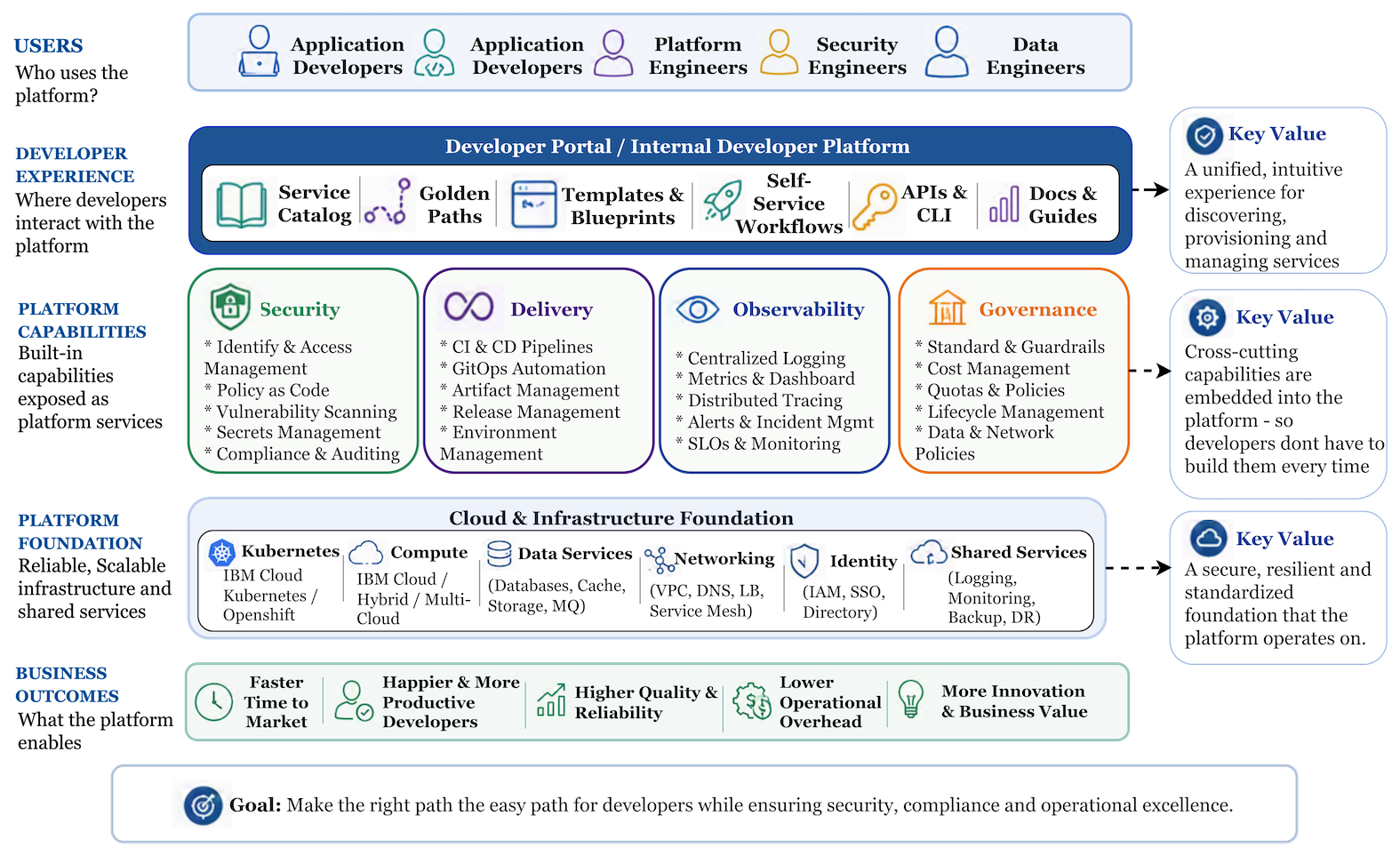
Below is the Product-Centric IDP reference architecture. Developers consume platform capabilities through self-service experiences, while the platform embeds security, observability, governance, and delivery capabilities and exposes them through Golden Paths.
Practice 4: Treat Platform APIs as Products
A power drill might have sophisticated engineering in it. Users judge it by a very simple standard: “Can I drill a hole fast and reliably?"
Many platform teams are focused on infrastructure automation and not developer experience. Each API, template, workflow, and portal interaction is a product interface. Questions worth asking include:
- Is the API predictable?
- Is documentation clear?
- Are error messages actionable?
- Is onboarding intuitive?
- Can developers discover capabilities easily?
Developers evaluate IDPs the same way. They are not interested in the complexity underneath. They care about usability. This principle is especially important when integrating observability services, cloud provisioning layers, or deployment automation platforms.
For example, IBM Cloud's managed services can significantly simplify operational complexity, but value is realized only when developers experience that simplicity through intuitive platform workflows.
Practice 5: Build Observability into the Platform, Not Around It
Imagine when you are driving a car without any speedometer, fuel gauge or warning indicators. You may still reach your destination but the risk increases dramatically. Observability is the dashboard for software systems. Observability is often treated as an afterthought. A team deploys an application and later attempts to add:
- Metrics
- Logs
- Traces
- Dashboards
- Alerting
This approach creates inconsistency and operational blind spots. Platform teams should embed observability from day one. Every service created through the platform should automatically include:
- Logging standards
- Distributed tracing
- Metrics collection
- Health monitoring
- Service dashboards
Whether organizations use IBM Cloud Observability, Instana, OpenTelemetry, Prometheus, Grafana, or other solutions, the platform should make observability automatic rather than optional.
Practice 6: Make Security Invisible but Ubiquitous
When entering a modern office building, people rarely think about security. Access badges, surveillance, and emergency controls are built into the environment — the building is secure without requiring employees to become security experts. The same principle applies to IDPs.
In immature environments, security is seen as a series of checkpoints, review meetings, manual compliance approvals, vulnerability assessments, and audit evidence collection. Developers find it as friction because it arrives late in the delivery lifecycle.
Traditional security models operate as gates. Platform-centric security operates as guardrails. The objective is not fewer security controls — it is fewer manual interactions.
Build Secure-by-Default Golden Paths
Every new service created through the platform should automatically inherit:
- Secure CI/CD pipelines with dependency and container image scanning
- Secret detection and policy enforcement
- Access control standards and audit logging
- Encryption best practices
Automate Policy Enforcement
Manual compliance verification is one of the biggest sources of deployment delays. Platform teams should adopt policy-as-code (PaC) approaches that automatically validate deployment configurations, infrastructure standards, and regulatory controls.
Instead of asking, "Did someone review this configuration?" the platform asks, "Does this configuration satisfy our policies?"
Reduce Security Cognitive Load
Developers should not need deep expertise in every security domain. The platform should abstract identity management, secrets management, certificate management, and vulnerability remediation workflows—particularly in hybrid and multi-cloud environments where security complexity grows rapidly.
A useful measure of progress: the percentage of security controls inherited from the platform versus manually implemented by application teams. The higher the inheritance rate, the lower the cognitive load.
Practice 7: Measure Platform Success Like a Product
A gym owner does not measure success by counting treadmills—they measure it by member outcomes. Platform teams should apply the same logic. Traditional infrastructure metrics like cluster utilization, pipeline counts, and resource consumption tell you whether the platform is running. They do not tell you whether it is working for developers.
Product-oriented platform teams focus on:
- Developer satisfaction
- Platform adoption
- Time to first deployment
- Deployment frequency
- Lead time for changes
If developers still circumvent the platform, no amount of technical sophistication matters.
The Developer Experience Scorecard
Measuring developer experience requires balancing sentiment, effort, and adoption. High-performing platform teams track four key measures:
|
Metric |
What It Measures |
How to Collect |
|
Developer Satisfaction Score (DSS) |
Overall platform sentiment |
Quarterly survey, 1–10 scale |
|
Platform NPS |
Willingness to recommend the platform |
"How likely are you to recommend this platform?" scored 0–10 |
|
Ease-of-Use Score |
How intuitive common workflows feel |
Per-task rating, 1–5 scale |
|
Developer Effort Score |
How much work is required to achieve an outcome |
Survey question on effort per task |
Together, these reveal not just whether developers are using the platform but whether they genuinely value it.
Satisfaction Is a Leading Indicator
Most delivery metrics lag behind—deployment frequency (e.g., lead time, incident count) and other metrics. Developer satisfaction is a leading indicator. Developers discover friction long before it is observable from the data. A declining DSS today will result in a decline in productivity and adoption tomorrow.
Listening early allows platform teams to respond before problems grow into organizational challenges. The real measure of success is not how many developers use the platform—it is how they feel while using it.
The IDP Health Dashboard
High-performing platform teams monitor a balanced set of metrics across four categories:
|
Category |
Metrics |
|
Sentiment |
DSS, Platform NPS, Ease-of-Use ratings |
|
Adoption |
Golden Path adoption, self-service usage, onboarding rates |
|
Friction |
Support ticket volume, documentation search failures, manual approval requests |
|
Productivity |
Time to First Deployment (TTFD), environment provisioning time, lead time for changes |
A platform succeeds not when developers are forced to use it, but when they prefer to use it.
Practice 8: Reduce Cognitive Load Relentlessly
The automotive industry spent decades simplifying the driving experience so drivers could focus on reaching their destination rather than understanding the mechanics of their vehicles. IDPs should do the same.
As organizations evolve into cloud-native architectures, developers are expected to navigate containers, Kubernetes, CI/CD, IaC, security policies, service meshes, observability tools, and compliance requirements all at once. Each one solves a very important problem individually. As a whole, they overwhelm developers and take focus away from developing business capabilities.
A successful platform is not one that exposes every infrastructure capability. It is one that hides unnecessary complexity while providing simple, intuitive paths to outcomes.
The goal of platform engineering is not to eliminate complexity. It is to absorb complexity so developers don't have to.
Common indicators of excessive cognitive load:
- Developers struggling to find documentation
- Frequent support requests for routine tasks
- Long onboarding times for new services
- Multiple handoffs between teams
- Tool sprawl across the engineering ecosystem
Reduce Tool Sprawl
Every tool a developer must learn introduces new interfaces, terminology, documentation, and configuration models. Platform teams should create a unified experience through a developer portal, service catalog, or platform API, that minimizes the number of decisions and interfaces developers encounter.
Minimize Context Switching
Every transition between tools, teams, or approval processes introduces cognitive overhead. Platform teams should ask: Can this be automated? Can these steps be consolidated? Can approvals be replaced with automated guardrails? The goal is fewer interruptions between code creation and deployment.
Platform Teams Are Complexity Brokers
Complexity never disappears — it moves. Organizations can either push complexity onto every development team, or centralize and manage it within the platform. High-performing platform teams choose the latter, absorbing operational, security, infrastructure, and compliance complexity so application teams can focus on features.
Practice 9: Obsess Over Time to First Deployment
The first experience developers have with a platform often determines whether they embrace it or avoid it.
Imagine a shopping mall where opening a new store requires twelve forms, multiple approval queues, and manual setup of every utility. Store owners would go elsewhere. The best malls provide ready-made spaces where businesses can start operating almost immediately. Developer platforms should do the same.
High-performing platform teams focus relentlessly on Time to First Deployment (TTFD) — the time between creating a service and successfully deploying it.
The Biggest Contributors to Poor TTFD
|
Bottleneck |
Root Cause |
Fix |
|
Manual infrastructure provisioning |
Ticket-driven approval chains |
Self-service IaC, service catalogs, platform portals |
|
CI/CD pipelines built from scratch |
No standard templates |
Pre-built, reusable pipeline templates |
|
Security reviews at the end |
Late-stage compliance gates |
Shift left — embed scans and policy checks in Golden Paths |
|
Observability setup delays |
Manual metrics/dashboard configuration |
Auto-provision logging, tracing, and health checks by default |
|
Too many decisions |
Choice overload at onboarding |
Provide Golden Paths with sensible defaults |
Measure Every Stage
|
Stage |
Target |
|
Service creation |
< 5 mins |
|
Repository creation |
Automated |
|
Pipeline creation |
Automated |
|
Infrastructure provisioning |
< 10 mins |
|
First build |
< 5 mins |
|
First deployment |
< 15 mins |
|
Observability enablement |
Automatic |
TTFD = Provisioning Time + Setup Time + Approval Time + Deployment Time
Many organizations discover that approval time is larger than all technical activities combined. The fastest platforms replace approvals with automated guardrails.
Practice 10: Build a Platform Community, Not Just a Platform Team
Cities flourish when residents contribute feedback and shape growth. Cities planned entirely from a central authority often struggle to meet citizen needs. IDPs are no different.
The best platforms evolve through continuous collaboration. Platform teams should create feedback loops through office hours, community forums, developer councils, internal documentation reviews, and experience surveys. Developers become co-creators rather than consumers.
Community Health Metrics
Running community mechanisms is not enough — each one needs a way to know whether it is working. Track these six indicators to measure community health:
|
Metric |
What It Measures |
Healthy Signal |
|
Monthly Active Community Members |
Developers engaging in forums, channels, or office hours |
Steady growth quarter over quarter |
|
Developer-to-Developer Answer Rate |
% of forum questions answered by non-platform-team members |
Above 40% indicates a self-sustaining community |
|
External Contributions per Quarter |
Pull requests or documentation edits from application teams |
Increasing trend |
|
Roadmap Items from Community Input |
% of platform backlog items originating from developer feedback |
Above 50% signals product-centric culture |
|
Office Hours Repeat Attendance Rate |
% of attendees who return across multiple sessions |
Above 60% indicates ongoing value |
|
Support Ticket Deflection Rate |
% of issues resolved via community before a ticket is opened |
Rising deflection reduces platform team toil |
The ultimate sign of a mature platform community is a change in how developers talk about the platform—from something that happens to them to something they help shape.
Practice 11: Think in Products, Roadmaps, and Customer Value
Smartphones succeeded because manufacturers continuously improved user experience. Customers did not buy phones because of processor specifications. They bought outcomes—better communication, productivity, and convenience. Developers adopt platforms for the same reason.
The strongest indicator that a platform is becoming a product is a change in language. Instead of asking:
- What infrastructure should we standardize?
Platform teams begin asking:
- What developer problems should we solve next?
- Which user journeys create the most friction?
- Which capabilities deliver the highest value?
- What does our product roadmap look like?
Features matter only when they improve the developer experience.
Practice 12: Design for Platform Reliability, not Just Application Reliability
Imagine a city that invests heavily in building roads, bridges, and public transport for its citizens, but has no maintenance crew, no traffic monitoring, and no plan for when a bridge closes. The infrastructure exists, but without reliability commitments, citizens cannot depend on it. Internal developer platforms face exactly the same risk.
Most platform engineering conversations focus on the reliability of applications running on the platform — uptime, error rates, latency SLOs for customer-facing services. What is rarely discussed is the reliability of the platform itself. Yet the platform is load-bearing infrastructure for every engineering team in the organisation. When the CI/CD pipeline degrades, every team's delivery stops. When the service catalog is unavailable, no new services can be provisioned. The platform's reliability is a multiplier — a single failure can simultaneously impact dozens of teams.
Define Platform SLOs Before Developers Define Them for You
Platform teams that do not define their own Service Level Objectives will find that developers define them informally — through frustration, workarounds, and loss of trust. Effective platform SLOs cover the experiences developers depend on most:
- Pipeline availability — what percentage of CI/CD pipeline executions succeed without infrastructure-related failures?
- Provisioning latency — how long does environment or resource provisioning take at the 95th percentile?
- Portal availability — is the developer portal and service catalog accessible during working hours?
- Golden Path build time — how long does a standard pipeline template take to complete?
These are the experience metrics developers encounter every day. A platform team that publishes and tracks these SLOs operates as a reliable internal service provider. A team that does not is invisible until something breaks.
IDP Maturity Model
|
Stage
|
Characteristics
|
|---|---|
|
Infrastructure Platform |
Standardized infrastructure, clusters, CI/CD tooling |
|
Self-Service Platform |
Service catalogs, automation, infrastructure on demand |
|
Developer Platform |
Golden Paths, integrated observability and security, DevEx focus |
|
Platform Product |
Platform roadmaps, adoption metrics, developer satisfaction measurement |
|
Adaptive Platform |
Continuous feedback loops, AI-assisted operations, continuous platform evolution |
Most organizations do not start with a Platform Product. They evolve toward it. The goal of the maturity model is not to reach the highest stage overnight, but to identify the next set of capabilities that will improve developer experience and platform adoption. High-performing platform teams treat platform maturity as a journey rather than a destination.
Assessing Your Current Stage
To identify where your platform currently sits, ask three diagnostic questions:
- How do developers access platform capabilities today? If the answer is "by opening a ticket," the platform is at the infrastructure stage. If developers provision resources on demand without human approval, they are at the self-service stage or beyond.
- Do developers choose the platform voluntarily or use it because they must? Voluntary adoption driven by speed and simplicity signals a developer platform or platform product. Mandatory usage with frequent workarounds signals an earlier stage.
- Does the platform team maintain a product roadmap prioritized by developer feedback? A yes here is the clearest indicator of a platform product. The absence of a roadmap almost always reflects an infrastructure or self-service mindset.
Moving to the Next Stage
Each stage has a single dominant unlock that drives progression:
- Infrastructure → Self-Service: Replace ticket-driven provisioning with self-service automation and a service catalog.
- Self-Service → Developer Platform: Introduce Golden Paths that embed security, observability, and CI/CD by default.
- Developer Platform → Platform Product: Establish a formal platform roadmap, measure developer satisfaction (DSS, NPS), and treat developer feedback as a product backlog.
- Platform Product → Adaptive Platform: Build continuous feedback loops, introduce AI-assisted operations, and invest in platform telemetry that proactively surfaces friction before developers report it.
The most common mistake is attempting to skip stages. Teams that build Golden Paths before self-service exists create well-designed paths nobody can access independently. Teams that adopt satisfaction metrics before Golden Paths exist measure friction without the tools to address it. Progress through the stages in order.
The IDP Architect's Checklist
Before launching any new platform capability, ask:
✅ Does this feature remove friction from a developer workflow?
✅ Can developers access it through self-service?
✅ Is it aligned with a Golden Path?
✅ Is observability included by default?
✅ Is security built into the platform?
✅ Is governance automated rather than manual?
✅ Can success be measured through developer outcomes?
✅ Does it reduce cognitive load?
✅ Does it improve Time to First Deployment?
✅ Would developers choose this platform if they had alternatives?
If the answer to several of these questions is "no," the capability is probably infrastructure-focused rather than product-focused.
Final Thoughts
The future of platform engineering is not about building more infrastructure. It is about delivering better developer experiences. The most successful IDPs combine the discipline of site reliability engineering (SRE), the automation of cloud-native technologies, and the mindset of product management. Whether your foundation runs on IBM Cloud, OpenShift, hyperscaler cloud services, or a hybrid environment, the winning formula remains the same:
Treat developers as customers.
Treat the platform as a product.
Treat developer productivity as the ultimate business metric.
When platform architects embrace this mindset, platforms stop being collections of tools and start becoming accelerators of innovation—and that's when platforms truly become products.
Opinions expressed by DZone contributors are their own.
Comments