

Building a DevOps-Ready Internal Developer Platform: A Hands-On Guide to Golden Paths, Self-Service, and Automated Delivery Pipelines
Learn how to build an internal developer platform with golden paths, GitOps, CI/CD, observability, and governance built into workflows.

 CORE
·
CORE
·
Join the DZone community and get the full member experience.
Join For FreeEditor’s Note: The following is an article written for and published in DZone’s 2026 Trend Report, Platform Engineering and DevOps: How Internal Platforms, Developer Experience, and Modern DevOps Practices Accelerate Software Delivery.
The role of the enterprise developer has become more complex over time as organizations adopt new technologies and tools, often without retiring their old ones. Add high staff turnover and increasing time and cost pressure, and developers are confronted with charting their own path through the SDLC. The purpose of internal developer platforms (IDPs) is to create a win-win scenario that benefits developers and their organizations.
In this tutorial, you’ll define one golden path for a backend service that covers service setup, deployment, observability, and guardrails end to end.
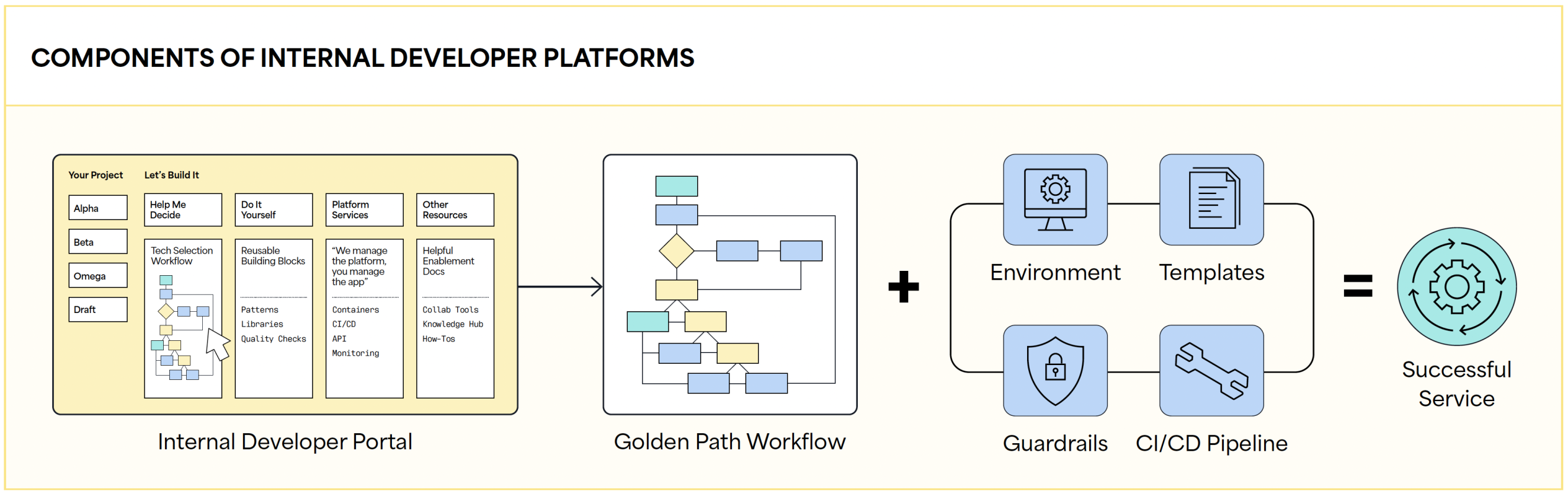
Step 1: Define the Platform Product and First Golden Path
Successful IDP efforts focus on end-to-end developer workflows: building a new interface, deploying an updated microservice, running a regression suite, or standing up an environment. Ideally, the whole workflow can be supported directly from your IDP as self-service.
Once you have identified the workflow to support, you need to design the “golden path,” which parts you will standardize and what you expose as configuration. It’s important to get that balance right. Components that have to change often, like service accounts, interfaces, and sizing, should be configurable. Creating templates and patterns helps reduce variability between outputs, making it easier to roll out necessary patching and updates.
For the first golden path, pick one high-value workflow that is common, repeatable, and easy to measure. We will use the deployment of our backend service to an integration test environment because it touches build, deployment, validation, and evidence capture in one flow.
User adoption is the key to success. To measure, it’s important to track both user adoption, such as how often a workflow is triggered, and outcome metrics like the number of compliant application instances, percentage of deployment failures, and average deployment duration.
Step 2: Design the Golden Path (Templates and Defaults)
Next, we get to design the golden path. An important factor for the developer experience is to provide documentation with contextual guidance. This can be traditional how-to guides or more advanced features such as AI-enabled chatbots. The documentation should explain how testing, application deployments, and other lifecycle activities happen along the golden path, and provide architectural guidance on embedding any newly developed capability in the existing architecture.
Standards and governance are other aspects that should be available for self-service, including naming conventions, common libraries, and reusable services.
On the technical side, the golden path should cover at least the following:
- Code repo and standard branching structure
- Skeleton code based on coding standards (e.g., environment config file, logging framework, data layer)
- CI/CD pipeline into an ephemeral cloud environment, or pointed at a standard persistent dev environment
- Skeleton quality gates in the CI/CD pipeline (e.g., unit test, functional regression, security scan)
- Access to common utilities; injection of environment values (e.g., URLs, IP addresses, access and secrets management)
- Ability to spin up the environment (if cloud based)
And lastly, the IDP needs to be designed with intuitive naming, a search function, tagging methods, and a hierarchical browsing structure so users can easily find the appropriate golden path. Supporting multiple ways of discovery provides a more resilient interface and eases the adoption of new golden path templates as they become available. For our backend service, choosing the workflow will show a representation of the steps included.
Step 3: Wire Self-Service Workflows (Without Tickets)
Besides golden path templates, IDPs should aim to be a one-stop shop for developers, so common requests should be available for self-service. Your existing ticket/ITSM systems can be a good source for creating the backlog. Identify the most common requests and start automating them in priority order.
In many cases, a ticket continues to be useful even in the self-service model for tracking and approvals, which can be integrated into the automatic workflow. Approvals should be provided automatically based on defined criteria, and only require human approvals when the request is outside of those parameters, such as access to restricted data, use of expensive resources, and non-standard requests. Over time, developers should be able to request new features through a transparent feature backlog and voting mechanism to engage the community.
When creating new features, keep things common wherever possible and provide ways for users to tailor their requests. For example, the standard deployment process might define a step for secrets injection, but some teams will tailor the process to skip it as necessary. This approach has two advantages: It creates a common language and process across teams and reduces the work to build and maintain the IDP.
Spending a bit more time up front to create customizability pays off over the medium and long term. For our backend service, the first service we define is deployment to the integrated test environment.
Step 4: Standardize Delivery With CI/CD + GitOps + IaC in One Flow
The principle of the golden path deployment process remains unchanged: You build a software artifact once, and you deploy it multiple times along the environment path. For our backend service, promotion should happen through a versioned change (think GitOps) to the desired environment state, so application version, infrastructure definition, and deployment evidence remain traceable together.
In the build stage, code is prepared in any pre-compile steps, then compiled and packaged with all necessary configuration files. In the deployment process, environment variables are injected, and the package is deployed to the target environment, which is scripted as Infrastructure as Code. The validation itself is usually layered: a technical validation to confirm that the deployment was correct, functional regression of core functionality, and testing the new changes. This sequence is based on speed of feedback, which is important in an automated IDP service.
When a validation check fails, the golden path needs to have defined failure behavior with clear steps to execute. Pipeline failures like a broken build, failed test, or policy violation will block progression automatically. If the environment is materially impacted, a rollback is automatically initiated. Only in rare cases should a human evaluation be required — for example, when the level of ambiguity is too high and impacts stakeholders who are using the environment.
Some policy violations can be treated with time-bound exceptions, such as allowing a new security vulnerability in a non-production environment. This allows functional testing to continue while the team remediates the security vulnerability. Prior to going live, the exception would be removed so the security vulnerability doesn’t progress to production. These types of exceptions should be set to auto-expire to prevent them from being forgotten later.
Golden Path Steps and Guardrails
| step | self-service action | guardrail | evidence |
|---|---|---|---|
|
Build |
Trigger pipeline via check-in action in source control |
Code scan and unit test results |
Build log, composition scan result |
|
Promote to non-prod environment |
Merge to staging branch, promotion request |
Technical validation, regression test |
Test results |
|
Promote to prod |
Promotion request |
Approval and compliance check |
Approval and audit trail |
|
Rollback |
Automated trigger or manual request |
Post-rollback validation and regression test |
Test results |
Step 5: Bake in Operability for Observability and Day-2 Readiness
IDPs reduce cognitive load and toil as solutions to common concerns are built in. This is especially true for the operational concerns. Each workflow and self-service feature creates the log files and traces for auditability. All code and configuration are driven from version control, and the metrics recorded provide insights into the outcomes and performance of the IDP. New operational initiatives, like introducing a software bill of materials, can be rolled out across all technologies that use the IDP.
When done correctly, templates can be updated centrally, and the log files provide full auditability to identify where old versions are still in use, reducing the overall security exposure. The IDP governance model needs to define the ownership of templates and any inheritance rules. For instance, some teams will tailor the template by adding additional steps required for their technology.
Alongside the IDP instrumentation, standard dashboards and alert definitions ship with the template, pre-wired to the appropriate ownership group. Who responds to what is documented, not assumed. Runbooks and escalation paths are stored in version control alongside the service itself so they evolve with the system rather than rotting in a forgotten wiki page.
Our backend service will include the following with the golden path:
- Logs, metrics, and traces
- Alerts
- Runbook link
- Ownership metadata
The final piece is the feedback loop. Incidents, near-misses, and recurring friction points are resolved and also used to help continuously improve the platform, first becoming a backlog item.
Step 6: Add Guardrails and Governance Without Slowing Delivery
The IDP should leverage approved templates where possible and embed basic compliance and policy checks in the workflows. Platform developers will receive immediate feedback on any problems they need to fix. When issue resolution requires a longer time, time-bound exceptions can be allowed. Along the environment path from development to production, the quality gates should become more restrictive as the software quality improves.
For our backend service, we define security scanning prior to deployments, and we don’t accept any deviations from the corporate standard for it. We follow a simple block, warn, escalate paradigm.
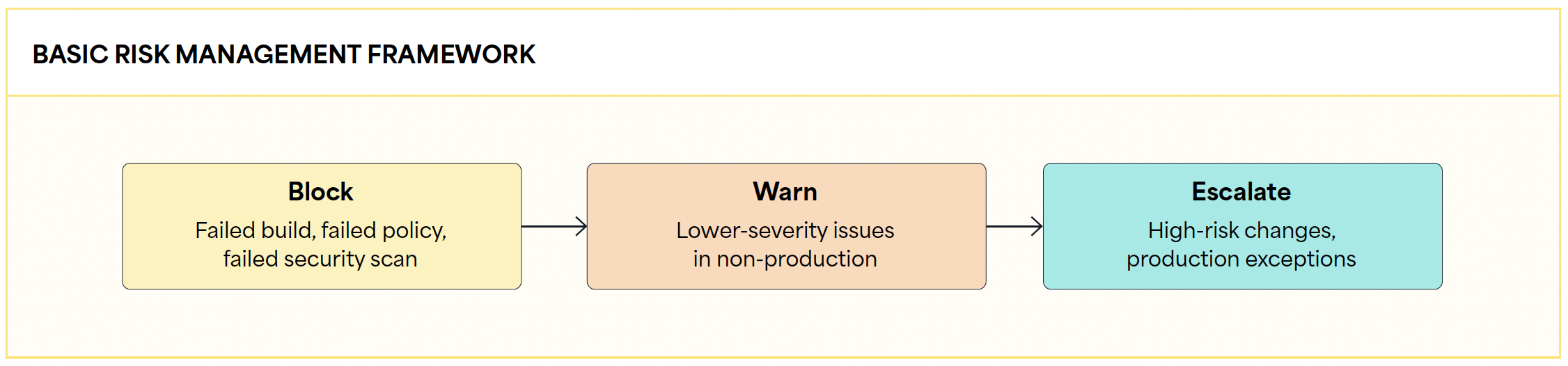
The goal is to address problems that teams can deal with immediately and provide enough time for more complex work. This balance allows work to flow at pace.
It is important to version templates and workflows so you can track what is in use. When significant problems are identified with a version, you can use the IDP logs to find any items in use and replace them quickly. Having the right guardrails in place might feel restrictive but in fact reduces the amount of rework over time as there are fewer incidents. Fast feedback reduces the time it takes to resolve problems.
Step 7: Measure Adoption, DevEx, and Platform ROI
One of the key success factors for IDPs is having the ability to measure adoption (covered earlier), developer experience, and platform ROI (e.g., DORA, SPACE). This allows you to break down and distinguish between adoption measures and outcome metrics. Implementing these criteria in the platform from the beginning captures data systematically.
Good adoption measures to start with: number of executed workflows, number and currency of templates, and number of active users. The following outcome metrics can also be used as part of the business case for IDPs: deployment failure rate, MTTR, incident volumes, number of tickets, and security vulnerabilities.
The team managing the IDP should actively use the metrics together with captured feedback from the user base (e.g., feature requests) to prioritize the backlog. Executive dashboards should be implemented to provide accountability and increase support across the organization.
A Minimal IDP You Can Scale
Bringing it together, take the following actions to kick-start your internal developer platform:
- Choose a common and not too complex workflow for your first golden path
- Create the code repository and CI/CD pipeline
- Define a self-service UI for the workflow
- Embed quality gates, metrics, and operational tooling into the workflow
Start with one workflow for one pilot team, prove the path, then extend to the next workflow or team. Don’t forget to engage with the pilot users to receive feedback and support adoption. If you want to dive deeper, explore the CNCF Platforms for Cloud-Native Computing whitepaper and Platform Engineering Maturity Model.
This is an excerpt from DZone’s 2026 Trend Report, Platform Engineering and DevOps: How Internal Platforms, Developer Experience, and Modern DevOps Practices Accelerate Software Delivery.
Read the Free Report
Opinions expressed by DZone contributors are their own.
Comments