

Security Is a Platform Property, Not a Pipeline Step
Security works best when it is built into the platform: Terraform guardrails, CI/CD checks, and golden path templates make secure delivery the default.
 ·
·
Join the DZone community and get the full member experience.
Join For FreeA few weeks ago, I disabled key authentication on an Azure storage account we used for Terraform state management. It was one of the key security recommendations in Microsoft Defender for Cloud. It made sense to use RBAC-only permissions, enforce PIM approvals for the Infrastructure team, and avoid storing static credentials in config files, where leaks are possible. This is exactly the kind of control you want for state files, which contain the keys to your entire cloud environment.
But I missed an important line in the azurerm backend config. If use_azuread_auth = true is not explicitly set, the provider uses key-based authentication by default. Since key authentication had been disabled, terraform init failed and the pipeline broke. The actual fix was easy, but finding what was wrong, not so much.
terraform {
  backend "azurerm" {
    resource_group_name  = "rg-tfstate-prod"
    storage_account_name = "sttfstateprod001"
    container_name       = "tfstate"
    key                  = "platform/prod.tfstate"

    use_azuread_auth = true
  }
}
This is not the kind of detail every engineer should have to remember in every repository. It belongs in the module.
That is the gap I am talking about: the security decision was correct, but the delivery path still allowed the wrong configuration. The same pattern shows up elsewhere: storage accounts left open, IAM roles with excessive permissions, credentials committed to repositories, diagnostic settings missed, or Terraform modules that still allow insecure defaults to slip through.
Security Enters Too Late, and Everyone Pays For It
There is a common pattern: a developer builds a feature, security reviews it and flags something, the developer reworks it, the release gets delayed, and someone gets the blame. The cycle repeats until everyone is frustrated.
The cost side of this doesn't get enough attention. Catching a vulnerability while you're still writing the code is a relatively quick fix. Finding the same issue in production is a different situation entirely: incident response kicks in, there may be regulatory questions to answer, and the reputational impact is difficult to measure. The further right security sits in the delivery process, the heavier each failure gets. Most teams are inadvertently set up to find problems at the point where they cost the most.
What Shifting Left Actually Looks Like
People toss around 'shift left' so much that it’s lost its punch. Here’s what it actually looks like in practice:
- Plan: Include threat modeling in sprint planning and spend 30 minutes on it rather than managing it in a separate process or document.
- Code: Use IDE plugins to flag insecure patterns in real time while you code and pre-commit hooks to run secrets detection before committing the code. The developer finds out immediately, not weeks later in a review.
- Build: Run SAST on every commit to catch injection risks, insecure cryptography, and hardcoded secrets/credentials before code is deployed to a shared environment.
- Test: Let DAST probe the application in staging as an attacker would. SAST reads code, and DAST attacks the running system. One finds what the other misses.
- Deploy: Scan your IaC before applying changes, check container images for CVEs, and use OPA policy gates to verify signing, permissions, and network policies before anything reaches production.
Running security through each of these stages means issues come up when they are still manageable, rather than after they have already caused damage.
Installing Tools Is Not a Program
How DevSecOps failures look in practice: Tools like Checkov and Semgrep are configured in the pipeline, and by next month, the developers have written suppression rules for the findings so the feature can be shipped. The tools keep running, but no one is checking their outputs.
Three things matter more than which tools you choose:
- Tuning: SAST generates false positives because it doesn’t know what’s happening at runtime. Run a co-triage session with a developer and a security engineer; work through the first 50 findings; fix the problematic rules; or write a justified suppression. After a couple of sessions, developers start trusting the output because it becomes more accurate and actionable.
- Signal engineering: Let critical and high CVEs block the pipeline immediately, while medium and low go to a dashboard with remediation SLAs. Developers will find ways to bypass the findings instead of fixing them if you block the commit for every medium, which will end up in a bigger mess than you started with.
- Ownership: Send findings straight to the person who can fix them, and give them enough info to act. A centralized security queue is where urgency goes to die.
The Terraform backend scenario I opened is the exact example. The security decision to use RBAC only and disable key authentication was absolutely the right one. But here’s the catch: use_azuread_auth = true was not enforced during provisioning. If a hardened module had that flag set by default, that misconfiguration simply couldn’t have happened. That’s the real difference between having a security policy and actually building a security platform.
The Platform Team Is the Structural Answer
Adding more process to a structural problem doesn’t fix it. What’s required is a different model entirely.
A real platform team treats the internal platform as a product, with engineers as its customers. Their job is to make secure, compliant delivery the path of least resistance: golden path templates, a shared CI/CD toolchain, secrets management, and self-service provisioning, all built with guardrails from the start.
When teams repeatedly provision similar workloads — containerized APIs, data pipelines, Kafka consumers – the same security configuration decisions recur. Golden path templates address this by embedding those decisions up front. Encryption at rest is already configured, IAM permissions are scoped to what the workload actually needs, logging and network policies are in place, and the backend authentication flags in the Terraform modules are set correctly from the start. A developer selects the right template, fills in the required fields, and provisions. The repository they get back already has security gates running in the pipeline. There is no separate step to secure it afterward.
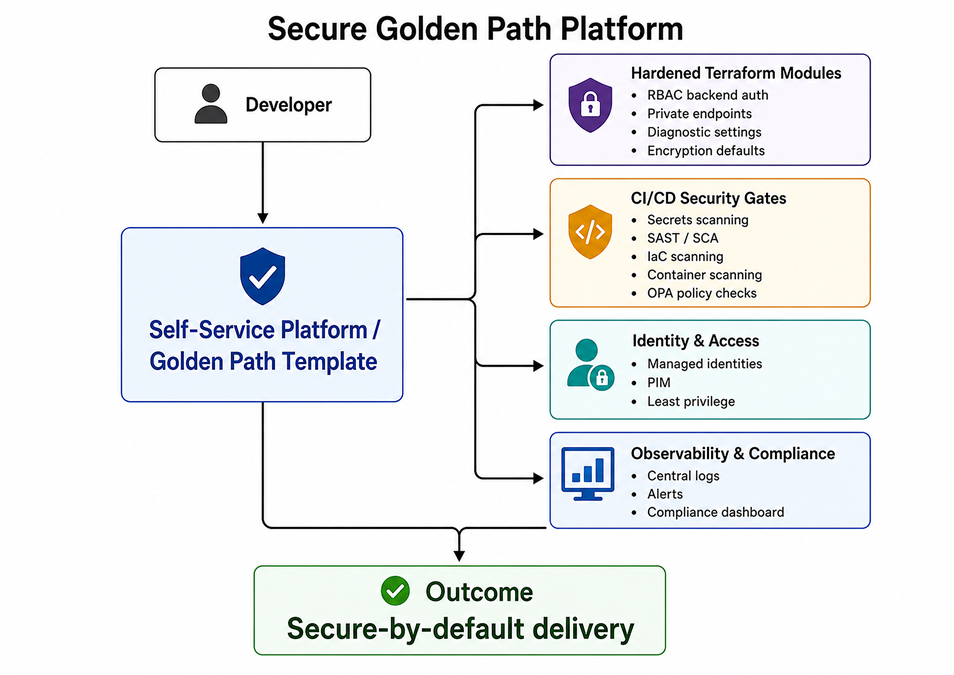
This is what removes the need for individuals to get every detail right under pressure. In my experience, even when you know the correct configuration, you can still miss something in the moment. The platform handles that by making the secure option the default.
In many organizations, platform teams work best when they sit within Engineering rather than reporting directly into the CISO function. If they are seen mainly as a compliance function, product teams may treat them as another gate to work around. Security should define the policies and risk boundaries; Engineering should build and operate the platform that makes those policies usable.
Where to Start: Sequence the Platform, Don’t Boil the Ocean
The most common mistake is trying to implement everything at once. Every scanner, every policy gate, every access control change lands in one big push. It creates noise before it creates trust, and teams lose confidence in the tooling before it has a chance to prove its value.
Sequence it instead.
Months 0 to 3: secrets scanning as a pre-commit hook, SAST in CI, IaC scanning before Terraform apply, and a security champions program with one dedicated developer per squad. Low friction, immediate signal, nothing that unnecessarily blocks delivery.
Months 3 to 6: DAST in staging, container image scanning, OPA policy gates, and SCA on every build. At this point, the platform needs to make a clear distinction: critical and high findings stop the pipeline; everything else goes into a remediation backlog with defined ownership and SLAs.
Months 6 to 12 mark the point at which platform security matures into deeper controls: workload identity, privileged access management, zero-trust network policies, and a real-time compliance dashboard. Never trust, always verify, and assume breach stop being principles on a slide and become defaults in the environment.
Don't wait for a fully staffed platform team or executive sponsorship. The Terraform backend fix I mentioned earlier eventually became a hardened provisioning module used by the wider infrastructure team, turning a one-off incident into a reusable secure pattern. No one needs to remember the flag because the platform handles it automatically.
That's what security as a platform property actually looks like. Not a gate at the end. A system that makes the right thing the easy thing, by default, every time.
Opinions expressed by DZone contributors are their own.
Comments