

Golden Paths in IDPs: From Developer Chaos to Clarity
Golden paths in IDPs turn best practices into living standards, reducing chaos and enabling teams to deliver faster, safer, and at scale.
 CORE
·
CORE
·
CORE
·
CORE
·
Join the DZone community and get the full member experience.
Join For FreeA new team spins up a service. They wire together a CI pipeline, stitch in some Terraform for infrastructure, and maybe — remember to add monitoring. Another team does the same, but with different tools, different conventions, and different assumptions.
Fast forward a few months, and what was once a fast-moving engineering org is now struggling with undocumented know-how, snowflake pipelines, and production incidents caused by inconsistent practices. Developers spend more time debugging environments than delivering features. Platform teams are stuck firefighting, trying to enforce standards that retroactively were never embedded in the first place.
This isn’t just a tooling problem — it’s a clarity problem.
And that’s exactly where golden paths shine.
Golden paths offer something powerful: a paved, opinionated route from idea to production — one that’s fast, secure, and consistent. When designed well inside an internal developer platform (IDP), they do more than just streamline deployments. They restore order to chaos, giving developers the confidence to move fast without second-guessing every step.
This blog explores how to design these golden paths — what makes them work, why they matter, and how they transform not just developer experience but organizational velocity as a whole.
What Are Golden Paths?
Golden paths are predefined, reusable workflows or templates that encode your organization's best practices into developer-friendly experiences.
They typically include:
- Pre-wired CI/CD pipelines
- Infrastructure provisioning templates
- Observability integrations
- Security and compliance policies
- Documentation and support
The Problem and the Solution
The Problem: Fragmentation and Friction
Without golden paths, every team builds its own pipeline, provisions infra differently, or skips security steps entirely. The result?
- Inconsistent deployments
- Hard-to-debug environments
- Security risks and policy violations
- Slowed developer onboarding
Platform teams often find themselves swamped with support tickets — ironically becoming bottlenecks in the name of “self-service”.
The Solution: Opinionated Workflows in IDPs
Golden paths shift the dynamic. Instead of offering endless choices, you offer smart defaults — production-ready blueprints developers can trust.
Here’s how a typical golden path flow looks inside an IDP:
- The developer opens the portal (e.g., Backstage, Port, Kratix)
- Selects a “New Service” template
- Code is scaffolded with prebuilt pipeline + IaC configs
- CI/CD is pre-configured for compliance gates
- Service is auto-wired into monitoring, alerting, and service mesh
- Production deployment is one command away
And just like that, compliant, observable, scalable software is in production. No chaos. Just clarity.
Key Principles for Designing Golden Paths
- Start with developer needs: Don’t impose workflows — co-create them with engineering teams. Interview teams to understand pain points and design for the 80% use cases.
- Be opinionated, yet flexible: Golden paths should include strong defaults but allow escape hatches. Not every team is the same.
- Opinionated: Standard CI/CD template
- Escape hatch: Custom pipeline step injection
- Automate everything: Automate infrastructure provisioning, observability setup, and security scanning. Golden paths should feel like magic. “From
git pushto production with confidence.” - Make the secure path the default path: Embed Guardrails, shift left on compliance by integrating:
- Secret management
- Policy checks (e.g., Open Policy Agent)
- Vulnerability scans
- Version and document paths: Treat golden paths like software:
- Version them
- Provide clear documentation
- Offer change logs and migration guide
Golden Path as Code: Layered Architecture
The diagram below shows the layered architecture that helps standardize the deployment across teams.

Golden Paths vs. Deployable Architectures
|
Aspect |
Golden Paths |
Deployable Architectures |
|
Definition |
Curated, opinionated workflows that guide developers through a consistent, secure, and fast path to production |
Reusable infrastructure blueprints packaged for provisioning across environments |
|
Focus |
Developer workflows, experience, and lifecycle |
Infrastructure setup, compliance, and scalability |
|
Abstraction Level |
High-level, user-facing developer experience |
Low-level, system-facing infrastructure definition |
|
Output |
End-to-end flow: scaffolded code → CI/CD → observability → deployment |
Infrastructure components: VPC, clusters, databases, firewalls, etc. |
|
Who Uses It |
Developers, via IDPs (e.g., Backstage, Port) |
Platform engineers, SREs, architects |
|
How It's Triggered |
Through portals, CLIs, or pipelines that abstract the complexity |
Via IaC tools like Terraform, IBM Schematics, Bicep, ARM, etc. |
Benefits: From Clarity to Velocity
|
Benefit |
Description |
|
Faster Time to Value |
Faster deployments and the environment is made available in a short period. |
|
Built-in Security & Guardrails |
Secrets, scanning, policies are embedded in the pipeline |
|
Standardized Deployments |
Every service meets your org’s SLOs by default |
|
Better Insights |
Easier to observe, debug, and audit across teams |
|
Happier Developers |
Reduced toil and cognitive load improves developer experience |
Designing Golden Paths: Best Practices
- Start with developer empathy — Interview teams. Identify their biggest points of friction. Build paths that solve real pain.
- Be opinionated (but flexible) — Offer strong defaults, but allow for extensibility. Advanced teams can opt out when necessary.
- Automate everything — Provisioning, monitoring, logging, security scans, bake them into the path.
- Version and document — Treat golden paths as code. Maintain versioning, changelogs, and onboarding docs.
- Measure and iterate — Track adoption metrics, deployment success rates, and developer satisfaction. Continuously improve.
Real-World Example
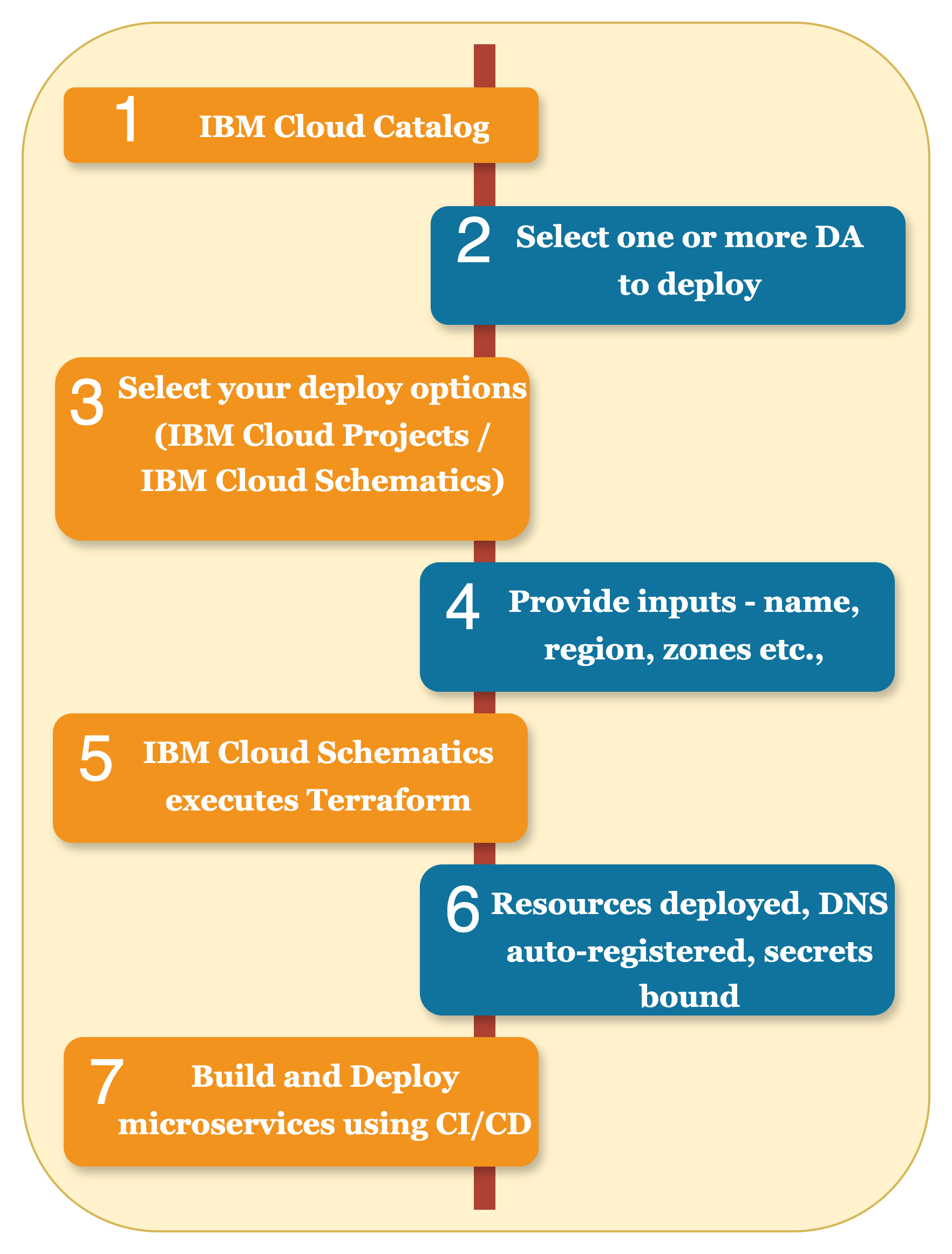
Golden Path for a Secure VPC-Based Microservice Deployment
Provision a secure-by-default microservice environment on IBM Cloud, complete with network isolation, integrated observability, and built-in security controls.
Components Involved
- Prebuilt Deployable Architecture for:
- VPC with subnets (zone-based)
- Load balancer and security groups
- VSI or OpenShift cluster for micro-service workloads
- IBM Cloud Monitoring and Logging instances are auto-attached
- Secrets configured via Secrets Manager
- Pre-integrated CI/CD pipeline (Tekton or GitHub Actions)
Developer Flow
Measuring Success
To ensure your golden paths are effective:
- Track adoption metrics.
- Measure the lead time for changes.
- Monitor platform support tickets.
- Gather qualitative feedback from developers.
Conclusion
Every engineering organization faces the trade-off between developer freedom and consistency. Left unchecked, autonomy breeds chaos — fragmented pipelines, fragile deployments, and hidden risks. Golden paths are not about taking away creativity; they offer a clear, trusted lane that removes friction while keeping innovation alive.
By embedding these paths into internal developer platforms, best practices become living standards. Developers move faster with confidence, platform teams ensure governance, and the organization scales without losing control.
The shift from chaos to clarity takes time, but once golden paths are in place, teams can focus on what truly matters: delivering value to users — faster, safer, and with greater confidence.
Opinions expressed by DZone contributors are their own.
Comments