

A Developer’s Experience of Onboarding to a Platform
From manual cloud setups to guided golden paths — my onboarding journey revealed how platforms transform friction into flow.
 CORE
·
CORE
·
Join the DZone community and get the full member experience.
Join For FreeAfter years of managing cloud services in a traditional setting — manually provisioning clusters, setting up networks, managing credentials, and navigating deployment scripts — I thought I had mastered the rhythm of delivery. Dashboards, support tickets, and carefully planned change windows were the most important things in my life. It was safe, predictable, and well-organized, but it was also slow, tiring, and full of dependencies that only worked after a lot of planning and careful changes.
Then came the shift.
Our organization launched a developer platform, which was a single, unified space that promised automation, golden paths, and built-in safety nets. It wasn't just a new tool; it was a whole new way of thinking. I was used to having full control over everything, like manually provisioning, configuring, and deploying. The idea of abstracted infrastructure and self-service pipelines felt new to me. It was both exciting and scary, like going from steering a ship by hand to trusting a smart navigation system to find the way.
At first, I hesitated. Could a system this well-organized really handle all the complicated things I had been doing by hand for years? But as I started to learn more about platform engineering by making a workspace, deploying a service, and watching everything connect without any problems, I began to get it. It wasn't about taking power away from developers; it was about getting us out of the never-ending cycle of setup and repetition so we could focus on building what really mattered.
This blog is about that transformation: going from a world of hand-made configurations to one powered by platforms, where speed, consistency, and safety finally work together. It's about letting go of old habits, accepting new rules, and understanding that joining a platform doesn't mean giving up control or knowledge; it means gaining more.
The Builders and the Bridge
For years, developers and operations teams worked towards the same goal, but from different sides: speed versus stability. Developers made things quickly, while ops made sure they worked. The end result was a bigger gap that made progress slower for both.
Then came the platform engineers, who built the bridges. They didn't just make another tool; they laid the groundwork for a new way of working. A system that made the boring tasks automatic, made the hard tasks easier, and gave developers the confidence to move quickly without breaking things. That base grew into the internal developer platform (IDP), which finally linked speed and stability.
The IDP was no longer just a bridge; it was the road that went across the river. Developers didn't have to wait in queue or raise tickets for every little change to a deployment or configuration anymore. They could go from idea to deployment in a matter of minutes with self-service golden paths.
Platform engineers worked behind the scenes to keep the bridge strong and safe. They improved automation, tightened guardrails, and made sure that every release went smoothly from code to production. The result? Innovation didn't just go faster; it also went smarter.
In essence,
- Platform engineering is the craft — the discipline of designing the systems, automation, and guardrails that empower teams.
- IDP is the product — the tangible outcome of that craft, offering developers a self-service, secure, and consistent way to bring ideas to life.
Design Principles of the Platform
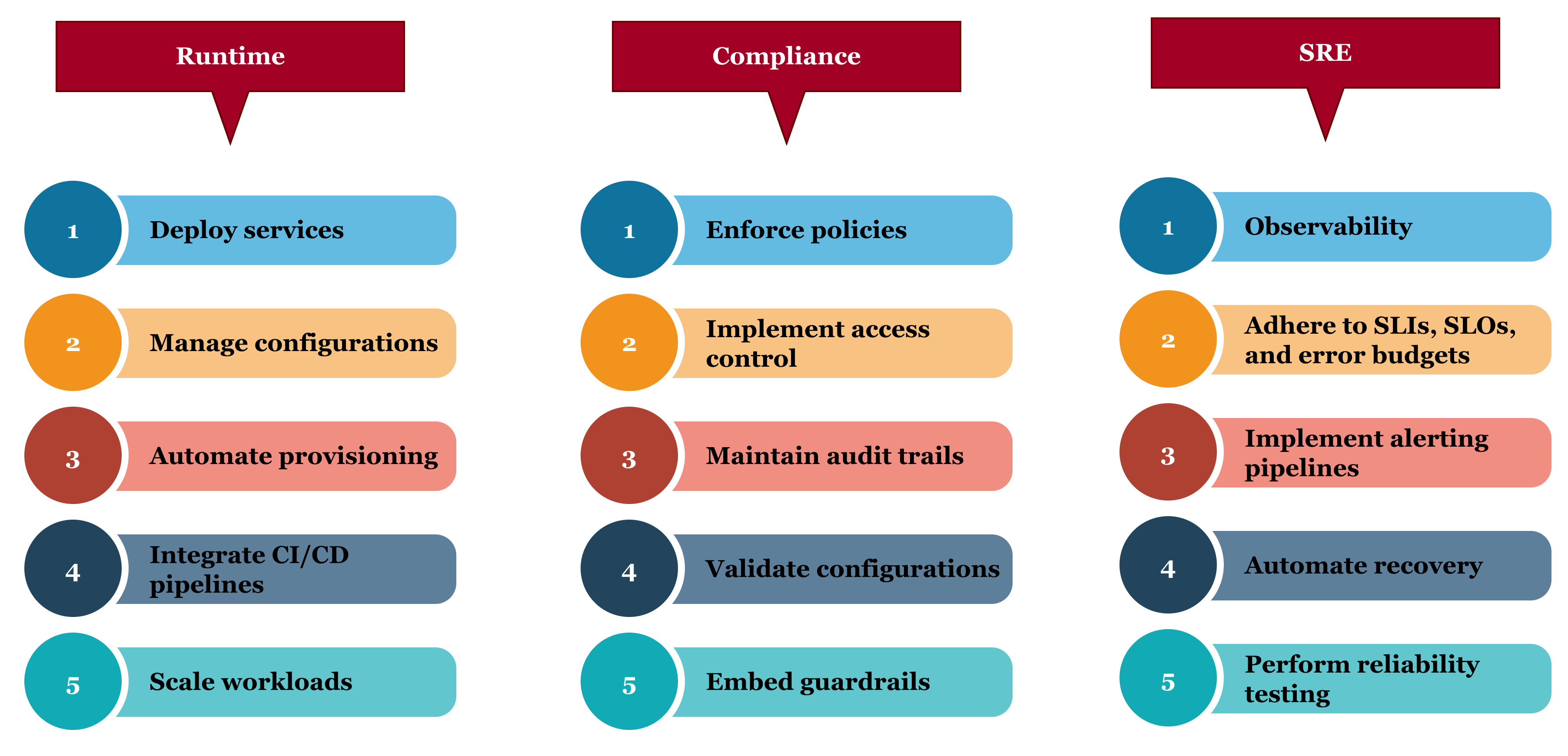
An effective IDP is more than a collection of tools; it's a carefully thought-out system that strikes a balance between automation, security, and reliability. Its design principles set the rules for how developers work with infrastructure while making sure that things stay the same and are governed on a large scale. Our platform was built on three main pillars:
- Runtime – The platform should make sure that applications run reliable, scalable, and work the same way in all environments. It makes infrastructure less complicated by automating it, which lets teams deploy, scale, and monitor workloads more easily.
- Compliance – Governance must be built into the platform. Compliance ensures that every deployment adheres to organizational and regulatory standards through policy enforcement, access control, and audit trails.
- SRE (Site Reliability Engineering) – Reliability is a shared responsibility. Embedding SRE practices into the platform makes it more resilient by using observability, error budgets, proactive monitoring, and automated recovery. This makes operational excellence a process that can be repeated.
The Human Side of Platform Engineering
No onboarding experience is perfect. There are still moments of confusion — “Which environment variable maps to which secret?” or “How do I roll back a feature?”
But when the platform team responds through community office hours, in-house chatbots, in-portal feedback, or documentation updates, trust grows. A great platform isn’t just a product — it’s a relationship between builders and enablers.
“When an issue was encountered, it was fixed by updating the template/automation to fix this for everyone/future. That’s when I realized what ‘platform engineering’ truly means.”
My End-to-End Journey of Onboarding to the Platform
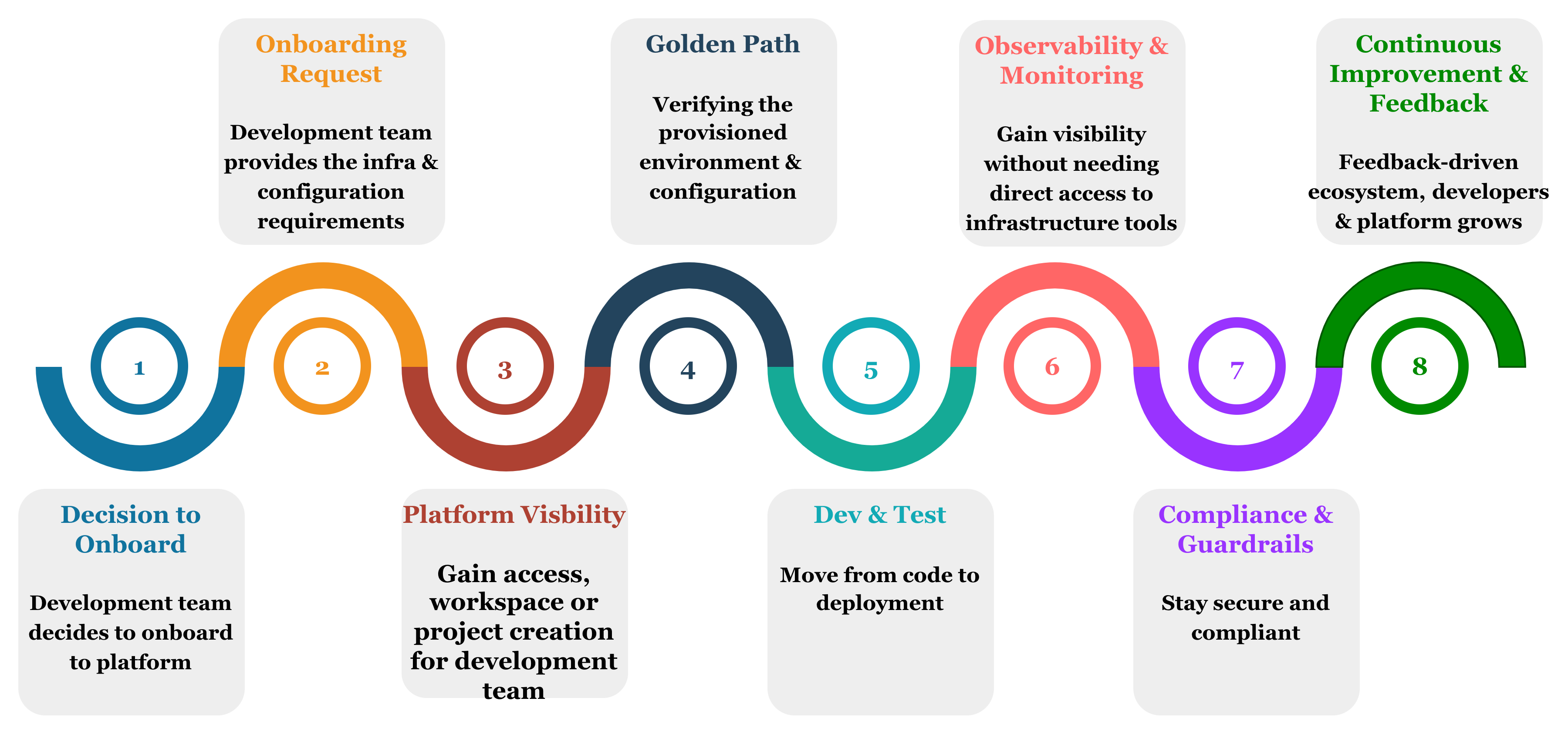
Moments That Changed How I Work
- Week 1
- The Beginning: A New Developer, A New Platform. When I first joined the team, the word “platform” floated around in every conversation. It was described as the foundation that powered all deployments, managed compliance, and simplified delivery. I didn't start my onboarding process with paperwork; I started it with curiosity.
- The First Login: Where the Story Begins. I log into the internal developer portal. Portal greets not just by a wall of documentation but by a dashboard of “golden paths.” A golden path is a carefully chosen, opinionated workflow.
- The Setup Phase: The platform automatically sets up a namespace in Kubernetes, sets resource quotas, and enforces security policies using pre-made templates instead of having to do it by hand.
- The Golden Path Moment: From Zero to Deployed – I pick a template, fill-in a few details — repo name, image path, environment — and the platform auto-provisions the infrastructure as per the developer requirement.
- Guardrails, Not Roadblocks: As I navigated deeper, I realized how carefully the platform balanced freedom and governance. There were safeguardrails around every action, from making a namespace to deploying an app.
- Week 2
- The Hidden Power: Shared Responsibility Without Friction: The platform's design includes shared responsibility, security is built in, performance patterns are pre-tested, and cost transparency is clear. There is a clear layer of responsibility for every action a developer takes.
- Within a Month
- From Developer to Contributor: The platform’s contribution model allowed me (developer) to extend templates, publish new workflows, and share best practices with peers. This is the final stage of onboarding — when developers become contributors. It’s about co-creating the ecosystem.
- Closing Thoughts: Onboarding as a Continuous Experience – Platform is a developer experience system. Every problem, every automation, and every feedback loop affects how developers think about productivity and new ideas. When onboarding goes smoothly, developers stop worrying about the platform and start thinking about what they can do with it.
- The Realization: Freedom with Limits – Initially, I worried that such automation might take away flexibility — the ability to tweak configurations or optimize deployments. But what I found was the opposite: freedom within a framework. The platform took care of the infrastructure scaffolding, compliance, and performance best practices that I used to have to enforce myself, so I could focus on my service logic.
Lessons Learned
My journey through platform onboarding taught me a few lasting lessons:
- Simplicity is the greatest enabler – Developers don’t want more tools; they want fewer decisions that matter.
- Golden Paths reduce cognitive load – Pre-defined workflows and templates (golden paths) guide developers through the right way to build and deploy, minimizing decision fatigue, setup errors, and inconsistency.
- Guardrails inspire confidence – When governance feels like guidance, compliance stops being a burden.
- Automation turns reliability into routine – Automated CI/CD pipelines, environment provisioning, and observability integrations replace manual steps — making reliability a default, not an afterthought.
- Observability is built-in, not bolted on – From metrics to traces, platform onboarding ensures that every service is observable by design, enabling faster debugging, root cause analysis, and proactive performance tuning.
- Onboarding never truly ends – Great platforms evolve as developers grow, keeping the experience fresh and relevant.
- A great platform grows with its developers – Platforms thrive when developers feel heard — it turns users into contributors.
- Culture completes the code – Behind every great platform is a team that listens, iterates, and learns from developer feedback. The human element — empathy, communication, and shared ownership — turns a system into a culture.
- Collaboration through standardization – When every team followed the same golden paths and governance patterns, it became easy to understand each other’s deployment pipelines, troubleshoot across teams without deciphering custom scripts, and compare performance and cost metrics in a meaningful way.
- Automation works best when it’s transparent – The platform didn’t hide complexity; it revealed it at the right moments, making me smarter, not passive.
The Role of AI in Modern Developer Platforms
As platforms mature, AI is becoming a silent teammate in the developer experience. It’s no longer just about automating pipelines; it’s about augmenting intelligence across the entire onboarding journey. While my platform team has identified many futuristic AI solutions to manage the platform, following are the current developer focused assistants, that focuses on enhancing the onboarding journey.
- Intelligent onboarding assistance – AI-powered assistants embedded in the developer portal guide newcomers contextually — explaining errors, suggesting templates, or even generating YAML manifests on the fly. This results in reduced onboarding time and fewer blockers.
- "re-inviteme" bot – AI-powered chat assistant that helps developers regain or request the right infrastructure access. Developer can run this to create/update their access, which at the background follows the organization policies to provide access to the corresponding developer.
- "create-config" bot – Chat assistant that helps developers create new golden path configuration.
- "update-config" bot – Chat assistant that helps developers update their existing golden path configuration.
AI doesn’t replace the platform engineer — it amplifies them.
Closing Thoughts
The journey of onboarding to a platform isn’t just about learning how to use the tools or processes to be followed; it’s about experiencing enablement. When a platform makes things easier, it empowers developers to focus on what they love most — building, experimenting, and innovating.
A great platform doesn’t just get developers started; it gives them confidence. And that's what I’ve learned: a platform transforms a system into a community.
Opinions expressed by DZone contributors are their own.
Comments