

Product-Led Software Delivery: Intelligent Platforms for DevOps at Scale
Platform engineering helps DevOps teams scale with golden paths, DevEx metrics, automation, and AI guardrails that reduce friction and improve delivery.
 CORE
·
CORE
·
Join the DZone community and get the full member experience.
Join For FreeEditor’s Note: The following is an article written for and published in DZone’s 2026 Trend Report, Platform Engineering and DevOps: How Internal Platforms, Developer Experience, and Modern DevOps Practices Accelerate Software Delivery.
Recent advances in tooling and automation have moved DevOps beyond a collection of siloed frameworks and tools toward a more unified delivery model. But the sprawl of disconnected tools and the cognitive load of constant context switching have also created analysis paralysis, slowing delivery and shifting attention away from technical progress toward coordination challenges. In response, platform engineering has become the delivery backbone for organizations. In 2026, scaling delivery and adopting AI successfully will require platforms to operate through a product-led model.
This article explores how practitioners and leaders can adopt product-led approaches, using real examples and practical best practices to measure the impact of DevOps at scale, where reliability and compliance are both critical. It examines tradeoffs such as speed vs. standardization and autonomy vs. integration.
What Breaks as DevOps Scales
As DevOps scales across multiple teams and systems, challenges emerge across infrastructure, security, compliance, and observability. These challenges are not only technical or skills-based. A technical solution may work at a smaller scale but will likely fail at a larger one. In a regulated organization, responsibilities such as auditing, logging, data processing, and managing suppliers and contractors are often handled by different teams. This can lead to slower response times and increased errors in deployment and testing.
At the same time, the growing number of tools, environments, and versions increases cognitive load and creates tool sprawl, both of which slow delivery. Context switching between disconnected systems adds further friction, reducing velocity and making it harder for teams to work effectively. Over time, these pressures affect delivery outcomes, contribute to burnout, and limit critical thinking.
Platform Engineering as the Scaling Mechanism
A common misconception is that teams and systems can be optimized individually. While this may be true in smaller organizations, it is not practical at scale. In this context, the platform-led model provides an umbrella under which systems and teams can be optimized as one unified unit, supported by self-service capabilities.
If the platform is treated as a product, it comprises all the necessary components, including users, processes, and measurable outcomes. The goal is to simplify and standardize processes so nothing breaks down as DevOps scales. In practice, this creates a shared operating model in which DevOps, SRE, platform engineering, and security teams align around common defaults, guardrails, and delivery expectations.
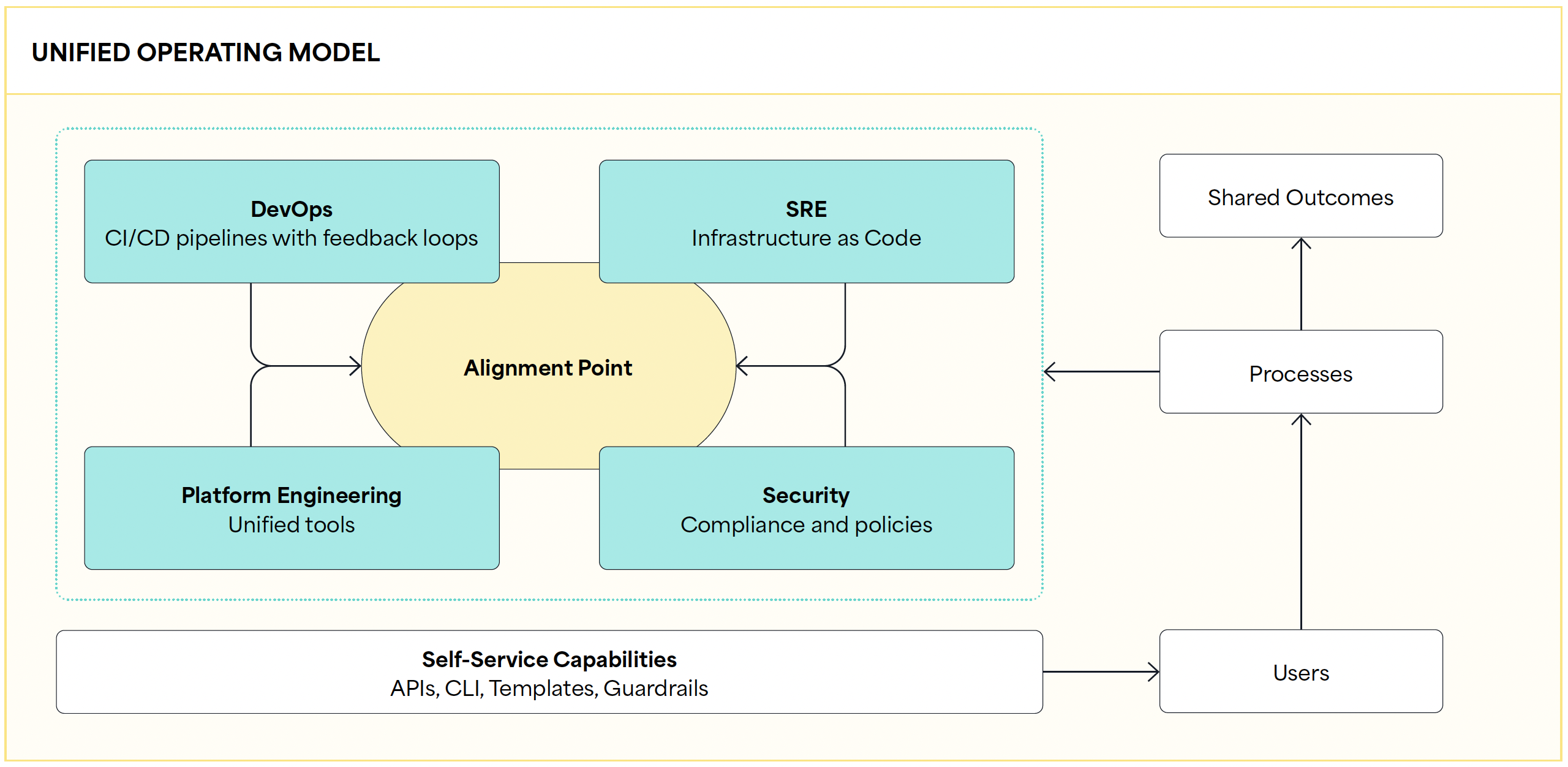
Figure 1
This can be implemented in practice through golden paths. For example, when a new service is requested, a workflow template can be created to add a new repository with all the required steps, including CI/CD pipelines, environment configuration, security, and alerts checks. This path can then be replicated and integrated with other services with minimal deployment effort.
At the same time, compliance, resilience, and regulatory steps are implemented automatically. Instead of relying on tickets or legacy knowledge, teams can use these paved paths as self-service workflows with built-in defaults and guardrails. Golden paths reduce error and failure rates because each stage is predefined for release, deployment, and rollback.
These pipelines require consistency across tools, environments, and release frameworks. Without it, incidents, cases, and handovers become more difficult to manage. At scale, standardization and integration make these workflows repeatable, reliable, and easier to adopt across teams. The following table compares the two approaches.
Old vs. Platform-led DevOps
| Old DevOps model | why it breaks at scale | platform-led devops |
|---|---|---|
|
Individual teams and pipelines |
Inconsistency and drift |
Replicated golden paths |
|
Documentation per team/system |
Outdated knowledge |
Centralized documentation |
|
High autonomy |
Missing interoperability |
Consistency is high |
|
Low standardization |
Expensive to maintain |
High standardization |
|
Challenging integration |
Increased error rates |
High integration |
Developer Experience Becomes a First‑Class Delivery Metric
Developer experience (DevEx) helps identify friction across tools, teams, and workflows, while also providing a way to measure quantitative and qualitative productivity. This is critical for any platform at scale, where slow onboarding, manual approvals, and persistent development constraints can delay delivery.
DevEx measures such as time to first deploy, failure rate, lead time, and MTTR can help uncover bottlenecks in DevOps. Improving them leads to better developer satisfaction, smoother scaling, and clearer platform priorities. Success criteria become even more important at scale, where multiple teams work closely together to produce similar services with similar pipelines under the same or similar compliance conditions. In those environments, friction is reduced, and practitioners benefit directly from a stronger developer experience.
Automation and AI: Leverage With Guardrails
Automation supports standardization and integration by handling repetitive tasks and default configurations. With the adoption of AI, its value is seen most clearly in assisting rather than replacing decision-making. Combined with automation, AI shortens feedback loops and makes processes easier to audit and monitor, reducing failure rates and improving the developer experience.
In practice, platform teams can use AI to intelligently automate triage, reduce alert noise, provide context-aware suggestions, and support guided remediation. However, applying automation and AI requires guardrails so systems and tools operate within clear boundaries, avoid incorrect outputs, and allow immediate rollback where necessary. There is a significant tradeoff between risk and speed, and finding the right balance is one of the first concerns organizations must address when integrating AI.
Measuring Platform Value
Measuring platform value should be demonstrated through outcomes, with recommendations supporting teams rather than replacing them. Increased platform adoption can act as a leading indicator that teams are choosing to follow golden paths and standardization and integration practices. A low adoption rate, by contrast, may signal growing friction and silos across teams and tools. When done well, the platform’s value becomes apparent in the ability to deliver releases without unnecessary overhead or disruption.
The focus should always be on measuring outcomes that reflect integrated and repeatable pipelines, strengthening service continuity, and raising the standard for auditing and compliance. Outcome-based measures validate adoption: reduced operational toil, fewer incidents, faster recovery, and more reliable delivery. These outcomes translate directly into service continuity and audit confidence. However, counting tools or templates say little about impact.
Two Failure Modes to Avoid
Not all failures are obvious. If teams continue to use old methods and approaches despite the introduction of golden paths, DevEx, automation, and AI, the result can be platform theater, where neither outcomes improve nor value is added. Here, the illusion of productivity is often caused by cultural resistance: Teams adopt new tools but continue using old methods, leading to minimal or no improvement. For example, a team may adopt an internal platform but still rely on tickets, manual approvals, and older team-specific processes to move work forward.
Another less visible failure is platform paralysis, where teams are pushed to build pipelines in parallel, leading to slower delivery and more controlled decision-making rather than flexibility, enablement, and repeatability. Here, the loss of velocity is often caused by over-engineering or too many competing solutions, with complex parallel approaches slowing delivery rather than accelerating it. For instance, multiple teams may create overlapping workflows and tooling for the same problem, increasing complexity instead of reducing it.
Avoiding these two failure modes requires a clear shift from treating the platform as a project with milestones to treating it as a unified product-led model, with DevEx, automation, and AI focused on improving how work is actually done.
What Product-led Delivery Looks Like in 2026
In 2026, delivery is increasingly shaped by standardization, integration, automation, and AI adoption. The goal is to help teams move faster without increasing complexity or raising the risk of bottlenecks and pipeline failure. In platform-led models, golden paths become the norm, allowing teams to follow repeatable processes with a greater degree of confidence in the outcome.
Many of the same tools and methods that were introduced to increase speed have also added cognitive strain, fragmentation, and delivery friction. The next step is to reduce that complexity through a platform-led model, where golden paths improve speed and reliability while lowering cognitive load. For organizations looking at the next quarter, two practical priorities are to establish a small number of reusable golden paths and to baseline a focused set of DevEx measures so bottlenecks can be identified and removed earlier.
This is an excerpt from DZone’s 2026 Trend Report, Platform Engineering and DevOps: How Internal Platforms, Developer Experience, and Modern DevOps Practices Accelerate Software Delivery.
Read the Free Report
Opinions expressed by DZone contributors are their own.
Comments