

Rethinking QA: From DevOps to Platform Engineering and SRE
A wake‑up call for QA to upskill for platform engineering and SRE, including cloud‑native practices, automation mastery, and system reliability at scale.
Join the DZone community and get the full member experience.
Join For FreeThe Wake-Up Call
The software development landscape is undergoing a significant transformation, challenging traditional roles and requiring new skills. While DevOps has been a key element for over a decade — promoting collaboration and continuous delivery — the specific role of a "DevOps engineer" is changing. Recent market analyses indicate a shift: while some reports suggest a stabilization or slight decrease in dedicated DevOps job postings, platform engineering and site reliability engineering (SRE) roles are experiencing a rise. This change does not mean the end of DevOps principles, but rather their deeper integration into specialized functions.
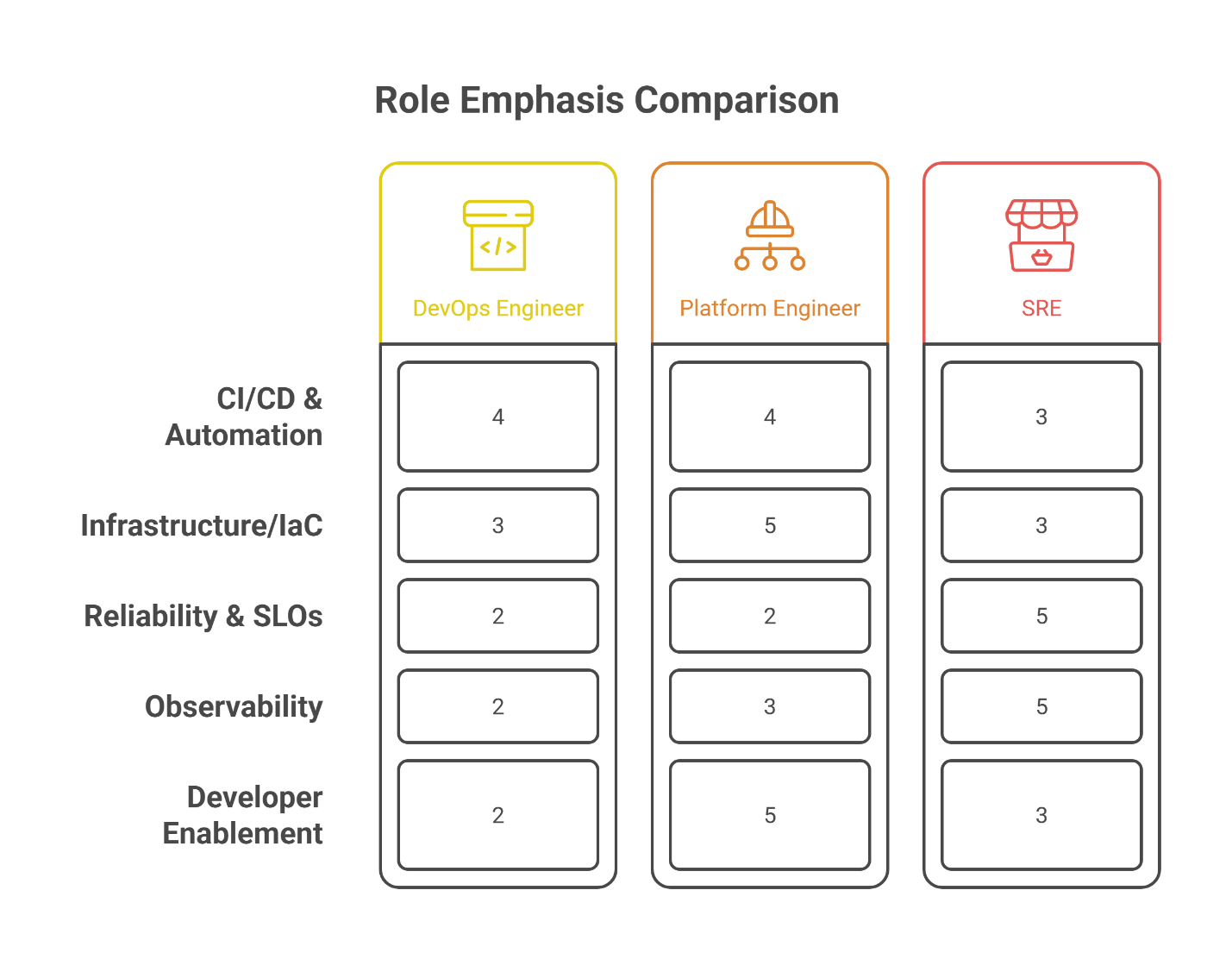
This article argues that the core principles of DevOps are being integrated into new, vital roles, necessitating a significant adjustment for Quality Assurance (QA) professionals. Failing to adapt risks QA teams becoming bottlenecks in modern engineering workflows. On the other hand, embracing this change provides QA with a unique chance to expand its influence and become an essential quality facilitator.
We will examine the factors driving this change, the emerging roles that are taking on DevOps responsibilities, and their immediate impact on the QA function. We will specify the key skills QA professionals need to develop to succeed in the post-DevOps era and provide practical steps for strategic upskilling. The goal is to provide QA teams with a clear roadmap to navigate this critical period, ensuring their ongoing relevance and strategic importance in the rapidly evolving tech industry.
The Shift: Why DevOps Roles Are Declining
The discussion about the "DevOps Engineer" role often misreads market trends. Although the term may be less common in job titles, the core DevOps philosophy — focusing on automation, teamwork, and continuous delivery — is more widespread than ever. This shift is driven by the maturation of organizational practices and the growing specialization of engineering roles.
Recent data emphasize this shift. A 2025 report by the Burning Glass Institute, for example, noted an 18% annual increase in job postings for "DevOps engineers" since 2020. Meanwhile, other analyses highlight a rise in demand for roles such as platform engineer and site reliability engineer (SRE). This indicates a reclassification rather than a decline in demand for DevOps skills.
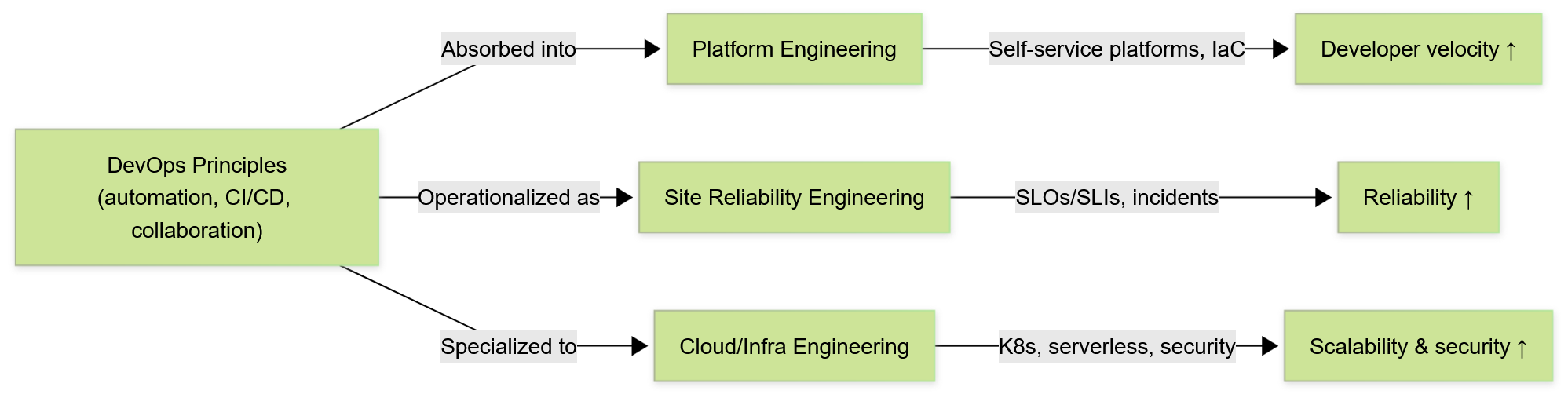
The global DevOps market is expected to grow from $13.16 billion in 2024 to about $15.06 billion in 2025, with a strong 20.1% CAGR, showing the ongoing economic significance of these practices.
This operationalization of DevOps principles has led to their absorption into specialized roles:
- Platform engineers: These professionals are increasingly responsible for building and maintaining internal developer platforms, abstracting infrastructure complexity, and enabling self-service for development teams. Their focus includes CI/CD pipelines, Kubernetes orchestration, and Infrastructure as Code (IaC). The platform engineering community has experienced rapid growth, marked by significant increases in engagement and adoption, highlighting its vital role in modern software delivery.
- Site reliability engineers (SREs): SREs apply software engineering principles to operations, emphasizing system reliability, scalability, and performance. They oversee observability (logging, monitoring, tracing), incident response, and establish service level objectives (SLOs) and service level indicators (SLIs). The SRE job market remains strong, with average annual pay ranging from $120,000 to $180,000 in 2024, reflecting high demand for these specialized skills.
- Cloud/Infrastructure engineers: These engineers specialize in managing and optimizing cloud environments (AWS, Azure, GCP), provisioning resources, implementing security, and ensuring scalability. They leverage Kubernetes, serverless functions, and IaC tools to automate infrastructure management.
This evolution reflects a natural progression in which the broad scope of DevOps is refined into interconnected, specialized disciplines. Understanding this landscape is essential for QA professionals to determine where their skills can have the most significant impact and growth.
How This Impacts QA
The evolving landscape of DevOps, platform engineering, and SRE significantly transforms the Quality Assurance function, presenting both challenges and opportunities.
1. The Good News: QA’s Influence Expands
DevOps principles, including automation and continuous delivery, are now widespread across engineering. This allows QA to incorporate quality earlier in the development process. For example, QA teams can work with platform engineering to implement automated testing gates within CI/CD pipelines, ensuring thorough testing of functionality, performance, and security before deployment.
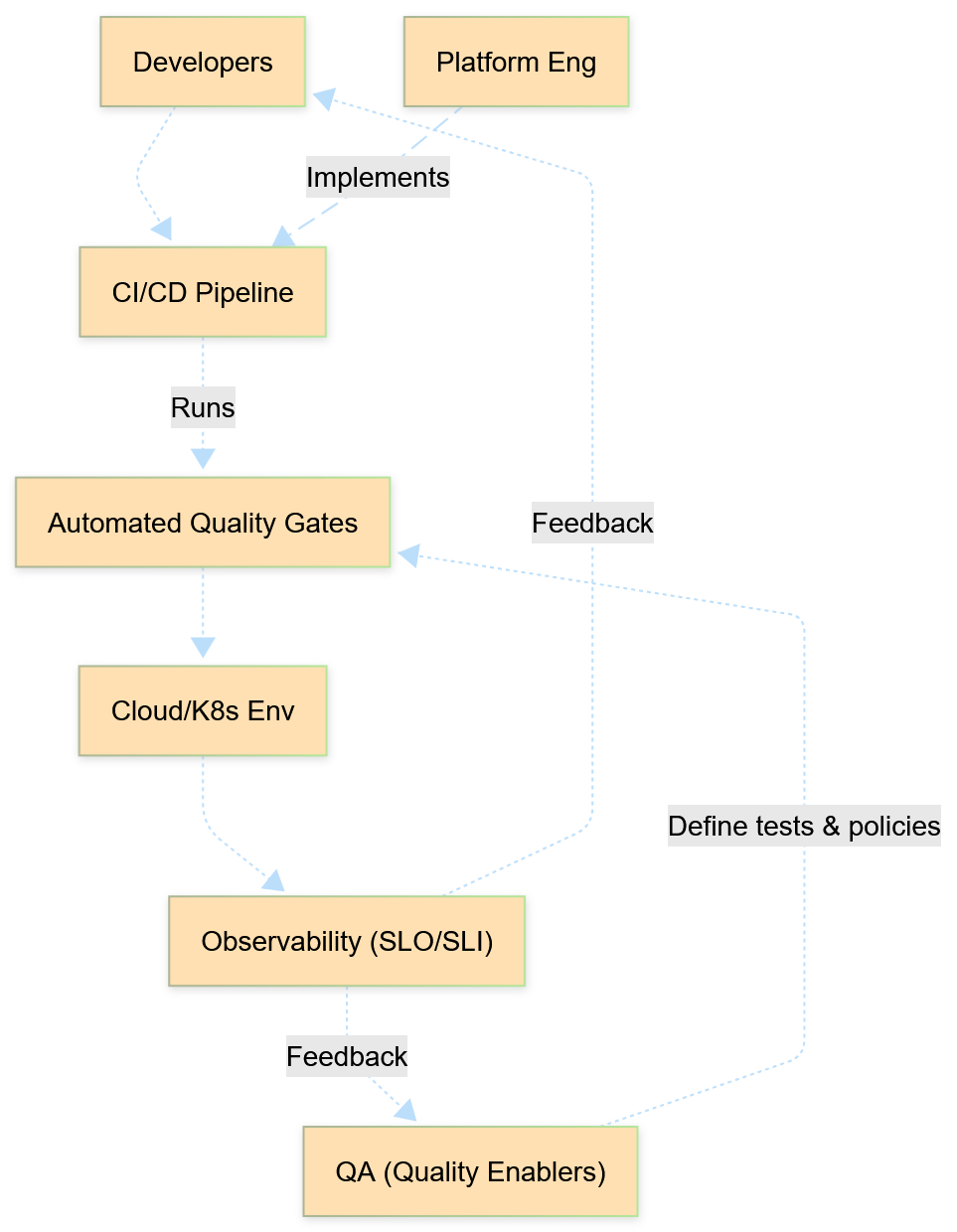
This proactive integration of unit, integration, and end-to-end tests into the pipeline helps prevent downstream defects, significantly reducing bug-fixing costs and accelerating release cycles. As a result, QA shifts from being a reactive gatekeeper to a proactive enabler, promoting a culture of shared quality responsibility.
2. The Bad News: Traditional QA Roles Are at Risk
The rapid pace of modern engineering environments, characterized by cloud-native applications and continuous delivery, makes manual-testing-heavy or siloed QA roles increasingly vulnerable.
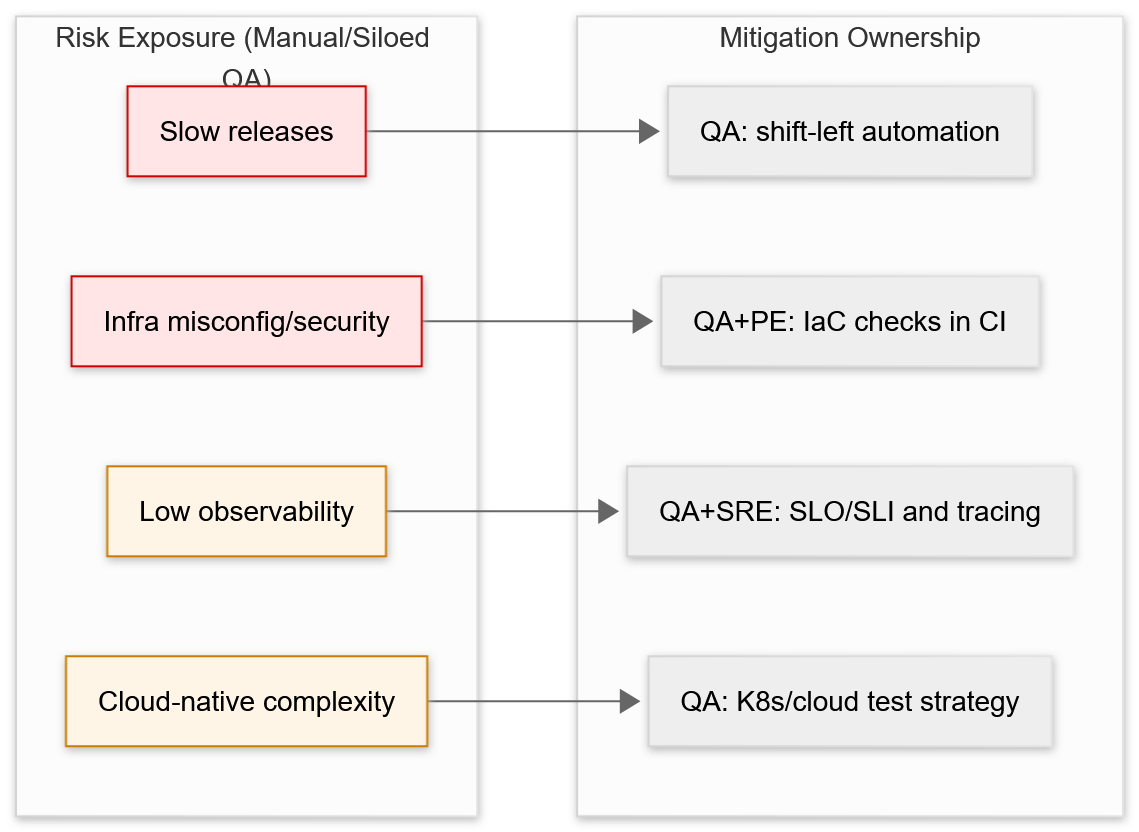
The agility required means that slow, manual processes are becoming outdated. Additionally, the complexity of cloud infrastructure and microservices demands a deeper technical understanding from QA. Companies now expect QA professionals to expand their expertise into infrastructure testing, including verifying Infrastructure as Code (IaC) scripts for misconfigurations and security issues. A QA team lacking these skills risks being marginalized.
3. The Opportunity: QA as Quality Advocates
This shift provides QA professionals with a unique opportunity to transform their role from “test executors” to “quality enablers” and “quality advocates.” This includes coaching developers on building testable, reliable, and observable systems, as well as promoting test automation frameworks and test-driven development (TDD).
QA can also play a vital role in establishing and monitoring SLOs and SLIs alongside SRE and development teams. Using observability tools (e.g., Prometheus, Grafana), QA can link test failures to system behavior, delivering actionable insights to enhance reliability. Additionally, QA can spearhead shift-left security testing (DevSecOps) by integrating security into the design phase. This expanded role positions QA as a strategic partner in delivering high-quality, resilient software.
Skills QA Needs to Survive and Thrive
To remain relevant and influential, QA professionals must proactively acquire new technical and soft skills, transforming into strategic quality engineers.
1. Mandatory Upskilling Areas
The technical demands on QA are expanding significantly:
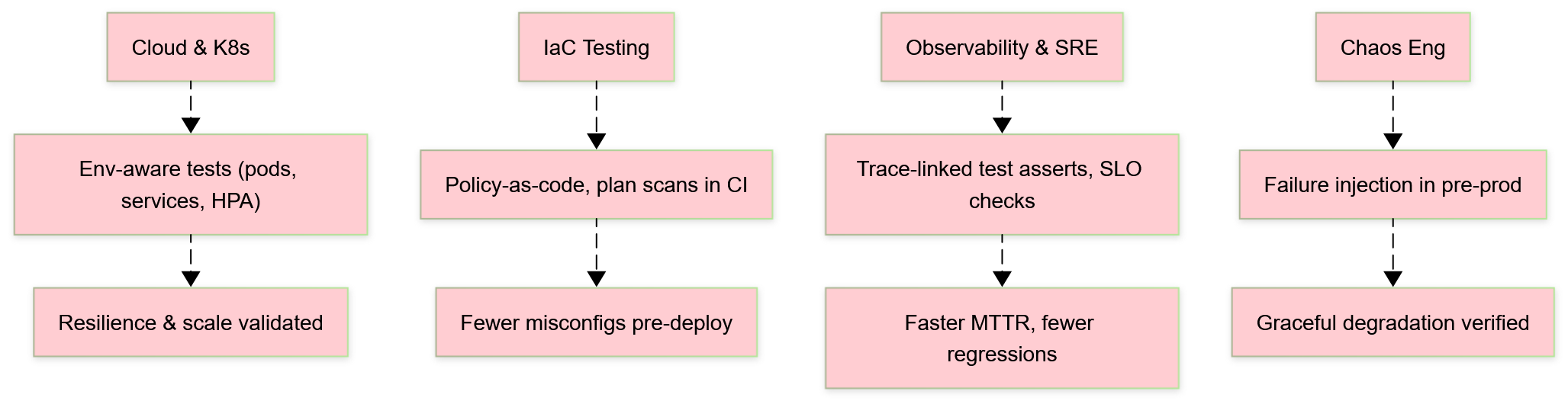
- Cloud & Kubernetes: As applications increasingly run in scalable, ephemeral cloud environments, QA must understand how these environments affect application behavior. This includes testing cloud-native applications, microservices, and serverless functions. Proficiency in containerization and orchestration is essential for effective testing in these complex, distributed systems.
- Infrastructure as Code (IaC) Testing: With infrastructure defined as code (e.g., Terraform, Ansible), QA must verify IaC scripts for correctness, security misconfigurations, and compliance. Integrating automated IaC checks into CI/CD pipelines is crucial to identifying infrastructure-related issues early.
- Observability & SRE Basics: Beyond traditional monitoring, observability emphasizes understanding internal system states through logs, metrics, and traces. QA professionals must be proficient with tools such as Prometheus, Grafana, and OpenTelemetry to correlate test failures with system health and diagnose issues in distributed systems. Grasping SRE concepts, such as SLOs and SLIs, allows QA to help define and ensure reliability targets.
- Chaos Engineering: This discipline intentionally injects failures to test system resilience. QA can leverage chaos engineering to proactively test application behavior under adverse conditions, such as network latency or resource exhaustion, validating graceful recovery and service-level maintenance.
2. Soft Skills & Collaboration
Beyond technical skills, modern QA professionals must excel in collaboration and advocacy:
- Work Closely with platform/SRE teams: Participating in their meetings and understanding their roadmaps promotes shared understanding and allows QA to influence pipeline design and reliability strategies, ensuring quality considerations are incorporated from the beginning.
- Advocate for shift-left security testing (DevSecOps): QA is uniquely positioned to incorporate security testing earlier in the development process. This includes integrating static and dynamic application security testing (SAST, DAST) and software composition analysis (SCA) into CI/CD pipelines, encouraging security best practices among development teams, and building more secure applications from the ground up.
These skills enable QA to move from reactive testing to proactive quality engineering and advocacy, which is crucial for success in the post-DevOps era.
Case Study / Real-World Example
Real-world applications highlight the need for QA evolution. For example, a large e-commerce company, despite having separate DevOps and QA teams, experienced ongoing deployment failures. By integrating key QA staff into their platform engineering team, they implemented automated quality checks for infrastructure provisioning and code quality directly into CI/CD pipelines. This strategic approach resulted in a 40% decrease in deployment failures within six months.
Similarly, another technology company, troubled by serious misconfigurations in cloud setups, empowered its QA team to lead Infrastructure as Code (IaC) validation. By using automated IaC scanning tools and custom policy enforcement within CI/CD pipelines, the QA team identified over 90% of critical misconfigurations before deployment. This proactive method prevented numerous security breaches and service disruptions, emphasizing QA’s vital role in maintaining infrastructure integrity.
These cases demonstrate how QA, by broadening its scope to encompass the entire software delivery ecosystem — from code to infrastructure — can significantly enhance reliability and efficiency, evolving from a traditional testing role into a strategic partner in operational excellence.
How to Start Adapting (Actionable Steps)
For QA teams and individual professionals, adapting to this evolving landscape requires a strategic and phased approach:
- Audit your team’s skills: Perform a thorough assessment of current QA capabilities, identifying gaps in cloud platforms, containerization, IaC tools, observability platforms, and SRE principles. This audit provides a clear basis for targeted upskilling.
- Partner with platform/SRE teams: Actively collaborate with platform engineering and SRE teams on shared goals. Join their meetings, learn their roadmaps, and provide QA expertise to build more reliable, testable platforms. This collaboration promotes shared responsibility for quality.
- Pilot a new practice: Begin small by testing a new practice or technology within a specific project. For example, include Kubernetes failure testing in a microservice’s test suite. This approach offers hands-on experience, controlled learning, and proof of value before expanding.
- Upskill strategically: Based on skill audits and collaboration insights, focus on high-impact areas for upskilling. Provide dedicated training, allocate time for learning, and encourage certifications to build deep expertise in key domains.

By systematically implementing these steps, QA teams can proactively evolve, demonstrate new value, and secure their indispensable role in the future of software delivery.
My Final Thought
The software engineering landscape is rapidly evolving, with the traditional "DevOps Engineer" role transitioning into more specialized areas such as platform engineering and SRE. This shift — driven by the maturation of DevOps principles and the demands of cloud-native environments — requires Quality Assurance professionals to adapt proactively.
Although the global DevOps market is expected to continue growing steadily, reaching $15.06 billion by 2025, the roles within this ecosystem are transforming. QA teams that fail to embrace this change risk becoming bottlenecks. Relying solely on manual testing or ignoring cloud-native architectures, IaC, and SRE practices will render QA irrelevant.
The future demands that QA professionals be more than testers — they must become quality engineers, reliability advocates, and strategic partners in building resilient systems. This is a pivotal moment for QA. The message is clear: proactively develop new skills. Whether mastering Kubernetes testing, understanding IaC validation, or leveraging observability tools, each step strengthens QA’s relevance and value. By shifting from reactive gatekeepers to proactive quality enablers, QA teams can secure their vital role in the post-DevOps era.
Opinions expressed by DZone contributors are their own.
Comments