

AI-Driven Enhancements to Project Risk Management in the PMO
Discover how AI is reshaping risk management with actionable tips and insights into new trends like real-time prediction and automated analysis.
 ·
·
Join the DZone community and get the full member experience.
Join For FreeIntroduction
I began writing this article as a study of how AI can strengthen delivery frameworks. But very quickly I realized: even if I focus solely on its impact on risk management, the topic is still too vast for a single article.
That’s why I've tried to strike a balance – to go deeper than general concepts while keeping the text concise enough to be practical and accessible.
This article is not a step-by-step guide to solving a specific problem. And the reason lies in the topic itself: AI's role in risk management is complex, new, and currently, there are simply no ready-made solutions. But where information is already available, I provide examples of how AI is used in risk management across various organizations – to show that this is not science fiction, but a practical and technically realistic outlook for the near future.
I’m convinced: AI will radically transform delivery frameworks – and this won’t happen sometime in the distant future, but very soon. From a technological standpoint, most things are already possible – what’s missing is investment, not capability.
Mine is not yet a full-fledged methodology, and certainly not a “boxed product.” Many details remain outside the scope of the article. But the model and principles of a framework with deep AI integration described here, in my opinion, are entirely realistic. And they are precisely what can fundamentally change the approach to risk management in IT.
I also don’t believe that AI integration in project management will lead to the disappearance of the project manager profession. On the contrary, it will open up new opportunities and change the role of PMO departments. There will be a need for high-level professionals who can, on the one hand, critically assess AI outputs and recommendations, and on the other, act as “AI advocates” within the team, explaining its logic, conclusions, and reasoning. Strict requirements for both hard and soft skills in project management will remain — and may even grow. Likewise, I believe new professions will emerge, and existing roles will evolve.
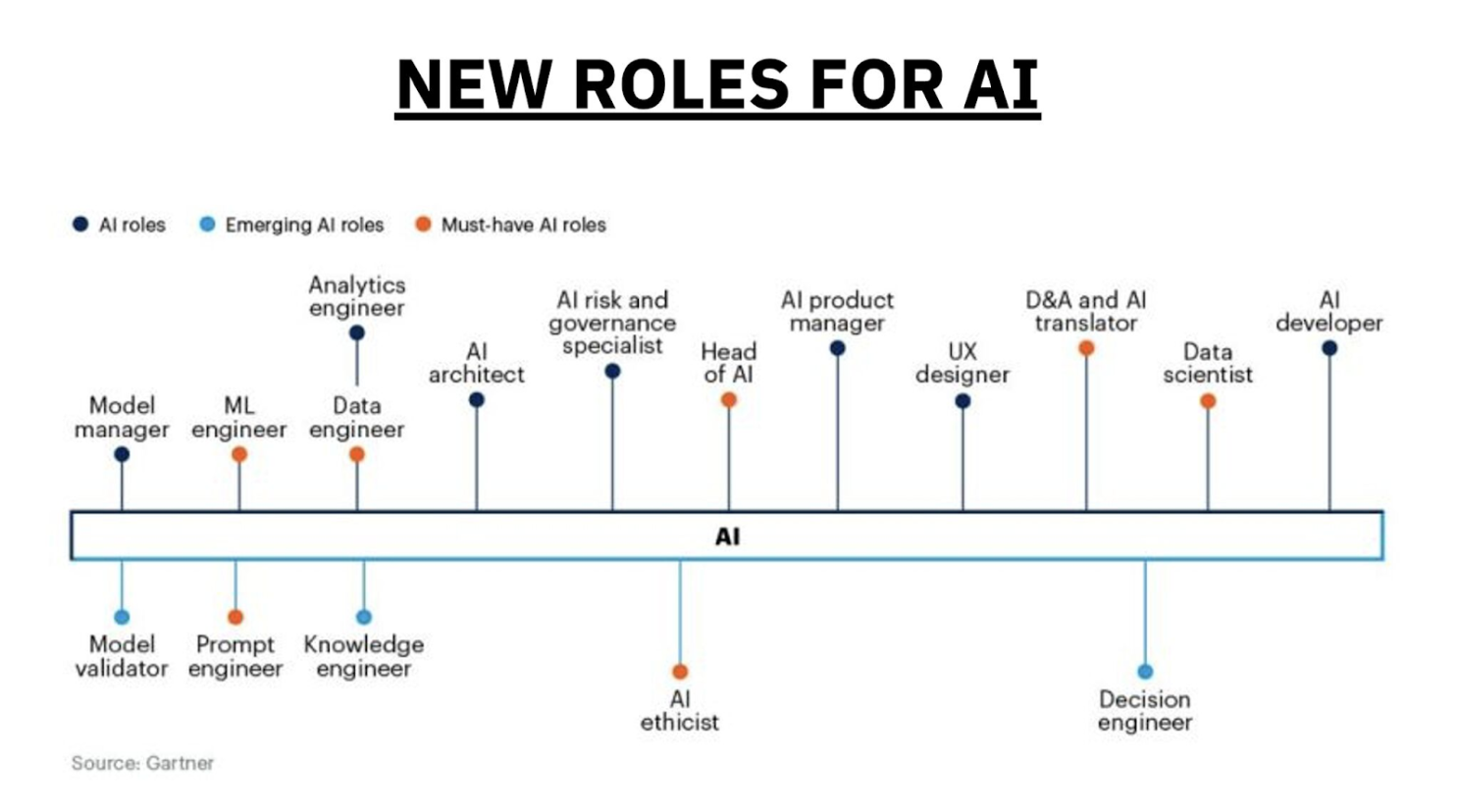
Of course, I’m aware that the topic of using AI in delivery and risk management raises many important questions — ethical, technical, and organizational. All of them, in their own way, affect how practical it is to implement such systems. But in this article, I’ve deliberately chosen a different perspective: to look a bit ahead — into a future where these problems have, one way or another, already been solved or at least partially addressed. And to imagine how, under such conditions, AI would work side by side with the PMO, what new opportunities it would unlock, and how the very nature of risk management in IT projects might change.
I’m also not claiming to have a final answer to the question: Should every company start building its own AI-integrated delivery management system today? For many small and medium-sized businesses, it’s still too expensive. And here lies a paradox: to get the most out of automation, you need mature processes — but to scale those processes, you need automation. So where do you start?
Most likely, the evolution will follow a familiar path:
- First, the major players will invest in their own internal frameworks.
- Then, other companies will begin learning from their experience.
- And after that, platforms like Atlassian, Monday.com, Notion, and others will start bringing these capabilities to the market as integrated delivery systems available by subscription.
It’s exactly this kind of progression — from local innovation to mass adoption — that gives rise to the most viable technologies.
This is the future that’s already approaching. And while this article doesn’t cover every aspect of the transition, I hope it clearly conveys one thing: AI in delivery is not an abstract idea. It’s a road that’s already been paved — and the journey has begun.
So let’s set aside the question of whether your organization should invest in AI-delivery integration right now — because there’s no single right answer.
Let’s imagine the decision has already been made. What exactly could AI do for your delivery process? And what might that look like in practice?
Challenges of Traditional Risk Management
Dynamics of the Environment and the Role of PMO
Project Management Offices (PMOs) today face the challenge of ensuring timely, on-budget project execution amid increasing uncertainty, complexity, and rapidly changing requirements. In these conditions, traditional risk management approaches — often based on spreadsheets, meetings, checklists, and human intuition — are increasingly demonstrating their limitations.
The Impact of Risk Management on Project Success: Research Data
Research and reviews in project management emphasize that ineffective risk management remains a key reason for project failure.
- PMI Pulse of the Profession 2025 highlights that companies which systematically implement risk management achieve higher project success rates and encounter fewer delays and cost overruns. (See pages 10, 15, 21, 27)
- According to a ResearchGate study, poor risk management is among the main causes of project failure across various industries. Poor Risk Management as One of the Major Reasons Causing Failure of Project Management
- Stafiz draws similar conclusions: ineffective risk management directly impacts project timelines and results. Main Causes of Project Failure
At the same time, modern academic and professional literature (for example, PMI “Risk Management Does (not) Contribute to Project Success”) cautions against overreliance on formal procedures:
- The mere existence of a risk management process or a risk register does not guarantee results. Formalism, lack of flexibility, low team involvement, or ignoring the context can render the process ineffective.
- Effectiveness is achieved only through a truly integrated approach with continuous work on data, analytics, and team engagement.
Key Problems of Traditional Risk Management
- Manual risk identification: Often based on brainstorming, checklists, and the experience of key people. This leads to missing less obvious or novel threats. (See: PMI, Risk Management)
- Static risk registers: Maintaining lists in spreadsheets makes it impossible to react quickly to changing project conditions. The register quickly becomes outdated if it is not maintained dynamically.
- Cognitive biases: The assessment of probability and impact is based on intuition, personal biases, and experience. This creates “blind spots” that remain unaddressed. (See: Visure Solutions)
- Limited data analysis: Most PMOs cannot process large volumes of structured and unstructured data in real time without modern tools. (See: Celoxis)
- Lack of integration with other processes: Traditional risk management is often viewed as an isolated function, even though risks affect all aspects of project execution.
- Insufficient adaptability to rapid changes: Registers and analyses are updated too rarely, and response to risks is often reactive rather than proactive.
Typical Consequences of These Limitations
- Missing early warning signals, leading to crises that could have been prevented at an early stage
- Reactive “firefighting” instead of purposeful prevention
- Deadline overruns, budget overspending, and reduced quality of outcomes
- Loss of trust from clients, top management, and stakeholders
Effective risk management must not be just a formal procedure, but rather an integrated, dynamic system that combines data work, modern technologies, flexible team collaboration, and ongoing monitoring. Only such an approach enables PMOs to truly impact project success and minimize losses from uncertainty.
In today's environment of cloud platforms, distributed teams, and rapid change dynamics, this ability becomes a critical competitive advantage for PMOs. After analyzing the limitations of traditional risk management, we can move on to how and why AI can influence risk management — and transform this aspect of project management for the better.
Implementing AI as a Driver of Change in Risk Management
The use of artificial intelligence (AI) in project risk management opens new opportunities for more effective and precise risk identification, assessment, and monitoring. Leading companies are already demonstrating real-world results from implementing AI-based solutions.
Case Studies
DHL's Intelligent Project Prediction (IPP)
DHL Supply Chain has developed the Intelligent Project Prediction (IPP) platform, based on machine learning and analysis of more than 10 years of project management data. IPP automatically collects and analyzes project KPIs, identifies risks, and provides recommendations to minimize them. In 2023, DHL’s solution was recognized as the winner in the Association for Project Management (APM)'s "Technology Project of the Year." Among the reported outcomes: a significant reduction in deadline failures and improved accuracy in forecasting potential issues.
Siemens
Siemens is implementing AI to analyze large volumes of manufacturing and project data to uncover hidden risks. In its 2024 report, the company cited more than 300 AI use cases in manufacturing, some of which are specifically aimed at optimizing and predicting project risks. This has improved the precision of failure probability assessments and enhanced response speed.
Innominds (Construction)
Innominds developed a solution for the construction industry that uses AI to detect and monitor risks in real time. In one case, a European client achieved a 60% increase in tool utilization and reduced routine operations by 90 hours per month thanks to automated reminders and risk alerts.
Using AI in Risk Management Enables:
- Machine learning models to analyze historical and current data, identifying hidden risk triggers that are often missed through traditional analysis.
- NLP tools (natural language processing) to scan emails, task-tracking systems, chats, and reports to detect shifts in tone, potential conflicts, and early warning signs.
- Predictive analytics to assess the likelihood and impact of risks with greater precision than manual expert evaluations.
- Automated monitoring to replace static reports with dynamic dashboards and real-time alerts, enabling PMOs to respond quickly and in a well-grounded manner.
Thanks to these capabilities, organizations are moving from a reactive to a proactive approach — where risks are not only recorded but also forecasted and controlled before they become critical. The experience of DHL, Siemens, and Innominds demonstrates that AI can fundamentally change the logic of the entire risk management cycle.
Now let's look at how modern AI tools are transforming the essential first step — risk identification.
AI-Supported Risk Identification
Timely and accurate risk identification is a key factor in ensuring project stability. However, traditional approaches often fail to detect hidden patterns and early warning signs — especially in large-scale or distributed teams. Artificial intelligence enables automation of this stage, increasing the likelihood of detecting “unknown unknowns.”
Key Capabilities Enabled by AI
- Continuous Data Scanning: AI tools analyze both structured sources (e.g., reports, backlogs, defect logs) and unstructured inputs (e.g., emails, chats, notes). Example: Microsoft Copilot automatically identifies risks and suggests mitigation actions based on project metadata.
- Real-Time Anomaly Detection: Machine learning algorithms detect sudden deviations — such as spikes in defects or unexpected budget shifts — faster than a human team typically would.
- Sentiment Analysis with NLP: Natural Language Processing (NLP) tools monitor communication channels (chats, emails, meetings) for signs of stress, frustration, or elevated risk. Example: Planview detects shifts in emotional tone or an uptick in anxiety-related language before formal reports reflect any issues.
- Learning from Historical Data: AI models analyze project archives to uncover patterns of risk factor combinations. Example: Microsoft Copilot generates risk estimates and response strategies based on similarities to past project issues.
- Detection of “Good News Culture”: Using NLP, AI scans informal communication and flags inconsistencies between "green" project statuses and the frequent use of terms like “risk,” “delay,” or “overdue” in chats — notifying the PMO when discrepancies are detected.
As a result, AI-powered data scanning and analysis enable the detection of non-obvious risks, which helps reduce response time and make risk management genuinely proactive. With built-in early-warning tools like these in place, the next critical challenge is assessing the severity of each identified risk.
In the next section, we’ll explore how AI enables dynamic evaluation of risk probability and impact.
AI-Based Risk Assessment: Dynamic Scoring
In traditional risk management, probability and impact assessments are often fixed in static tables — and may become outdated before the next scheduled review. Artificial intelligence transforms this process into a dynamic one, continuously updating risk evaluations based on new data and changes in the project context.
Key Capabilities and Examples
- 1. Dynamic Probability and Impact Assessment: Machine learning models analyze historical data, real-time KPIs, project communications, and even external signals. Benefit: Risk ratings are continuously updated to reflect the evolving project context. Tool Example:Microsoft Copilot
- 2. Automated Scenario Analysis: AI runs thousands of simulations (e.g., Monte Carlo), modeling various combinations of risk factors to evaluate potential outcomes. Benefit: Provides deep insight into uncertainty and helps prepare response strategies. Tool Examples:Deltek Acumen Risk, Oracle Primavera Cloud
- 3. Real-Time Heatmap Updates: Interactive dashboards dynamically reflect changes in the risk matrix. Benefit: As new data is received, the system automatically repositions risks for instant visual interpretation. Tool: Often custom-built or integrated within enterprise PPM platforms
- 4. Portfolio-Level Prioritization: AI enables numerical scoring and comparison of risks across multiple projects. Benefit: Helps focus attention and resources on the most impactful risks at the portfolio level, not just individual projects. Tool: Typically part of advanced BI, analytics, or strategic PMO tools
- 5. Reduction of Cognitive Bias: AI identifies risks that humans might overlook or underestimate due to intuition-based judgment. Benefit: Especially valuable in high-stakes domains like finance, where AI helps reveal hidden vulnerabilities. Example:Insight Global: AI in Financial Risk Management
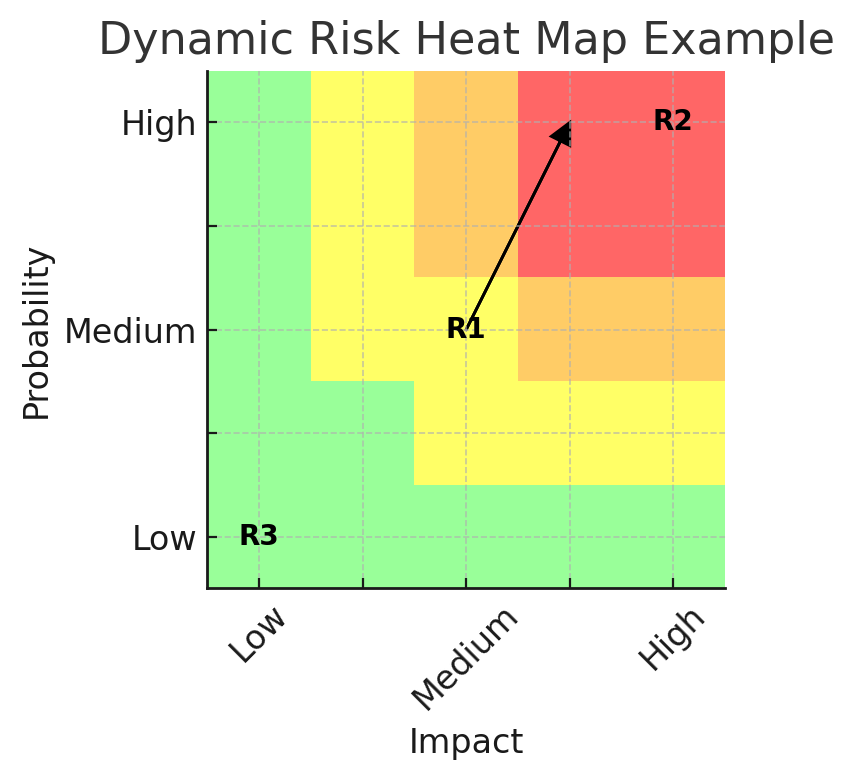
In this matrix, each cell represents the risk's criticality level using the following colors: green — Low, yellow — Medium, orange — High, and red — Very High, based on probability (shown on the Y axis) and impact (shown on the X axis). Artificial intelligence enables real-time updates to each risk’s position on the matrix. For example, Risk R1 was initially located in the yellow zone (medium risk), but after AI-driven recalculation — due to increased probability and impact ratings — it shifted into the red zone, indicating a high risk. These predictive heatmaps allow the PMO to instantly visualize the current risk profile across a project or portfolio — rather than relying on outdated static matrices.
What This Might Look Like in Practice
Initially, a risk was assessed as Medium — with a 30% probability × $100K impact = $30K risk exposure. After new data comes in — supply delays, a spike in defects, and a negative tone in team communications — AI updates the assessment to 50% × $120K = $60K, automatically reclassifying the risk as High before the team even has time to meet.
Dynamic risk assessment provides the PMO not only with real-time data for decision-making, but also with the flexibility to respond to real-world changes — reducing the likelihood of “unexpected” crises.
Now that we’ve expanded our approach to quantitative risk evaluation, the next section explores how AI can accelerate and strengthen response strategies.
Optimizing Risk Mitigation and Response with AI Support
Once risks have been identified and assessed, AI's true value lies in the speed and quality of response facilitates. Modern AI tools strengthen this phase by leveraging historical project data, automating response triggers, and optimizing resource allocation.
Key AI Capabilities and Use Cases
1. Intelligent Recommendation Systems: AI analyzes historical project data to suggest tailored mitigation actions. These may include switching vendors, revising contracts, or adjusting team composition. Benefit: AI can also simulate “what-if” scenarios — for example, modeling how risks shift when changing the team size, tools, or delivery partners.
Tool Example: Microsoft Copilot generates actionable mitigation plans based on past patterns and recommends the most effective strategies.
2. Automated Response Triggers: AI continuously monitors live project metrics like task velocity, remaining budget, defect rates, and supplier status. Benefit: Upon detecting deviations or early signs of risk, the system can automatically initiate predefined contingency actions — such as rescheduling, task reassignment, or resource reallocation.
Tool Examples: Smartsheet AI Agents, Oracle Primavera Cloud
3. Resource & Dependency Optimization: AI detects workload imbalances and bottlenecks across parallel projects. Benefit: It suggests optimizations like shifting personnel, delegating tasks, or altering schedules. In supply chain-related risks, AI may recommend alternate vendors or logistics routes.
Tool Example: Epicflow provides AI-powered workload balancing and simulations to resolve resource conflicts or delivery disruptions.
The Human Role Remains Central
Despite the power of modern AI systems to analyze massive datasets and propose actionable strategies, final decision-making remains with humans — the Project Manager or PMO. AI acts as a “risk advisor”, providing data, suggestions, best practices, and statistical insights — such as: “We recommend hedging currency risk — this strategy proved effective in 90% of similar project profiles.”
Ultimately, the PMO retains full responsibility for choosing and implementing the right strategy — considering context, company culture, and team-specific dynamics.
Thanks to AI-driven support, the response process becomes not only faster — but shifts from reactive “firefighting” to proactive prevention. This significantly increases the likelihood of timely, high-quality project execution and gives the PMO real tools to influence project outcomes.
Next, we’ll explore how AI enables real-time risk monitoring and early warnings throughout the project lifecycle.
Continuous Risk Monitoring and Early Warning
Modern artificial intelligence systems enable 24/7, continuous risk management — giving PMOs the ability to detect threats and respond before issues escalate into crises. This stands in contrast to traditional approaches, where control is periodic and often delayed.
-
24/7 Indicator Tracking: AI processes data from a variety of sources: task execution timelines, budget changes, defect trends, supplier statuses, test metrics — as well as external factors like regulatory updates and news. This allows for early detection of changes in the project’s risk profile — even at night or over weekends.
-
Composite Risk Alerts: The system correlates signals across tools (planners, financial modules, defect tracking systems, internal communications) to surface hidden, combined threats. For example: Slight schedule delay + rising defect counts + team overtime → triggers a warning of potential burnout.
Automated RAID Updates
-
Risks – Priority updates and dashboard refreshes in real time Assumptions – Continuously validated using live data, including external sources Issues – Automatic anomaly detection and logging, with routing to responsible parties Dependencies – Delay forecasts across dependency chains and auto-generated reminders for accountable roles
Example in Practice
During a multi-region software rollout, one PMO team observed how the AI module detected a sudden drop in customer sentiment following an update in a specific market. The system immediately alerted the responsible stakeholder, reducing response time from days to just hours. This early intervention helped avoid a critical service disruption.
DHL Case Study: DHL’s PMO — in partnership with MIGSO-PCUBED and Greyfly.ai — implemented the Intelligent Project Prediction (IPP) system. IPP is capable of forecasting schedule or budget deviations months in advance, issuing early warnings to project leaders. For this approach, DHL received the 2024 APM Project Management Award. Source: APM
Thanks to continuous AI-driven monitoring, the traditional static risk matrix is transformed into a real-time decision-making dashboard — empowering PMOs to act with greater speed and foresight.
AI and the Risk Matrix: From Static Tool to Dynamic Management
Traditional risk matrices are static tools that offer only a momentary snapshot of the situation — typically updated manually during periodic meetings. In fast-moving projects, these matrices quickly become outdated.
Artificial intelligence radically redefines this approach, turning the matrix into a living, interactive dashboard that reflects risks in real time.
- Real-Time Updates: Risk data is continuously refreshed as project conditions evolve. Benefit: The position of each risk dynamically shifts on the matrix — for example, moving from “yellow” to “red” — without manual input.
- Multidimensional Scoring: Beyond the traditional “probability × impact” model, AI incorporates additional dimensions such as risk velocity, detectability, and confidence level. Benefit: These factors can be visually represented — e.g., bubble size, color intensity, or animation — for richer interpretation.
- Predictive Scenarios: AI analyzes trends and historical patterns to generate forward-looking risk maps. Benefit: Helps anticipate where new risk clusters are likely to emerge and prepares teams for high-impact disruptions.
- Interactive Drill-Down: Clicking on a specific risk opens a detailed view: current score, recent changes, root causes, key triggers, and recommended mitigation steps. Benefit: Provides instant context and actionable insights, making the risk matrix not just a dashboard, but a real decision-making tool.
Real-World Example
Zepth Platform: This system uses AI to automatically score risks and display them on the PMO dashboard in real time — allowing managers to immediately explore details and trigger mitigation actions. Source: Zepth Risk Management
Benefits of an AI-Powered Dynamic Risk Matrix:
- More accurate prioritization — risks are evaluated based on live data, not outdated assumptions
- Faster, more informed risk communication — leadership gets clear, visual, and timely insights
- Increased trust in the risk management process — decisions are based on real-time evidence
And finally, these AI-driven capabilities extend to full project documentation management via the RAID log — automating updates and early warnings across all four dimensions: Risks, Assumptions, Issues, and Dependencies.
AI in RAID Management: Automated Updates and Early Warnings
RAID logs (Risks, Assumptions, Issues, Dependencies) offer PMOs a comprehensive view of project health. However, manual RAID updates are time-consuming and error-prone.
AI reduces this burden by automatically creating and maintaining entries — allowing teams to spend less time on administrative work and more on strategic decision-making.
AI Capabilities in RAID Management
- Risks: AI transforms risk management from static logs to dynamic, self-updating intelligence. Benefits: – Reprioritizes risks in real time as probability or impact changes – Allows one-click risk generation from charters, reports, or meeting notes – Ranks recurring risks using pattern recognition across past projects
- Assumptions: AI validates assumptions against real-world signals and alerts teams when they weaken. Benefits: – Continuously monitors supplier performance, market shifts, and team velocity – Escalates fragile or violated assumptions into active risks or issues automatically
- Issues: AI proactively surfaces problems — even before they’re formally reported. Benefits: – Detects anomalies in project metrics and stakeholder feedback – Auto-categorizes new issues, links relevant documentation, and estimates severity based on historical data
- Dependencies: AI helps teams stay ahead of hidden constraints and cross-team impacts. Benefits: – Predicts delays from upstream blockers and models downstream consequences – Sends proactive suggestions: reorder task sequences, switch vendors, or adjust milestones
Example
Every morning, the PMO lead receives an AI-generated summary:
“Overnight, 3 new risks were detected, 2 assumptions are flagged as unstable, and 1 dependency shows signs of delay. Below is the full context and recommended next steps.”
From Archive to Real-Time Nerve Center
With AI integration, the RAID log transforms from a static historical document into a living, real-time risk and dependency management system. Clear alerts, visual indicators, and automated summaries allow the PMO to:
- React faster
- See the full picture
- Focus on decision-making, not data entry
The result? A significant boost in delivery process efficiency.
Next, let’s explore the risks and limitations of applying AI in project risk management.
Limitations and Risks of Using AI in Risk Management
While AI significantly strengthens risk management processes, its implementation brings a range of challenges that must be addressed to ensure both reliability and effectiveness.
Data Quality and Model Bias
AI is only as good as the data it's trained on. Historical risk logs are often incomplete or biased toward “typical” scenarios. This can cause models to repeat past mistakes or ignore rare but high-impact events. For example, if past supplier delays were never logged, the model will miss that risk. If only successful cases are recorded, it will underestimate the likelihood of failure.
To mitigate this:
- Implement strong data governance standards
- Regularly update and audit datasets
- Test for bias using tools like IBM's AI Fairness 360
The Need for Human Oversight
AI should be treated as a co-pilot, not an autopilot. Strategic decisions must remain in human hands — whether PMO leads, project managers, or stakeholders. It’s critical to review AI recommendations, especially when informal agreements, strategic pivots, or client-specific nuances are involved.
Best practices include:
- Using interpretable models (e.g., SHAP, LIME)
- Maintaining a clear audit trail of changes
- Defining strict boundaries for automation
These practices help avoid the pitfalls of "black box" decisions, preserve trust, and maintain the balance between automation and expert judgment.
AI as an Amplifier, Not a Replacement
Despite its clear advantages, AI is not a “magic bullet” for risk management. Successful integration requires thoughtful process alignment and active team involvement.
Next, we’ll explore practical recommendations for integrating AI tools into your risk management workflow to generate real business value for both the PMO and the organization.
Key Considerations for Implementing AI Tools in Risk Management
To fully leverage the benefits of integrating AI into risk management, organizations must go beyond technology — they must also address culture, data readiness, and process maturity. The following phased approach outlines essential steps:
- Data Readiness: Before any AI insights can be trusted, your data must be clean, complete, and connected. Actions: – Conduct a data inventory (e.g., Jira, financial systems, logs, dashboards, chat history) – Clean and normalize: remove duplicates, standardize formats, fill missing fields – Set up governance: assign data stewards, define validation rules, and schedule regular quality checks
- Integration Architecture: Bringing AI into your workflow shouldn’t mean switching tools — it should amplify what you already use. Actions: – Build automated ETL pipelines from PM systems via jobs, APIs, or webhooks – Embed AI outputs directly into dashboards and tools like Power BI, Looker, Confluence, or Jira
- Model Validation & Management: The right model is only half the story — teams also need to trust and understand it. Actions: – Match models to task complexity (start simple, then use XGBoost or ensembles for deeper layers) – Ensure transparency: apply explainable AI techniques (e.g., SHAP, LIME), maintain benchmarking and changelogs
- Change Management & Training: No AI rollout succeeds without people. Upskilling and trust-building are critical. Actions: – Host enablement workshops for the PMO and delivery teams – Appoint AI champions to lead adoption and feedback loops – Keep internal communication clear: leverage wikis, emails, and team meetings
- Piloting & Scaling: Prove value before scaling wide. Iterate fast, measure clearly. Actions: – Start with a data-rich project that has internal sponsorship – Define success metrics (e.g., +30% increase in early risk identification, –50% manual reporting time) – Collect feedback, improve usability, retrain models – Gradually expand across the portfolio, monitoring adoption and impact
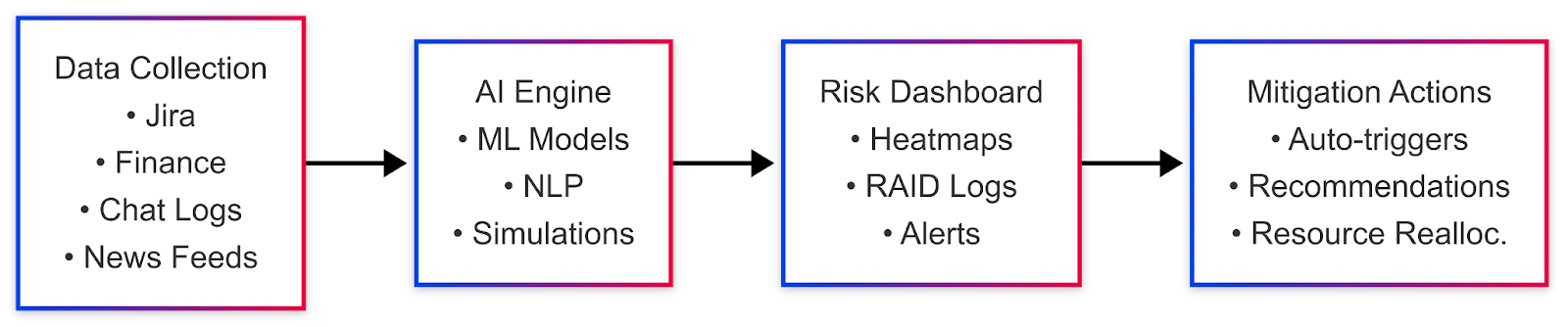
A properly structured AI implementation not only minimizes technical and organizational risks, but also lays the foundation for measurable business outcomes.
Next, we’ll focus on how to evaluate the real impact of AI in risk management processes — and what tangible benefits it brings to the PMO and the organization as a whole.
Real Impact and Summary of Benefits
The integration of artificial intelligence into project risk management is no longer a theory—it’s a practice delivering measurable business value.
How AI Improves Risk Management
- Risk Identification:Challenge: Human-led brainstorming often misses early or hidden risks — especially technical or emerging ones. AI Contribution: Continuous scanning of project metrics, documentation, and team communications using NLP and ML reduces blind spots and cognitive bias. Example: An ML tool flagged 30% more initial risks than the manual process — including a critical technical risk that surfaced two weeks before human escalation.
- Risk Assessment:Challenge: Probability and impact scores are often subjective and rarely updated until formal review sessions. AI Contribution: Models dynamically assess risks using live and historical data, simulate scenarios, and adjust scoring in real time. Example: While the team estimated a 30% chance of delay, AI predicted 60%. This insight helped a construction company reprioritize tasks, cutting operational risk by 40%.
- Mitigation & Response:Challenge: Teams respond reactively, often relying on templated mitigation actions or manual approvals. AI Contribution: Predictive recommendations suggest effective responses early, while automatic triggers handle risk threshold breaches. Example: AI flagged a supplier risk and proposed 3 alternatives — one of which was onboarded within hours. In another case, rising defect rates led AI to shift 10% of QA resources, cutting bug counts in the next release.
- Risk Monitoring:Challenge: Periodic reviews and siloed systems delay detection of evolving risks. AI Contribution: AI ensures 24/7 visibility through anomaly detection, cross-system data fusion, and real-time dashboards. Example: DHL’s PMO forecasted budget risks long before they became critical. In another case, AI flagged a morale drop that was later linked to productivity dips — enabling proactive team support.
Business Impact
Benefits of AI in Risk Management:
- More risks are identified—and earlier in the project
- More accurate assessments → smarter prioritization
- Faster and more effective responses
- Constant monitoring → fewer “surprises”
What this means for the business:
- Fewer crisis events
- More efficient use of contingency reserves
- Stronger stakeholder trust
Examples:
- A global logistics company improved on-time delivery by 15% after implementing an AI risk framework—risks of delays were caught and mitigated in advance.
- Another company saved dozens of hours per month by automating manual reporting, freeing PMs for more strategic work.
AI Doesn’t Replace People—It Amplifies Them
AI is not here to replace project managers — it's here to partner with them. It processes vast amounts of data, models complex scenarios, and provides insights. But it’s the human who makes the final decision, applies contextual judgment, and communicates with stakeholders.
Organizations that strike the right balance between AI capabilities and human expertise are achieving breakthrough improvements in risk management efficiency.
AI Tools Landscape for Risk Management
Today, the market offers dozens of solutions for automating project risk management — from built-in modules in task management systems to specialized platforms and custom-built solutions. Below is a comparative overview of the most relevant options, focusing on real capabilities.
- Planview: Capabilities: AI-enhanced portfolio management, dynamic dashboards, team communication analysis, issue forecasting Target Users: Corporate PMOs managing large project portfolios Deployment: SaaS
- Zepth: Capabilities: AI-powered RAID automation, risk analysis, integration with construction workflows, instant reporting Target Users: Construction firms, development teams, multi-contractor projects Deployment: Cloud / SaaS
- RAIDLOG.com: Capabilities: Online RAID logs, auto-risk scoring, report generation, audit-ready tracking Target Users: Fast-start teams, small to mid-size PMO setups Deployment: Web-based
- 4. Custom ML Pipelines (McKinsey QuantumBlack): Capabilities: Tailored ML models, integration with enterprise data lakes, advanced risk modeling Target Users: Large organizations with unique risk profiles and high data complexity Deployment: On-prem / Cloud
- 5. Jira Intelligence: Capabilities: AI-based task and blocker analysis, project summaries, recommendations, auto-tagging Target Users: Atlassian-based IT and product teams Deployment: SaaS (Jira Cloud)
- 6. PlanRadar: Capabilities: AI-driven analysis of documents, images, and blueprints; task automation; CRM and defect tracking Target Users: Developers, site managers, and field engineers in construction Deployment: SaaS
- 7. MS Project for Web + Copilot: Capabilities: Automated risk scoring, predictive insights, scenario planning, Teams integration Target Users: Microsoft 365 enterprise environments Deployment: SaaS
- 8. Greyfly.ai: Capabilities: Risk analytics, PMO-level decision support, early deviation detection Target Users: Enterprise PMOs and delivery organizations Deployment: SaaS
Key Terms and Definitions
Risk Velocity: The speed at which a risk materializes after its trigger is activated — whether in days, weeks, or months. Why it matters: Helps prioritize rapidly developing threats that require immediate action.
Detection Difficulty: Refers to how hard it is to detect a risk with existing tools, data, or processes. AI relevance: Affects how the system weights early warning signs and adjusts sensitivity.
Explainable AI (XAI): A set of techniques (like SHAP, LIME) that help explain how AI models make decisions. Why it matters: Ensures transparency — teams can understand which factors influenced a risk prediction.
RAID: A foundational project log covering Risks, Assumptions, Issues, and Dependencies. AI relevance: Many modern tools now enhance RAID logs with automation, dynamic scoring, and predictive insights.
Monte Carlo Simulation: A statistical approach that runs thousands of scenario iterations to assess risk distribution and potential outcomes. Why it matters: Delivers a probabilistic view of risk exposure and supports robust planning.
Dynamic Heatmap: An interactive, real-time version of the classic risk matrix. Key feature: Each risk updates its position based on evolving inputs — offering a live view of the risk landscape.Once these key concepts are understood, it becomes much easier to grasp how modern trends are shaping the evolution of risk management.
Future Trends and Vision
Explainable AI (XAI) is becoming the standard: Interactive dashboards now display not only risk ratings but also explanatory insights—thanks to model transparency techniques like SHAP and LIME.
Generative AI for automated reporting: Models such as GPT-4/5 generate executive summaries, heatmap explanations, and stakeholder-ready notes automatically.
Edge AI for distributed teams: Local AI agents monitor risks even when cloud access is interrupted—particularly valuable for large-scale or regionally dispersed projects.
AI for compliance control: Projects are automatically checked for alignment with ISO 31000, GDPR, and other standards. Any deviations are flagged and prepared for audit instantly.
Collaborative AI assistants: Integrated with Slack or Teams, AI copilots allow PMs to quickly retrieve data (e.g., “Show me the top 5 risks this week”).
Portfolio-level analytics: AI tools sync data across programs, uncover cross-project dependencies, bottlenecks, and even new opportunities for growth.
Thanks to these trends, AI in the PMO is already laying the foundation for the next level of risk management effectiveness.
Conclusion: How AI Transforms Risk Management into a Competitive Advantage
Traditional risk registers and "gut feelings" can no longer keep pace with the scale and dynamics of modern projects. AI adds flexibility and analytical power at every stage—from identification to response—enabling PMOs to move from reactive firefighting to proactive leadership in risk management.
Key business benefits of AI integration:
- More projects delivered on time and within budget thanks to early warnings.
- Fewer surprises as AI detects anomalies before they become critical issues.
- Time savings on manual reporting using automated RAID logs and recommendations to free up dozens of hours each month.
- Stronger alignment with leadership and customer expectations is created through model transparency, audit trails, and clear accountability.
- Added business value emerges by demonstrating technological leadership in the market.
Bottom Line
Investing in AI for risk management is already delivering tangible results. Organizations that blend analytics with human expertise not only reduce losses—they unlock new areas for growth.
AI implementation is not just a tech upgrade; it's a bridge to the future, a strategic leap to a new level of risk management, where data, transparency, and foresight become the foundation for sustainable project portfolio success.
References
- Deloitte Insights – AI Readiness & Management Framework (aiRMF): A maturity model for assessing and managing AI-related risks during implementation. https://www2.deloitte.com/content/dam/Deloitte/us/Documents/public-sector/ai-readiness-and-management-framework.pdf
- PMI – Artificial Intelligence in Project Management: A guide for PMOs and project managers on integrating AI into project environments. https://www.pmi.org/learning/ai-in-project-management
- ISO 31000:2018 – Risk Management Guidelines: The foundational international standard for structured risk management. https://www.iso.org/standard/65694.html
- Planview Blog – How AI is Improving Early Warning Systems in Project Management: Proactive risk detection through anomaly detection and sentiment analysis. https://blog.planview.com/how-ai-is-improving-early-warning-systems-in-project-management/
- McKinsey & Company – The State of AI: Global Survey: A global report on the current state and impact of AI adoption, including project risk use cases. https://www.mckinsey.com/capabilities/quantumblack/our-insights/the-state-of-ai
- PwC – How GenAI Can Enhance Risk Management: Use cases for generative AI in enterprise risk analysis and mitigation. https://www.pwc.com/us/en/industries/financial-services/library/gen-ai-and-risk-management.html
- IEEE Standards Association – Mitigating AI Risk in the Enterprise: Certified approaches for minimizing AI-related risks in regulated and critical domains. https://standards.ieee.org/beyond-standards/mitigating-ai-risk-ieee-certifaied/
- ProjectManager.com – The Ultimate Guide to PMOs: Comprehensive overview of the Project Management Office’s core functions and modern practices. https://www.projectmanager.com/guides/pmo
- Lumivero Blog – The Future of AI in Risk Management: Examines how predictive analytics, machine learning, and XAI are reshaping risk strategies. https://lumivero.com/resources/blog/the-future-of-ai-in-risk-management/
- ResearchGate – AI-Driven Project Risk Management: Research on how AI can be used to predict, mitigate, and manage project risks in high-stakes domains. https://www.researchgate.net/publication/390521301_AI-Driven_Project_Risk_Management_Leveraging_artificial_intelligence_to_predict_mitigate_and_manage_project_risks_in_critical_infrastructure_and_national_security_projects
About the Author
Vitalii Oborskyi is a PMO and delivery manager with over 10 years of experience in IT project management and process improvement. He has led delivery teams and PMO functions for organizations in Europe, focusing on practical frameworks, risk management, and the integration of AI tools into everyday management workflows. Connect with Vitalii on LinkedIn: linkedin.com/in/vitaliioborskyi
Published at DZone with permission of Vitalii Oborskyi. See the original article here.
Opinions expressed by DZone contributors are their own.
Comments