

The AI Gateway Pattern That JPMorgan, Stripe, and Every Smart Fintech Is Quietly Standardizing On
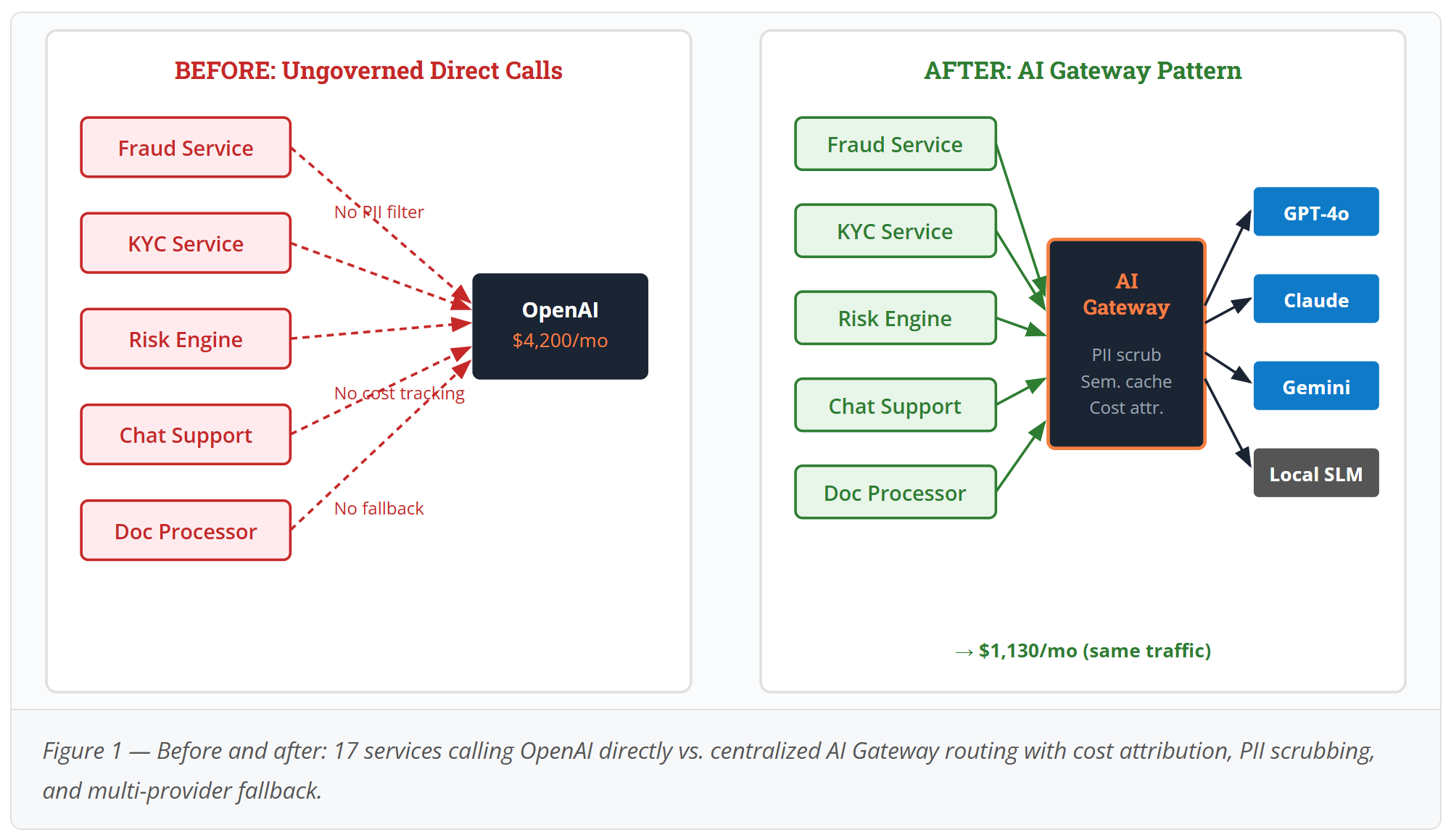
Every microservice calling OpenAI directly is a $4,000/month surprise waiting to happen. The shift nobody's writing about — but everyone at scale is building.
 CORE
·
CORE
·
Join the DZone community and get the full member experience.
Join For FreeBefore getting into the architecture, I want to address the first objection I hear from every platform team: "We already have Kong / NGINX / AWS API Gateway — can't we just plug AI calls through that?"
Short answer: no. Longer answer: it depends on what you mean by "plug in," but also still no.
Traditional API gateways are stateless request routers. They handle auth, rate limiting, and load balancing on the assumption that requests are roughly uniform in cost, latency, and risk. None of those assumptions hold for LLM traffic.
The core problem: A single GPT-4o completion call can cost anywhere from $0.003 to $0.40 depending on context length. It can take 200ms or 45 seconds. It might include PII your compliance team would rather not send to a third-party API. And the "correct" model to route to changes week by week as providers update pricing. Traditional gateways know nothing about any of this.
What you actually need is a gateway with semantic awareness — one that understands what's being asked, not just that a request arrived. That distinction matters enormously in production.
The Four Pillars of a Production AI Gateway
When I talk to architects at other fintechs — and I talk to a lot of them, because everyone is quietly comparing notes right now — the pattern that keeps emerging has four core components. Not three, not seven. Four. Let me walk through each one with enough specificity to actually be useful.
1. Semantic Caching
This is the one most teams skip, and it's the one that pays for everything else. Semantic caching means: before you forward a request to an LLM, compute a vector embedding of the prompt, check it against a cache of recent completions, and if a semantically similar prompt was answered recently, return the cached response.
It sounds obvious. It's almost never implemented. Why? Because traditional HTTP caching on exact-match request hashes handles zero percent of LLM traffic — users phrase things differently every time. You need cosine similarity against a vector store, with a configurable similarity threshold, not a string equality check.
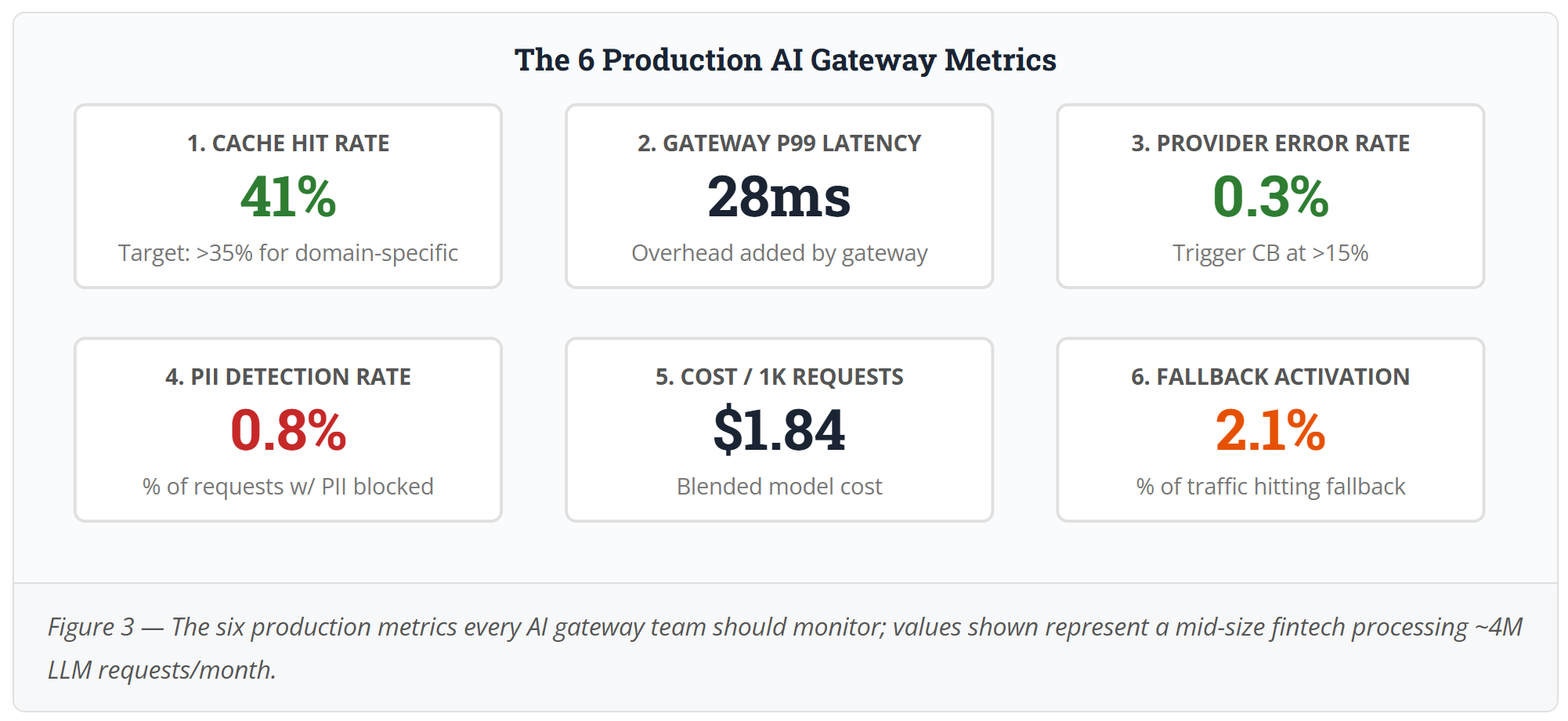
"Semantic caching cut our GPT-4o call volume by 41% in the first week. Not because users were asking identical questions — they never do. Because they were asking equivalent questions."
Our threshold ended up at 0.92 cosine similarity after a week of tuning. Below 0.88, too many semantically different questions were getting collapsed, and users noticed. Above 0.95, the cache hit rate dropped below 10%, and it wasn't worth the overhead. Your mileage will vary by domain — financial queries have a much narrower semantic space than general-purpose assistants, which makes caching significantly more effective in fintech specifically.
# Simplified semantic cache lookup — production version adds TTL,
# namespace isolation per service, and Redis cluster support

async def semantic_cache_lookup(
    prompt: str,
    cache_store: VectorStore,
    threshold: float = 0.92
) -> Optional[CachedCompletion]:
    embedding = await embed_prompt(prompt)
    results = await cache_store.query(
        vector=embedding,
        top_k=1,
        score_threshold=threshold,
    )
    if not results:
        return None

    hit = results[0]
    await metrics.increment(
        "ai_gateway.cache_hit",
        tags={"service": hit.source_service, "model": hit.model}
    )
    return hit.completion
2. Cost Attribution and Budget Enforcement
This is the one that gets finance off your back. The premise is simple: every LLM call flowing through the gateway gets tagged with the originating service, team, cost center, and environment. Token counts — prompt tokens and completion tokens separately — are recorded. At the end of the month, the AI operations bill is automatically disaggregated by team.
Sounds administrative. It fundamentally changes behavior. Once the fraud team sees that their experimental model evaluation accounted for 34% of last month's AI spend, they start batching their calls. Once the product team realizes that their customer-facing chat feature costs $0.0018 per conversation at current token lengths, they start thinking about response truncation. Visibility creates accountability. The gateway is where that visibility lives.
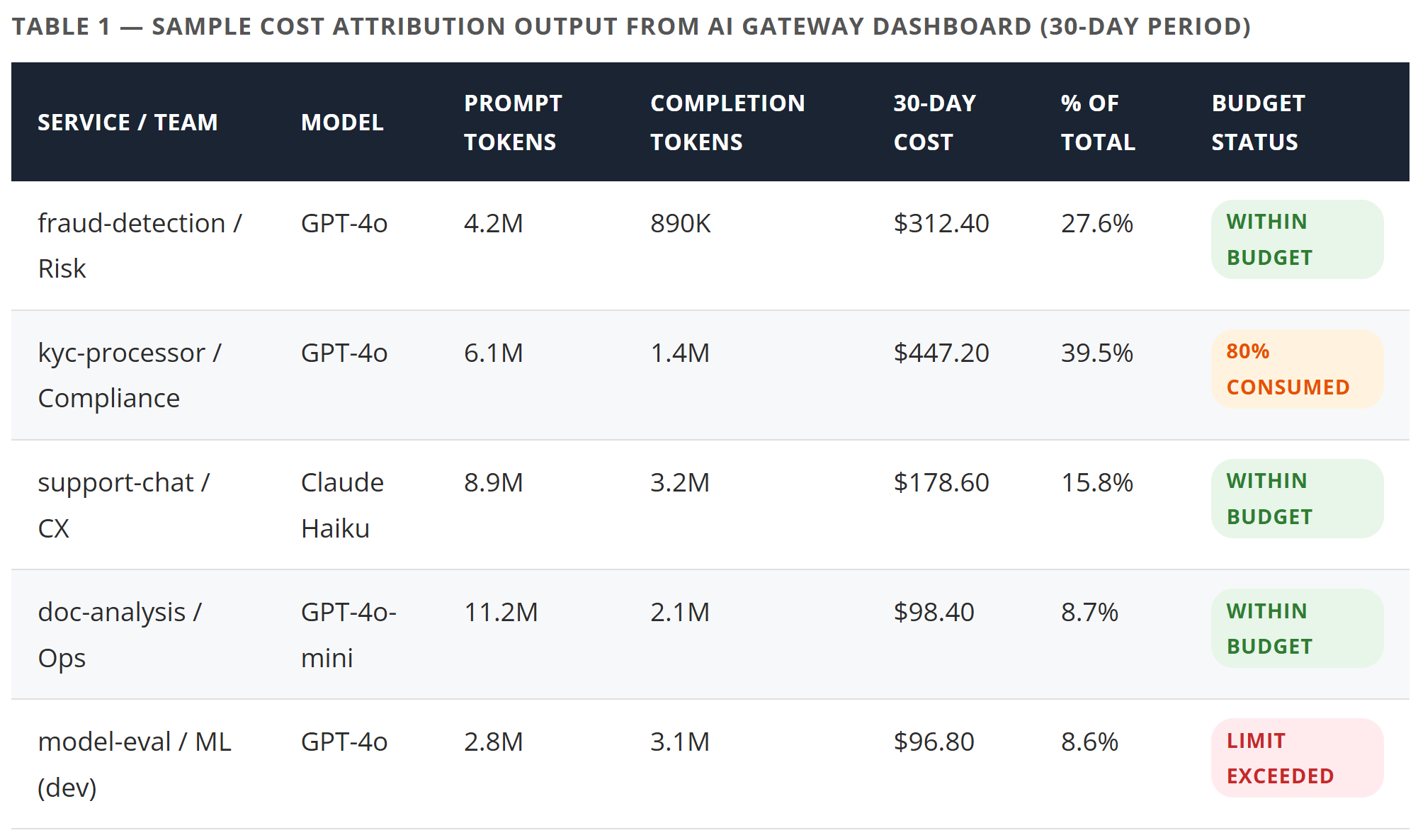
Budget enforcement is the enforcement half of this. Each service gets a monthly token budget. When they hit 80%, an alert fires. When they hit 100%, calls start being routed to a cheaper model. When they hit 120%, calls are queued or rejected with a structured error that tells the engineer exactly what happened and who to contact. No surprises. No $4,200 Tuesday invoices.
3. PII Detection and Scrubbing
This one is non-negotiable in regulated industries. Full stop. Sending raw customer prompts to a third-party LLM API without PII scrubbing is a GDPR Article 28 problem, a CCPA problem, and in a financial services context, a potential GLBA problem. Your legal team will discover this at the worst possible time if you don't build it into the gateway layer first.
The implementation has two stages. Pre-flight scrubbing runs a named-entity recognition model against the prompt before forwarding — replacing detected PII (SSNs, account numbers, phone numbers, names in certain contexts) with structured placeholders like [ACCOUNT_NUMBER_1]. Post-flight restoration optionally rehydrates placeholders in the completion for cases where the downstream service needs the original values. The key is that nothing identifiable ever leaves your network perimeter in readable form.
4. Circuit Breakers and Intelligent Fallback
OpenAI's API goes down. Not often, but it does. And when it does, every service that's calling it directly fails simultaneously, visibly, and often in ways that produce thoroughly confusing error messages to end users ("Something went wrong" when the real issue is a 503 from a third-party API your customer has never heard of).
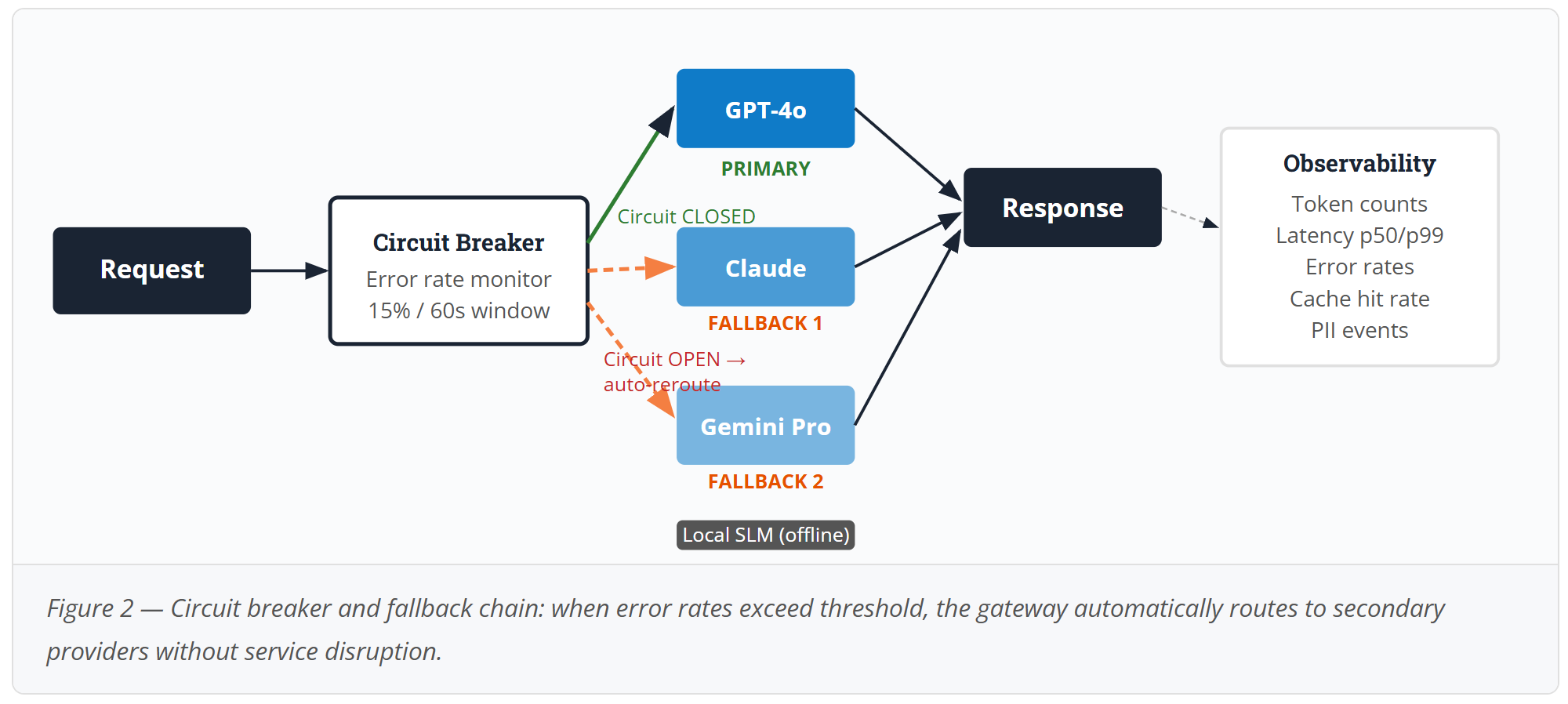
The AI gateway implements circuit breakers at the provider level. When error rates from a given provider exceed a threshold — we use 15% over a 60-second window — the circuit opens and traffic is automatically rerouted to the fallback provider chain. For us that looks like: GPT-4o → Claude Sonnet → Gemini Pro → local Llama 3.3 deployment, in that order of preference. Each model in the chain has a defined capability tier, so the gateway can make routing decisions based on task complexity, not just availability.
Build vs. Buy: The Honest Accounting
You have three options here. Build it yourself, use an open-source gateway (LiteLLM, PortKey, Traefik AI), or buy a managed solution (Apigee AI extensions, AWS Bedrock Gateway, Kong AI Gateway). I've done all three. Here's what I learned.
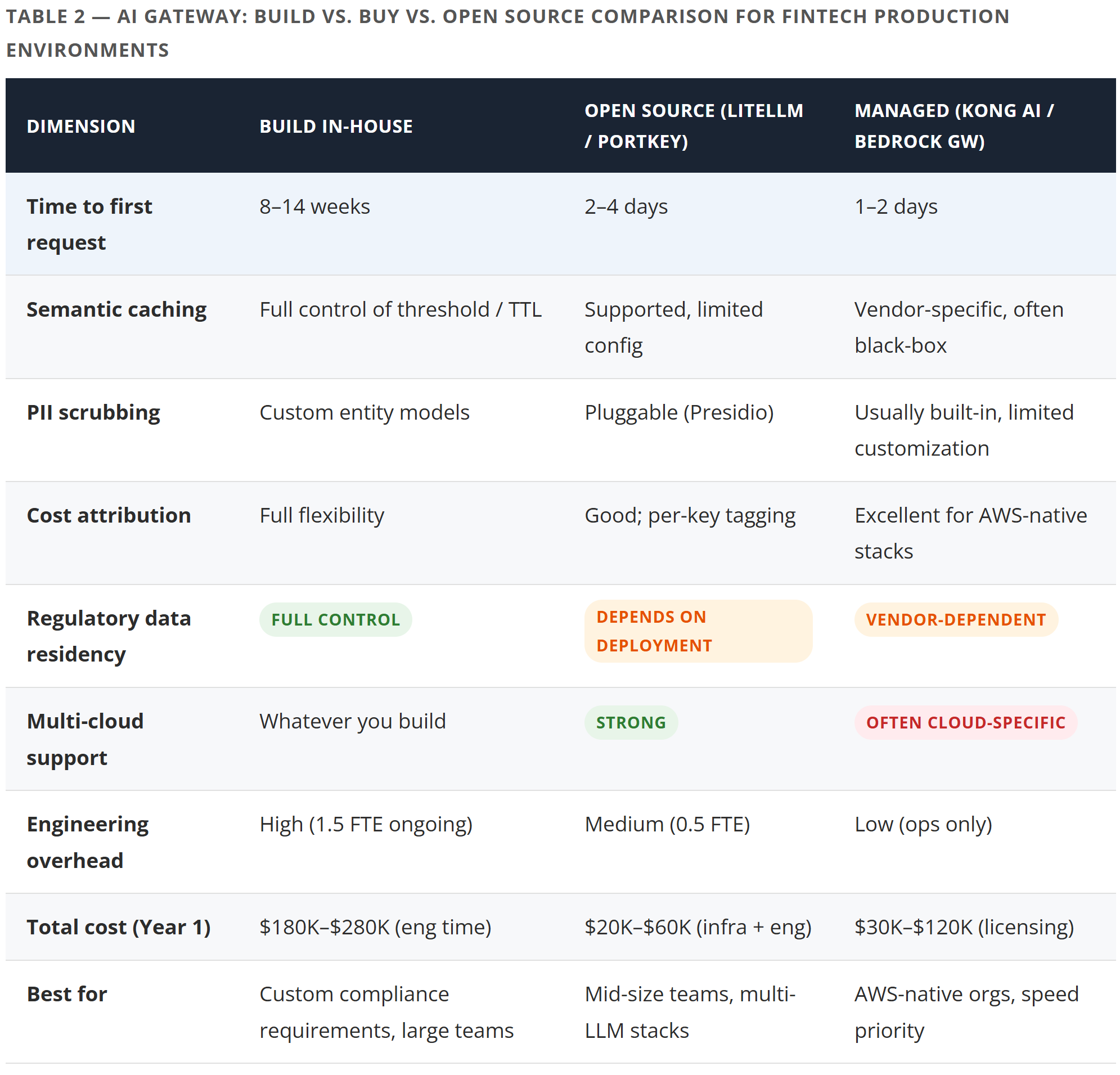
My honest opinion: start with LiteLLM behind a thin wrapper you control, and plan a migration path to a fully owned solution if your compliance requirements tighten — which in financial services, they will. The trap is trying to build everything custom on day one. You will spend six months building infrastructure instead of shipping features, and by the time you're done, three better open-source options will have appeared.
The Metrics That Actually Matter in Production
Every observability vendor will try to sell you fifty dashboards. The AI gateway team at a major payments processor I've advised runs on six numbers. These six numbers. If they're green, everything is fine. If one turns red, you know exactly where to look.
What "Quietly Standardizing" Actually Means
I want to be precise about the headline here, because I've seen it misread. When I say JPMorgan and Stripe are standardizing on this pattern, I don't mean they've published a spec you can download. I mean: engineers who've left those organizations are showing up at mid-size fintechs and immediately building AI gateways, because that's what they built at their last job. The pattern is diffusing through engineering talent, not through documentation.
JPMorgan's LLM COE — their internal Center of Excellence for AI — has been running something functionally identical to this architecture since at least early 2025, according to multiple engineers who presented at FinTech DevCon. They call it their "AI traffic control layer." The components are the same: centralized routing, semantic cache, PII scrubbing pipeline, cost ledger per business unit.
How to Get From Here to There Without a Rewrite
The migration question is always: how do we adopt this pattern when seventeen services are already calling OpenAI directly, and we have zero appetite for a multi-month refactor?
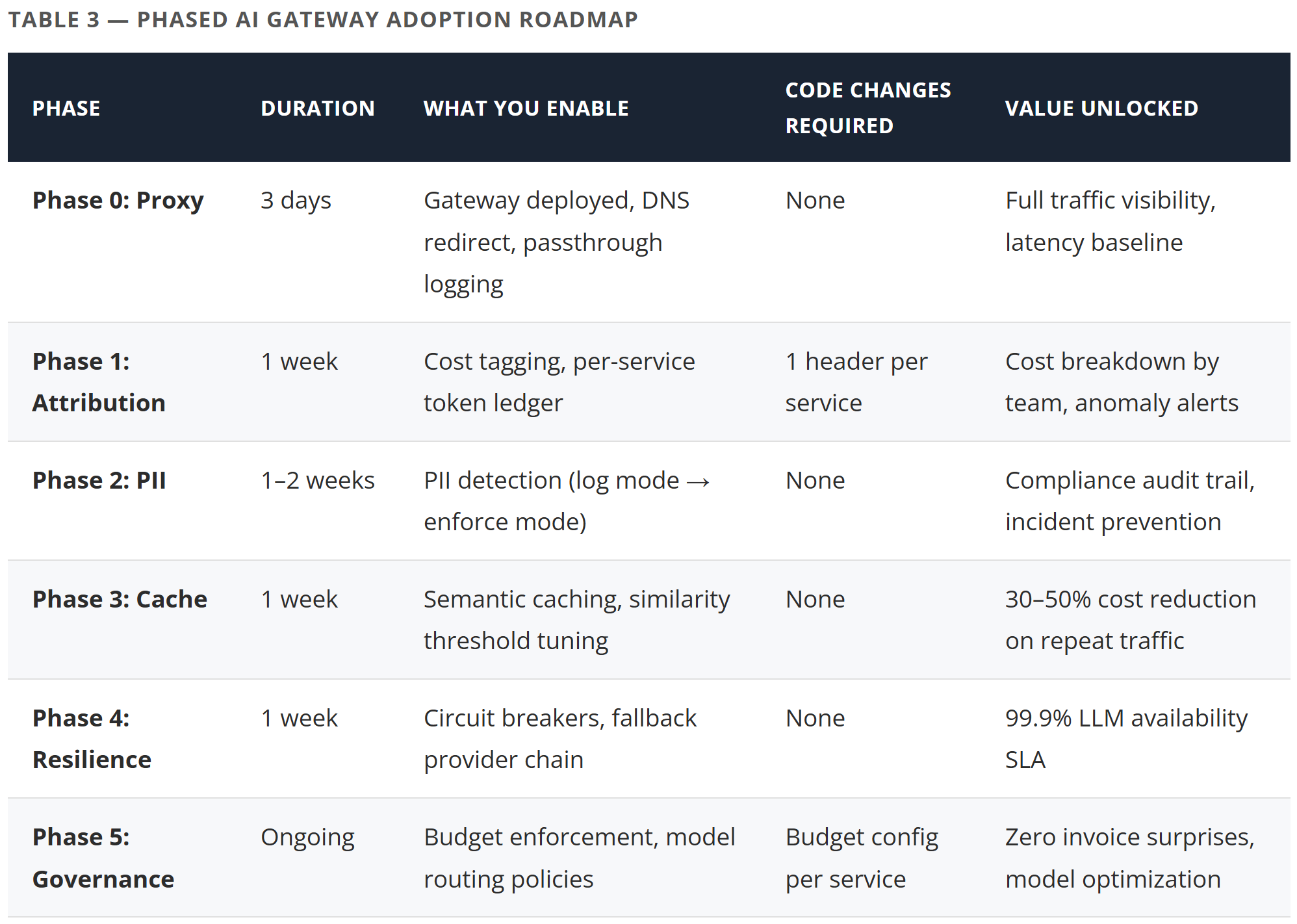
The answer is DNS. Specifically: deploy your gateway, update your internal DNS to resolve api.openai.com to your gateway IP, and configure the gateway to proxy through to OpenAI by default. From day one, all your existing services are routing through the gateway with zero code changes. You get visibility immediately. Then, service by service, you opt into semantic caching, PII scrubbing, and cost attribution at whatever pace your team can manage.
We did this migration in four weeks with a team of three. Week one: deploy the gateway, enable DNS redirect, establish baseline observability. Week two: enable cost attribution tagging — this required adding a service identifier header to each client, which was a one-liner change per service. Week three: PII scrubbing in logging mode (detect but don't block, so you can tune the entity model without breaking anything). Week four: enable semantic caching, tune the similarity threshold, deploy budget enforcement in warning-only mode.
The Tradeoffs Nobody Mentions
I want to be honest about where this pattern has real costs, because the breathless "AI gateway will solve everything" takes that have appeared over the past year are exhausting to read.
Latency. The gateway adds overhead. Our p50 overhead is about 12ms; p99 is 28ms. For customer-facing real-time applications, that matters. If you're building a trading platform where sub-10ms matters, the centralized gateway pattern may not be the right call for your latency-critical paths. Build a hybrid — gateway for asynchronous workloads, direct for ultra-low-latency paths, strict manual governance for the latter.
Semantic cache consistency. A 0.92 cosine similarity threshold means you'll occasionally return a cached response that's slightly wrong for a slightly different question. We've seen this cause issues in dynamic financial contexts — "What's the risk on my open AAPL position?" at 9:30am and at 3:30pm are semantically similar but factually require different answers. Cache TTLs and domain-specific exclusion lists are your mitigation here, but they require ongoing tuning. This is not a set-it-and-forget-it component.
Single point of failure. Yes, the gateway is a SPOF. This is why you deploy it across multiple availability zones with automatic failover, health checks that your load balancer actually uses, and a documented break-glass procedure for direct LLM access if the gateway cluster fails entirely. Treat it like your auth service: make it reliable enough that SPOF isn't actually the risk it sounds like.
Opinions expressed by DZone contributors are their own.
Comments