

Evolve or Automate: What It Actually Means to Be an AI-Native Data Engineer
The role isn't disappearing. But if you're still doing the same job you were doing two years ago, you're already behind.
 CORE
·
CORE
·
Join the DZone community and get the full member experience.
Join For FreeThe Moment It Gets Real
At some point in the last year, every data engineer had the same experience. You opened a copilot tool, typed a rough description of what you needed, and watched it generate a working ETL pipeline in about thirty seconds. Not a skeleton. Not pseudocode. Actual, runnable PySpark with joins, transformations, and a DAG scaffold.
And for a moment, the question that the industry had been treating as hypothetical became very concrete: if AI can do this, what exactly am I here for?
That question deserves a serious answer — not the dismissive "AI is just a tool" reassurance, and not the catastrophist "engineers are obsolete" take. The honest answer is more nuanced, more interesting, and more actionable than either of those.
What AI Can Actually Do Today
Let's be precise about what has changed, because the hype runs in both directions.
AI copilots in 2026 are genuinely impressive at a specific class of data engineering tasks. Give a well-prompted model a schema and a business requirement, and it will produce SQL that would have taken a competent engineer thirty minutes to write. Ask it to scaffold a dbt model with tests and documentation, and it delivers something you can actually work from. Point it at a slow query and ask for optimization suggestions, and it identifies the right indexes and join strategies most of the time.
The work that once defined the day-to-day of data engineering — writing transformations, building pipeline boilerplate, generating unit tests, documenting schemas — is now legitimately acceleratable by an order of magnitude.
That compression is real. A pipeline that took a week to build from scratch now takes a day. A day's worth of dbt model work now takes a morning. The cycle time has collapsed, and pretending otherwise is not a useful position.
But Would You Actually Deploy It?
Here is where the honest conversation has to happen.
AI generates code that looks production-ready. It compiles. The DAG runs. The transformations return the right rows on the test dataset. And then you look closer.
There are no retry semantics. There is no idempotency guarantee — run it twice, and you get duplicates. There are no data quality checks, no row count assertions, no schema drift detection. Observability is absent. The error handling catches exceptions and logs them to nowhere. Governance controls do not exist because the model has no idea what your data classification policies are.
The code is impressively correct at the logic layer and completely unprepared for production reality. And that gap — between "AI generated it" and "it is actually deployable" — is not a small gap. It represents most of what makes data engineering genuinely hard.
This is not a criticism of AI tooling. It is a precise description of where the boundary currently sits. And that boundary is exactly where the value of a skilled data engineer now concentrates.
The Three-Bucket Reality
Not all data engineering work is equally automatable, and the honest framework is to split it into three categories based on where AI sits today.
What AI handles well. SQL and transformation generation, dbt model scaffolding, unit test generation, schema documentation, query explanation, code refactoring, and first-draft pipeline boilerplate. These tasks are high-volume, pattern-heavy, and well-represented in training data. AI performs them at a level that meets or exceeds what most engineers produce under time pressure.
What AI assists but cannot own. Pipeline architecture decisions, root cause analysis on production failures, performance tuning for complex distributed jobs, and data modeling judgment for novel domains. AI is genuinely useful here as a thought partner and accelerant, but the decisions require context, business knowledge, and judgment that models do not reliably carry.
What remains fundamentally human. Trade-off evaluation with real organizational constraints, governance and compliance decisions, architecture choices with long-term consequences, and anything requiring accountability. These require not just the right answer but the right answer for this company, this data, this regulatory environment, this team. That is irreducibly human work.
The critical observation is that the boundary between these buckets is not static. Tasks that sat in the second bucket eighteen months ago have migrated into the first. The direction of travel is clear. Engineers who have concentrated their value entirely in automatable work are already exposed. Engineers who have built depth in judgment, architecture, and systems thinking are in an increasingly strong position.
The Workflow Has Already Changed
The before and after is not theoretical. It is visible in how high-performing data engineering teams actually operate today.
The traditional workflow moved linearly through extraction, transformation, loading, and serving — each stage measured in hours to days, the full cycle measured in weeks. It was plagued by boilerplate, manual testing, documentation that was always out of date, and context-switching that fragmented deep work.
The AI-enhanced workflow runs the same stages but with a fundamentally different time signature.
| Stage | Traditional | AI-Enhanced |
|---|---|---|
| Extract | Hours — manual SQL, custom connectors | Minutes — AI-generated queries, auto connectors |
| Transform | Days — dbt models, Spark jobs | Hours — AI-assisted modeling, auto schema detection |
| Load | Hours — DAG authoring, scheduling | Minutes — auto DAG generation, smart scheduling |
| Serve | Days — dashboard building, documentation | Hours — auto documentation, natural language query |
The total cycle time compresses from weeks to days. That compression does not come from removing the engineer. It comes from removing the repetitive execution work so the engineer can focus on the decisions that actually require human judgment.
What the Collaboration Actually Looks Like
The AI-native data engineer workflow is not "prompt and deploy." It is a structured collaboration with a clear division of responsibility.
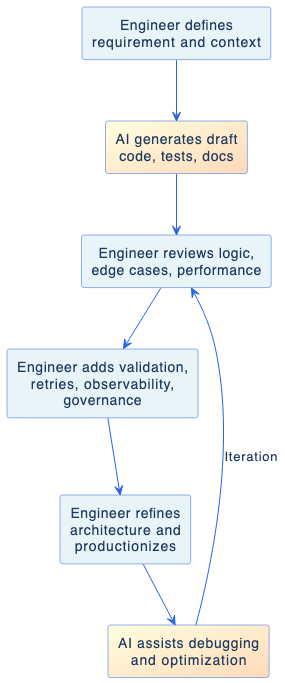
AI accelerates the build. The engineer ensures it is correct, reliable, observable, and production-ready. The accountability for what ships belongs to the engineer, not the model. That accountability is not a burden — it is the source of professional value.
The engineers who treat AI output as a draft to be critically evaluated and hardened will consistently outperform those who either ignore the tools entirely or treat generated code as finished work. Both of those failure modes are common. Neither is sustainable.
The Skill Set Reorganizes, Not Disappears
The skills required to be an excellent data engineer are shifting, but they are not evaporating. They are reorganizing around three pillars.
Technical depth now centers on evaluating AI-generated code rather than writing all code from scratch. This requires strong fundamentals — you cannot spot the subtle join fanout in AI-generated SQL if you do not understand join semantics. It also means investing in observability, reliability engineering, and prompt crafting as first-class technical skills. A well-constructed prompt that produces deployable output in one iteration is genuinely more valuable than the ability to write the same code manually from scratch.
Systems thinking becomes the primary differentiator. Architecture decisions, data modeling judgment, trade-off evaluation, and problem framing are tasks that compound in value as AI handles more execution work. The engineer who can look at a generated pipeline and immediately identify the three ways it will fail at scale is providing something no current model reliably provides.
Engineering leadership expands to include guiding AI usage within a team, establishing review standards for AI-generated code, owning governance controls, and setting the quality bar that separates production-ready from impressive-looking. This is not a soft skill add-on — it is a core engineering responsibility in an environment where the output volume of any individual engineer has increased dramatically.
The role is shifting from execution to judgment. That is an upgrade, not a downgrade, for engineers willing to make the transition deliberately.
How to Actually Evolve
The path forward is concrete, not abstract.
Start by integrating AI into your daily work right now — not as an experiment but as a workflow change. Use it for SQL drafting, pipeline scaffolding, and test generation. Build the muscle of critically evaluating what it produces. Develop prompting habits that consistently get you to a usable first draft rather than something you have to rewrite from scratch.
Level up by investing deliberately in the areas AI does not cover well. System design. Distributed systems fundamentals. Reliability and observability patterns. Data modeling for complex domains. These skills appreciate in value as AI handles more of the execution layer — the relative scarcity of strong systems thinkers increases as the supply of generated boilerplate becomes effectively infinite.
Lead by taking ownership of AI quality standards on your team. Be the person who defines what "production-ready" means for AI-generated pipelines, who establishes review checklists, who sets governance guardrails. This is influence that compounds over time and is not replicable by a model.
The Honest Bottom Line
AI will not replace data engineers. But data engineers who treat their value as residing primarily in writing code — rather than in the judgment, architecture, and reliability thinking that makes code worth deploying — are taking a position that becomes harder to defend with each model release.
The opportunity is real, and it is now. The engineers who learn to work with AI as a genuine collaborator, who develop the critical evaluation skills to close the gap between generated and production-ready, and who invest in the systems thinking that AI cannot replicate — those engineers are not threatened by this transition. They are the ones who define what data engineering looks like on the other side of it.
Evolve deliberately. The alternative is not standing still — it is falling behind at an accelerating rate.
Opinions expressed by DZone contributors are their own.
Comments