

AI in Software Architecture: Hype, Reality, and the Engineer’s Role
AI won’t replace engineers—it shifts their role. It boosts speed but adds complexity, debt, and review cost. Advantage goes to those who use it critically.
 CORE
·
CORE
·
Join the DZone community and get the full member experience.
Join For FreeThere’s a recurring pattern in software engineering: every few years, a new wave arrives promising to redefine everything, and the conversation quickly drifts to extremes. The current wave — driven by advances in machine learning and large language models — is no different. Some argue that AI will replace engineers entirely; others reduce it to just another tool in the IDE. Both views oversimplify what is actually happening. If you look historically — from assembly to high-level languages, from monoliths to distributed systems — each shift didn’t eliminate complexity; it relocated it.
The word architecture itself, from the Greek arkhitekton (“chief builder”), is revealing. It never referred to the act of placing bricks, but to the decision about how the structure holds together. That distinction becomes sharper now. As AI reduces the effort required to produce code, it does not remove the need for design, trade-offs, or system thinking. Instead, it amplifies them. When the cost of generating code drops, the cost of making poor decisions increases — because you can produce more, faster, and propagate mistakes at scale.
This article takes a pragmatic stance: not debating whether AI will replace engineers, but examining how it shifts the role of those designing systems. What actually changes when code is no longer the main constraint? What remains stable despite the hype? And where should senior engineers, staff engineers, and architects focus their attention? Because, as in every previous shift, the advantage lies with those who understand where the real constraints have moved.
Software Development and the Hype Around AI
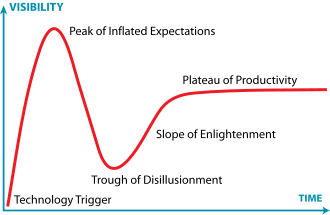
Technology has always lived close to hype. The word hype comes from hyperbole, the Greek idea of “excess” or “throwing beyond,” and that is exactly what often happens in software: a real innovation appears, but the expectations are projected far beyond its current maturity. Gartner describes this pattern through the Hype Cycle, which follows five phases: first, the Innovation Trigger, when a breakthrough creates attention; then the Peak of Inflated Expectations, when success stories dominate the narrative; after that, the Trough of Disillusionment, when limitations become visible; then the Slope of Enlightenment, where practical use cases emerge; and finally the Plateau of Productivity, where the technology becomes boring, useful, and integrated into real work (Gartner).
Software development has seen this many times. We saw it with object-oriented programming, service-oriented architecture, cloud computing, microservices, blockchain, low-code platforms, and even DevOps. Each of these movements carried a promise: faster delivery, better scalability, more autonomy, less complexity. Some of those promises were partially true, but never magically true. Microservices did not eliminate architecture; they moved complexity into communication, deployment, observability, and organizational design. Cloud did not remove infrastructure concerns; it changed who manages them and how much financial discipline matters. The same skeptical lens must be applied to AI.
AI itself is not new. The term Artificial Intelligence was formally introduced at the Dartmouth workshop in 1956, one of the field's foundational moments. (Dartmouth) What is new is not the existence of AI, but its accessibility, visibility, and integration into everyday software work. For the first time, many engineers, managers, executives, and non-technical professionals can interact with AI directly through natural language. That popularity creates excitement, fear, and confusion simultaneously. So before asking whether AI will replace developers, destroy architecture, or make fundamentals irrelevant, we need a better question: where does AI actually change software development, and where does it simply underscore the importance of engineering fundamentals? That is what the next sections will explore.
Will AI Replace the Software Engineer?
The short answer is no — but that answer deserves a bit of skepticism rather than blind acceptance. If you look at the history of engineering, every leap in productivity has triggered the same narrative. Compilers didn’t replace programmers; frameworks didn’t eliminate design; cloud didn’t remove infrastructure thinking. Each abstraction removed friction, but also shifted where complexity lives. AI follows the same path. It accelerates code generation, but software engineering has never been about code alone. As John Ousterhout argues in A Philosophy of Software Design, the core problem is managing complexity, not producing lines of code. That part remains stubbornly human.
Still, it would be a mistake to treat AI as just another autocomplete. It clearly changes the economics of development. Studies such as McKinsey & Company's “The Economic Potential of Generative AI” highlight how AI can significantly increase developer productivity on specific tasks. Similarly, GitHub research and product insights on Copilot show measurable gains in code-generation speed. But speed is only one dimension of engineering. Surveys from Stack Overflow consistently reveal developers' concerns about correctness, maintainability, and trust in AI-generated outputs. These signals point to a familiar pattern: local efficiency improves, while global system complexity often increases.
What changes, then, is not the existence of engineers, but their focus. We are already seeing the emergence of new responsibilities — engineers acting as reviewers of machine output, curators of codebases, and guardians of architectural integrity. You could argue that “writing code” becomes less central, while “ensuring that the right code exists” becomes more critical. This includes cleaning technical debt introduced by generated code, validating domain alignment, and enforcing consistency across systems. In that sense, AI does not replace engineers; it raises the bar. The more code we can generate, the more discipline we need to sustain it — and that is exactly where experienced engineers become even more valuable.
One of the most interesting aspects of AI in software engineering is that the data does not fully support the popular narrative of “always faster and cheaper.” In fact, several recent studies suggest the opposite in specific contexts. For example, a controlled study by Model Evaluation & Threat Research found that experienced developers using AI tools were 19% slower than those without AI assistance, largely due to time spent prompting, reviewing, and correcting outputs (Business Insider). This contradicts developers' perceptions of their own productivity, revealing a gap between how they feel and how they actually deliver.
Beyond speed, the long-term cost is even more critical. Research analyzing large-scale codebases shows that AI-generated code tends to increase code churn, duplication, and technical debt, making systems harder to maintain over time (DevOps.com). This aligns with academic findings that AI-assisted development can shift the burden toward experienced engineers, who end up spending more time reviewing and fixing code rather than producing new value. In one study, senior developers saw a drop in their own productivity while their review workload increased, highlighting that AI may redistribute effort rather than eliminate it (arXiv).
There is also a structural cost often ignored in hype-driven discussions: maintainability and system evolution. While AI can generate working code quickly, it lacks a deep understanding of the system, leading to inconsistencies and hidden coupling. Studies comparing AI-generated and human-written code show different defect profiles, including increased security risks and structural issues that require additional quality assurance (arXiv). In practice, this means teams may move faster initially but pay the price later when evolving the system — exactly the kind of trade-off that experienced engineers have recognized for decades in software development.
So your intuition is correct: there is growing evidence that in the long term, teams that deeply understand their systems may outperform those that rely heavily on AI without proper control. Not because AI is bad, but because software engineering is not about generating code — it is about sustaining systems over time. AI optimizes the former; engineers are still required for the latter.
Should I Use AI — or Is It an Enemy?
Framing AI as an enemy is the wrong abstraction. In engineering terms, it’s a tool that shifts constraints — and ignoring it is not a neutral decision. Throughout history, engineers who refused to understand new tools did not preserve craftsmanship; they simply became less effective. AI follows the same trajectory. It introduces a new layer of abstraction that can increase productivity and impact, but only if approached critically. As with Docker or Kubernetes before it, understanding how and when to use it becomes part of the job.
Used well, AI can remove friction from repetitive tasks. It can generate boilerplate code, assist with test creation, improve documentation, and even help explore alternative implementations. Many engineers already use assistants in their IDEs or more advanced agentic workflows to accelerate delivery. But there is a catch: generated code often lacks coherence with the system as a whole. It may solve the local problem while introducing global inconsistencies. That is why your role shifts — you are no longer just writing code; you are curating, validating, and aligning it. The real skill becomes prompt design, critical review, and architectural enforcement. AI can write code, but it does not understand your system. You still need to be the adult in the room.
There are also real, documented risks. Studies show that AI does not always improve productivity — especially for experienced engineers. A study published on arXiv found that developers using AI tools were actually slower in certain scenarios, a result also discussed by Reuters. Research from the Massachusetts Institute of Technology highlights how generative AI changes how engineers spend time and can reduce deep engagement with problem-solving.
Additional studies indicate that senior engineers often absorb the cost of reviewing and fixing AI-generated code, shifting — not eliminating — the workload. Meanwhile, industry analysis, such as that from DevOps.com, points to increased technical debt and maintainability challenges. There is also a behavioral dimension: over-reliance on AI can reduce attention and critical thinking, reinforcing the need for deliberate usage.
So, should you use AI? Yes — but deliberately. Not using it means falling behind in understanding a tool that is already reshaping the industry. Using it blindly, however, is equally problematic. The goal is not to replace your thinking, but to amplify it. AI should handle the mechanical aspects of development, while you remain responsible for structure, correctness, and long-term sustainability. Or, to adapt a well-known idea often attributed to Bill Gates: the real advantage does not belong to the machine, nor to the human alone, but to the human who knows how to use the machine well.
Opinions expressed by DZone contributors are their own.
Comments