

Architecting AI-Native Cloud Platforms: Signals to Insights to Actions
AI-native platforms embed intelligence into cloud infrastructure, allowing systems to sense events, generate insights with AI, and trigger automated actions in real time.
 ·
·
Join the DZone community and get the full member experience.
Join For FreeCloud platforms have historically been built to execute applications at scale. Over the past decade enterprises pushed workloads from private datacenters to the cloud, taking advantage of elasticity, automation, and worldwide scale.
Today’s digital businesses process massive amounts of signals every second:
- customer behavior
- system activity
- transaction processing
- IoT data
- operational health
Legacy cloud architectures collect these signals and then process them later for insights via dashboards and reports. This model served organizations well but in a world where microseconds matter, it comes with a crippling drawback:
There is often a significant delay between when an event occurs and when a decision can be made about that event.
Enterprises now demand systems which can sense what is going on in real time, comprehend what those signals mean, and act upon those insights immediately.
Platforms that do these three things - Sense, Comprehend, Act - will be AI-Native Cloud Platforms.
Applications can no longer simply run on platforms; they must think.
Architecting an AI-Native Platform
Platform architects treat artificial intelligence as a first-class citizen. Data streaming continuously through the platform is analyzed by machine learning models which trigger automated decisions inside business applications.
Platform components talk to each other intelligently.
At their core, AI-Native Platforms transform cloud platforms from infrastructure providers into digital brains for your applications.
What Do I Mean by AI-Native Cloud Platform?
When I say AI-Native Cloud Platform, I’m referring to an architecture where data, machine learning, and applications are tightly integrated together.
Instead of data feeds going into a traditional analytics stack while ML models are built and run elsewhere, AI-native platforms weave intelligence into the fabric of the platform.
Signals become Insights, which automatically trigger Actions.
Characteristics of AI-Native Platforms
- Data is streamed continuously as event feeds.
- Machine learning models are embedded into operational workflows.
- AI systems automate decisions.
- Machine learns from real-world decisions.
- Intelligence flows through the platform.
Evolution of Cloud System Architecture
Here’s how I see cloud system architecture evolving:
Traditional Cloud Platforms
Driven by compute and storage needs. Automation was focused on infrastructure rather than applications.
Analytics-Driven Platforms
Modern data lakes, warehouses, and analytics systems generated significant business insights, but most processing was still done after the fact.
AI-Native Cloud Platforms
Everything starts to come together. Intelligence is infused into the platform itself.
Signals are sensed → processed into Insights → trigger Actions
Building Blocks of AI-Native Platforms
Let’s take a deeper look at the architecture of AI-Native Cloud Platforms.
Below is my own high-level architecture that shows how intelligence flows through an AI-Native Platform.
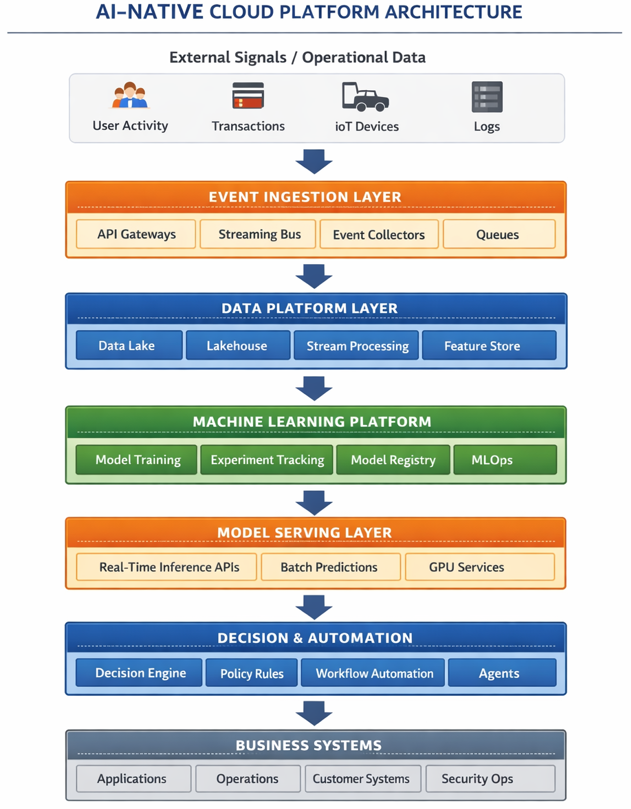
1. Event Ingestion Layer
Apps, devices, and services on modern digital platforms emit streams of events and signals.
They need to be reliably captured at scale.
Popular ingestion technologies:
- event streaming platforms
- API gateways
- message queues
- log shippers
Ingestion layers move data “into” the platform. Think of them like data on-ramps.
Streaming platforms also allow services to decouple from each other. Data pipelines connect systems without requiring tight integration.
2. Data Platform Layer
Raw events are persisted to and processed within your data platform.
Modern data platforms often include:
- data lakes
- lakehouse platforms
- stream processing backends
- feature stores
Feature stores warrant special call-out here. Feature stores allow you to atomically version and serve machine learning features.
So the same features used to train models are used at production time. Serving stale features is a common reason models go from performing well to poorly.
3. Machine Learning Platform
With the data captured and served, data scientists and engineers can use a machine learning platform to build models.
Platforms that enable:
- distributed model training
- experimentation tools
- model versioning
- retraining pipelines
Organizations are implementing MLOps practices to operationalize these workflows.
MLOps applies software engineering practices to the development and lifecycle management of ML models.
4. Model Serving Layer
Building models is great, but serving models to generate predictions is where the value lies.
ML models are hosted on AI-native platforms using low-latency model serving infrastructure.
Includes technologies like:
- containerized model servers
- scalable Kubernetes clusters
- GPU inference servers
- prediction endpoints
Coupled with your ingestion layer, this allows digital systems to make predictions seconds (often milliseconds) after data is created.
5. Decision & Automation Layer
The output from our models should lead to decisions.
AI-powered decisions should trigger follow-on actions.
Includes but is not limited to:
- approving vs blocking a financial transaction
- making product recommendations to users
- scaling up/down infrastructure
- identifying cyber-security threats
Decisioning capabilities can include:
- ML predictions
- policy engines
- workflow automation
- AI agents
Combine these tools to build a closed-loop decisioning system.
Intelligent Feedback Loop Architecture
AI-native systems also rely on continuous feedback.
Below is another original conceptual diagram showing the learning loop.
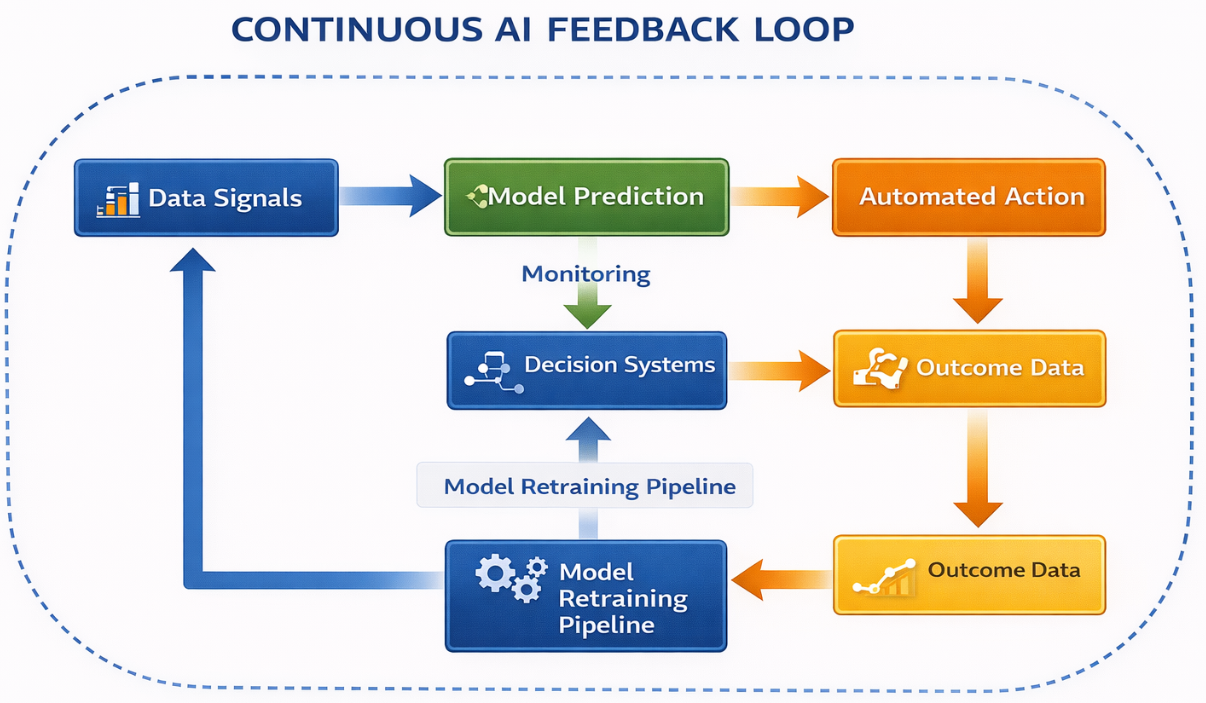
This loop ensures the system constantly improves.
As more data flows through the platform, models are retrained and refined.
Examples of AI-Native Applications
- Financial services: Banks process streams of transactions to identify fraud in milliseconds.
- Retail: Online retailers serve real-time recommendations as customers browse their site.
- Manufacturing: Factories correlate millions of sensor readings to predict machine failures.
- Cloud operations: AI correlates metrics and events to automatically troubleshoot issues.
AI-native Applications Are Not Without Challenges
Bad data poorly pipelined = bad predictions: The predictions generated from poor quality data are inaccurate.
Drifting Markov Chain: Model’s knowledge becomes less accurate as real-world variables shift.
Accountability: Leaders need to be sure AI decisions can be explained and audited.
Monolith of doing it all: Connecting data infrastructure, ML pipelines, and application services at scale is complex.
What’s Next: Towards Autonomous Digital Ecosystems
Tomorrow’s cloud platforms will be capable of
- Automatically optimizing themselves
- Managing infrastructure without human intervention
- Operating entire ecosystems of AI-driven applications
Cloud platforms won’t just run our applications. They will see. They will think. They will act.
Cloud. Rethought.
Intelligence is the new scale.
The next evolution of cloud-native architecture isn’t about how big your deployment can grow. Or how available your application could be.
It’s about creating an environment that knows what’s happening in real-time across your business.
AI-native applications weave together realtime event streams, machine learning models, and automated decision making to deliver business value that responds to the needs of your customers at the speed of data.
Opinions expressed by DZone contributors are their own.
Comments