

AWS Glue ETL Design Principles for Production PySpark Pipelines
Learn eight AWS Glue ETL design principles for building production PySpark pipelines that are maintainable, scalable, observable, and cost-efficient.
 CORE
·
CORE
·
Join the DZone community and get the full member experience.
Join For FreeAWS Glue makes it easy to get a PySpark pipeline running quickly. It is significantly harder to build one that stays maintainable as logic grows, performs reliably at scale, and does not quietly accumulate operational debt over time.
Most Glue pipelines start simple and become difficult to manage gradually — formulas get hardcoded, modules grow without boundaries, output files proliferate, and before long a single job is doing too many things in ways that are hard to test, hard to debug, and expensive to change.
This article presents a set of design principles drawn from production Glue ETL pipelines processing billions of rows. Each principle is independent — you do not need to adopt all of them to benefit from any one. But together they form a coherent approach to building Glue pipelines that are modular, observable, cost-efficient, and built to last.
Principle 1: Externalize Logic Into Config, Not Code
The single most impactful structural decision in a Glue pipeline is where business logic lives.
When formulas, dataset references, column selections, and filter conditions are hardcoded in PySpark, every change requires modifying job code, redeploying, and re-validating the full pipeline. A one-line formula change carries the same deployment risk as a structural refactor. Over time, this creates a strong disincentive to make changes, and the pipeline calcifies.
The better pattern is to treat the Spark job as a generic executor and externalize all business-specific declarations into configuration. Formulas are declared as config entries with operands, rounding rules, and output names. Dataset loading behavior — which table, which columns, which filters, whether to cache — is declared per source rather than scripted per job. Schema shapes for complex types are declared explicitly rather than inlined.
{
  "source_table": "headcount_actuals",
  "database": "finance_db",
  "select_columns": ["site", "badge_type", "headcount", "fiscal_week"],
  "filters": [{"column": "is_active", "value": "Y"}],
  "rename": {"hc_count": "headcount"},
  "cache": true
}
When a new dataset is needed, a new config entry is added — no Spark code changes. When a formula changes, the config entry is updated — no job redeployment required. The job itself becomes stable and generic; only config changes as business requirements evolve.
This principle pays increasing dividends over time. Pipelines with externalized logic are faster to modify, safer to deploy, and easier to hand off because the business rules are readable independently of the execution engine.
Principle 2: Design Modules With Explicit Boundaries
A Glue job that does everything in one place is easy to write and hard to maintain. As pipelines grow, the instinct to add more logic to an existing job accelerates technical debt faster than almost any other decision.
The more durable pattern is to decompose computation into modules with explicit input and output contracts. Each module receives one or more DataFrames, applies a focused set of transformations, and produces a named output DataFrame. Modules communicate exclusively through in-memory DataFrame references — there is no disk I/O between stages, no shared mutable state, and no implicit dependency on execution order beyond what the data flow itself requires.
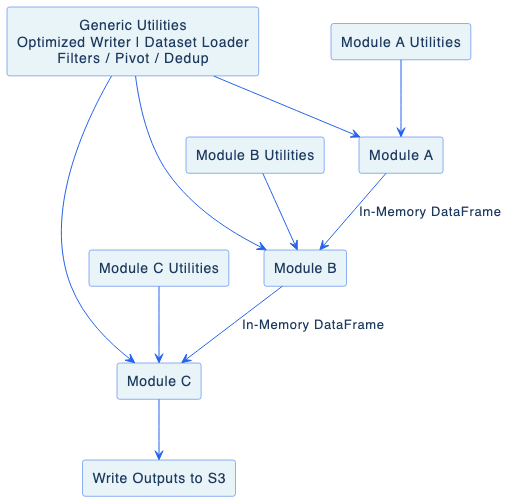
Utilities follow the same boundary principle, organized into two layers. Generic pipeline utilities handle cross-cutting concerns — file writing, dataset loading, filtering, deduplication, pivot operations — and are shared across all modules. Module-specific utilities implement transformation logic scoped to a single module and are never invoked outside it.
This structure means adding a new module requires only writing its scoped utilities and wiring it into the pipeline. The generic layer is never touched. Existing modules are never at risk from new module development.
The downstream benefit is testability. Each module with clean boundaries can be validated independently using mocked PySpark DataFrames with no Glue environment required. Engineers can run pytest locally against individual modules, iterate quickly, and deploy only after local validation passes.
Principle 3: Choose Your Job Topology Deliberately
A common default in complex pipelines is to split computation across multiple Glue jobs, using S3 as the handoff layer between stages. This is sometimes the right choice — but it should be a deliberate decision, not an instinct.
Multi-job topologies make sense when stages have genuinely different compute profiles, when intermediate outputs need to be reused independently by other consumers, or when a stage failure should not force a full recompute from the beginning. In these cases, job separation gives you independent retry boundaries, independent DPU sizing, and the ability to schedule stages on different cadences.
Single-job topologies — where the full pipeline runs within one Spark session — make sense when all computation is tightly coupled, modules share the same input datasets, and intermediate outputs have no standalone value. Running everything in one session eliminates cold start overhead for intermediate stages, avoids the cost of serializing data to S3 and deserializing it back between jobs, and keeps the execution model simple to reason about: one trigger, one job, one result.
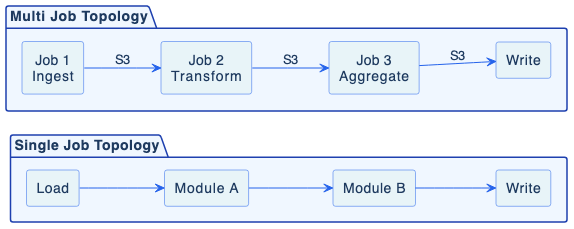
The question to ask is whether the stages truly need to be independent. If intermediate S3 persistence adds coordination complexity without adding value — no independent consumers, no differential retry requirements, no meaningful DPU difference between stages — then collapsing to a single job is usually faster, simpler, and cheaper. If stages have real independence requirements, splitting them is the right call and the operational overhead is justified.
Neither topology is inherently superior. The mistake is defaulting to one without evaluating the trade-offs for the specific pipeline at hand.
Principle 4: Overlap Writes With Computation When Latency Matters
Overlapping writes with computation is a well-established technique in high-performance computing, deep learning training, and heavy database operations. The core idea is to hide the slow latency of I/O operations by running them in the background while the CPU or GPU continues processing data. Rather than waiting for a write to complete before starting the next computation, both proceed simultaneously — I/O latency is absorbed into computation time rather than added on top of it.
In Glue ETL pipelines, the same principle applies directly. In a pipeline where multiple output DataFrames are produced, the naive write strategy — complete all computation, then write all outputs sequentially — has two compounding problems. First, it creates a peak memory spike: all computed results are held in memory simultaneously while writes proceed one by one. Second, it serializes work that does not need to be serial: every millisecond spent waiting for S3 acknowledgment is a millisecond the Spark executors are idle.
This is worth addressing only when latency is a meaningful constraint. For low-frequency batch jobs running overnight with no user-facing SLA, sequential writes are perfectly adequate. But for pipelines where users or downstream systems are waiting on results — or where job duration directly affects infrastructure cost — overlapping writes with computation delivers measurable wall-clock reduction.
The two-phase write strategy implements this directly. Outputs from early modules are written to S3 in background threads immediately after those modules complete, running in parallel with later computation stages. By the time all computation finishes, a significant portion of the output data has already landed in S3. Remaining outputs are then flushed concurrently in a second phase.

The implementation leans on Python's concurrent.futures.ThreadPoolExecutor to manage background write threads while the main Spark session continues computation on the driver. A generic write orchestration utility can wrap this pattern so individual modules never need to manage thread lifecycle directly — they simply declare their output and the utility handles scheduling, thread management, and error propagation.
from concurrent.futures import ThreadPoolExecutor, as_completed

def write_phase_a(write_tasks):
    with ThreadPoolExecutor(max_workers=len(write_tasks)) as executor:
        futures = {executor.submit(task["fn"], task["df"], task["path"]): task["name"]
                   for task in write_tasks}
        for future in as_completed(futures):
            name = futures[future]
            future.result()
            logger.info(f"[Phase A] Write complete: {name}")
The practical effect is that peak memory pressure is distributed over the job's lifetime rather than concentrated at the end, and total wall-clock time is reduced by the overlap between I/O and CPU-bound computation. For pipelines with many output datasets and a latency SLA to meet, the savings compound significantly.
Principle 5: Right-Size Output Files With a Reusable Writer Utility
Right-sizing output files is the practice of tuning file sizes to balance disk I/O performance, network transfer speeds, and downstream processing efficiency. Too many small files and downstream readers spend more time on metadata operations and S3 API calls than on actual data reads. Too few large files and parallelism suffers — readers cannot split work efficiently across threads or nodes. The target is consolidated, evenly sized files that match the read patterns of downstream consumers.
Spark's default output behavior writes one file per partition, and partition counts are typically tuned for computation throughput rather than output shape. A job optimized for shuffle performance might produce hundreds of partitions, each containing a few megabytes of output data — perfectly reasonable for Spark internals, but harmful for any reader that comes after. This small file problem compounds over time as output partitions accumulate in S3 and the Glue Catalog metadata grows with them.
The fix is a reusable writer utility that decouples output file sizing from Spark's internal partition count. Rather than accepting the default, the utility estimates the DataFrame's actual size, calculates the appropriate number of output files for a target file size — typically 128MB to 256MB per file — and coalesces partitions before writing.
def write_optimized(df, output_path, partition_cols, target_file_size_mb=128):
    estimated_size_mb = df.rdd.map(lambda row: len(str(row))).sum() / (1024 * 1024)
    optimal_partitions = max(1, int(estimated_size_mb / target_file_size_mb))
    df.coalesce(optimal_partitions) \
      .write \
      .partitionBy(*partition_cols) \
      .parquet(output_path, mode="overwrite")
Making this a shared generic utility rather than inline logic in each module has two practical benefits. First, it enforces consistent file sizing behavior across all outputs in the pipeline — no module accidentally writes thousands of tiny files because an engineer forgot to coalesce. Second, it centralizes the tuning knob: when the target file size needs to change — because downstream query patterns shift or a new consumer has different read characteristics — it changes in one place and applies everywhere.
Right-sized output files improve Athena scan performance, reduce per-query S3 API costs, keep Glue Catalog partition metadata manageable, and make the output data easier to consume for any downstream system reading from S3. This is a low-effort, high-payoff improvement that applies to virtually every Glue pipeline writing to S3.
Principle 6: Use Complex Types to Defer Denormalization
SQL-based pipelines are constrained to flat, fully denormalized row structures at every intermediate stage because SQL has no native complex type support. This forces denormalization to happen early, inflating data volume at every subsequent join and aggregation.
PySpark has native support for structs, maps, and arrays. Using these types at intermediate stages allows related values to be grouped logically without inflating row counts. A row that would require five denormalized rows in SQL can be represented as a single row with a struct or array column in Spark.
Denormalization is then deferred to the final output layer only — applied once, at write time, for consumers that require flat structures. Everything upstream of the final write benefits from reduced volume, fewer shuffles, and faster joins.
This principle is particularly impactful in pipelines with multi-level aggregations or wide schemas where dozens of metrics attach to the same dimensional key. Keeping those metrics grouped in a struct until the final output stage reduces the effective row count and join complexity throughout the pipeline.
Principle 7: Build Observability Into Every Stage
Glue jobs that fail silently or surface errors as opaque stack traces at the end of a long execution are expensive to debug. The investment in step-level observability pays back quickly the first time something goes wrong in production.
The minimum viable observability pattern is row count logging at every materialization point. After each module completes and after each write, log the output row count with a descriptive label. This gives a running picture of data volume through the pipeline and makes it immediately obvious when a transformation has dropped rows unexpectedly or produced more rows than expected.
def log_step(df, step_name):
    count = df.count()
    logger.info(f"[{step_name}] Row count: {count:,}")
    return df
Pair this with a try/except/finally pattern at the job level that ensures spark.catalog.clearCache() is always called on exit — whether the job succeeds or fails — to release cached DataFrames and avoid memory leaks across retries.
try:
    run_pipeline()
except Exception as e:
    logger.error(f"Pipeline failed: {e}")
    raise
finally:
    spark.catalog.clearCache()
CloudWatch captures all logs automatically. When a job fails, the row count trail shows exactly where in the pipeline the problem occurred, making triage faster and reducing the time between failure and fix.
Principle 8: Isolate Executions for Concurrency
Pipelines that share compute resources across simultaneous executions create contention that is difficult to predict and expensive to manage. The common response — queue-based serialization — adds operational complexity without solving the underlying resource constraint.
AWS Glue's execution model eliminates this problem structurally. Each job execution gets its own isolated DPU allocation. There is no shared compute pool. Ten simultaneous executions consume ten independent DPU allocations and do not interfere with each other in any way.
Designing for this means treating each execution as fully independent: no shared state, no cross-execution coordination, no assumption about what other executions are running. Combined with idempotent writes — using overwrite mode so a retry produces the same result as the original execution — the pipeline becomes safe to run concurrently at any scale without additional coordination logic.
The cost model reinforces this. Glue bills per DPU-second of actual compute consumed. An execution that takes eight minutes on 240 DPUs costs the same whether it runs alone or alongside a hundred other executions. There is no premium for concurrency and no shared pool to provision for peak load.
Putting It Together
These eight principles are independent but complementary. A pipeline that applies all of them is modular enough to develop in parallel, observable enough to debug quickly, cost-efficient enough to run at scale, and stable enough to maintain over time without accumulating structural debt.
The quickest wins for most existing pipelines are Principles 1, 5, and 7 — externalizing logic into config, right-sizing output files with a shared utility, and adding row count logging at every stage. Each can be applied incrementally without restructuring the full pipeline. The remaining principles become more valuable as pipeline complexity grows and concurrency requirements increase.
The underlying thesis is simple: a well-designed Glue pipeline should be easy to change, easy to test, easy to debug, and cheap to run. None of those properties require exotic infrastructure. They require deliberate design decisions applied consistently from the start.
Opinions expressed by DZone contributors are their own.
Comments