

Beyond Caching: Content Delivery Networks
How CDNs boost speed, security, and scalability. A guide for software engineers, professionals, and architects exploring modern web delivery.
 CORE
·
CORE
·
Join the DZone community and get the full member experience.
Join For FreeConsider a user in Australia browsing their social media feed to catch up with friends in Europe and America. The media shared by friends takes a considerable time to load despite the user having a reasonably fast internet connection — while the same content loads instantly for those browsing from within Europe.
Consider another user in America trying to watch a live concert in Europe on their device. The broadcast is interrupted briefly but frequently. However, for the European audience, the broadcast is seamless.
In both cases, users outside the geography faced delays in accessing content over the internet due to increased round-trip time and additional network hops. This happens despite users having reasonably fast internet connections and providers having servers with enough capability to serve traffic and withstand spikes.
To provide a fair user experience, content providers need to ensure the geographical disadvantage is blunted by serving content locally. This is the core problem that Content Delivery Networks (CDNs) solve — bringing content closer to the user by caching and serving it from geographically distributed edge servers.

Content Delivery Network (CDN)
Definition
Formally, a Content Delivery Network (CDN) is a geographically distributed network of proxy servers and corresponding data centers.
The primary purpose of a CDN is to provide content at high speed. Thus, it shouldn’t be considered as a replacement of a web host but a service to help traditional web host overcome various limitations.
Core Components
A typical CDN consists of below core components →
- Origin Server → The primary server where the original, authoritative version of content resides. This server is the web host. Without a CDN, every user request would hit this server directly, regardless of their location.
- Edge Servers → CDN cache servers deployed at the “edge” of the network, physically closer to end users. They store cached copies of content. When a user requests a resource, the nearest edge server serves it, drastically reducing round-trip time (RTT).
- Point of Presence (PoP) → A PoP is a physical data center location housing a cluster of edge servers. Major CDN providers operate hundreds of PoPs worldwide. Each PoP serves users in its geographic vicinity — think of them as regional cache of content.
- Internet Exchange Points (IXPs) → These are physical locations where different networks (ISPs, CDNs, cloud providers) interconnect and exchange traffic. CDNs strategically collocate at IXPs to peer directly with ISPs, minimizing network hops and improving delivery speed.
Traffic Management
A typical CDN utilizes below to manage traffic →
- Global Server Load Balancing (GSLB) → A DNS-based mechanism that intelligently routes user requests to the optimal PoP based on factors like geographic proximity, server health, network congestion, and current load.
- Selector (Request Routing) → The decision logic — often working alongside GSLB — that determines which edge server within a PoP handles a specific request, factoring in content availability, server capacity, and session affinity.
Key Concepts
- Offloading → The percentage of requests served directly by edge servers without going back to the origin. A high cache-hit ratio (e.g., 95%) means significant offloading — reducing origin bandwidth, compute costs, and the risk of origin overload.
- Footprint → Refers to the CDN’s global reach — the total number and distribution of PoPs, edge servers, and network capacity. A larger footprint means better coverage, lower latency for diverse user bases, and greater resilience against regional failures.
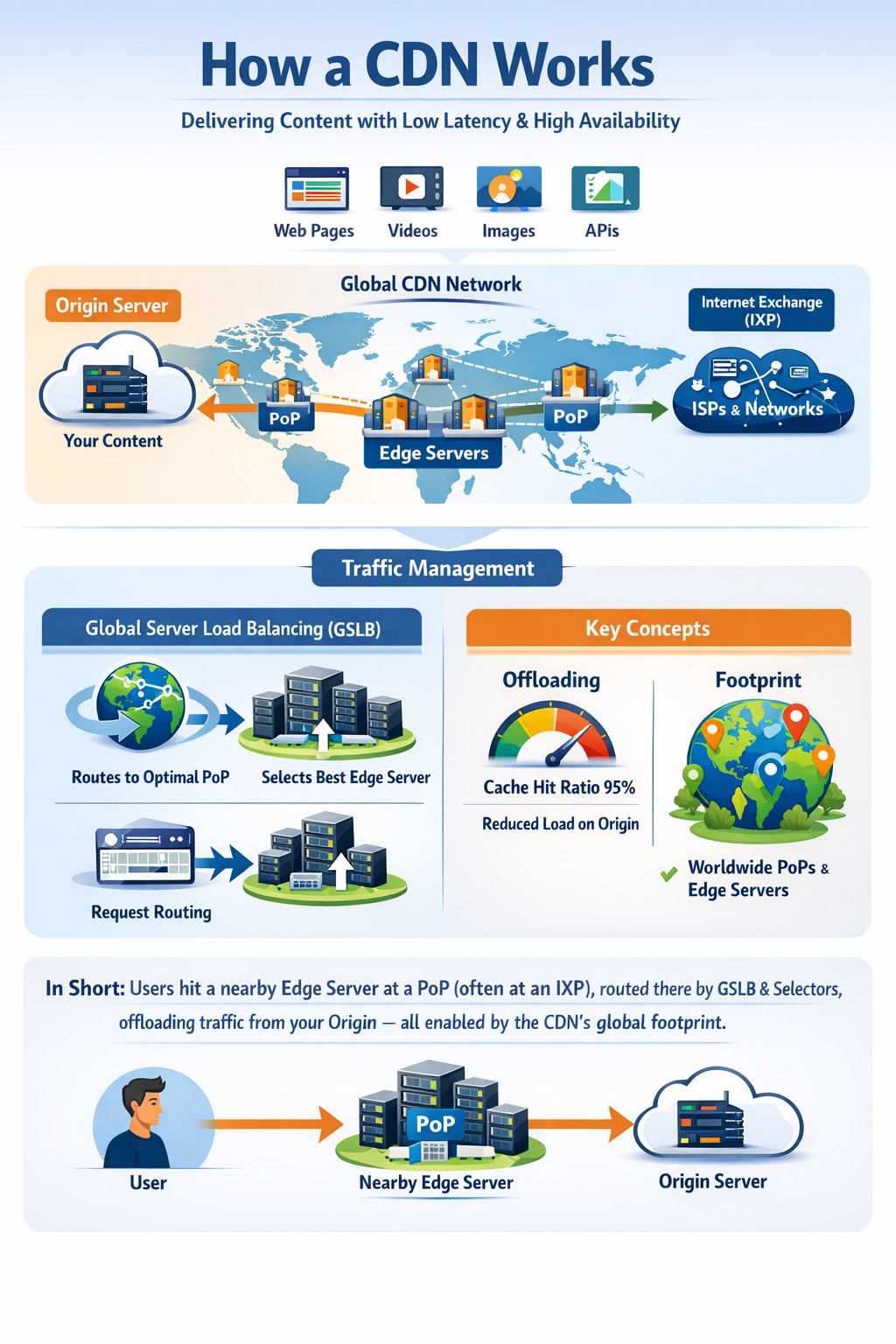
In Summary → Users hit a nearby edge server at a PoP (often at an IXP), routed there by GSLB/selectors, offloading traffic from your origin — all enabled by the CDN’s global footprint.
Type of CDNs
CDNs can be classified based on the networking techniques they use to route and deliver content →
- Anycast-Based CDN → Uses Border Gateway Protocol Anycast routing, where the same IP address is announced from multiple geographically distributed PoPs. Thus, when a user sends a request, the network’s BGP routing directs the packet to the nearest (in terms of network hops/latency) server advertising that IP. This is simple, fast failover, resilient to DDoS attacks (traffic is naturally distributed) and utilized by Cloudflare, Google Cloud CDN.
- DNS-Based CDN → Uses DNS resolution to direct users to the optimal edge server. Thus, a user request is resolved to a domain, the CDN’s authoritative DNS server returns the IP of the closest or least-loaded edge server based on the user’s location (via the resolver’s IP or EDNS Client Subnet). This provides fine-grained control over routing decisions (can factor in server load, geography, health). However, it suffers from DNS caching/TTL delays; routing is based on the DNS resolver’s location, not always the end user’s. Utilized by Akamai and Amazon CloudFront.
- Unicast-Based CDN → Uses a unique IP address for each edge server, and traffic is directed via DNS or application-layer logic. The CDN’s control plane decides which specific server IP to hand back for a given request. Although this provides full control over which server handles which request, it requires more complex routing logic at the application/DNS layer.
- Multicast-Based CDN → Uses IP Multicast to deliver the same content to multiple recipients simultaneously. A single stream is sent and replicated at network routers to reach all subscribers — avoids sending duplicate copies. This is extremely efficient for live streaming/broadcast scenarios. However, due to limited multicast support across the public internet it is mostly used within managed/private networks (IPTV, enterprise).
- Peer-to-Peer (P2P) Hybrid CDN → Combines traditional CDN edge servers with P2P networking among end users. Users who have already downloaded content share chunks with nearby peers, reducing load on origin/edge servers. This scales massively for popular content; reduces bandwidth costs. However, it heavily depends on peer availability this latency can vary. Moreover, it has potential security/privacy concerns.
- Application-Layer (Overlay) CDN → Builds a logical overlay network on top of the existing internet infrastructure, using application-layer routing. Edge servers communicate with each other through an optimized overlay topology (not relying on default BGP paths). Requests are routed through intermediate CDN nodes for optimal performance. It can optimize around congestion, packet loss, and suboptimal BGP routes with added complexity though. This also requires a sophisticated control plane.
Benefits & Use cases
CDN provides below benefits →
- Reduced Latency → CDNs cache content on edge servers geographically closer to users, drastically reducing round-trip time.
- High Availability & Redundancy → Traffic is distributed across multiple servers, so if one node fails, others handle requests seamlessly.
- Scalability → CDNs absorb traffic spikes (e.g., flash sales, viral content) without overloading the origin server.
- Bandwidth Cost Savings → Caching reduces the number of requests hitting the origin, lowering bandwidth and infrastructure costs.
- Security → Many CDNs offer DDoS mitigation, WAF (Web Application Firewall), and TLS termination at the edge.
- Improved SEO → Faster page loads positively impact search engine rankings.
Common Use Cases for CDN are →
- Static asset delivery → Images, CSS, JavaScript, fonts, and videos (e.g. social media sites).
- Video/audio streaming → Low-latency media delivery at scale (e.g., Netflix, YouTube).
- Software distribution → Serving binaries, patches, and updates (e.g., OS updates, game downloads).
- API acceleration → Caching API responses for read-heavy workloads.
- E-commerce → Handling global traffic with consistent performance during peak events.
In short, CDNs are essential for any application that serves content to a geographically distributed audience and needs fast, reliable delivery.
However, its imperative to know When Not to Use a CDN →
- Highly dynamic/personalized content → User-specific dashboards, real-time data feeds, or authenticated API responses gain minimal caching benefit.
- Real-time applications → WebSocket connections, live gaming, or chat systems require persistent connections poorly suited to CDN architecture.
- Geographically concentrated users → If your audience is near the origin server, a CDN adds unnecessary intermediary hops.
- Sensitive/regulated data → Distributing confidential or compliance-bound content (e.g., healthcare, financial) across third-party edge servers raises security and legal concerns.
- Small-scale projects → The operational complexity and cost outweigh performance gains for low-traffic applications.
Limitations
CDNs cache content at edge servers, but cache invalidation is complex — stale content can persist after updates. They add cost overhead (bandwidth fees, per-request charges) that may not justify the benefit for low-traffic sites.
CDNs offer limited control over edge server behavior and can introduce debugging complexity when issues arise across distributed nodes. They also have origin dependency — if your origin server fails, the CDN can only serve cached content until it expires.
Additionally, latency for cache misses can actually be higher than direct origin requests due to extra routing hops.
Conclusion
Content Delivery Networks have become a cornerstone of modern web architecture, ensuring that applications deliver fast, reliable, and secure experiences to users regardless of geography.
By caching content closer to end users, intelligently routing traffic, and providing resilience against spikes and failures, CDNs address the fundamental challenges of latency and scalability on the internet.
While they offer significant benefits — ranging from performance gains to cost savings and security enhancements — CDNs are not a one-size-fits-all solution. Their limitations, such as cache invalidation complexity and added operational overhead, must be carefully weighed against project needs.
For software engineers and architects, understanding when and how to leverage CDNs is critical to building systems that balance efficiency, reliability, and cost-effectiveness in a globally connected world.
References and Further Reads
Published at DZone with permission of Ammar Husain. See the original article here.
Opinions expressed by DZone contributors are their own.
Comments