

When Build-Time Infrastructure Assumptions Meet Real Hardware
As hardware evolves faster than infrastructure, build-time assumptions become liabilities and runtime adaptability becomes essential.
Join the DZone community and get the full member experience.
Join For Free“The greatest danger in times of turbulence is not the turbulence; it is to act with yesterday’s logic.” — Peter Drucker
Infrastructure rarely fails because hardware is new or still in beta testing. It fails because long-standing engineering assumptions are too rigid to support hardware that isn’t fully qualified yet but must still be made available to meet market demand. This article examines what happens when frequent server hardware updates collide with infrastructure designed for stability, and why early adopters are forced to rethink assumptions that once worked well.
When Infrastructure Assumptions Meet Real Hardware
A few years ago, cloud demand was manageable. Supply and demand were largely balanced, or at least infrastructure teams could meet demand through capacity extrapolation and careful planning. Post-COVID, work patterns changed significantly, and demand quickly outpaced supply. The rapid rise of AI workloads has pushed this gap even further.
Historically, infrastructure was designed around stable and predictable environments. New hardware typically had sufficient time to be qualified, vetted, and integrated into base infrastructure code. When issues occurred, they surfaced gradually, giving on-call engineers time to diagnose problems and apply fixes based on severity. That operating model no longer holds.
Cloud demand now shifts so rapidly that new hardware often needs to be production-ready before test equipment is even available. Validation happens only after hardware lands in production, and the window to bring systems online is extremely narrow. Delivery commitments, vendor delays, data-center power constraints, staffing shortages, and broader supply-chain limitations all compress timelines. This forces teams to revisit foundational design choices while operating under constant time pressure.
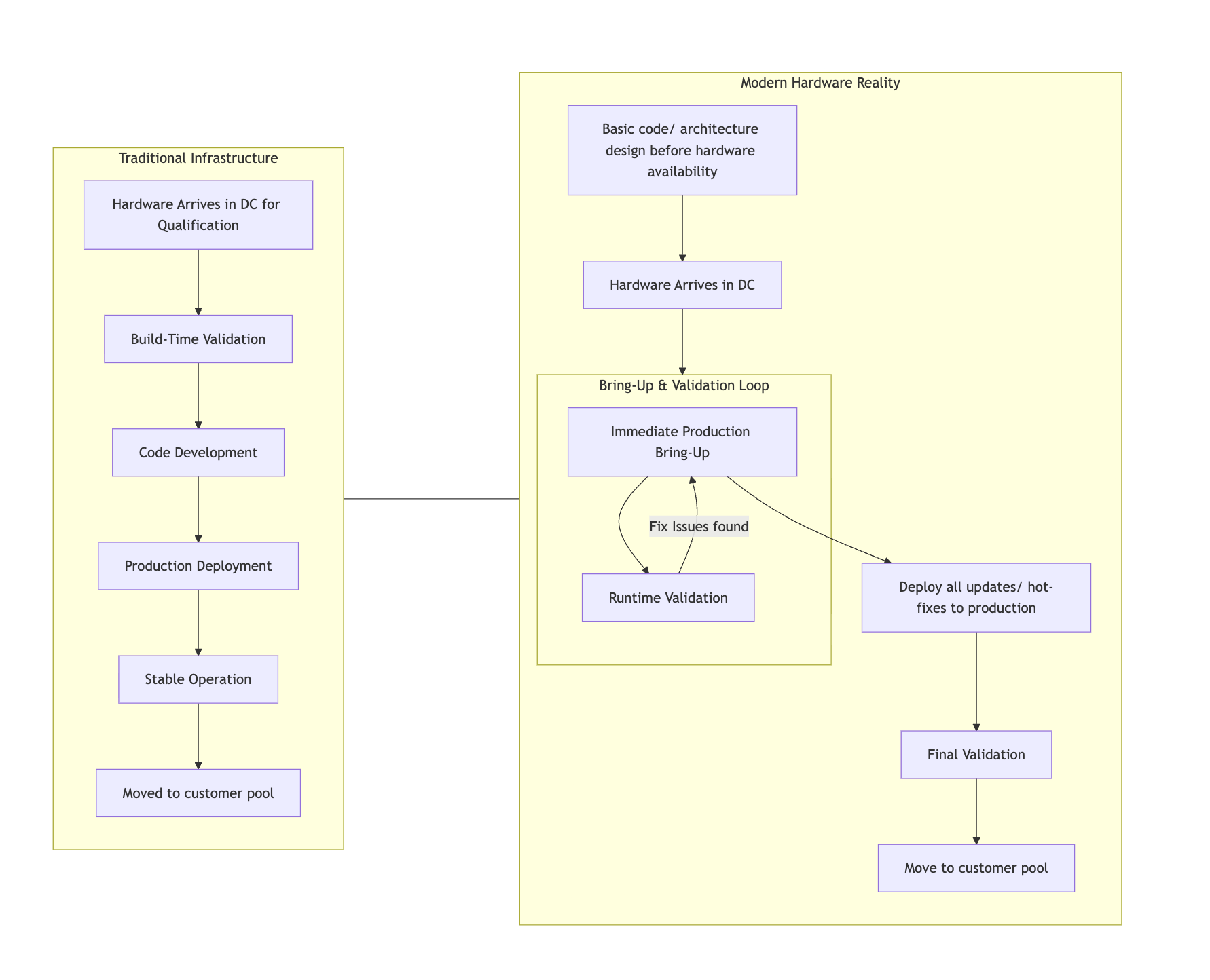
The Reality of Modern Hardware Fleets
Today, customers don’t just want new hardware; they want control over the firmware running on it. Experienced cloud users understand that adding more cores alone does not guarantee better performance. Firmware on components such as HostNICs, NVMe devices, and GPUs often plays a critical role in workload benchmarking and behavior.
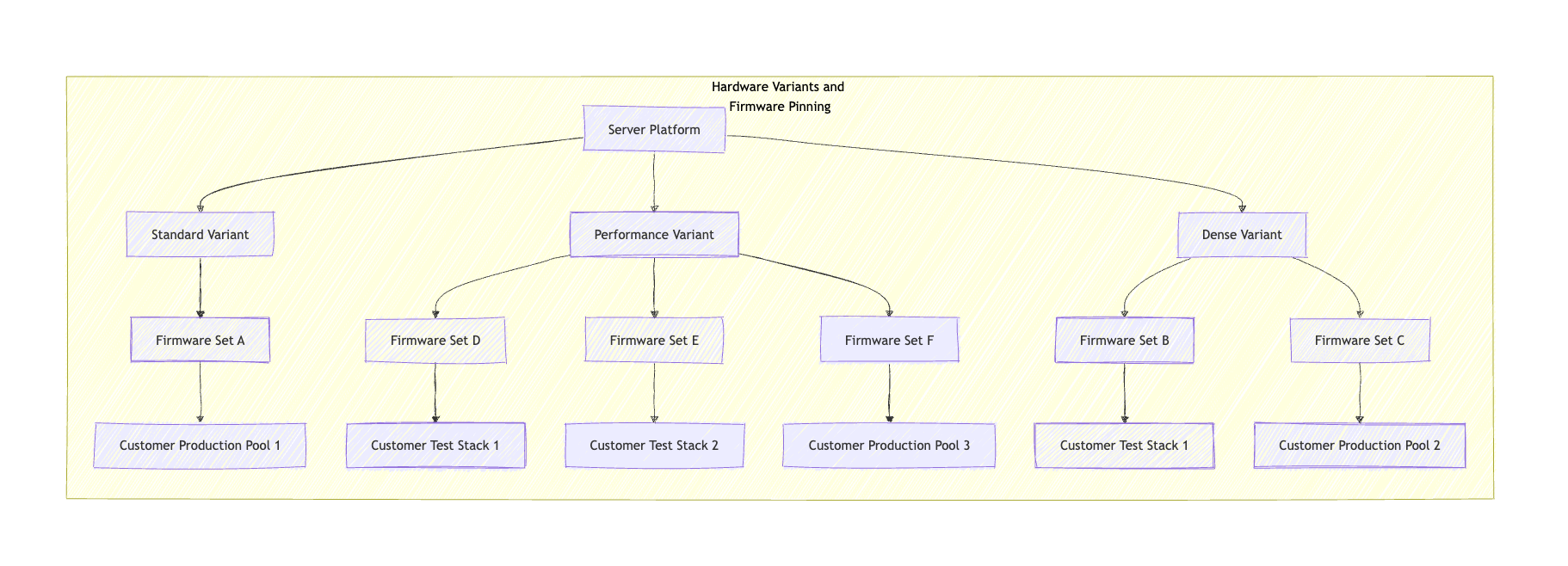
A growing pattern is for customers to run real workloads on a small subset of servers, benchmark performance, and then require those exact firmware versions to be pinned across their capacity pool. Early attempts relied on hardcoded server identifiers and limited external configuration checks to introduce flexibility. As requirements grew, so did the challenges. Hardware variants evolved rapidly, and platform definitions were no longer purely internal decisions. Customers began requesting multiple variants within the same platform: standard, dense, and performance-focused configurations.
Standard variants support general workloads. Dense variants prioritize memory and storage. Performance variants trade memory for bandwidth and throughput. If a new platform is qualified every other week, firmware pinning across these variants quickly grows into hundreds of combinations per year. Managing pinned firmware across customer-specific capacity pools becomes a constraint almost immediately. Uniform infrastructure stops being a reality and becomes an assumption.
How Assumptions Get Locked in Too Early
When remote work surged a few years ago, the immediate need was raw compute capacity and fast. In-house hardware could not keep up, so whitebox servers from external vendors became common.
There was no standard way to integrate third-party hardware into existing infrastructure while preserving customer experience and security guarantees. Teams modified proprietary hardware and altered software interactions to make it work. At the time, this felt like a one-time architectural decision, with the expectation that future variants would require only small, incremental changes.
Today, customers place letters of intent and commit to large-scale deals before the next generation of hardware reaches the market. Commitments are often made before hardware qualification is complete. At scale, even a 0.1% issue across a massive fleet becomes highly visible and demands explanation at the leadership level. Build-time validations lost relevance, and canaries became necessary to observe behavior across constantly changing hardware.
Moving Critical Decisions Later in the Lifecycle
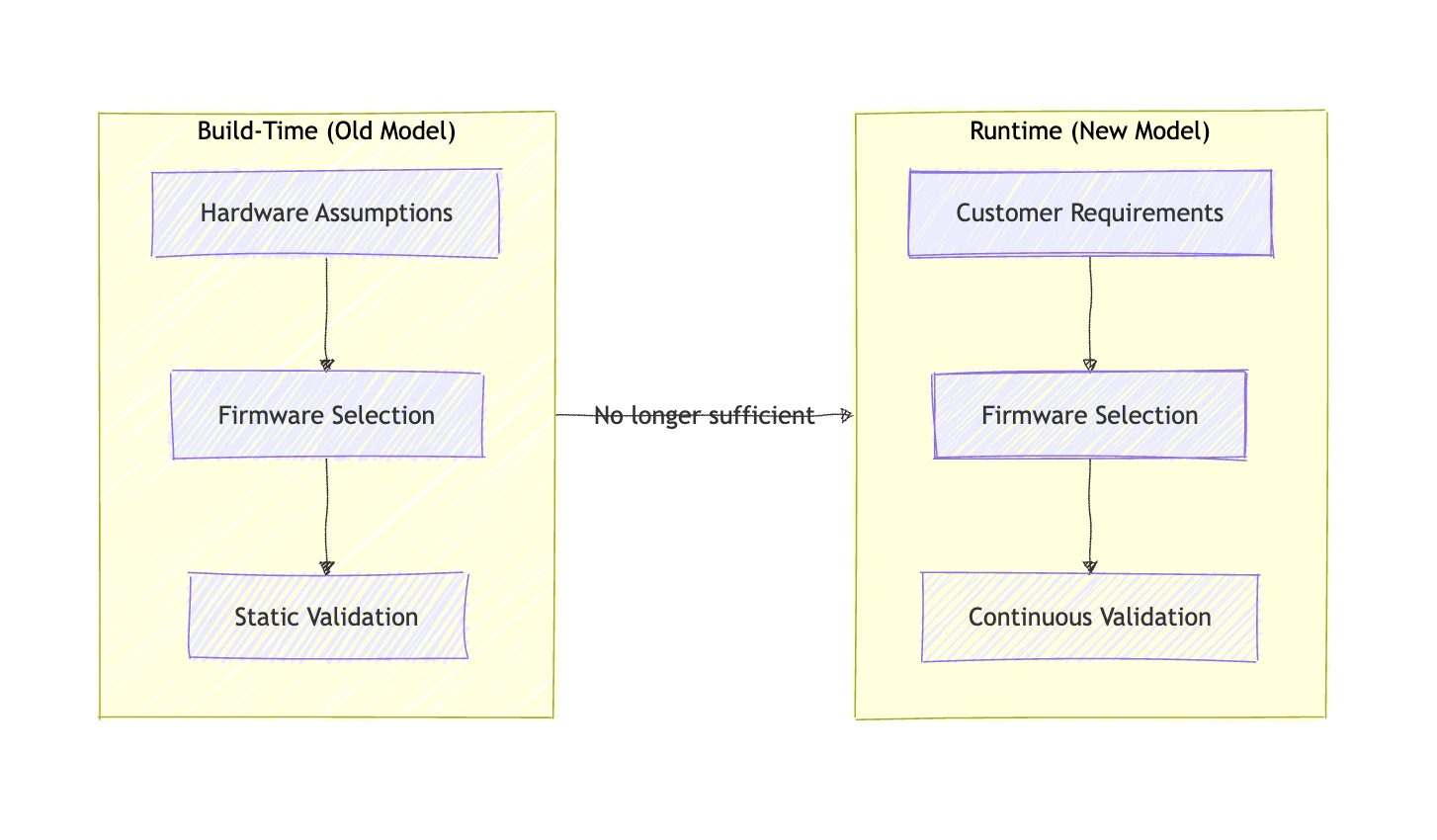
As customer requirements increased, infrastructure had to support variability, not just uniformity. Firmware selection shifted from a build-time decision to a customer-driven runtime choice.
Without an established design to support this, we built an in-house mechanism to pin firmware configurations per server platform and persist them across rebuilds. Infrastructure shifted from static capability to a dynamic runtime agreement defined by customers.
What began as a simple conditional code path evolved into a full-fledged Python-based system with its own repositories, eventually growing into a complex engine managing over 200 server platforms and customer-selectable firmware combinations. Solving the combinatorial problem at scale exposed another challenge: data reliability. Were customers actually receiving the firmware versions they requested? Did the system behave correctly as new hardware platforms and components were continuously added?
The short answer was no. Infrastructure that works 99.9% of the time can still cause significant damage in the remaining 0.1%. That gap is large enough to temporarily impact an entire region if not handled carefully. Rollback mechanisms became critical to restoring system health quickly.
The only reliable way to catch issues earlier was to introduce tighter validation just before placing servers into production pools. Component-level checks were no longer sufficient. Final validation expanded to ensure that components behaved correctly as a cohesive unit, providing greater confidence before hosts entered production.
The Trade-Offs This Approach Introduces
Firmware pinning satisfied customer requirements but introduced trade-offs. Implementation complexity increased, and correlating configuration combinations became harder over time. Managing version-set lifecycle and deprecation added operational overhead as combinations grew.
While the system worked for the intended use case, it was difficult to debug. Because version sets were generated at build time, making targeted customizations required careful changes without destabilizing the generation logic. Deprecated version sets could not simply be deleted, as they would be regenerated in subsequent builds, making it difficult to distinguish active and inactive configurations cleanly.
The solution worked, but it was not free. Maintenance and debuggability became ongoing costs rather than a one-time investment.
Key Technical Takeaways
- Avoid hardcoding assumptions about future hardware. The pace of hardware evolution now exceeds the pace at which infrastructure can be redesigned.
- Move critical decisions closer to runtime. Build-time validation alone is often insufficient when hardware qualification continues after systems enter production.
- Design for partial failure, not perfect execution. Recovery mechanisms, rollback paths, and targeted remediation workflows are often more valuable than additional happy-path automation.
- Treat configuration as a product, not a static artifact. Firmware versions, platform definitions, and customer-specific requirements eventually become operational dependencies that require ownership, testing, and lifecycle management.
- Optimize for adaptability as much as efficiency. Systems designed only for today’s hardware tend to become bottlenecks when new platforms arrive.
Designing for What Comes Next
There comes a point where you start to question whether a system has become too complex to solve future problems. Has the architecture evolved in a way that makes adding support for new hardware components increasingly difficult? Once other teams have onboarded onto the system, complexity tends to compound, and moving to a new architecture becomes significantly harder.
This raises a familiar set of questions. Should we design for flexibility, even if that introduces redundancy, or aim for a more rigid design that still supports new platforms efficiently? Each approach comes with trade-offs. This is not a school project where designs can be rewritten freely when they fall short. Customers are already using these systems, and even minor architectural changes can result in substantial financial and reputational impact.
The influx of next-generation platforms driven by AI demand is not slowing down, nor are customer expectations. In this environment, the most practical path forward is often an in-between architecture, one that allows new components to be added while maintaining resilience. Guardrails become essential when things break, and adaptability shifts from being a nice-to-have to a primary design goal.
For teams operating at this scale, the challenge is no longer choosing between stability and change, but learning how to design systems that can sustain both.
Opinions expressed by DZone contributors are their own.
Comments