

Building a Multi Tenancy Platform Using Camunda
This guide shows how to build a multi-tenant platform using Camunda BPM, covering AWS deployment, tenant isolation, upgrades, observability, and scaling best practices.
Camunda is an open-source workflow and decision automation platform for the modeling, execution, and monitoring of business processes following BPMN (Business Process Model and Notation), DMN (Decision Model and Notation), and CMMN. It is used for the orchestration of complex workflows among microservices, APIs, human tasks, and external systems. Camunda is embedded by developers into their applications to automate business logic, monitor process state, and bring operational transparency.
Camunda enables companies to orchestrate processes across people, systems, and devices to tame complexity continuously and drive efficiency. A common visual language enables business and IT teams to collaborate seamlessly in designing, automating, and optimizing end-to-end processes with the speed, scale, and resilience required to compete.
When companies scale their businesses, it becomes a requirement to support multiple business units, customers, or partners on the same infrastructure. This is where multi-tenancy is used. A multi-tenant architecture allows you to efficiently host multiple isolated tenants (e.g., customers, departments, or business domains) in one deployment. In workflow automation and process orchestration, Camunda BPM offers a powerful and flexible platform to build such platforms.
This article explains how to establish a multi-tenant workflow platform using Camunda BPM, including architectural strategies, isolation levels, implementation options, and best practices.
Multi-Tenancy Approaches in Camunda
Camunda BPM (particularly in version 7 and Camunda 8/Zeebe) offers flexibility to implement different levels of isolation. Here is one of the main approaches:
Shared Engine, Logical Isolation (Soft Multi-Tenancy)
Within a Shared Engine with Logical Isolation deployment, a single Camunda process engine instance is shared by several tenants, which are logically separated depending on identifiers like tenantId, custom variables, or HTTP headers. Even if the engine is shared, processes, data, and access of users are isolated at the application level in order to preserve tenant-specific visibility and control. This form is cheaper and simpler to manage than having a separate engine per tenant but must be well-designed to prevent cross-tenant data access or privilege escalation.
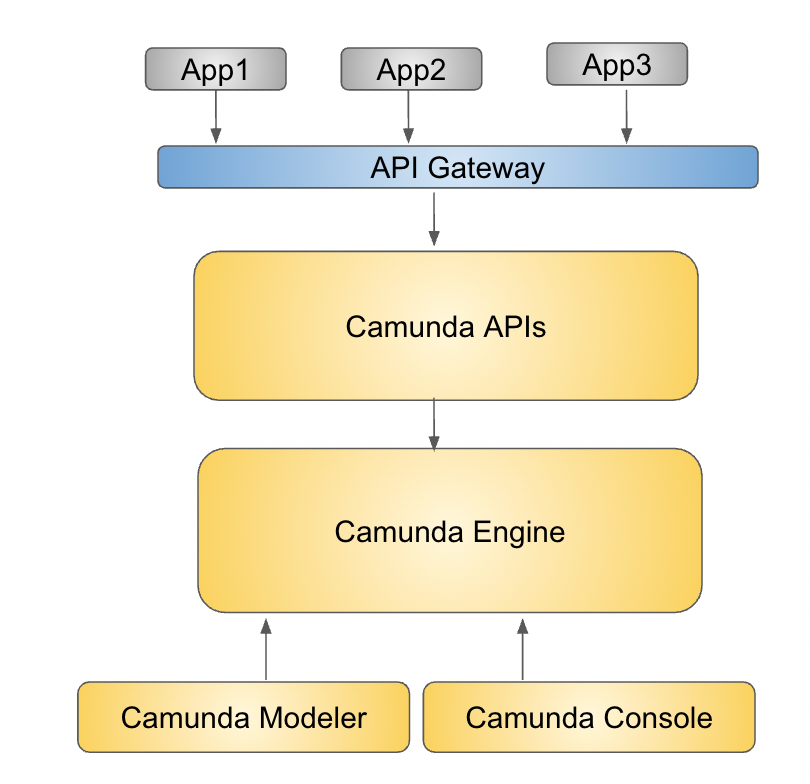
With the implementation of cloud technologies, Camunda can be deployed on AWS via a number of cloud-native patterns that support scalability, cost-effectiveness, and ease of use. The most common approach is to execute the Camunda engine as a containerized application on AWS Fargate or ECS in order to gain smooth scalability and minimal infrastructure management. Here, asynchronous or long-running tasks can be coded as AWS Lambda functions, which provide an on-demand scaling serverless execution layer. Amazon API Gateway is used for API requests to initiate or check workflows, and multi-tenant authentication and scoping are handled by AWS Cognito or an identity provider. For persistence, Amazon Aurora Serverless or Amazon DynamoDB could be utilized to save the execution data and tenant-specific metadata with flexibility and high availability.
To achieve resiliency on a worldwide basis, a multi-region deployment approach can be adopted. In this case, Camunda can be deployed across two or more AWS regions (such as us-east-1 and eu-west-1), with active-active or active-passive strategies:
Active-active: The Camunda engine runs in parallel in various regions, and requests are routed through Amazon Route 53 and global load balancers. Stateful elements (e.g., databases) use cross-region replication with Aurora Global Database or DynamoDB Global Tables and near real-time data synchronization.
Active-passive: All traffic is processed by the master region and the slave region is in standby mode. During regional failure, infrastructure gets automatically upgraded using Route 53 failover policies and infrastructure-as-code tools like Terraform or AWS CloudFormation to be fully functional again.
Camunda supports effective state management from DB, which makes the resiliency work in modern cloud technologies.
Under This Platform Model, the Shared Responsibility Model Becomes Crucial
Camunda (the platform team) is responsible for the shared process engine runtime consistency and reliability. Also creation of tenants and ensuring right granular access are granted to the underlying resources is the platform's responsibility.
The application team also has the responsibility to support tenant-conscious logic, enforce access restrictions, data segregation, and ensure workflows, APIs, and user interactions stay scoping to the correct tenant securely.
Tenants require strict boundaries and strict validation in code, APIs, and external task handlers to make certain that they keep tenant isolation and meet compliance or business integrity demands.
Challenges and How to Overcome Them in This Model
- Versioning and upgrading the shared Camunda engine or process models can pose risks to all tenants if not managed via blue/green or canary deployment strategies.
- Make sure blue/green deployments are enabled for Camunda version upgrades and corresponding DB scripts are executed based on camunda’s release notes
- Ensure the models are version controlled and built for backward compatible ways to enable old process instances to continue to work without any breaking changes.
2. Observability across the entire system is another concern, as monitoring needs to cover distributed AWS services, Camunda logs, and workflow traces, often requiring unified dashboards and tracing tools like Otel and Application logs. Enable Tenant’s dashboards for easy troubleshooting and monitoring
- Enable self servicing capabilities to eliminate the burden on platform teams and enable smooth onboarding tenant experience. Have good documentation on enabling tenants to leverage the platform effectively
This approach unlocks the possibility of reusing platforms and delivering business process solutions at enterprise-level commitments—without compromising performance, cost savings, or dependability.
Published at DZone with permission of Lakshmi Narayana Rasalay. See the original article here.
Opinions expressed by DZone contributors are their own.
Comments