

Building Production-Grade GenAI on GCP with Vertex AI Agent Builder
GenAI is easy to prototype but hard to productionize. Vertex AI Agent Builder provides a unified platform for RAG, orchestration, security, and scalable deployment.
 ·
·
Join the DZone community and get the full member experience.
Join For FreeEvidence of the ideas behind generative AI is not challenging to build, but the barrier between experimentation and production presents another group of concerns: repeatability, workflow predictability, safety, tracking, and scalability. The quality of the model is often not the bottleneck, and many teams find it challenging to apply GenAI into real systems and have enterprise-grade level guarantees. The Vertex AI Agent Builder offered by Google Cloud fills the gap with a managed infrastructure of deploying intelligent agents run on Gemini models, generation based on retrieval-augmented generation (RAG), and tools orchestration. In place of manually configuring a collection of services, Agent Builder is a unified runtime that allows balanced application development, both data grounding and deployment as well as monitoring, to be authored in GenAI.
Architecture Foundations for Production GenAI
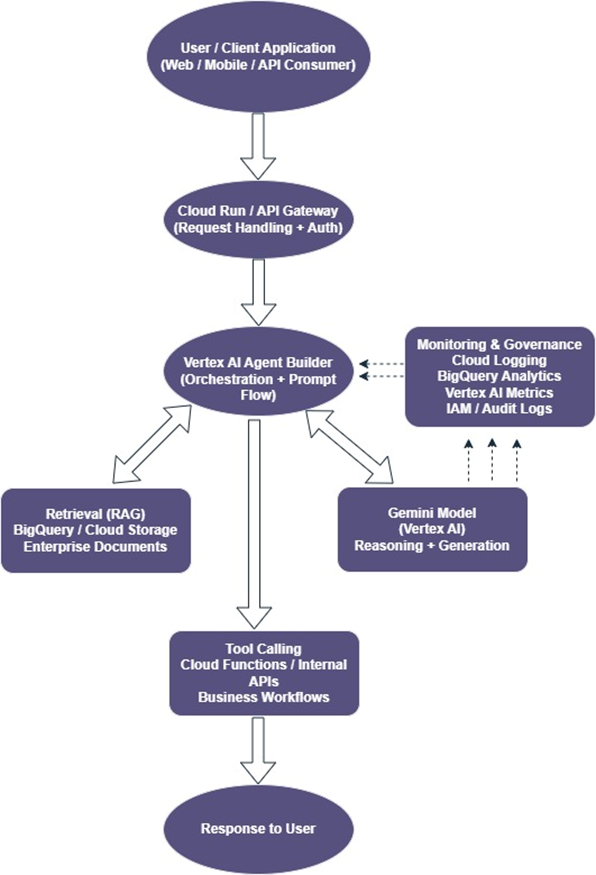
A GenAI system on GCP that is production-grade is usually designed to have a layered architecture. The client applications communicate with Cloud Run or API Gateway and send requests to agents that are hosted by Vertex AI Agent Builder. Such agents plan prompts, access contextual information in indexed enterprise datastores like Big Query or Cloud Storage, reason using Gemini models and access external (or internal) tools (including Cloud Functions and internal APIs) when necessary. This division of labor enables frontend services, agent logic and knowledge systems to scale independently, without involving business workflows in immediate templates.
The fundamental unit of this architecture is Retrieval Augmented Generation. In the absence of RAG, the model only uses pretrained knowledge and therefore, it tends to hallucinate or provide general answers. The use of agent Builder supports native indexing over both structured and unstructured data, thus enabling the application of outputs by applications to be based on actual organizational content. Documents are divided, inserted and filled with metadata to enable retrieval based on access level, department or domain. This practically forms a pipeline whereby user queries activate retrieval, dynamically assembled relevant context is formed and responses are produced by Gemini based on authoritative data. This method is much more accurate but flexible because the knowledge of the enterprise is going to change.
Production GenAI Architecture Using Vertex AI Agent Builder on GCP
Orchestration, Security, and Operational Readiness
Recent GenAI applications do not typically limit themselves to text generation. There are databases, ticketing systems, and business services that must be touched by the production agents. Vertex AI Agent Builder allows the calling of tools so that models can invoke external actions like asking the status of orders, creating support tickets or running workflows. The teams do not have to write the logic inside prompts but can define structured flows using the assistance of Agent Builder, Cloud Workflows, or event-driven Cloud Functions. This renders orchestration checkable and verifiable whilst allowing the model to focus on argumentation and language production. Security is also the important thing. Vertex AI is connected to GCP IAM directly, allowing role-to-agent and role-to-dataset access as well as supporting service-to-service authentication. Sensitive areas may be covered in retrieval, audit logs can be viewed on the interactions of the agents, and VPC Service Controls are used to provide a boundary on data. Such capabilities are required in controlled settings where GenAI must abide by the current governance systems. Making agents like any other production service, which is subject to identity management, network controls, and logging, makes GenAI not an exception in architecture.
Observability, Deployment, and Continuous Improvement
The operational risk of deploying GenAI is that it is not observable. Vertex AI also offers logging of requests, latency, and tracing of the usage of tokens, although production teams often go further and export interaction data to BigQuery to analyze it offline. Gaining feedback on users, assessing response quality and versioning allows constant improvement, without destabilizing production systems. Another typical trend is to A/B test the promotion of prompt or agent changes in staging before they go to production, as with the traditional software release process.
During deployment, the teams tend to open the agents through secured endpoints enabled by Cloud Run, manage the infrastructure with the help of Terraform, and create CI/CD pipelines to modify agent settings. This ensures that it can be replicated and it has reduced manual effort. Like traditional microservice ecosystems, successful GenAI platforms can be said to be monitored, versioned and constantly optimized in the long term. Vertex AI Agent Builder makes this process faster by bringing models, retrieval, orchestration and governance together on a single platform, which enables engineering teams to build reliable products instead of gluing the infrastructure together.
Finally, GenAI in its production form will not be about access to powerful models, but rather the construction of robust systems to run them. Verse AI Agent Builder enables organizations to push agent deployment that is based on enterprise data, with cloud-native controls, and enhanced by feedback loops that are measurable to go to dependable applications.
Conclusion
Bringing GenAI out of the prototype and into production takes much more than model integration, it needs to be reliable in retrieval, deterministic in orchestration, hard security boundaries and continuously observable. The Vertex AI Agent Builder, offered by Google Cloud, unites all these abilities into one platform so that the teams can develop agents whose foundation lies in enterprise data, which relates to actual business processes and are controlled by cloud-native mechanisms. The integration of the Gemini models with Retrieval Augmented Generation, tool calling, and the operational ecosystem of GCP would enable organizations to implement scalable GenAI-based systems, which act similarly to the other production services. With enterprises becoming more entangled into AI-driven applications, they will find success once they start considering GenAI as part of infrastructure and not an experimental setup. Vertex AI Agent Builder can help speed up this shift by lowering the complexity of the existing architecture and allowing an engineering team to concentrate on the provision of quantifiable business value by offering reliable and production-ready intelligent systems.
Opinions expressed by DZone contributors are their own.
Comments