

Emerging Patterns in Large-Scale Event-Driven AI Systems
Build scalable AI event pipelines with Kafka to enable continuous learning systems that perceive, reason, and act in real time.
Join the DZone community and get the full member experience.
Join For FreeModern distributed systems are increasingly being transformed by event-driven architectures (EDA) and the integration of artificial intelligence (AI). Organizations across FinTech, e-commerce, and IoT domains are moving from static request–response models to asynchronous, event-driven systems capable of processing billions of transactions in near real time.
The traditional AI pipeline, train → deploy → infer, is designed for batch use and is effective when insights can wait. However, there are domains in which decisive action must occur immediately, for example, fraud detection, IoT telemetry, or autonomous navigation. Waiting would be an unacceptable risk.
With the introduction of AI-based decisioning and autonomous event processing, some new architectural decisions must be made. Traditional event-streaming systems, based on event-triggered rule-based stream processors, have no way to accommodate changing data semantics, anomalies, or contextual intelligence. In light of these shortcomings, architects are implementing AI-augmented, event-driven architectures that enable dynamic routing, intelligent correlation, and autonomous system action.
For instance, a financial application that processes millions of transactions per hour must detect suspicious activity as, or before, it happens. Each transaction event triggers an ML model that determines the probability of fraud. Depending on this outcome, downstream actions taken by the system can inform an immediate alert, a temporary hold, or continued approval, all within a matter of milliseconds.
This article discusses the emerging architectural orientations, design drivers, and implementation methods for building event-driven AI solutions at scale with scalability, fault tolerance, and adaptive intelligence. By the end, readers will understand:
- How EDA and AI integrate to build intelligent, reactive systems.
- Core design patterns for scaling AI in event-driven environments.
- A practical implementation snapshot in Python with Kafka Streams.
- Key challenges and research directions shaping the next generation of event-driven intelligence.
Evolution of Event-Driven Systems
Event-driven systems were initially designed to decouple producers and consumers, allowing systems to react to changes asynchronously. Early implementations centered on publish–subscribe or queue-based messaging (e.g., RabbitMQ).
With the rise of cloud-native technologies and streaming platforms such as Apache Kafka, AWS Kinesis, and Azure Event Hubs, event-driven architecture has become the foundation for microservice-based ecosystems. These systems handle massive data streams, offering horizontal scalability, partitioning, and guaranteed delivery.
Today’s evolution extends beyond streaming into cognitive event processing, where AI models interpret, enrich, and prioritize events based on learned patterns rather than static logic. This convergence has birthed event-driven AI systems (EDAIS): systems that not only respond to events but also understand and optimize them dynamically.
Architectural Foundations
- Event sources: IoT sensors, application logs, financial transactions, or user actions.
- Event broker: Platforms like Apache Kafka or Apache Pulsar manage reliable, scalable event distribution.
- AI processing layer: Worker processor powered by LLM.
- Action/feedback layer: Persists enriched data, triggers alerts, or invokes downstream systems for response.
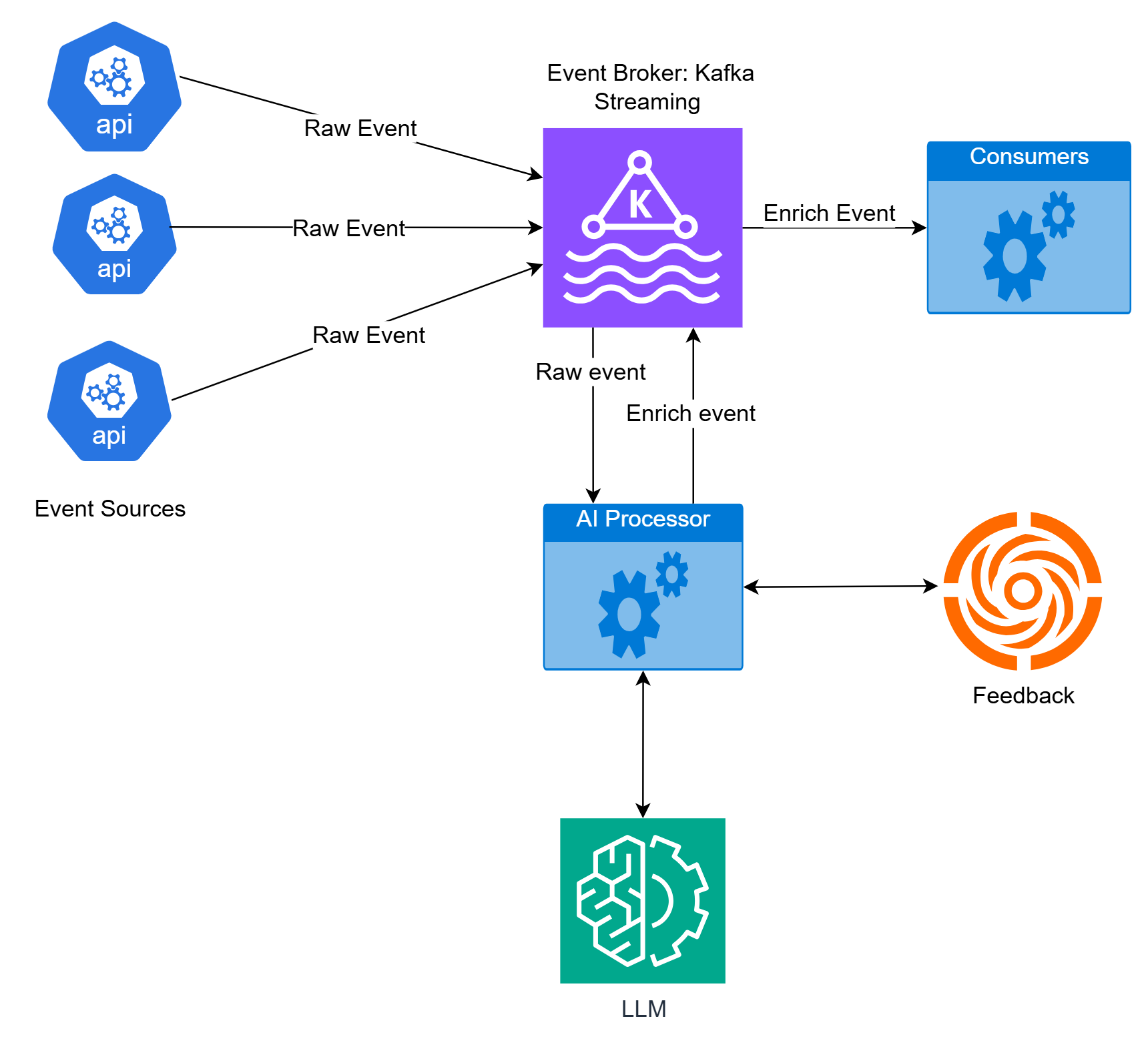
This architecture allows systems not just to respond to events but to understand and optimize them. In advanced setups, AI models embedded within the event pipeline can dynamically classify, correlate, or prioritize events, while feedback loops continuously refine model accuracy.
Emerging Patterns in Event-Driven AI Systems
Below are the key patterns shaping next-generation large-scale event-driven AI architectures.
1. Intelligent Event Enrichment (Model-as-a-Service)
Events are enriched with contextual or semantic data before reaching consumers. AI models deployed as microservices process raw events in-stream.
Example: A bank transaction is augmented with customer risk scores, geo-location patterns, or spending anomalies.
AI models are exposed as asynchronous microservices.
- Each model consumes events, processes them, and emits new events.
- Brokers handle inference requests/responses, enabling parallel scaling and multi-model orchestration.
Example: NLP Intent Detection Service
from kafka import KafkaConsumer, KafkaProducer
from transformers import AutoModelForSequenceClassification, AutoTokenizer
import torch
import json

# Kafka setup
consumer = KafkaConsumer(
    'user_messages',
    bootstrap_servers='localhost:9092',
    auto_offset_reset='earliest'
)
producer = KafkaProducer(bootstrap_servers='localhost:9092')

# Load NLP model
model_name = "distilbert-base-uncased"
model = AutoModelForSequenceClassification.from_pretrained(model_name)
tokenizer = AutoTokenizer.from_pretrained(model_name)

for message in consumer:
    # Deserialize event
    event = json.loads(message.value.decode('utf-8'))

    # Perform intent prediction
    inputs = tokenizer(event['message_text'], return_tensors='pt')
    outputs = model(**inputs)
    intent = torch.argmax(outputs.logits, dim=1).item()

    # Enrich event with predicted intent
    event['predicted_intent'] = intent

    # Serialize and send enriched event
    producer.send('enriched_user_messages', json.dumps(event).encode('utf-8'))
This allows AI models to scale independently from other services and handle high event throughput.
2. Stream-Aware Processing With Dynamic Routing
Instead of batch inference, AI models process events directly from streams using frameworks such as Apache Flink, Spark Structured Streaming, or Kafka Streams. This approach enables low-latency, real-time predictions, while dynamic routing steers events based on model output or contextual intelligence.
Key benefits:
- Reduces latency, enabling real-time predictions.
- Supports adaptive workflows by routing events to appropriate services or queues.
- Particularly useful for social media sentiment analysis, autonomous navigation, fraud detection, or dynamic pricing systems.
This enables real-time inference for applications like social media sentiment analysis, autonomous navigation, or dynamic pricing systems.
Example: Real-time sentiment detection with dynamic routing (PySpark Streaming):
from kafka import KafkaConsumer, KafkaProducer
from transformers import AutoModelForSequenceClassification, AutoTokenizer
import torch, json

# Kafka setup
consumer = KafkaConsumer('user_messages', bootstrap_servers='localhost:9092', auto_offset_reset='earliest')
producer_high = KafkaProducer(bootstrap_servers='localhost:9092')
producer_low = KafkaProducer(bootstrap_servers='localhost:9092')

# Load NLP model
model_name = "distilbert-base-uncased"
model = AutoModelForSequenceClassification.from_pretrained(model_name)
tokenizer = AutoTokenizer.from_pretrained(model_name)

for message in consumer:
    event = json.loads(message.value.decode('utf-8'))

    # Stream-aware processing: predict intent
    inputs = tokenizer(event['message_text'], return_tensors='pt')
    outputs = model(**inputs)
    intent_score = torch.softmax(outputs.logits, dim=1)[0][1].item()  # example probability

    # Dynamic routing based on model output
    if intent_score > 0.7:
        producer_high.send('high_priority_intents', json.dumps(event).encode('utf-8'))
    else:
        producer_low.send('low_priority_intents', json.dumps(event).encode('utf-8'))
3. Federated Event Processing and Predictive Scaling
When data is sensitive or distributed, AI inference can happen locally at the edge, and only aggregated insights or model updates are sent upstream.
Benefits:
- Preserves privacy
- Reduces network bandwidth
- Supports scalable edge deployments
Example use case: Drones performing real-time video analysis detect anomalies locally and send only summarized event metadata.
from kafka import KafkaProducer
import random, json

# Simulated edge device processing
producer = KafkaProducer(bootstrap_servers='localhost:9092')

def process_sensor(sensor_data):
    # Local edge inference
    anomaly_detected = random.random() > 0.8
    # Only send summary to central system
    summary_event = {'sensor_id': sensor_data['id'], 'anomaly': anomaly_detected}
    producer.send('sensor_summaries', json.dumps(summary_event).encode('utf-8'))

# Example usage
sensor_data = {'id': 'sensor_001', 'temperature': 72.5}
process_sensor(sensor_data)
4. Feedback-Driven Self-Learning Pipelines
Traditional models degrade over time due to data drift. Event-driven AI systems close this gap by automating retraining through event triggers.
- Data drift events initiate partial retraining pipelines.
- Anomaly-detection events can trigger parameter updates or recalibration of features.
This enables continuous learning loops in which AI models evolve in response to real-time changes in event distributions.
from kafka import KafkaConsumer, KafkaProducer
import json
import random

consumer = KafkaConsumer('fraud_predictions', bootstrap_servers='localhost:9092', auto_offset_reset='earliest')
producer = KafkaProducer(bootstrap_servers='localhost:9092')

for message in consumer:
    event = json.loads(message.value.decode('utf-8'))

    # Simulate post-consumption feedback
    confirmed_fraud = random.choice([True, False])
    event['feedback'] = confirmed_fraud

    # Send feedback to retraining topic
    producer.send('retraining_events', json.dumps(event).encode('utf-8'))
5. Multi-Agent Collaboration/Hybrid Orchestration
Pure orchestration (central control) can limit scalability, while pure choreography (event-only coordination) can reduce visibility. A hybrid orchestration pattern balances both.
- Centralized orchestration manages workflows, model deployment, and dependency resolution.
- Event-driven choreography handles runtime adaptivity, dynamic routing, re-prioritization, and scaling.
This pattern is critical in AI-driven microservices ecosystems, where multiple models and pipelines must interact autonomously while maintaining global oversight.
Design Considerations and Observability
Building AI-augmented event-driven systems introduces unique architectural challenges:
1. Latency vs. Intelligence
Embedding inference in real-time streams may increase latency. Solutions include:
- Async inference using background consumers.
- Edge caching for frequent model calls.
- Adaptive batching for high-throughput inference.
2. Model Drift and Retraining Governance
Use tools like MLflow, BentoML, or Kubeflow Pipelines to track model versions, retraining events, and accuracy decay.
3. Distributed Observability
Leverage OpenTelemetry for tracing events across brokers, AI inference services, and consumer pipelines.
Event lineage metadata should record:
- Which event triggered inference
- Which model and version handled it
- Inference outcome and confidence score
4. Explainability and Compliance
AI events must include explainability metadata, and each inference output can attach interpretability vectors or SHAP scores for downstream auditing.
Key Technologies Powering Event-Driven AI
| Category | Technologies |
|---|---|
| Event Streaming | Apache Kafka, Redpanda, Apache Pulsar |
| Stream Processing | Apache Flink, Spark Structured Streaming |
| Model Serving | TensorFlow Serving, TorchServe, Ray Serve, BentoML |
| Workflow Orchestration | Kubeflow, Airflow, Prefect, Temporal |
| Observability | OpenTelemetry, Grafana, Prometheus |
| Multi-Agent Frameworks | LangGraph, AutoGen, CrewAI |
These technologies form the backbone of event-driven AI ecosystems, enabling resilience, scalability, and adaptive intelligence.
Challenges and Future Research Directions
Despite their promise, large-scale event-driven AI systems face unresolved challenges:
- Consistency across distributed AI components. Maintaining synchronized model versions and event states in global deployments remains complex.
- Balancing throughput and inference latency. Optimizing inference pipelines for ultra-low-latency use cases (like trading systems) demands hybrid CPU/GPU scheduling.
- Trustworthy AI in asynchronous contexts. Ensuring fairness, explainability, and non-deterministic behavior under concurrent event flows requires new governance models.
- Integrating LLMs and multi-agent systems. Emerging Agentic AI paradigms enable autonomous agents to subscribe to streams, reason contextually, and execute adaptive routing. These multi-agent architectures could redefine event orchestration into self-managing, intelligent ecosystems.
Some Real-World Use Cases
FinTech Fraud Detection
Financial institutions leverage event-driven AI to process transactions in milliseconds. Anomalies detected in event streams trigger adaptive routing to fraud investigation services.
E-Commerce Personalization
User clickstream events are continuously analyzed by reinforcement models to update product recommendations in near real time.
Cloud Platform Resilience
Large-scale cloud systems use event-driven AI to detect degradation patterns in telemetry data and automatically re-route workloads or restart failing services.
Conclusion: From Reactive to Proactive Intelligence
Event-driven AI systems represent a paradigm shift, merging the scalability of event-driven architecture with the adaptability of AI.
Emerging patterns such as model-as-a-service, stream-aware AI, federated inference, event-driven retraining, and hybrid orchestration are transforming how intelligent systems learn, react, and evolve.
The next wave, powered by Agentic AI, will move systems beyond reaction and into proactive, self-optimizing intelligence, where every event becomes both a signal and a learning opportunity.
Opinions expressed by DZone contributors are their own.
Comments