

The Citizen Developer Boom: How Generative AI Lowers the Barrier to Entry
Traditional "Citizen Development" initiatives often fail due to skill gaps and lack of support. Here's a pattern for democratizing development by using GenAI APIs.
Join the DZone community and get the full member experience.
Join For FreeFor years, enterprises have chased the dream of “Citizen Development”—empowering non-engineers to build their own tools using low-code/no-code platforms. The promise is enticing: business users solve their own problems, IT backlogs shrink, and innovation accelerates.
However, the reality is often different. Adoption stalls because the “low-code” barrier is still too high for the average employee. They get stuck on API integration, basic logic flow, or security compliance.
Recent internal data suggests that Generative AI (GenAI) is the missing catalyst. By providing a secure, internal chat API, organizations can trigger a massive surge in grassroots development.
This article outlines an architectural pattern for deploying an internal GenAI API that empowers employees to build their own tools securely and efficiently.
The Problem: The “Blank Slate” Paralysis
When you give a business analyst a Power Platform or Salesforce license, they face a “blank slate.” They know what they want to solve (e.g., automate invoice processing), but they don’t know how to structure the logic.
Citizen Development initiatives typically fail due to:
- Technical complexity: Even low-code tools require understanding data types, loops, and conditions.
- Security fears: Employees worry about “shadow IT” risks, such as leaking data or creating vulnerabilities.
- Lack of support: IT departments are often too busy to mentor thousands of potential citizen developers.
The Solution: A Secure GenAI API Gateway
Instead of just giving employees a chat interface (like ChatGPT), provide them with a GenAI API. This allows them to integrate AI reasoning directly into their scripts, spreadsheets, and low-code apps.
Architecture: The Chat Wrapper
To make this safe and accessible, you don’t expose raw OpenAI or Azure API keys directly. Instead, you wrap them in an internal gateway service.
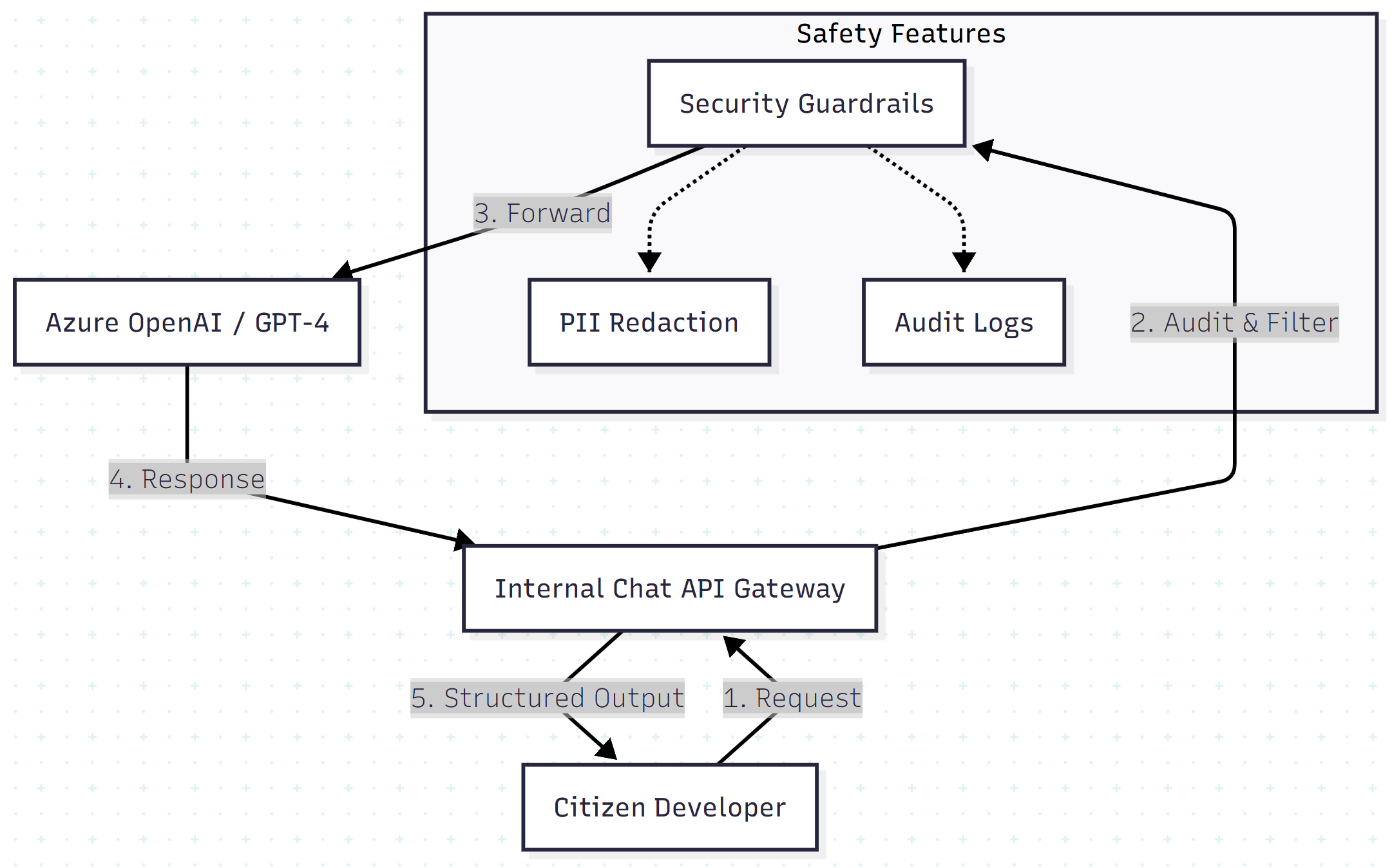
Key Architectural Features:
- Token management: The gateway handles authentication, so users don’t manage sensitive keys.
- Grounding: The API can be configured to search internal intranets (RAG) before answering, reducing hallucinations.
- Output sanitization: Responses are checked for policy violations before reaching the user.
Use Case 1: DocTalker (No-Code RAG)
One of the first apps to emerge from this pattern was a simple tool called DocTalker. A non-developer in HR wanted to extract specific clauses from hundreds of PDF contracts.
Using the internal chat API, they built a script that:
- Extracts text from a PDF
- Sends chunks to the API with a prompt: “Extract the termination clause from this text.”
- Saves the result to Excel
The impact: What previously required a dedicated engineering team to build a “Contract Analysis System” was built by a business user in an afternoon.
Use Case 2: AIm² (Meeting Analytics)
Another citizen developer combined the API with a meeting transcript tool. The app analyzes hours of meeting logs and outputs a structured JSON summary containing:
- Decisions made
- Action items (assigned to specific people)
- Sentiment analysis
Because the API handles the “intelligence,” the citizen developer only had to write the “glue code” to move text from A to B.
Empowering the User: The “Prompt Recipe” Library
Providing an API isn’t enough; you must teach people how to prompt. Successful implementations include a “Prompt Recipe” portal — a GitHub-like repository for prompts.
Example recipe for Python developers:
# Recipe: SQL Query Generator
# Use this to let business users query databases using natural language.

import requests

def generate_sql(user_question):
    prompt = f"""
    You are a SQL expert. Convert this question into a SQL query for table 'Sales':
    Columns: Date, Region, Amount, Product.
    Question: {user_question}
    SQL:
    """
    response = requests.post("https://api.internal/chatai", json={"prompt": prompt})
    return response.json()['text']
By copying these snippets, employees learn by doing. They start by modifying existing code and eventually learn to write their own.
Results: The “Boom” in Numbers
In a case study at Fujitsu, releasing this internal API resulted in:
- 4,000+ registered developers: Employees from non-technical departments signed up to use the API.
- 600,000+ requests per month: Sustained activity indicating real business value, not novelty usage.
- 30+ production apps: Tools for translation, document analysis, and coding assistance built without central IT involvement.
Conclusion
Generative AI is the ultimate low-code platform. It translates human intent into machine action. By exposing this capability via a secure, internal API, you remove the steepest barrier to Citizen Development.
The takeaway: Don’t just give your employees a chatbot. Give them the API — and let them build the tools they actually need.
Opinions expressed by DZone contributors are their own.
Comments