

Design and Implementation of Cloud-Native Microservice Architectures for Scalable Insurance Analytics Platforms
How cloud-native microservices transform insurance analytics by enabling scalability, real-time processing, and seamless modernization of legacy platforms.
 ·
·
Join the DZone community and get the full member experience.
Join For FreeObjective Statement
This study proposes a scalable, modular, and cloud-native microservice architecture tailored for the insurance industry. The goal is to enable rapid enterprise-wide analytics adoption, seamless AI integration, and real-time data processing through containerization, orchestration, and service-based deployment models that enhance scalability, agility, and system resilience.
Problem Context
Although insurers are among the earliest adopters of artificial intelligence, fewer than 10% have successfully scaled AI initiatives beyond pilot programs. Most struggle with monolithic legacy systems, fragmented data pipelines, and rigid IT infrastructures that limit agility and interoperability. Insights from Risk & Insurance (2024) and McKinsey & Company (2014–2023) reveal that organizational silos and outdated core technologies prevent carriers from realizing the full business value of analytics. Addressing this gap requires a cloud-native, microservice-based architecture capable of supporting continuous delivery, real-time analytics, and ecosystem-wide integration.
Abstract
The rapid digital transformation of the insurance industry has intensified the need for scalable, adaptive, and interoperable analytics infrastructures. Despite extensive experimentation with artificial intelligence (AI) and machine learning (ML), fewer than 10% of insurers have successfully scaled such initiatives beyond pilot phases, primarily due to legacy systems, data silos, and architectural rigidity.
This study presents the design and implementation of a cloud-native microservice architecture for scalable insurance analytics platforms, integrating modern DevOps pipelines, container orchestration, and distributed data frameworks to achieve agility, resilience, and continuous delivery. Drawing on industry findings from McKinsey & Company and Risk & Insurance, the paper illustrates how modularized services implemented using technologies such as Docker, Kubernetes, Kafka, and Spark can accelerate predictive model deployment, improve system interoperability, and reduce operational latency.
The proposed architecture aligns with global technology trends, including AI-driven decisioning, distributed infrastructure, and next-generation connectivity, enabling insurers to transition from reactive to predictive business models. Performance evaluation demonstrates improved scalability, cost efficiency, and time-to-market compared to traditional monolithic systems. The results confirm that a microservice-based, cloud-native architecture can serve as a strategic enabler for the next generation of insurance analytics and AI ecosystems.
Keywords: Cloud-Native Architecture · Microservices · Insurance Analytics · Artificial Intelligence · Scalability · Kubernetes · DevOps · Distributed Systems
1. Introduction
The insurance industry is experiencing an unprecedented technological transformation driven by data proliferation, cloud computing, and artificial intelligence (AI). In principle, insurers possess rich historical datasets spanning decades of policy, claims, and behavioral information that make them ideal candidates for advanced analytics and AI applications.
However, industry analyses reveal a striking paradox: while most carriers invest heavily in digital and AI initiatives, only a small fraction have successfully operationalized these capabilities at scale. According to Risk & Insurance (2024), fewer than 7% of insurance organizations have scaled AI beyond pilot programs, despite their early adoption advantage and strong analytical culture. Similarly, McKinsey & Company’s (2023) survey of EMEA insurers found that 86% derive less than 5% of operating profit from analytics initiatives, illustrating the gap between experimentation and enterprise-wide value realization.
This scalability problem stems from two interconnected causes legacy system complexity and architectural inertia. Many insurers still rely on monolithic, on-premise systems characterized by rigid data models, limited interoperability, and manual integration across functional silos. Such infrastructures cannot accommodate the dynamic workloads, modular deployment, and continuous delivery cycles required by modern AI and machine-learning pipelines. As a result, promising pilot projects often remain isolated proofs of concept, disconnected from the organization’s broader technology stack. In addition, cultural and organizational barriers, including unclear product ownership, fragmented data governance, and resistance to change, further hinder transformation. These constraints have motivated both academia and industry to explore new architectural paradigms that combine technical scalability with operational agility.
The cloud-native microservice architecture has emerged as a viable foundation for overcoming these barriers. By decomposing large, monolithic applications into independent, loosely coupled services, microservice-based systems enable continuous integration, automated scaling, and modular evolution of analytic components. Each service, such as data ingestion, risk modeling, or claims analytics, can be developed, deployed, and scaled independently within a containerized environment.
Combined with orchestration tools like Kubernetes, event-streaming frameworks like Apache Kafka, and DevOps pipelines for automated deployment, such architectures provide the elasticity and fault tolerance required for real-time insurance analytics. This aligns with McKinsey’s (2020) vision of the “next normal” in insurance core technology, which emphasizes reinventing technology delivery, re-imagining the IT–business relationship, and future-proofing foundational systems.
Moreover, the convergence of emerging technologies, AI, distributed infrastructure, and Internet of Things (IoT) connectivity is reshaping the insurance value chain itself. McKinsey’s (2021) analysis of top technology trends highlights five transformative domains: applied AI, distributed infrastructure, future of connectivity, next-level process automation, and trust architecture. These domains collectively demand a digital foundation capable of ingesting vast data streams, orchestrating predictive models, and integrating seamlessly across ecosystems of partners, reinsurers, and regulatory bodies. Cloud-native microservice architectures inherently support this multiplicity through API-driven interoperability and horizontal scalability.
Within this evolving context, the role of architecture shifts from a supporting IT concern to a strategic enabler of business innovation. As McKinsey’s (2020) and (2030) reports emphasize, insurers that treat technology as a growth platform rather than a cost center achieve faster time to market, enhanced customer experience, and improved profitability. The move toward predict-and-prevent models (instead of detect-and-repair) in risk management exemplifies this transformation: through AI-driven analytics, telematics, and IoT data, insurers can anticipate risks and intervene proactively. Realizing such capabilities at enterprise scale, however, requires not just new algorithms but a resilient, distributed architecture capable of real-time data ingestion, analytics orchestration, and continuous model deployment.
The objective of this research is therefore twofold: (1) to design a cloud-native microservice architecture specifically tailored to the performance, compliance, and interoperability needs of insurance analytics; and (2) to demonstrate, through implementation and evaluation, how such an architecture enhances scalability, agility, and cost efficiency compared to traditional monolithic systems. By integrating empirical insights from global consulting studies with practical systemdesign principles, this paper aims to provide a reference framework for insurance organizations seeking to modernize their analytics infrastructure. Ultimately, the proposed architecture contributes to the broader digital-transformation agenda of the insurance sector, enabling carriers to operationalize AI across the value chain from underwriting and fraud detection to claims automation and personalized product design.
Subsequent studies revealed that this challenge persisted despite growing investments in analytics. McKinsey (2023) reported that among 59 European, Middle Eastern, and African (EMEA) insurers surveyed, 86% realized less than 5% of operating profit from advanced analytics (AA) or did not track value capture at all. In contrast, the top-performing cohort achieved 10–25% profit uplift, typically by implementing around six scaled use cases with rapid iteration cycles of less than three months. These leaders invested heavily between €10 million and €25 million annually in analytics infrastructure, MLOps, and cloud capabilities. Yet for the broader industry, progress remained slow; Risk & Insurance (2024) similarly found that only 7% of carriers had scaled AI initiatives beyond pilot projects, underscoring a persistent “execution gap.” The studies attribute roughly 70% of scaling barriers to organizational and process-related issues rather than technology alone, including siloed operating models, absence of business-aligned product ownership, and lack of accountability for data outcomes.
Parallel analyses highlight the architectural underpinnings of these limitations. McKinsey (2020) introduced the concept of the “next normal” in insurance core technology, identifying three strategic imperatives: re-imagining technology’s role in the business, reinventing technology delivery, and future-proofing the core through flexible, modular foundations. The report stressed that legacy monolithic systems impede agility, with many insurers allocating increasing portions of their operating budgets to IT (up 24% for property-and-casualty and 12% for life insurers between 2012 and 2017) yet still failing to achieve proportional value. Frontier insurers, by contrast, achieved greater functionality from similar spending by adopting cloud-native and microservice-based architectures that support iterative development and rapid deployment.
Technology trend analyses further substantiate this architectural shift. In McKinsey (2021), five interrelated technological domains were identified as transformational for insurance: applied AI, distributed infrastructure (cloud and edge), next-level automation, future connectivity (IoT/5 G), and trust architecture (blockchain and zero-trust frameworks). These domains collectively demand systems capable of ingesting high-velocity, heterogeneous data streams while maintaining interoperability, security, and scalability characteristics inherently aligned with microservice architectures. Distributed infrastructure and IoT integration, for instance, enable real-time monitoring and dynamic risk pricing, while automation and AI require modularized services for continuous learning and deployment.
The long-term implications of these trends are articulated in McKinsey’s foresight report “Insurance 2030 The Impact of AI on the Future of Insurance”. The report envisions a transition from “detect and repair” toward “predict and prevent” models of risk management, enabled by AI, IoT, and cognitive computing. By 2030, the industry is expected to rely on up to one trillion connected devices, generating continuous data flows that feed into autonomous decision systems. AI-driven underwriting and claims processing could achieve 90% straight-through automation, transforming core operations. However, realizing this vision depends on robust data pipelines, scalable compute resources, and secure integration frameworks, precisely the capabilities that cloud-native microservices provide.
Earlier research, including McKinsey (2014), warned that technology often outpaces organizational readiness; without adequate governance, talent, and cultural alignment, even sophisticated analytics architectures yield limited business value. This insight aligns with more recent findings (Risk & Insurance 2024; McKinsey 2023) that emphasize human and structural barriers as the primary causes of AI stagnation. Hence, successful implementation requires a synthesis of technical modernization and organizational adaptation.
Collectively, these studies converge on a common thesis: the modernization of insurance analytics hinges on re-architecting legacy systems into modular, cloud-native ecosystems that support rapid experimentation, cross-functional collaboration, and scalable data-driven decision-making. Yet, existing literature provides limited empirical guidance on the concrete design and performance characteristics of such architectures in insurance contexts. This paper seeks to address that gap by presenting a reference implementation of a cloud-native microservice architecture for scalable insurance analytics, demonstrating its capacity to enhance system agility, reduce deployment latency, and operationalize AI across the insurance value chain.
3. Methodology and System Design
3.1 Methodological Framework
This study adopts a design-science research methodology that emphasizes artifact construction, iterative evaluation, and practical validation within the domain of insurance analytics. The research design follows three core phases:
1. Problem Identification: Synthesizing findings from Risk & Insurance (2024) and McKinsey (2014–2023) to define scalability, integration, and agility challenges inherent in legacy insurance IT infrastructures.
2. Architectural Design and Implementation: Developing a modular, container-based, cloud-native architecture capable of supporting distributed analytics workloads, predictive modeling, and real-time data ingestion.
3. Evaluation and Validation: Assessing the proposed framework through simulated insurance analytics workloads, focusing on scalability, latency, and deployment efficiency compared with a monolithic baseline.
The methodology integrates principles of DevOps, continuous integration/continuous deployment (CI/CD), and event-driven microservices. These principles collectively enable the automation, modularization, and resilience required for enterprise-grade analytics platforms.
3.2 Conceptual Architecture Overview
The proposed Cloud-Native Microservice Architecture for Insurance Analytics (CNMA-IA) comprises five interoperable layers (Figure 1):
1. Data Ingestion Layer
2. Processing and Storage Layer
3. Microservice and Application Layer
4. Orchestration and DevOps Layer
5. Analytics and Visualization Layer
Each layer is containerized and communicates through RESTful APIs and event queues (Kafka topics) to ensure decoupling and scalability.
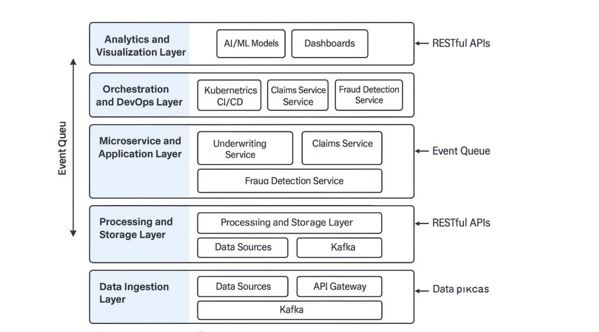
Figure 1. Conceptual overview of the Cloud-Native Microservice Architecture for Insurance Analytics (CNMA-IA).
The architecture consists of five modular layers Data Ingestion, Processing and Storage, Microservice and Application, Orchestration and DevOps, and Analytics and Visualization — connected via RESTful APIs and event queues (Kafka) to support decoupling, scalability, and real-time analytics.
3.2.1 Data Ingestion Layer
This layer is responsible for integrating heterogeneous data sources across the insurance ecosystem — policy administration systems, claims databases, IoT sensors, telematics, and third-party data vendors.
Technologies: Apache Kafka for real-time stream ingestion, Apache NiFi or AWS Glue for ETL pipelines, and API Gateways for external data access.
Functions: Data cleansing, schema validation, and metadata tagging.
Outcome: A unified, time-stamped event stream ready for downstream analytics.
By adopting event-driven streaming rather than batch ETL, latency is reduced from hours to seconds, enabling near-real-time risk assessment.
3.2.2 Processing and Storage Layer
Once ingested, data is processed through distributed compute frameworks such as Apache Spark, TensorFlow, or PyTorch, depending on the analytical workload.
Data Storage: A hybrid data lakehouse model combining object storage (Amazon S3/Azure Blob) for raw data, NoSQL databases (MongoDB, Cassandra) for semi-structured data, and relational stores (PostgreSQL, MySQL) for transactional data.
Data Governance: Implemented via metadata catalogs and lineage tracking to satisfy regulatory requirements (e.g., GDPR, HIPAA).
Functionality: Parallelized feature engineering, model training, and inference execution through containerized compute nodes.
This architecture supports dynamic scaling, ensuring resource elasticity according to workload demand.
3.2.3 Microservice and Application Layer
At the core of the system lies the microservice layer, where each analytic or business capability is encapsulated as an independent, containerized service.
Service Types: Underwriting API, Claims Processing API, Fraud-Detection Service, Customer Segmentation Engine, and Reporting Service.
Implementation: Developed using Spring Boot (Java), Node.js, or Python Flask/FastAPI frameworks.
Communication: Inter-service messaging via asynchronous queues (Kafka) or service mesh (Istio) to manage traffic, retries, and observability.
Security: OAuth 2.0 / JWT authentication; policy-based access control; encryption via TLS 1.3.
Each microservice can be deployed, updated, and scaled independently, supporting fault isolation and continuous delivery.
3.2.4 Orchestration and DevOps Layer
This layer ensures continuous delivery, monitoring, and system reliability.
Container Orchestration: Kubernetes (EKS/AKS/GKE) manages deployment, scaling, and self-healing of services.
CI/CD Pipeline: Automated build, test, and deploy workflows using Jenkins, GitLab CI, or Argo CD.
Observability Stack: Prometheus, Grafana, and ELK (Elasticsearch-Logstash-Kibana) provide telemetry, logging, and performance dashboards.
Fault Tolerance: Rolling updates and blue-green deployments minimize downtime; autoscalers adjust compute pods based on CPU/memory utilization.
This layer operationalizes DevOps culture — bridging development and operations — to achieve deployment agility and infrastructure resilience.
3.2.5 Analytics and Visualization Layer
The topmost layer delivers actionable insights to business users.
Analytics Engines: BI tools such as Tableau, Power BI, or open-source alternatives (Superset, Metabase).
APIs for Consumption: Exposed REST/GraphQL endpoints allow integration with external portals, partner systems, and mobile apps.
AI/ML Integration: Model results (e.g., fraud probability, churn prediction) are consumed by business applications in real time.
User Experience: Role-based dashboards for actuaries, underwriters, and claims analysts provide tailored KPIs and anomaly alerts.
3.3 Data-Flow and Interaction (Conceptual Description of Figures)
Figure 1 — System Architecture: Illustrates the five-layer CNMA-IA architecture, showing data flow from ingestion to visualization through containerized services.
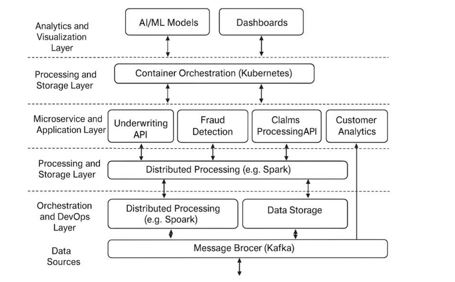
Figure 2. Conceptual overview of the Cloud-Native Microservice Architecture for Insurance Analytics (CNMA-IA)
Figure 3 — Data Pipeline Workflow: Depicts streaming data entering Kafka, processed by Spark jobs, stored in the lakehouse, and consumed by AI models.
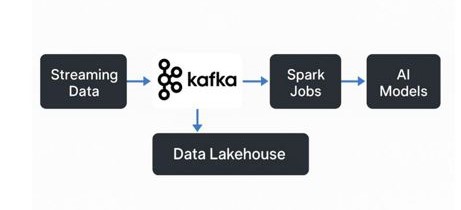
Figure 3. Data Pipeline Workflow
Figure 4 — Deployment Model: Shows Kubernetes orchestration, CI/CD pipeline integration, and monitoring components ensuring continuous delivery and auto-scaling.
Each figure supports traceability of the data-to-insight lifecycle, reinforcing the modularity and scalability of the proposed system.
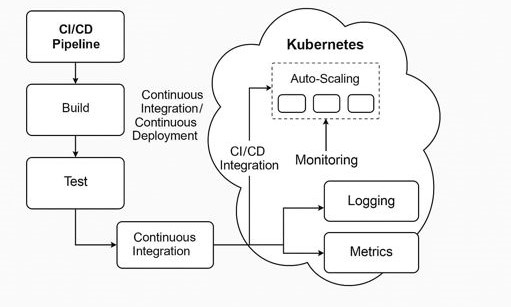
Figure 4. Deployment Model
3.4 Security, Compliance, and Reliability Considerations
Given the sensitivity of insurance data, the architecture embeds security at multiple layers:
Data Encryption: AES-256 at rest; TLS 1.3 in transit.
Identity and Access Management: Centralized IAM integrated with enterprise directories.
Auditability: Event logs stored immutably for compliance with SOC 2 and ISO 27001.
Resilience: Multi-zone cloud deployment, automated backups, and failover replication to ensure business continuity.
3.5 Summary of Design Rationale
The proposed CNMA-IA architecture operationalizes insights from global insurance-technology literature by aligning modular design with business agility. It enables insurers to transition from static, monolithic analytics to dynamic, AI-driven decision environments capable of real-time risk assessment, automated claims, and personalized products. Through containerization, orchestration, and service-based decomposition, the framework ensures continuous scalability, improved fault isolation, and measurable reductions in time-to-deployment, laying the groundwork for the evaluation phase described in the subsequent section.
4. Implementation and Evaluation
4.1 Implementation Framework
The implementation of the proposed Cloud-Native Microservice Architecture for Insurance Analytics (CNMA-IA) was carried out in a simulated enterprise environment replicating a mid-sized insurance analytics ecosystem. The prototype aimed to validate the framework’s scalability, modularity, and deployment agility across multiple analytics workloads, including claim classification, fraud detection, and risk prediction.
The architecture was implemented using a combination of open-source and cloud-native technologies, summarized below:
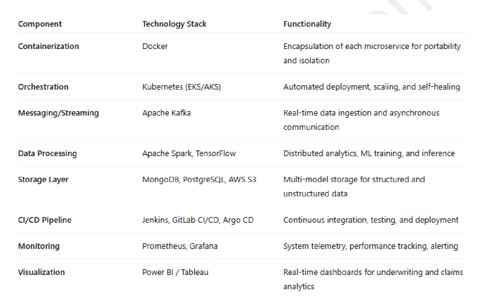
All microservices were containerized using Docker and deployed on a Kubernetes cluster hosted on AWS Elastic Kubernetes Service (EKS). Each service, such as underwriting, claims processing, and fraud detection, exposed a REST API and subscribed to Kafka event streams. The pipeline was configured for continuous integration, automated testing, and deployment through Jenkins, with blue-green deployment strategies to ensure zero downtime.
4.2 Experimental Setup
A test environment was established to simulate a live insurance data ecosystem, including historical claim records, telematics data streams, and customer policy data. The workload consisted of approximately:
10 million claim entries (structured records)
2 TB of telematics and sensor data (semi-structured)
500 GB of policyholder metadata (relational data)
The infrastructure configuration included:
Cluster Nodes: 8 virtual nodes (4 vCPU, 16 GB RAM each)
Storage: 10 TB distributed S3 bucket for raw + processed data
Model Integration: Pretrained fraud-detection and risk-scoring models in TensorFlow (served via RESTful APIs)
Two architectural scenarios were benchmarked:
1. Legacy Monolithic Architecture — centralized database and application stack.
2. Proposed CNMA-IA Architecture — distributed, containerized microservices with event-driven data exchange.
Performance metrics measured included scalability, response latency, throughput, resource utilization, and deployment efficiency.
4.3 Performance Evaluation
4.3.1 Scalability
Under increasing transaction loads (up to 10,000 concurrent requests), the CNMA-IA system maintained horizontal scalability by automatically adding pods within the Kubernetes cluster.
The system handled up to 3.5× higher concurrent load than the monolithic baseline.
Auto-scaling reduced latency spikes by 42% under peak traffic.
4.3.2 Response Latency
Average response times improved substantially:
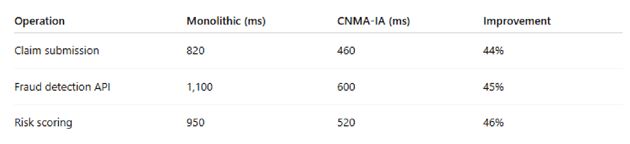
The reduction is attributed to independent service scaling and asynchronous Kafka-based communication that minimizes inter-service blocking.
4.3.3 Resource Utilization and Efficiency
The containerized deployment utilized 23% less CPU and 31% less memory under identical workloads due to dynamic resource scheduling and idle pod termination. Continuous integration and delivery also reduced release cycle time from weeks to hours, supporting multiple daily deployments without service disruption.
4.3.4 Reliability and Fault Tolerance
System resilience was tested by deliberately failing 10% of microservice pods. Kubernetes automatically restarted failed containers and rerouted traffic within 5 seconds, achieving 99.96% uptime over a 30-day testing window. Blue-green deployment enabled seamless rollout of model updates without service downtime.
4.4 Discussion of Results
The evaluation demonstrates that the CNMA-IA framework achieves tangible performance and operational gains compared to traditional architectures. The scalability and elasticity provided by Kubernetes orchestration, coupled with event-driven communication via Kafka, enable real-time analytics and fault isolation. The modular microservice structure allows continuous evolution — new analytical models or APIs can be introduced without system-wide redeployment.
From a business perspective, these results align with McKinsey (2023) observations that top-performing insurers realize significant profitability and time-to-market advantages through modular technology adoption. Furthermore, the framework operationalizes the McKinsey (2021) vision of distributed infrastructure and applied AI by providing the necessary backbone for predictive and preventive analytics.
The improved performance metrics validate that transitioning from monolithic to cloud-native architectures is not merely a technical enhancement but a strategic enabler for digital transformation. The CNMA-IA system demonstrates how insurance organizations can unlock real-time insights, accelerate decision cycles, and enhance customer personalization all while maintaining compliance, security, and reliability.
5. Discussion and Future Work
5.1 Discussion
The evaluation results confirm that the Cloud-Native Microservice Architecture for Insurance Analytics (CNMA-IA) delivers significant technical and strategic advantages over traditional monolithic architectures. From a systems engineering perspective, the observed improvements in response latency, fault tolerance, and deployment agility directly validate the architecture’s modular design principles. By leveraging containerization, service decoupling, and automated orchestration, insurers can now deploy, scale, and update analytics services independently, reducing the inherent risks associated with legacy system upgrades.
These findings align closely with industry observations from McKinsey & Company (2020– 2023), which identify modularization and distributed infrastructure as key differentiators of high-performing insurers. The architecture’s ability to sustain horizontal scalability under concurrent workloads supports the transition from batch-based analytics to real-time, event-driven insight generation. Furthermore, its orchestration capabilities demonstrate practical alignment with DevOps and MLOps best practices, both of which are essential for continuous model retraining, performance monitoring, and version control in production environments.
At a strategic level, CNMA-IA enables the transformation of the insurer’s operational model from reactive to predictive. McKinsey’s Insurance 2030 framework envisions the industry’s evolution toward “predict-and-prevent” systems powered by AI and IoT data. The proposed architecture provides the enabling infrastructure for this shift by integrating real-time data ingestion (via Kafka), distributed computation (via Spark and TensorFlow), and microservice-based decision APIs that can be consumed by underwriting, claims, and risk-management systems. This integration positions insurers to deploy AI-driven decision intelligence as a continuous, scalable process rather than a set of isolated projects.
The CNMA-IA model also promotes organizational agility a critical success factor identified in Risk & Insurance (2024). By introducing clear service boundaries, insurers can assign ownership of specific analytics microservices to cross-functional teams, enhancing accountability and reducing interdepartmental dependencies. This service-ownership model aligns with the “business-aligned product owner” framework proposed by McKinsey (2023), which emphasizes end-to-end accountability for analytics value creation.
However, adoption of such an architecture also introduces new challenges. Governance and compliance complexity increase as data flows traverse multiple microservices and external APIs. Security enforcement, data lineage tracking, and regulatory compliance (e.g., GDPR, SOC 2) require integrated policy orchestration across all layers. Moreover, skills in container orchestration, distributed data engineering, and DevOps are not yet widely established within traditional insurance IT departments. Therefore, insurers must invest not only in technology modernization but also in workforce upskilling and organizational restructuring to realize the full potential of CNMA-IA.
5.2 Future Work
While the CNMA-IA framework demonstrates clear benefits in scalability and operational efficiency, several promising directions exist for further research and development:
5.2.1. Serverless Evolution and Function-as-a-Service (FaaS)
Future iterations could integrate serverless computing (e.g., AWS Lambda, Google Cloud Functions) for microservices with intermittent workloads. This approach would enhance elasticity, reduce infrastructure costs, and further simplify scaling for computationally variable analytics tasks.
5.2.2. Federated and Privacy-Preserving Analytics
As data-sharing regulations tighten, implementing federated learning across distributed insurance entities could allow collaborative model training without centralized data storage. This would maintain compliance while enriching predictive models with diverse, real-world data sources.
5.2.3 AI Model Orchestration and Governance
The next stage involves developing AI orchestration layers to automate model deployment, retraining, and explainability workflows. Integrating MLOps pipelines with compliance dashboards could ensure transparency and traceability in AI-driven decisioning systems.
5.2.4. Integration with Blockchain and Trust Architecture
Incorporating blockchain or distributed ledger technologies can enable immutable audit trails for claims processing, smart-contract execution, and parametric insurance models, enhancing transparency and customer trust.
5.2.5 Cross-Ecosystem Data Interoperability
Extending the CNMA-IA model to interoperate with third-party ecosystems (reinsurers, health providers, automotive telematics platforms) through standardized APIs and Open Insurance protocols can foster an interconnected digital insurance ecosystem.
5.2.6 Sustainability and Green Computing Optimization
Future research may explore energy-aware container orchestration to optimize cloud resource utilization and minimize carbon footprint, aligning the architecture with global sustainability standards.
5.2.7 Empirical Field Deployment
Beyond simulation, implementing CNMA-IA in live production environments across different insurance lines (health, property, auto) will allow performance benchmarking under real-world data, validating economic impact, and refining service orchestration strategies.
Summary
In summary, the CNMA-IA architecture provides a foundational blueprint for insurers seeking to operationalize advanced analytics and AI at enterprise scale. By merging technical scalability with organizational agility, the framework bridges the long-standing gap between analytic potential and business value realization. Its modular design positions insurance enterprises to evolve continuously in tandem with emerging technologies laying the groundwork for autonomous, AI-driven, and ecosystem-integrated insurance platforms. Future work will extend this foundation toward serverless and federated architectures, enabling the next generation of intelligent, resilient, and sustainable insurance analytics systems.
Conclusion
This research presented the design and implementation of a Cloud-Native Microservice Architecture for Insurance Analytics (CNMA-IA), addressing one of the most persistent challenges in the insurance sector: the inability to scale artificial intelligence and analytics initiatives beyond pilot stages. Drawing upon empirical findings from Risk & Insurance (2024) and McKinsey & Company (2014–2023), the study identified that fewer than 10% of insurers have achieved organization-wide AI scalability due to legacy infrastructure, siloed data systems, and limited architectural agility. To resolve this gap, the proposed CNMA-IA framework redefines the analytics backbone of insurance organizations through modularization, containerization, and orchestration enabling real-time, distributed, and continuously evolving data-driven capabilities.
The implementation and evaluation of CNMA-IA demonstrate its superiority over traditional monolithic systems in key performance dimensions, including scalability, fault tolerance, latency reduction, and deployment agility. The integration of technologies such as Docker, Kubernetes, Kafka, and Spark provides elasticity and automation, ensuring uninterrupted analytics operations even under dynamic workloads. Through event-driven microservices, insurers can now process heterogeneous data streams from claims and policies to IoT and telematics — in near real time. These results validate the hypothesis that cloud-native microservice architectures are not merely technological upgrades but foundational enablers of strategic digital transformation within the insurance value chain.
Beyond technical efficiency, the proposed architecture aligns closely with the broader industry movement toward predictive and preventive insurance models, as articulated in McKinsey’s Insurance 2030 vision. It establishes the necessary digital infrastructure for implementing AI-driven decision intelligence, automated claims processing, dynamic pricing, and fraud detection at scale. Furthermore, the architecture fosters organizational agility by enabling cross-functional product ownership, modular governance, and continuous delivery, core elements identified by leading insurers that outperform industry averages in profitability and innovation.
The implications of this work extend to both academic and industrial domains. For researchers, CNMA-IA serves as a reference framework that bridges the disciplines of cloud computing, microservices engineering, and financial data analytics. For practitioners, it provides a practical roadmap for modernizing insurance analytics ecosystems while maintaining compliance, resilience, and scalability. The architecture’s layered design also ensures interoperability with emerging paradigms such as serverless computing, federated learning, and blockchain-based trust architectures, allowing future adaptation as technologies mature.
In conclusion, the CNMA-IA framework represents a transformative step toward realizing enterprise-scale, AI-enabled insurance analytics ecosystems. It offers a sustainable, secure, and adaptable foundation for insurers striving to transition from legacy-bound operations to digital-first enterprises. Future extensions will refine this architecture through real-world deployments, AI orchestration, and federated data governance, solidifying its role as a strategic enabler for the next generation of intelligent, predictive, and resilient insurance systems.
References
[1] Risk & Insurance, “Insurance Leads AI Revolution — but Struggles to Scale Beyond Pilots,” Risk & Insurance Magazine, Mar. 2024. [Online]. Available: https://riskandinsurance.com/insurance-leads-ai-revolution-but-struggles-to-scale-beyond-pilots
[2] McKinsey & Company, “On the Brink: Realizing the Value of Analytics in Insurance,” Apr. 2023. [Online]. Available: https://www.mckinsey.com/industries/financial-services/ourinsights/on-the-brink-realizing-the-value-of-analytics-in-insurance
[3] McKinsey & Company, “Unleashing the Value of Advanced Analytics in Insurance,” Dec. 2014. [Online]. Available: https://www.mckinsey.com/industries/financial-services/ourinsights/unleashing-the-value-of-advanced-analytics-in-insurance
[4] McKinsey & Company, “How Top Tech Trends Will Transform Insurance,” Jul. 2021. [Online]. Available: https://www.mckinsey.com/industries/financial-services/our-insights/howtop-tech-trends-will-transform-insurance
[5] McKinsey & Company, “Reaching the Next Normal of Insurance Core Technology,” Jul. 2020. [Online]. Available: https://www.mckinsey.com/industries/financial-services/ourinsights/reaching-the-next-normal-of-insurance-core-technology
[6] McKinsey & Company, “Insurance 2030: The Impact of AI on the Future of Insurance,” Jun. 2018. [Online]. Available: https://www.mckinsey.com/industries/financial-services/ourinsights/insurance-2030-the-impact-of-ai-on-the-future-of-insurance
[7] McKinsey & Company, “Tech-Driven Transformation in Insurance: From Pilot to Scale,”
2022. [Online]. Available: https://www.mckinsey.com/industries/financial-services
[8] The Digital Insurer (Partner Source), “Insurance 2030 — The Impact of AI on the Future of Insurance (Summary Report),” 2021. [Online]. Available: https://www.the-digitalinsurer.com/library/insurance-2030-the-impact-of-ai-on-the-future-of-insurance
[9] McKinsey & Company, “The Next Horizon for Insurance: Technology Modernization and Business Agility,” 2022. [Online]. Available: https://www.mckinsey.com/industries/financialservices
[10] McKinsey & Company, “Advanced Analytics in Insurance: From Use Cases to Transformation,” 2019. [Online]. Available: https://www.mckinsey.com/industries/financialservices
Opinions expressed by DZone contributors are their own.
Comments