

DevOps vs. DataOps vs. MLOps vs. AIOps: Comparison of All "Ops"
The acronym "Ops" has rapidly increased in IT operations in recent years. Explore different "Ops" in this explanation of DevOps, DataOps, MLOps, and AIOps.

 CORE
·
CORE
·
 ·
·
Join the DZone community and get the full member experience.
Join For FreeThe acronym "Ops" has rapidly increased in IT operations in recent years. IT operations are turning towards the automation process to improve customer delivery. Traditional application development uses DevOps implementation for Continued Integration (CI) and Continued Deployment (CD). The exact delivery and deployment process may not be suitable for data-intensive Machine Learning and Artificial Intelligence (AI) applications.
This article will define different "Ops" and explain their work for the following: DevOps, DataOps, MLOps, and AIOps.
DevOps
This practice automates the collaboration between Development (Dev) and Operations (Ops). The main goal is to deliver the software product more rapidly and reliably and continue delivery with software quality. DevOps complements the agile software development process/agile way of working. 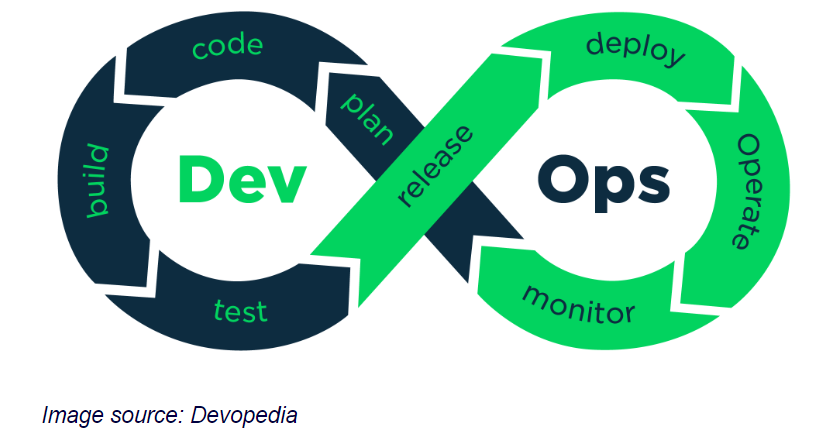
DataOps
DataOps is a practice or technology that combines integrated and process-oriented data with automation to improve data quality, collaboration, and analytics. It mainly deals with the cooperation between data scientists, data engineers, and other data professionals. 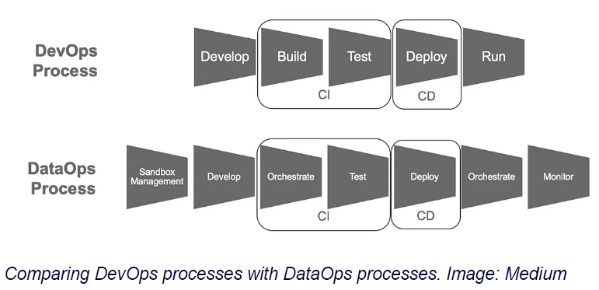
MLOps
MLOps is a practice or technology that develops and deploys machine learning models reliably and efficiently. MLOps is the set of practices at the intersection of DevOps, ML, and Data Engineering.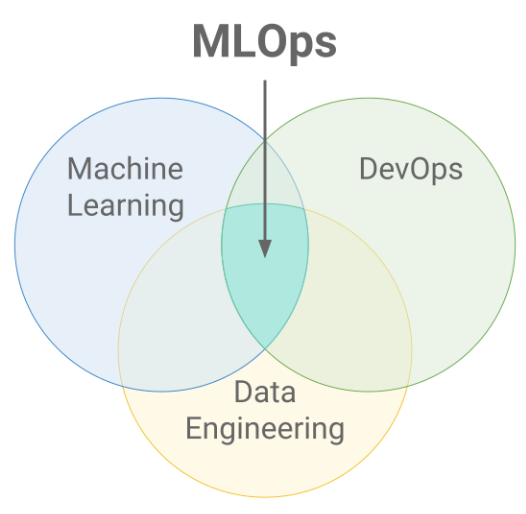
AIOps
AIOps is the process of capabilities to automate and streamline operations workflows for natural language processing and machine learning models. Machine Learning and Big Data are major aspects of AIOps because AI needs data from different systems and processes using ML models. AI is driven by machine learning models to create, deploy, train, and analyze the data to get accurate results.
As per the IBM Developer, below are the typical “Ops” work together: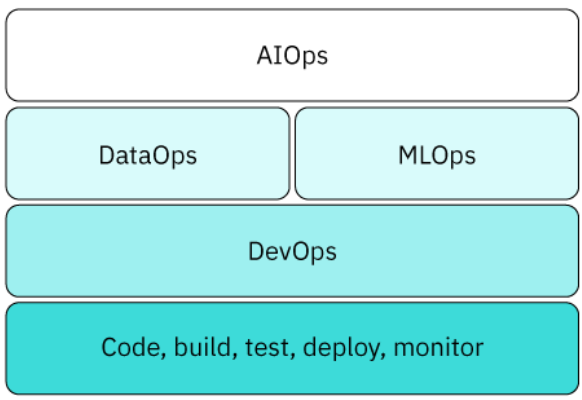
Image Source: IBM
Collective Comparison
The table below describes the comparison between DevOps, DataOps, MLOps, and AIOps:
| Aspect | DevOps | DataOps | MLOps | AIOps |
|---|---|---|---|---|
|
Focus on: |
IT operations and software development with Agile way of working |
Data quality, collaboration, and analytics |
Machine Learning models |
IT operations |
|
Key Technologies/Tools: |
Jenkins, JIRA, Slack, Ansible, Docker, Git, Kubernetes, and Chef |
Apache Airflow, Databricks, Data Kitchen, High Byte |
Python, TensorFlow, PyTorch, Jupyter, and Notebooks |
Machine learning, AI algorithms, Big Data, and monitoring tools |
|
Key Principles: |
|
|
|
|
|
Primary Users |
Software and DevOps engineers |
Data and DataOps engineers |
Data scientists and MLOps engineers |
Data scientists, Big Data scientists, and AIOps engineers |
|
Use Cases |
Microservices, containerization, CI/CD, and collaborative development |
Ingestion of data, processing and transforming data, and extraction of data into other platforms |
Machine learning (ML) and data science projects for predictive analytics and AI |
IT AI operations to enhance network, system, and infrastructure |
Summary
In summary, managing a system from a single project team is at the end of its life due to business processes becoming more complex and IT systems changing dynamically with new technologies. The detailed implementation involves a combination of collaborative practices, automation, monitoring, and a focus on continuous improvement as part of DevOps, DataOps, MLOps, and AIOps processes. DevOps focuses primarily on IT processes and software development, and the DataOps and MLOps approaches focus on improving IT and business collaborations as well as overall data use in organizations. DataOps workflows leverage DevOps principles to manage the data workflows. MLOps also leverages the DevOps principles to manage applications built-in machine learning.
Opinions expressed by DZone contributors are their own.
Comments