

DZone
Thanks for visiting DZone today,
Edit Profile
  • Manage Email Subscriptions
  • How to Post to DZone
  • Article Submission Guidelines
Sign Out View Profile
  • Post an Article
  • Manage My Drafts
Newsletter
Log In / Join
Refcards Trend Reports
Events Video Library
Refcards
Trend Reports

Events

View Events Video Library

Related

  • A Retrospective on GenAI Token Consumption and the Role of Caching
  • Conducting Sprint Retrospective Meetings
  • Strengthen Your Team Relationships and Take Your Team to the Next Level
  • Low Latency Microservices, a Retrospective

Trending

  • Microsoft Foundry Agent Debugging Dashboard with Microsoft Fabric Eventhouse, KQL, Docker and Grafana
  • Post-Quantum TLS for Cloud APIs and Microservices
  • Gitember: Building a Git Client Beyond Commit, Push, and Pull
  • Microsoft Fabric Throttling: Diagnose Before You Scale

Draft This article hasn't been published, so readers can't see it.

In moderation This article is waiting for review, so readers can't see it yet.

Deleted This article has been deleted, so readers can't see it.

Creating a Homemade Retrospective Game

Zone Leader John Vester talks about a restrospective you can create at home that plays a lot like a famous board game...

By 
John Vester
DZone Core CORE ·
Apr. 04, 16 · Opinion
Post on X (opens in a new tab) Share on LinkedIn (opens in a new tab)
8.3K Views

Join the DZone community Save articles, join the discussion, and download Refcards and Trend Reports with a free account.

Join for free Already a member? Log in

There are quite a few options on how to facilitate your Sprint Retrospective meeting, some can be found at the TastyCupcakes.org web-site.  Recently, a colleague of mine (Curtis Penner) decided to create his own Retrospective board game.

About the Game

Curtis was able to find an empty game board and chance cards from Amazon.  Once his order arrived, he fashioned the board in a design similar to the Parker Brothers game Monopoly.  There are squares around the edge of the board, where players will navigate their pieces guided by a roll of the dice.  When they land on their spot, they follow the instructions on the space.

In the center of the board are four dedicated sections:

  1. A placeholder for Post-it notes focused on high points of the sprint

  2. A placeholder for Post-it notes focused on challenges from the sprint

  3. A placeholder for Post-it notes focused on expected future challenges

  4. A section to house a deck of cards

The deck of cards are considered "chance" cards and contain an equal mix of good and bad things.  Some of his examples are listed below:

  • You broke the main branch, lose a turn

  • Your team had an awesome velocity, read two Post-It notes

A picture of Curtis' game is listed below:
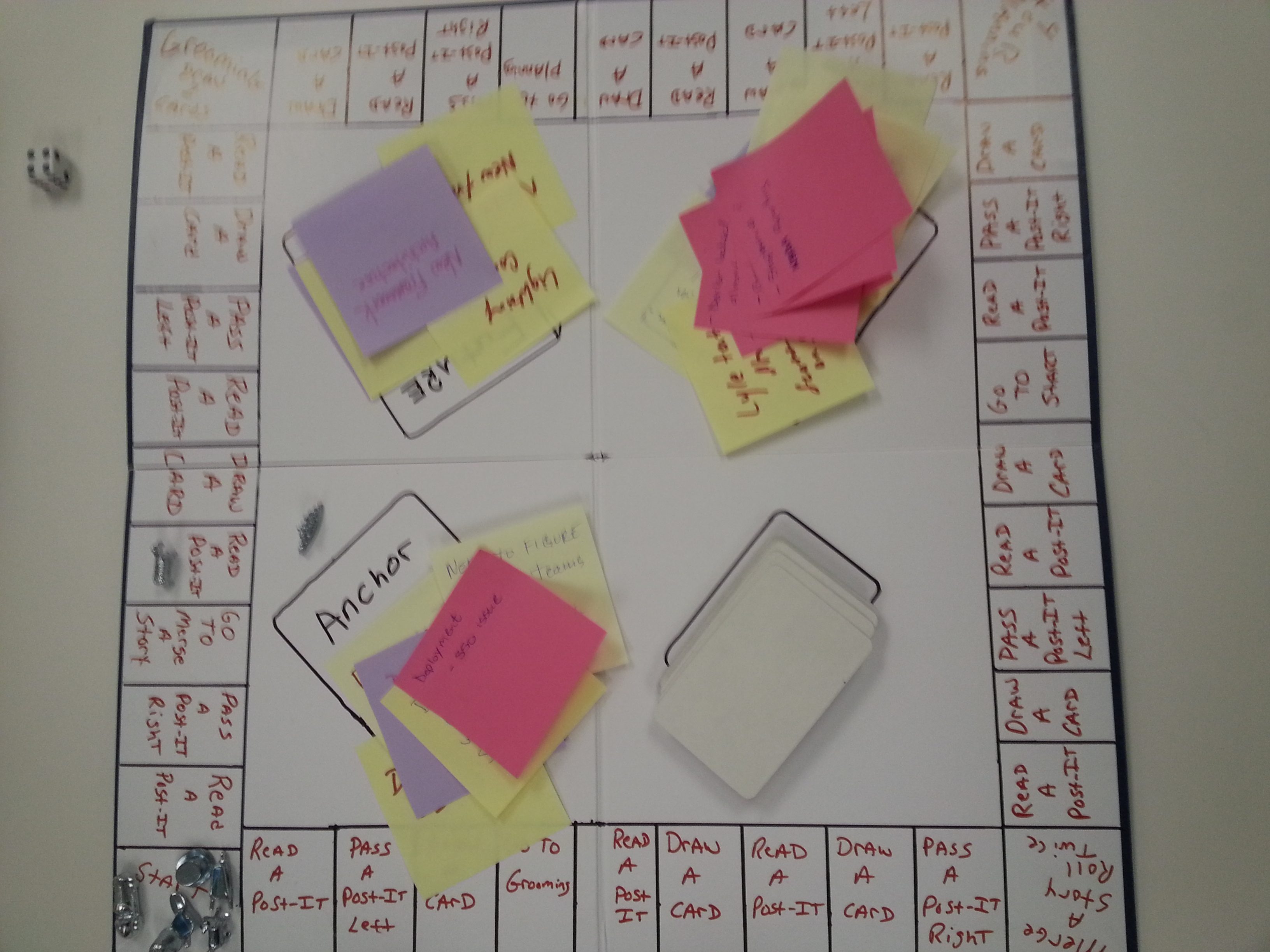
Image title

How the Game Works

Players use Post-It notes to note their high points, challenges and future items.  Once they are finished, they are placed onto the appropriate placeholder in the center of the board.  Each player then has a token that is placed on the start.

The player rolls a die to move around the board.  When they land on a spot, they follow the instructions provided.  Each time the player passes start, they automatically get to pick-up a Post-It note from the pile of their choice. 

The goal is to focus on the Post-It note and reflect on the item, noting take-aways where appropriate.

The winner is the player with the most Post-It notes after the last Post-It note is picked up.

Conclusion

I was able to borrow Curtis' game during our last Retrospective and we had a lot of fun playing.  Our game did end up in a two way tie for first place.  There wasn't anything in the instructions about what to do in the event of a tie, so we just did the normal thing ... had the two fight it out in the middle of the room.  (Just kidding.)

Have a really great day!

retrospective

Opinions expressed by DZone contributors are their own.

Related

  • A Retrospective on GenAI Token Consumption and the Role of Caching
  • Conducting Sprint Retrospective Meetings
  • Strengthen Your Team Relationships and Take Your Team to the Next Level
  • Low Latency Microservices, a Retrospective

Partner Resources

×

Comments

Loading comments

The comments didn't load

Please try again in a moment.

Likes

Loading

The next likes didn't load. Please try again.

The likes didn't load

Please try again in a moment.

See who liked this

Log in or join DZone for free to see who liked this article.

Log in Join for free
  • RSS
  • X
  • Facebook

ABOUT US

  • About DZone
  • Support and feedback
  • Community research

ADVERTISE

  • Advertise with DZone

CONTRIBUTE ON DZONE

  • Article Submission Guidelines
  • Become a Contributor
  • Core Program
  • Visit the Writers' Zone

LEGAL

  • Terms of Service
  • Privacy Policy

CONTACT US

  • 3343 Perimeter Hill Drive
  • Suite 215
  • Nashville, TN 37211
  • [email protected]

Let's be friends:

  • RSS
  • X
  • Facebook