

Crypto Agility for Developers: Build Agile Encryption Now
Quantum is coming! Your encryption won’t survive; it's time to make your code crypto agile before it’s too late. This guide breaks down how.
Join the DZone community and get the full member experience.
Join For FreeIn 2025, software development is evolving rapidly with the rise of Vibe Coding and Agentic AI, but so is the cryptographic landscape that underpins these systems. As quantum computing moves closer to practical applicability and encryption standards become outdated, one imperative is becoming unavoidable: crypto agility.
Crypto agility, the ability of systems to switch between cryptographic algorithms and protocols quickly without requiring massive re-engineering, is no longer just a security or compliance concern. It’s becoming a core requirement of resilient, future-ready software. For developers building applications that require trustworthiness and security, now is the time to understand and embrace crypto agility.
This article explains why crypto-agile architecture matters, how to implement it, and why every software developer should build with crypto agility in their mind to stay ahead of future quantum-safe and compliance-driven requirements.
Crypto Agility
Crypto agility refers to a software system’s ability to rapidly adapt to changes in cryptographic algorithms, libraries, or protocols with minimal disruption. This includes:
- Swapping out deprecated or broken algorithms (e.g., RSA, SHA-1)
- Integrating post-quantum cryptography (PQC) in response to quantum threats
- Enabling fallback or hybrid cryptographic modes
- Supporting algorithm negotiation between clients and servers
In practice, a crypto-agile system allows developers and operators to transition to newer algorithms or protocols without rewriting entire applications, breaking compatibility, or introducing operational delays.
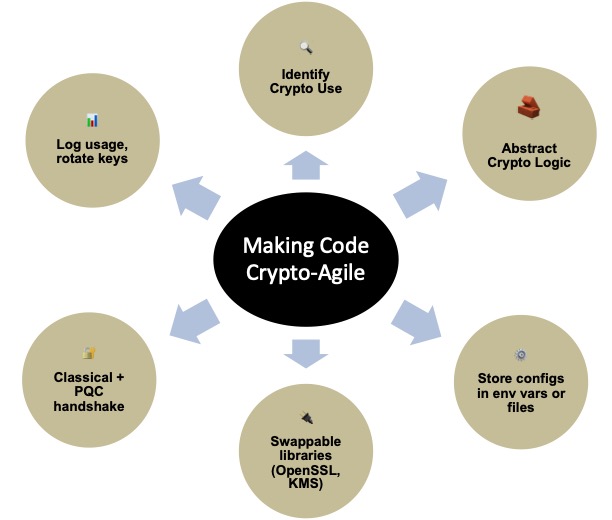
Why Crypto Agility Matters Now: Urgency for Developers
1. Quantum Threats Are Coming: Why Developers Must Prepare Now
The urgency of preparing for quantum-safe encryption has reached new heights in 2025. According to the Cloud Security Alliance, a quantum computer capable of breaking current encryption could emerge by April 14, 2030
Central to this shift, NIST finalized its first post-quantum cryptography standards in August 2024, specifically, CRYSTALS-Kyber and CRYSTALS-Dilithium, and added a fifth algorithm, HQC, for key encapsulation in March 2025. These advancements reinforce calls from U.S. agencies like the NSA and FBI, which are pressing federal entities and vendors to begin migration plans now, with mandates extending to 2030 compliance deadlines
This urgency is because of the “Harvest Now, Decrypt Later” (HNDL) threat. As highlighted in recent industry commentary, nation-state actors and organized groups are already hoarding encrypted communications today, betting that future quantum breakthroughs will render them readable.
What does this mean for developers? If your application handles data that must remain confidential (legal documents, proprietary code, personal health information), you’re already a potential target. Crypto agility is no longer optional. Without it, migrating to post-quantum standards will require deep, disruptive refactoring, far more difficult and riskier than architecting for change today.
2. Crypto Agility and Compliance: New Security Mandates Developers Can’t Ignore
Security standards across industries are rapidly shifting toward crypto agility. For instance:
- The Cybersecurity and Infrastructure Security Agency (CISA) has issued guidance recommending that organizations prepare for post-quantum cryptography by identifying and cataloging cryptographic assets.
- The European Union Agency for Cybersecurity (ENISA) has emphasized the importance of agility in public key infrastructure (PKI) and identity management systems.
- ISO/IEC 19790 and 27001 updates include stronger cryptographic governance, requiring organizations to demonstrate control over the algorithms used and flexibility in their lifecycle.
If your software is subject to compliance audits, demonstrating crypto agility will soon be a baseline expectation.
3. Broken Encryption Standards: How Crypto Agility Helps You Adapt Fast
Even outside the quantum context, the need for crypto agility is evident. Consider the recent depreciations of:
- SHA-1, due to successful collision attacks.
- RSA-1024, which no longer provides sufficient key strength.
- TLS 1.0/1.1, which were widely used until security flaws prompted their retirement.
Without crypto agility, migrating away from these compromised algorithms can be a nightmare, requiring manual code changes, new client certificates, infrastructure updates, and application downtime.
The Developer’s Role in Crypto Agility: Design Secure and Adaptable Software
Crypto agility isn’t just a concern for cryptographers. It’s a software engineering practice that must be embedded in how we design, build, and maintain systems. Here’s how developers can help:
1. Abstract Your Crypto Logic: Decouple Algorithms From Code
Avoid hardcoding specific algorithms or libraries in your application logic. Instead, use abstraction layers or cryptographic interfaces (e.g., Java’s JCE, Python’s cryptography library, or OpenSSL APIs).
For example, instead of:
cipher = AES.new(key, AES.MODE_CBC)Use:
cipher = CryptoBackend.get_cipher(algorithm="AES", mode="CBC", key=key)This makes it easier to swap out AES for a post-quantum cryptography (PQC) algorithm like Kyber or NTRU when needed.
2. Configurable Crypto Policies: Secure Defaults and Agile Configs
Where possible, define cryptographic algorithms, key lengths, and modes in configuration files or environment variables, not in code. This supports dynamic reconfiguration, especially during incident response or deprecation events.
crypto:
  algorithm: AES-256
  mode: GCM
  key_management: AWS-KMS
This also enables your ops and security teams to enforce org-wide crypto policies without requiring developer intervention.
3. Build Pluggable Crypto Architectures for Long-Term Flexibility
Design your systems to support pluggable crypto backends. This can include:
- Swappable TLS libraries (e.g., OpenSSL, BoringSSL, AWS-LC)
- Modular identity providers (e.g., certificate authorities that can support hybrid PQC)
- Cryptographic services via APIs (e.g., AWS KMS, HashiCorp Vault, Azure Key Vault)
Such architectures make it easier to roll out hybrid or post-quantum crypto without downtime.
4. Embrace Hybrid Cryptography: Classical + Post-Quantum Resilience
Many vendors and standards bodies recommend a hybrid approach, i.e., combining classical and post-quantum algorithms in a single cryptographic handshake. This approach preserves compatibility while introducing resistance to quantum attacks.
Your application should support dual-algorithm modes during this transition period. Libraries like BoringSSL, liboqs, and Open Quantum Safe already support hybrid TLS.
Avoid These Crypto Agility Mistakes
Crypto agility can easily become crypto fragility if not implemented carefully. Watch out for:
- Over-customization: Avoid rolling your cryptographic logic or creating complex wrappers. Use vetted libraries.
- Inconsistent algorithm use across components: Ensure your front-end, backend, and APIs all negotiate and validate algorithms consistently.
- Ignoring certificate chains and key management: Agility isn't just about algorithms; it's also about how keys are stored, rotated, and revoked.
Developer’s Crypto Agility Checklist: First Steps Toward Post-Quantum Readiness
- Inventory your crypto usage: Identify all places in your code where cryptographic functions, libraries, and protocols are used.
- Abstract and externalize: Refactor code to use abstracted interfaces and external configuration for crypto controls.
- Evaluate library support: Ensure your crypto libraries support post-quantum and hybrid cryptography (or have a roadmap to do so).
Implement monitoring and auditing: Log algorithm use and monitor for deprecated cipher suites or failed negotiation attempts. - Collaborate with security teams: Make crypto agility a core part of your secure software development lifecycle (SDLC), not an afterthought.
Future-Proofing Software: Why Developers Must Act on Crypto Agility Now
We are at the edge of a cryptographic transition unlike any seen before. The transition to post-quantum security will not be a simple patch — it will require flexible, adaptable systems that can keep pace with rapidly evolving standards and threats.
As a software developer, your job isn’t to reinvent cryptography. Your job is to make sure your applications can evolve as cryptography evolves.
The time to build crypto agility is now, before the algorithms we rely on become the vulnerabilities we fear.
Opinions expressed by DZone contributors are their own.
Comments