

Designing Intelligent AI Systems for Tax Anomaly Detection
A real intelligent AI system automatically detects anomalies, irregularities, and potential fraud by leveraging hybrid architectures and explainable predictive models.
Join the DZone community and get the full member experience.
Join For FreeArtificial intelligence finance analysis systems are the automated systems that detect anomalies and potential fraud in tax reports and financial statements using machine learning algorithms and deep neural networks. These systems help to enhance accuracy in identifying compliance issues, reduce manual audit time, and improve financial transparency through intelligent pattern recognition and predictive analytics.
This article explores how developers can design and implement AI-driven systems to detect tax irregularities by focusing on practical architectural and engineering considerations rather than theoretical models.
Why Tax Irregularity Detection Is Hard
Financial statement analysis and tax compliance verification are very critical processes for governments, regulatory bodies, auditing firms, and financial institutions. Traditional methods that are used for detecting anomalies in financial statements rely on manual review, rule based systems and statistical sampling techniques. These conventional approaches are time consuming, prone to human error, and often fail to identify sophisticated fraud schemes or complex tax evasion patterns.
Tax anomalies can manifest in various forms including revenue under reporting, expense overstatement, improper deduction claims, transfer pricing manipulation, offshore account concealment, and timing differences exploitation. The complexity of modern financial transactions, combined with voluminous data and intricate tax regulations across multiple jurisdictions, makes manual detection increasingly impractical.
Because of this, combining AI with existing systems works well for detecting tax irregularities.
What Kinds of Tax Irregularities can Artificial Intelligence Detect?
Artificial intelligence and machine learning applications have effective capabilities for pattern recognition, anomaly detection and accurate analysis. These models can process massive datasets and detect irregular patterns that would be impossible for human auditors to discover within reasonable time frames. Natural language processing enables the extraction of relevant information from unstructured financial documents, while neural networks can learn from historical fraud cases to predict future risks.
- Integrating multiple AI technologies including deep neural networks, natural language processing, graph neural networks and ensemble learning methods to achieve superior anomaly detection accuracy across fraud and evasion patterns.
- It also helps to build a comprehensive, continuously updated tax knowledge base covering multiple jurisdictions and automatically adapts to regulatory changes without requiring manual rule reprogramming.
- It helps to perform multi-dimensional analysis including cross-document verification, temporal pattern analysis, peer bench marking, and relationship network mapping to identify sophisticated tax evasion schemes.
- With explainable AI capabilities, system can generate detailed audit trails, anomaly explanations, and supporting evidence to facilitate regulatory compliance and legal proceedings.
- It enhances existing system with real-time risk scoring, predictive analytics, and proactive alert mechanisms that enable preventive intervention before fraudulent tax returns are filed.
System Architecture Overview
A tax anomaly detection system automatically identifies anomalies and potential fraud in tax filings and financial statements by using advanced artificial intelligence and machine learning techniques.
These technologies combines a modular architecture including data ingestion, preprocessing, deep learning detection, tax compliance verification, risk scoring, explainable AI, and reporting modules. The deep learning detection module implements a hybrid neural network architecture with parallel processing pathways which includes convolutional neural networks for numerical pattern analysis, recurrent networks for temporal sequence analysis, transformer models for natural language understanding of textual disclosures, and graph neural networks for relationship network analysis. The fusion mechanisms combine outputs using attention weights to generate anomaly scores. The tax compliance verification module contains a continuously updated knowledge documents of tax regulations that automatically adapts to regulatory changes through natural language processing. The explainable AI module provides human interpretable explanations including feature analysis, counterfactual explanations, attention visualizations, audit trails, and rule violation reports to enable auditors to understand and justify detected anomalies.
This system ensures high impact of anomaly detection accuracy compared to traditional rule-based systems, reduces manual audit time and costs, adapts automatically to evolving tax regulations and fraud schemes provides transparent and legally defensible explanations for detected anomalies, enables proactive risk-based audit resource allocation, and improves overall tax compliance and financial transparency through intelligent automated analysis of complex financial data.
System Architecture Block Diagram
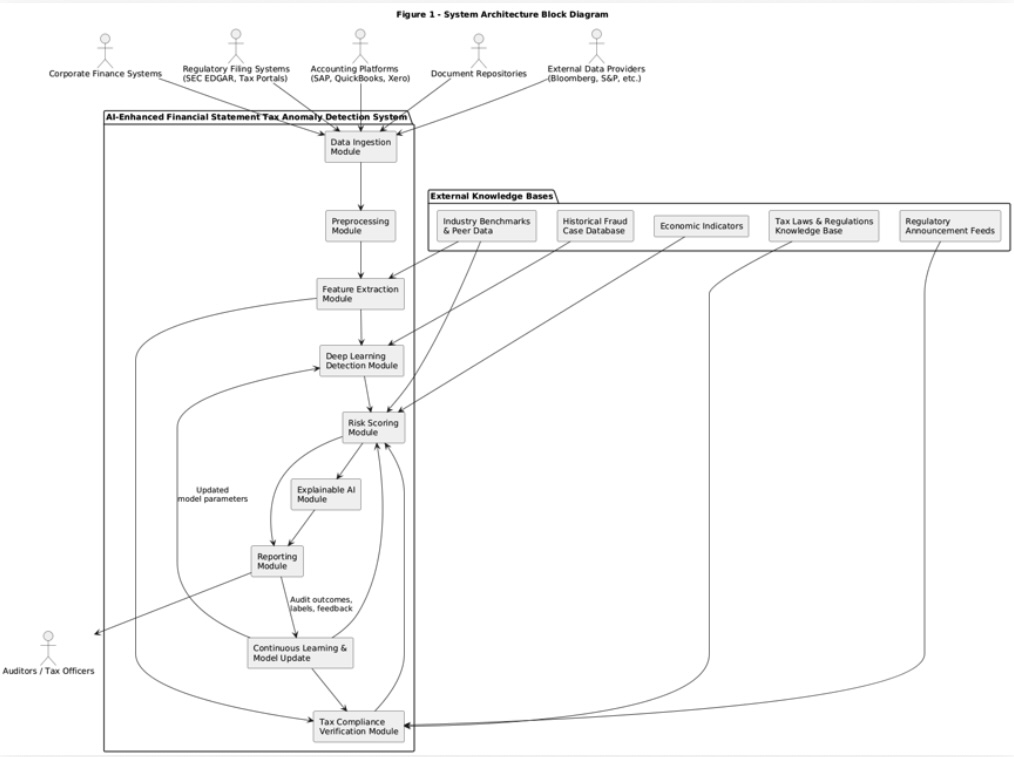
This diagram illustrates the complete system architecture of the AI enhanced financial statement tax anomaly detection system.
Input Layer: This layer includes multiple data sources such as corporate financial databases, regulatory filing systems (SEC EDGAR, tax authority portals), accounting software platforms (QuickBooks,SAP), document repositories, and external data providers (Bloomberg) which will feed into the system.
Data Ingestion Module: This module will receive data through various interfaces including API connections, file upload mechanisms (supporting PDF, Excel, XML/XBRL, JSON formats), database connections, and web scraping capabilities. The module performs document parsing, OCR for scanned documents, metadata extraction, and version control.
Pre processing Module: This module will be connected to the ingestion module performing data cleaning operations including missing value imputation, outlier detection and treatment, format standardization, currency conversion, inflation adjustment and data validation checks (balance sheet equation verification, cash flow reconciliation, cross-statement consistency).
Feature Extraction Module: Receiving preprocessed data and generating two parallel streams:
- Numerical features - Financial ratios (liquidity, profitability, leverage, efficiency ratios), growth rates, trend indicators and volatility measures.
- Textual features - NLP including BERT embeddings, named entity recognition, sentiment analysis, topic modeling, and textual-numerical consistency checks.
Deep Learning Detection Module (Central Processing Core): Shown as the central component with four parallel pathways:
- CNN Pathway: Processing numerical time series with convolutional and pooling layers
- LSTM Pathway: Processing sequential multi period data with attention mechanisms
- Transformer Pathway: Processing textual disclosures with self attention mechanisms
- Graph Neural Network Pathway: Processing entity relationships and transaction networks
- Fusion Layer: Combining all pathway outputs with attention weights.
Tax Compliance Verification Module: This is the module operated in parallel with the deep learning module which contains:
- Tax Knowledge Base (with tax laws, regulations and court precedents across jurisdictions)
- Rules Engine (checking deduction eligibility, income classification, documentation requirements)
- Automated Update System (monitoring regulatory websites, processing amendments via NLP)
- Avoidance Pattern Detection (template matching for known tax avoidance schemes)
Risk Scoring Module: Receiving inputs from both the deep learning module and tax compliance module, generating multi-tiered risk scores (transaction-level, account-level, statement-level, filing-level, entity-level), implementing Bayesian inference for score updating, and performing calibration against historical outcomes.
Explainable AI Module: This module outputs processes to generate:
- SHAP feature values
- Counterfactual explanations
- Audit trail documentation
- Reports for rule violations
- Analysis on Peer comparisons
Reporting Module: Generating outputs including:
- Detailed anomaly reports with evidence
- Executive dashboards with metrics
- Audit Logs
- Real time compliance reports
External Knowledge Bases: These are supporting components including industry benchmark databases, historical fraud case databases, economic indicator feeds, and regulatory announcement monitoring systems.
Feedback Loop: Arrows showing a continuous learning pathway from audit outcomes back to model training and enabling learning from findings.
Conclusion
An AI enhanced financial statement tax anomaly detection system offer significant advantages over traditional approaches. It provides detection accuracy through hybrid architectures, automated adaptation based on regulatory changes without manual reprogramming and comprehensive multi modal analysis by analyzing textual, numerical, and relationship data in parallel. Scalability allows millions of financial transactions to be processed through distributed computing and proactive risk management and allows preventive intervention before fraudulent returns are filed. Additionally automated analysis significantly reduces audit costs by 60-70% while continuous improvement ensures the system progressively improves and adapting detection strategies.
Opinions expressed by DZone contributors are their own.
Comments