

Engineering Production Agentic Systems: An Introduction
Explore a three-part field manual on building reliable production AI agents through context engineering, guardrails, and human-in-the-loop architecture.
Join the DZone community and get the full member experience.
Join For FreeA Three-Part Field Manual on What Actually Determines Production Outcome Quality
This is the introduction to a three-part series. It frames the conviction, names the production failure modes that motivated the series, and previews the three parts that defend the argument with engineering specifics.
The Backdrop
After eighteen months of hands-on designing agentic systems in production — multi-agent platforms in regulated industries where context-window collapse means a compliance violation, not a UX bug — I have stopped paying attention to which model the team picked. In production, model choice does not predict success. Three other things do, and the field is underinvesting in all three.
Most of the agentic AI discourse I read focuses on models. New benchmarks. New context-window sizes. New reasoning architectures. These announcements matter at the research frontier, where the frontier moves. They matter much less in production, where the failure modes that determine outcome quality have almost nothing to do with which frontier model you’re calling. The papers and benchmarks are about models. Production is about everything else.
This series is about everything else. The conviction underneath all three parts:
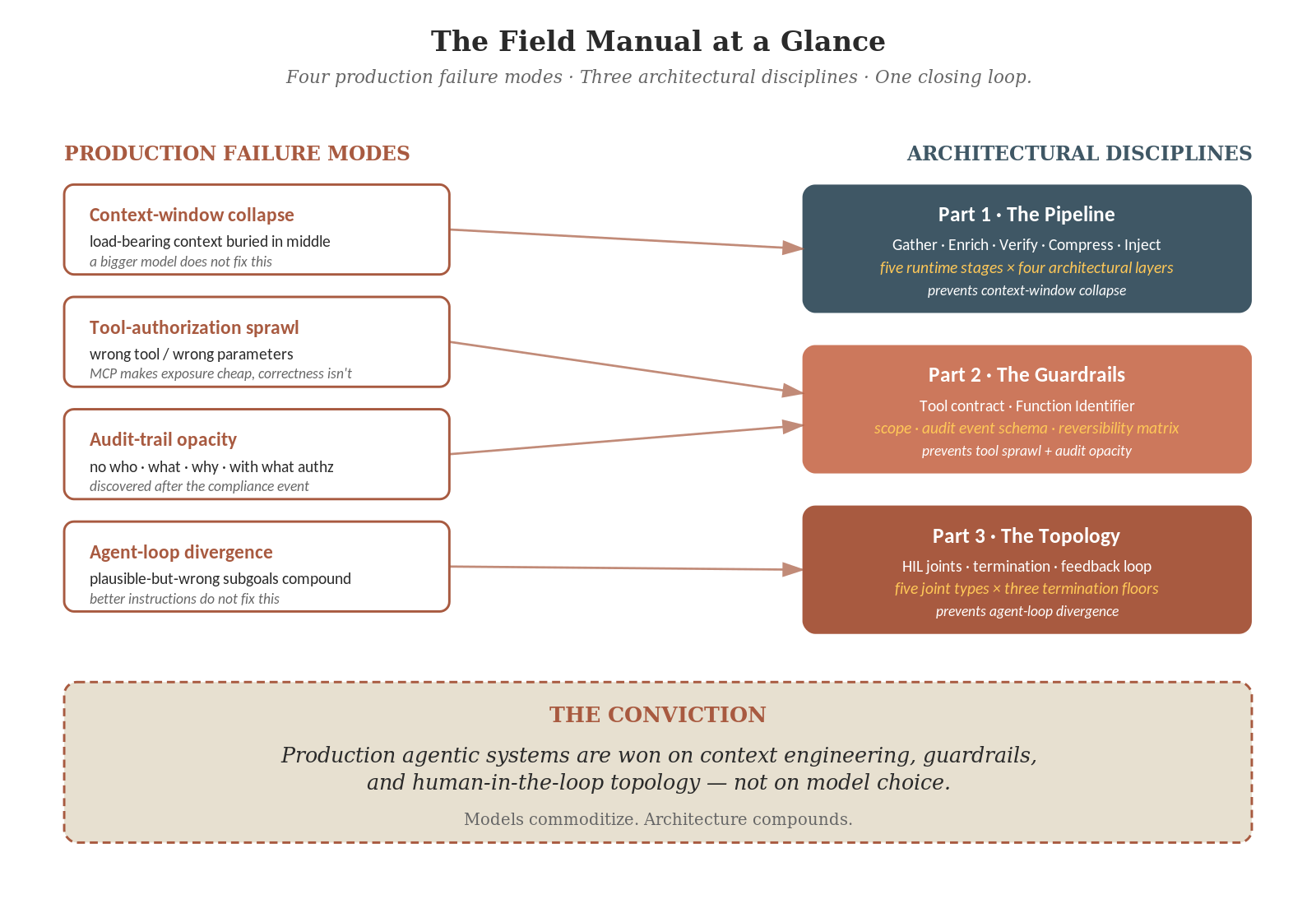
Production agentic systems are won on context engineering, guardrails, and human-in-the-loop topology — not on model choice.
That is an unfashionable claim because the model providers are the loudest voices in the room. But if you are designing agentic systems for regulated industries or for production at enterprise scale, you already know this is true. The architecture is the moat.
4 Failure Modes You Keep Hitting
The argument is anchored in four specific production failure modes I have watched recur across the agentic systems I have hands-on built. Each of them is the kind of thing that does not show up in a demo but absolutely shows up at scale.
Context-Window Collapse
The agent loop accumulates junk — earlier outputs, partial reasoning, retrieved chunks that turned out to be irrelevant — and by turn ten the most important context is buried in the middle, exactly where the model cannot see it. The team tries to fix this by switching to a bigger model with a longer context window. It does not fix it. The fix is upstream: deliberately curating what enters the context and what gets compressed out. Part 1 takes this on.
Tool-Authorization Sprawl
MCP gateways make it easy to expose a hundred tools to an agent. The agent picks the wrong one because the right one was not named clearly, or it picks the right one but with the wrong parameters because the schema was ambiguous. In regulated environments, this is not theoretical; it is a write to the wrong account, a fetch of the wrong customer record, a compliance event. The fix is rigorous tool surface design and authorization scopes — not a more capable model. Part 2 takes this on.
Audit-Trail Opacity
In regulated industries, every agent action must be traceable to who, what, and why. Models do not produce audit trails. The fix is to engineer the audit trail at the system level — what context was injected, which tools were called with which parameters, what human approval gates were crossed, and what the outputs were at each stage. Part 2 takes this on alongside tool sprawl.
Agent-Loop Divergence
The agent reasons in a loop that should have terminated three turns ago, generating plausible-but-wrong subgoals, calling tools that should not be called, and producing output that looks confident but is structurally broken. The fix is explicit loop topology: agent reasoning bounded by deterministic logic, with human approval at the joints. Not “give the agent better instructions.” Part 3 takes this on.
What the 3 Parts Cover
Part 1 — The Pipeline
Context engineering as a managed pipeline rather than a one-shot retrieval step. Five runtime stages (Gather, Enrich, Verify, Compress, Inject) compose with four architectural layers (Acquisition, Refinement, Distribution, Evolution) plus Orchestration. Code references from a working FastAPI implementation. Hybrid retrieval with weighted fusion, hierarchical context trees with role adaptation, landmark attention compression, token-level injection. The pipeline produces role-calibrated, token-efficient context. It prevents context-window collapse.
Part 2 — The Guardrails
Tool surface as a five-field contract (name, schema, scope, risk class, reversibility), not a function signature. The Function Identifier as the runtime gate that filters the full tool catalog into a per-turn surface. Audit trail as a first-class artifact emitted by the pipeline with a stable event schema and append-only storage. A reversibility-by-risk matrix that determines the HIL gate depth for every action. The guardrails prevent tool-authorization sprawl and audit-trail opacity. A short note on how regulated-industry constraints — SOX, GDPR, PCI-DSS, the EU AI Act — sit on top of this architecture.
Part 3 — The Topology
Five canonical HIL joint types (planning approval, parameter approval, action approval, post-hoc review, escalation), each with its purpose, context shape, and default-on-timeout behavior. Three independent termination conditions (cost ceiling, turn limit, confidence floor) composed in AND-not-OR. A closing feedback loop where HIL approvals retune the pipeline’s strategy parameters rather than retraining the model. Multi-agent extensions where humans become handoff points between agents as well as gates over actions. The topology prevents agent-loop divergence and closes the system.
How to Read the Series
Each part stands alone. A reader who reads only Part 1 gets a defensible argument about why context engineering is the moat. A reader who reads only Part 3 gets a complete summary of all three parts at the closer. The cross-references compose into a single architecture — the Role Adapter from Part 1 reappears in Part 3, the reversibility classes from Part 2 govern the HIL joints in Part 3, the Function Identifier from Part 1 becomes the enforcement seam in Part 2 — so reading all three produces a stronger mental model than reading any one of them.
The running example is the same across all three parts: supply chain exception management. Five process stages, five roles, three high-stakes decisions. The example was chosen because it is concrete enough to ground the engineering choices and regulated enough to make the guardrails and HIL topology matter. The pattern generalizes to banking exception handling, mainframe modernization, healthcare diagnostic support, financial compliance, and the other domains where I have applied this architecture.
The implementation that backs the series is an open code reference: a FastAPI service organized into four architectural layers, with the runtime pipeline traversing all four for a single request. Code snippets in each part are real, drawn from context_acquisition.py, context_refinement.py, context_distribution.py, and context_evolution.py. Where a snippet illustrates a pattern that’s prescription rather than implementation, the prose says so explicitly.
References appear at the end of each part for the work that part draws on. A consolidated Part 4 — Further Reading & Research Lineage — collects all references in one place plus a cross-cutting reference and a note on what is deliberately not cited.
Who This Is For
This series is written for people designing agentic systems for production, in regulated industries or at enterprise scale. Distinguished engineers and architects who have to defend their architecture under audit. Solutions engineers who have to deploy agentic systems into customer environments where the failure cost is high. CTOs and engineering leaders who have to decide where to invest engineering effort across context, tools, models, and human-review processes.
The series is not written for people who are deciding which model to call. That decision is largely commoditizing. The series is written for the architectural decisions underneath the model — the decisions that will still matter when this year’s frontier model is next year’s baseline.
If you are designing agentic systems in production right now, the question is not which model you should use. The question is which of these architectural disciplines you have not yet engineered. Most teams have not engineered any of the three. That is the opportunity. That is the moat.
Continue to Part 1 — The Pipeline for the context engineering layer.
Opinions expressed by DZone contributors are their own.
Comments