

Your Cloud Diagram Is Already Out of Date: An Operating Model for Continuous Security Architecture
A five-stage operating model — Define, Prevent, Observe, Validate, and Improve — for keeping multi-account cloud environments aligned with architectural intent.
 ·
·
Join the DZone community and get the full member experience.
Join For FreeThe Diagram-to-Deployment Gap
Cloud security architecture often begins with a strong design, account boundaries are defined, identity federation and vending patterns are selected, centralized security services are planned, and diagrams show how telemetry, governance, and incident response should work together. The design may be reviewed by experienced architects and approved by risk stakeholders. Yet the most difficult part starts after deployment.
Cloud environments are not static. New accounts are created, workloads are modernized, emergency changes are made, teams adopt new services, and temporary exceptions accumulate. Over time, the deployed environment can diverge from the approved design even when no single team intends to weaken security. A diagram captures architectural intent while the running cloud environment represents operational reality. A mature security program must continuously reconcile the two.
The central challenge is therefore not only whether an organization can design a secure cloud architecture. It is whether the architecture can continuously determine that its assumptions still hold. In practice, applying the operating model in this article reduced the time to detect architecture drift from weeks to hours - because divergence from intent is checked continuously against explicit invariants rather than discovered during periodic reviews or audits.
I have watched this play out on several architectures I have helped design over the years. The architecture was approved, the launch was clean, and a couple of quarters later the environment no longer matched the diagram we had signed off on. No single team broke it. It drifted organically through dozens of individually reasonable decisions, each of which looked fine on its own review.
This article presents a five-stage Continuous Security Architecture Loop — Define, Prevent, Observe, Validate, and Improve — for turning architecture from a one-time deliverable into an operating system for cloud assurance.
Why Traditional Security Architecture Becomes Static
Traditional architecture processes are strongest at design time. Teams conduct threat modeling, select controls, review trust boundaries, approve exceptions, and publish reference patterns. Once a workload is approved, responsibility often shifts to platform engineering, application teams, security operations, compliance, and audit. The handoff creates a structural gap where architecture defines the intended state, while operations manages the actual state.
This gap becomes particularly visible in multi-stakeholder environments. A central team may define a standard account structure, but application teams control many day-to-day decisions inside each account. A security service may be enabled at launch but disconnected later. A centralized log destination may exist while selected workloads stop delivering critical events. A temporary administrative role may become a permanent access path. Each change may look like a configuration issue, yet the combined effect can break the original trust model.
Configuration Drift vs. Architecture Drift
Configuration drift and architecture drift are different problems. Configuration drift means a resource no longer matches an expected setting. Architecture drift means a security property of the system is no longer true. Logging may still be enabled while workload administrators can now alter the evidence. Encryption may still be present while key access violates the intended separation of duties. The resources look compliant, but the architecture has quietly lost an assumption it depended on.
None of this means engineering teams are careless. Drift is what you get when architectural decisions are never wired to enforceable boundaries, current evidence, and operational feedback.
Defining Continuous Security Architecture
Continuous security architecture is an operating model that translates security principles into testable requirements, applies those requirements through preventive and detective mechanisms, validates deployed environments against architectural intent, and feeds operational findings back into future designs. It is related to continuous compliance, policy as code, infrastructure as code, cloud security posture management, and security monitoring, but it is not equivalent to any one of them. Continuous compliance asks whether a defined requirement is satisfied; continuous security architecture asks a broader question: does the implemented environment continue to preserve the trust assumptions, control objectives, and security outcomes of the approved architecture?
This distinction matters because an architecture can satisfy many individual configuration checks and still fail as a system. A useful model must therefore connect four elements: the principle being protected, the architecture requirement derived from that principle, the controls that implement the requirement, and the evidence used to determine whether the outcome remains true.
How continuous security architecture relates to adjacent practices:
| practice | core question | relationship to this loop |
|---|---|---|
|
Policy as code |
Is this rule encoded and enforced? |
A mechanism used inside Prevent and Validate - not the model itself. |
|
Continuous compliance |
Is a defined requirement satisfied? |
A subset: answers per-control conformance, not whether the system’s trust assumptions still hold. |
|
CSPM |
Are resources misconfigured against a benchmark? |
Feeds the Observe stage; scores configurations, not architectural invariants. |
|
Continuous security architecture |
Do the architecture’s trust assumptions still hold in production? |
The superset - connects principle, requirement, control, and evidence across all five stages. |
The Continuous Security Architecture Loop
The Continuous Security Architecture Loop contains five stages. The stages are not a maturity sequence that an organization completes once. They form a recurring operating cycle. Each stage produces information needed by the next, and the final stage feeds learning back into the beginning.
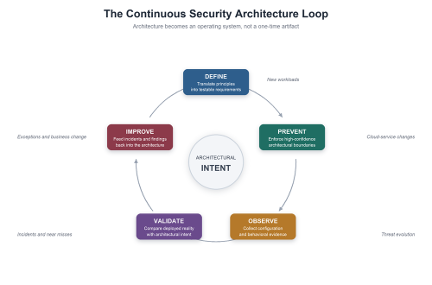
|
Running example throughout this section: We follow one invariant, “Security logs cannot be modified by workload administrators” (INV-LOG-001), through all five stages, so “invariant” stops being an abstract term and becomes a single property each stage acts on. |
1. Define: Convert Principles Into Testable Requirements
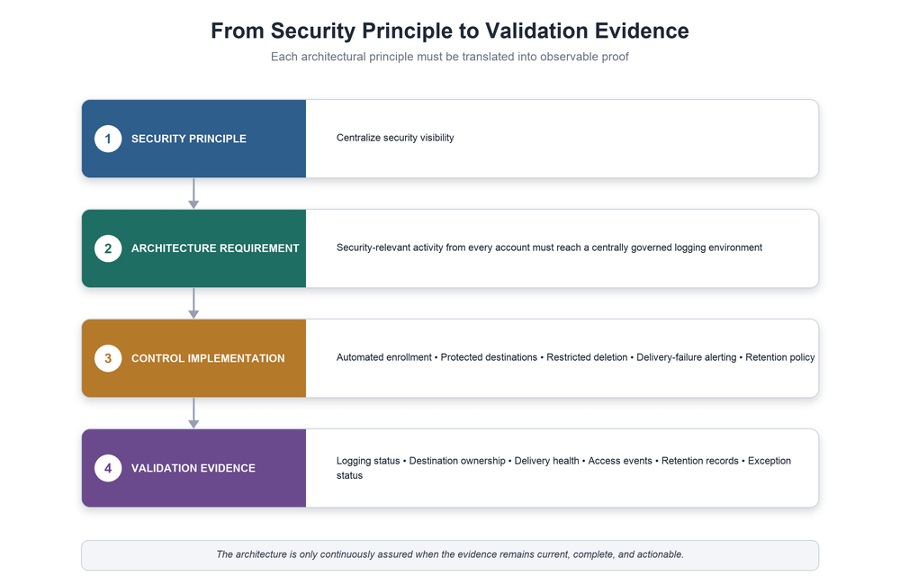
Security principles are often written as apply least privilege, centralize visibility, minimize blast radius, protect administrative access, or encrypt sensitive data. These are directionally correct, but they do not specify what evidence proves implementation, so different teams interpret the same principle differently.
The Define stage converts broad principles into testable architecture requirements. Consider centralizing security visibility. A testable requirement might state that security-relevant activity from every account must be delivered to a centrally governed logging environment. That statement decomposes into measurable conditions: required audit sources are enabled, destinations are centrally controlled, workload teams cannot delete retained evidence, delivery failures generate alerts, newly created accounts are automatically enrolled, and retention supports investigation needs.
You are not trying to turn every architecture document into a long checklist. Rather, you are identifying the properties that materially support the security model. Each requirement should describe the intended outcome, identify the evidence needed to validate it, specify an owner, and state whether the implementation is preventive, detective, responsive, or compensating. The strongest requirements are technology-aware without being tool-bound: state the security property first, then map it to the chosen cloud services, so the design survives a change of implementation technology.
Express the requirement as a structured, adoptable artifact rather than prose:
# invariant: logs-immutable-by-workload
id: INV-LOG-001
principle: Centralize security visibility
requirement: >
  Security-relevant events from every account are delivered to a centrally
  governed logging destination that workload administrators cannot alter or delete.
outcome: Log evidence remains complete and tamper-resistant for investigation.
control_type: preventive + detective
owners:
  control: platform-engineering
  evidence: platform-engineering
  risk: security-architecture
evidence_sources:
  - cloudtrail: organization trail delivery status
  - config: S3 bucket policy + KMS key policy on the log destination
  - scp: effective policy on workload OUs
validation_frequency: near-real-time   # log-delivery failure is high-consequence
exception_policy:
  allowed: false                        # no standing exceptions to this invariant
residual_risk_target: none
Define — running example: The principle centralize security visibility becomes the spec above (INV-LOG-001). The security property is stated first, and then the AWS services are mapped underneath it.
2. Prevent: Enforce High-Confidence Architectural Boundaries
Some architectural decisions should not depend on detection after a violation occurs. Disabling central logging, moving data into an unapproved region, disconnecting an account from governance, or creating an unmanaged administrative path can undermine the security model immediately. Preventive controls make selected decisions non-optional.
In a multi-account environment, platform teams can use organizational policies, account foundations, identity boundaries, deployment controls, and protected service configurations to prevent workload accounts from changing central audit destinations, leaving the organization, disabling designated security services, or creating resources in restricted locations. The goal is to protect the boundaries that preserve the architecture.
A single service control policy (SCP) makes the boundary concrete-the action is simply unavailable to workload accounts:
{
  "Version": "2012-10-17",
  "Statement": [
    {
      "Sid": "ProtectCentralLogDestination",
      "Effect": "Deny",
      "Action": [
        "s3:DeleteBucket",
        "s3:PutBucketPolicy",
        "s3:PutEncryptionConfiguration",
        "s3:PutLifecycleConfiguration"
      ],
      "Resource": "arn:aws:s3:::org-central-security-logs*",
      "Condition": {
        "StringNotEquals": {
          "aws:PrincipalArn": "arn:aws:iam::*:role/PlatformLoggingAdmin"
        }
      }
    },
    {
      "Sid": "PreventLeavingOrgAndDisablingAudit",
      "Effect": "Deny",
      "Action": [
        "organizations:LeaveOrganization",
        "cloudtrail:StopLogging",
        "cloudtrail:DeleteTrail"
      ],
      "Resource": "*"
    }
  ]
}
The design challenge is selectivity. Excessive preventive control makes the platform brittle, blocks legitimate engineering work, and creates pressure that leads to bypasses. Not every deviation has the same consequence. A useful rule: prevent actions that would materially break the security architecture, and detect-and-remediate lower-risk deviations where flexibility is necessary. Only a small number of actions, like those above, warrant a hard Deny. Before enforcing a preventive control, evaluate service behavior, failure modes, exception needs, and recovery paths. A guardrail that cannot be safely changed during an incident introduces a different form of risk.
Prevent — running example: The SCP above, applied to all workload OUs, denies StopLogging, DeleteTrail, and mutating actions on the central bucket for every principal except the platform logging role. INV-LOG-001’s boundary is now unavailable, not merely monitored.
3. Observe: Collect Evidence About the Deployed Architecture
Architecture cannot be validated using resource configuration alone. The evidence layer may need configuration state, identity activity, network flows, deployment events, security findings, data-access records, control exceptions, and account-lifecycle events. Observation turns a running environment into evidence that can be compared with architectural intent.
Consider an approved privileged-access model requiring federation, strong authentication, time-limited role assumption, and centralized activity logging. A configuration scan will happily confirm that the administrative role exists. What it will not show you is the engineer who skips that path entirely - using a long-lived key, an alternate role, or direct access from an unmanaged identity. That only shows up in behavioral evidence. So the questions worth asking are practical ones: does the property still hold, what proves it, how fresh is that proof, and who gets paged when it goes missing? Treat absence of telemetry as a finding in its own right — a gap in the logs is a gap in your ability to say anything true about that account.
Centralization should not eliminate local ownership. Workload teams still need visibility into their findings and operational context, while the organization needs a protected evidence plane that cannot be selectively altered by the systems being observed.
Observe — running example: For INV-LOG-001, the platform collects trail delivery status, bucket and key policy state, and every S3 mutation event against the log destination. Absent delivery telemetry is itself recorded as a finding.
4. Validate: Compare Deployed Reality With Architectural Intent
Security programs often report findings as isolated events: one missing log source, one excessive role, one unmanaged connection, or one failed service enrollment. Continuous architecture validation asks whether those findings indicate that a larger architectural property is no longer true.
Validation can be organized around architectural invariants which represent properties that must remain true regardless of application changes. Examples include: security logs cannot be modified by workload administrators; production identities originate only from approved sources; all production accounts inherit baseline governance; privileged access is time-bound and attributable; and external connectivity passes through approved control points.
An invariant is machine-checkable. A query for INV-LOG-001, where a zero-row result is the passing state:
-- Did any non-platform principal touch the central log destination?
SELECT eventtime, useridentity.arn AS principal, eventname, requestparameters
FROM security_events
WHERE eventsource = 's3.amazonaws.com'
  AND eventname IN ('PutBucketPolicy','DeleteBucket',
                    'PutEncryptionConfiguration','PutLifecycleConfiguration')
  AND element_at(requestparameters, 'bucketName') LIKE 'org-central-security-logs%'
  AND useridentity.arn NOT LIKE '%role/PlatformLoggingAdmin'
  AND eventtime > date_add('day', -1, now());
A returned row is an architecture-conformance failure rather than a lone configuration finding. Even when the SCP already blocked the action, the attempt itself is a signal the Improve stage should see.
Each invariant should be connected to a validation record containing the expected state, evidence sources, current state, owner, validation frequency, exception status, residual risk, and remediation target. The record is not simply an audit artifact; it provides a shared language for architecture, platform, operations, and workload teams. A single failing record communicates the thesis better than a page of prose:
| field | example value |
|---|---|
|
Invariant |
Security logs cannot be modified by workload administrators (INV-LOG-001) |
|
Expected state |
Central log bucket + KMS key policies deny workload principals; org trail delivering |
|
Evidence sources |
Config rule s3-log-bucket-policy; org CloudTrail delivery status; effective SCP |
|
Current state |
FAIL — Account 1234 delivering, but bucket policy drifted to allow WorkloadAdmin |
|
Owner |
Platform engineering (control) / Security architecture (risk) |
|
Validation frequency |
Near-real-time |
|
Residual risk |
High until remediated — evidence integrity not guaranteed |
|
Remediation target |
4 hours |
Validation frequency should reflect risk and rate of change. Public exposure, privileged access, and log-delivery failures may require near-real-time evaluation. Account ownership may be checked daily. Exception reviews may occur monthly or quarterly. Reference architectures should also be reviewed when new services, threats, incidents, or business models invalidate prior assumptions.
Validate — running example: A daily and event-driven check finds Account 1234’s bucket policy has drifted to grant a workload role write access. It is recorded as an architecture-conformance failure against INV-LOG-001 - with owner, residual risk, and a 4-hour remediation target - not as a standalone S3 finding.
5. Improve: Feed Operational Learning Back Into Architecture
Security incidents and recurring findings are frequently remediated at the workload level. The immediate problem is fixed, but the reusable architecture remains unchanged, allowing the same design weakness to appear in other environments.
The Improve stage treats operational events as feedback about the architecture itself. Incidents, near misses, recurring findings, control bypasses, exception patterns, deployment failures, new threat intelligence, and cloud-service changes should all influence future design decisions.
Suppose an incident reveals that a workload role could redirect security logs. Correcting the role is necessary but not sufficient. The organization should ask whether the reference architecture clearly separates log ownership, whether organizational controls should protect the destination, whether other accounts share the condition, whether new validation logic is required, and whether the account-vending process should be updated. A practical rule: every significant incident should produce both a workload-level corrective action and an architecture-level learning decision—a revised reference pattern, a new preventive control, an additional validation test, clearer ownership, an improved deployment template, or an explicit acceptance of residual risk.
I remember a stretch where three newly vended accounts failed the same detection-enrollment step inside a single month. Fixing them one at a time felt like progress until the pattern became impossible to ignore. It revealed that the account vending pipeline was the defect, not the accounts. Once we corrected the pipeline, the failure class stopped appearing.
Improve — running example: Root cause of the Account 1234 drift: the account-vending template applied the bucket policy once but did not protect it against later edits. The fix is not just repairing Account 1234 - it is (a) adding the mutating actions to the SCP, (b) adding a Config rule to catch policy drift, and (c) updating the vending template so future accounts start protected. The invariant, not the incident, drives the change.
From Control Deployment to Control Effectiveness
A control being deployed does not prove that it is effective. Logging may be enabled while important events are excluded. Encryption may be enabled while key access is broader than intended. Threat detection may be active while findings have no response owner. Backup policies may exist while restoration has never been tested. Organizational guardrails may be present while alternative paths bypass the intended restriction.
Continuous assurance therefore needs more than a binary deployed/not-deployed status. A practical evaluation can examine five dimensions:
| dimension | question it answers |
|---|---|
|
Coverage |
How much of the intended environment is protected. |
|
Correctness |
Whether the implementation matches the requirement. |
|
Resilience |
Whether the control can be bypassed, altered, or disabled. |
|
Responsiveness |
Whether failure produces timely action. |
|
Outcome |
Whether the control measurably reduces the intended risk. |
These dimensions should not be collapsed into a universal score without context. A high coverage percentage can conceal a critical gap, while a small number of exceptions may carry disproportionate risk. The architecture team should define what effective means for each important control objective and how that effectiveness will be demonstrated.
The specific dimension I have seen fail most quietly is Resilience. A control can be present, correct, and even alerting, and a workload role can still disable it or route around it. Coverage and Correctness are the easy numbers to put on a slide, while Resilience is the one that decides whether those numbers mean anything.
Central Governance With Distributed Ownership
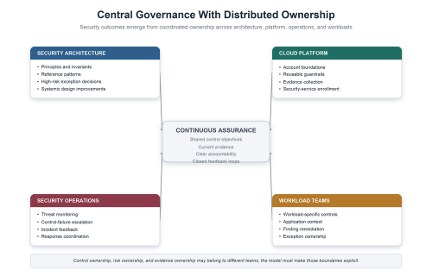
No central team can manage every workload configuration, and no workload team can set enterprise-wide requirements on its own. The shared responsibility that works in practice is that architecture owns the principles, reference patterns, invariants, and the hard exception calls. Platform turns those into the account foundations, guardrails, enrollment workflows, and evidence collection everyone else inherits. Workload teams own what is specific to their application — the controls, the context behind a finding, and their own exceptions. Security operations watches for threats and control failures and feeds what it learns back into the architecture. Risk and compliance tie the evidence to obligations and to whatever risk has been formally accepted.
The model must distinguish among control ownership, evidence ownership, and risk ownership. The platform team may operate centralized logging, while the workload owner remains accountable for producing the application events needed for investigation. Security operations may own an alerting process, while architecture owns the invariant that the process is meant to protect. Ambiguity at these boundaries is a common cause of unaddressed findings.
End-to-End Scenario: Creating a New Production Account
Consider the creation of a new production account. The organization defines several requirements: the account must join the production governance hierarchy, use approved identity federation, deliver security logs to a protected destination, enroll in centralized detection, and restrict deployment to approved regions.
During Prevent, organizational policies enforce these boundaries with concrete mechanisms. SCPs on the production OU deny organizations:LeaveOrganization, deny mutating actions on the central log bucket, and deny non-approved regions via an aws:RequestedRegion condition. Account Factory (or an equivalent vending pipeline) provisions the account directly into the production OU so the guardrails apply from creation, not after.
During Observe, the security platform collects the literal events: CloudTrail CreateAccount and the account’s move into the OU, the AWS Config recorder status, GuardDuty/Security Hub enrollment state, identity-federation configuration, and organization-trail delivery status.
Validation compares the account with the production architecture invariants. Suppose the account is delivering logs but has not enrolled in centralized detection. The check returns a failing record:
invariant:        all-prod-accounts-inherit-baseline-governance (INV-GOV-002)
account:          1234
expected_state:   GuardDuty + Security Hub enrolled via delegated admin
current_state:    FAIL - Security Hub not enrolled (Config recorder ON, trail OK)
owner:            platform-engineering (control) / security-architecture (risk)
residual_risk:    medium - threat findings not aggregated for this account
remediation_by:   24h
This is recorded as an architecture-conformance issue rather than an isolated configuration finding. The record names the account owner, the missing evidence, the remediation target, and any approved exception.
The Improve stage examines patterns across accounts. If several new accounts fail at the same enrollment step, the organization does not continue fixing them individually. It treats the repeated failure as evidence that the account-vending or enrollment architecture is incomplete, and the reusable process is corrected so future accounts begin in the expected state. This example illustrates the essential shift where continuous architecture is not a larger collection of controls; it is a system that connects design intent, platform implementation, operational evidence, validation, and learning.
Common Anti-Patterns
- Architecture by diagram. There is a beautiful target-state picture on the wiki, and no way to answer the only question that matters: does the running environment still look like it?
- Guardrail accumulation. Controls pile up over years. Nobody removes them, nobody re-checks whether they still fire, and eventually the platform is so encrusted that engineers route around it - which is its own risk.
- Dashboard assurance. The board is green, so leadership feels safe - even though the dashboard only measures the handful of configurations someone remembered to wire up.
- Permanent “temporary” exceptions. The exception was granted for two weeks in 2023. It has no expiry, no owner, no compensating control, and no evidence the original risk still exists. It is now load-bearing.
- Finding-by-finding remediation. Teams close tickets faster than the architecture produces them, treating each symptom as new while the weakness that generates them stays untouched.
- Tool-defined architecture. The security model quietly shrinks to whatever the chosen product happens to detect. The tool should serve an architecture you defined independently - not the other way around.
Adopting the Loop Incrementally
Continuous security architecture does not require building all five stages at once. A workable sequence can be:
- Start with 3-5 invariants, not a catalog. Pick the properties whose failure would most damage the trust model, such as log integrity, production identity origin, privileged-access time-bounding, network egress control, baseline governance inheritance. Write each as a spec like INV-LOG-001.
- Validate before you observe everything. You do not need a complete evidence lake to begin. For each invariant, identify the single signal that proves it and check that. Breadth of telemetry comes later.
- Prevent only the highest-consequence actions first. A small set of well-chosen Deny guardrails, like leaving the org, disabling logging, or altering the log destination, protects more than a large, brittle policy set. Add preventive controls where a violation is irreversible; detect-and-remediate everywhere else.
- Wire the feedback loop early, even if manual. A monthly review that turns recurring findings into architecture changes delivers most of the Improve-stage value before any automation exists.
- Automate by consequence and rate of change. Move the highest-risk, fastest-changing invariants to near-real-time checks first. Slower-moving properties can stay on a daily or weekly cadence.
A team can reach a useful state with five invariants, a handful of SCPs, one validation query per invariant, and a recurring review, and then expand coverage as the model proves its value. This is also how the weeks-to-hours improvement in drift detection is realized in practice: near-real-time validation of a few high-consequence invariants, not full automation on day one.
When I have taken teams through this, the first few invariants we picked mattered far more than the tooling around them. Choose the properties whose failure would genuinely hurt, prove those, and resist the pull to boil the ocean on day one.
Conclusion: Architecture as an Operating System
A reference architecture captures intended security design. Continuous security architecture is how you find out whether that intent still holds as systems, teams, threats, and cloud services change. The loop gives you a practical model: Define testable requirements, Prevent the actions that would break critical boundaries, Observe the evidence you need to understand the environment, Validate reality against intent, and Improve the design from what operations teaches you.
The value of a security architecture is not determined by the quality of its diagram. It is determined by how reliably the organization preserves its security assumptions in production and how quickly it learns when those assumptions no longer hold. Applied to a multi-account environment, this model cut architecture-drift detection from weeks to hours, turning drift from a condition found in periodic reviews into one that is continuously observed.
Opinions expressed by DZone contributors are their own.
Comments