

Secure Private Connectivity Between VMware and Object Storage: An Enterprise Architecture Guide
This guide details how to establish secure private connectivity between VMware and Object Storage using Cloud Service Endpoints.
 CORE
·
CORE
·
Join the DZone community and get the full member experience.
Join For FreeAs an architect, security is the first thing that comes to mind when defining an architecture for a customer. One of the key things that you need to keep in mind is minimizing the network traffic routed through the public internet. This article discusses how to bring private connectivity to cloud services, working with compute platforms like VMware on Cloud.
Modern cloud architecture follows a "defense-in-depth" philosophy where network isolation forms the foundational security layer. Public internet exposure creates unacceptable risks for enterprise workloads handling sensitive data, financial transactions, or regulated content. Private connectivity addresses this by implementing a critical architectural principle: Zero Trust Network Access (ZTNA).
Unlike perimeter-based security models, ZTNA assumes all external networks are hostile and requires verification at every access point. By routing traffic through private backbones rather than the public internet, organizations eliminate the most common attack vectors. DNS poisoning, SSL stripping, and credential sniffing, while gaining:
- Intrinsic security through network isolation
- Reduced attack surface by removing public IP exposure
- Compliance enforcement via architecture rather than configuration
- Data sovereignty assurance by keeping traffic within provider-controlled networks
This architectural approach transforms connectivity from a vulnerability to a security control, making private links non-negotiable for production workloads.
Introduction to VMware Cloud Foundation
VMware Cloud Foundation (VCF) is an integrated software-defined data center platform that combines compute virtualization (vSphere), software-defined storage (vSAN), advanced networking (NSX), and cloud management into a unified stack. Enterprises adopt VCF to maintain operational consistency across hybrid environments using familiar VMware tools, automate lifecycle management for reduced administrative overhead, enable workload portability for seamless cloud migrations, and implement granular security through micro-segmentation.
VMware Cloud Foundation as a Service (VCFaaS) on IBM Cloud delivers these capabilities as a fully managed offering, eliminating infrastructure management burdens while preserving VMware's operational model and enterprise-grade features.
Understanding Cloud Object Storage
Cloud Object Storage (COS) is a scalable, durable cloud storage service designed for modern unstructured data workloads like backups, media files, and AI datasets. Unlike traditional block or file storage, COS organizes data as discrete objects containing the file content, customizable metadata (retention policies, security tags), and a globally unique identifier.
Key advantages include massive scalability to exabyte levels, cost-efficient pay-as-you-grow pricing, industry-leading data durability through geographic replication, and S3-compatible REST APIs for seamless integration. COS is ideally suited for data lakes, backup repositories, media distribution, and IoT data streams, with immutability features like S3 Object Lock providing critical ransomware protection.
Cloud Networking: Private CIDR Ranges
IBM Cloud reserves specific RFC1918-compliant private IP ranges exclusively for its internal infrastructure and services. These ranges prevent overlap with customer subnets and enable secure service connectivity:
| CIDR Range | Purpose | Accessibility |
|---|---|---|
10.0.0.0/14 |
IBM internal management planes | Customer workloads blocked |
10.198.0.0/15 |
Core service orchestration | Filtered by IBM backbone |
10.200.0.0/14 |
Hypervisor and storage infrastructure | Restricted to IBM systems |
166.9.0.0/16 |
Cloud Service Endpoints (e.g., COS private access) | Customer workloads via CSE |
161.26.0.0/16 |
IBM DNS and internal service resolution | Automatically routed |
Architectural Benefits
- Infrastructure isolation: Dedicated addressing for IBM’s control planes.
- Overlap prevention: Ensures no conflict with customer VPC subnets.
- Private service endpoints: COS private endpoints resolve to
166.9.x.xaddresses. - Traffic segregation: Backbone filters block customer access to IBM-reserved ranges.
The Critical Need for Private Connectivity
Public internet access to cloud storage introduces three critical risks:
- Security vulnerabilities: Exposure to eavesdropping, MITM attacks, and malicious scanning.
- Performance volatility: Unpredictable latency from internet congestion and bandwidth throttling.
- Cost inflation: Data egress fees that accumulate exponentially with large transfers.
Private connectivity via IBM’s backbone solves these by:
- Keeping traffic within IBM’s controlled network (
166.9.0.0/16). - Eliminating public internet exposure.
- Providing consistent sub-10ms latency.
- Waiving data transfer fees entirely.
Architecture: VCFaaS to COS via Cloud Service Endpoints
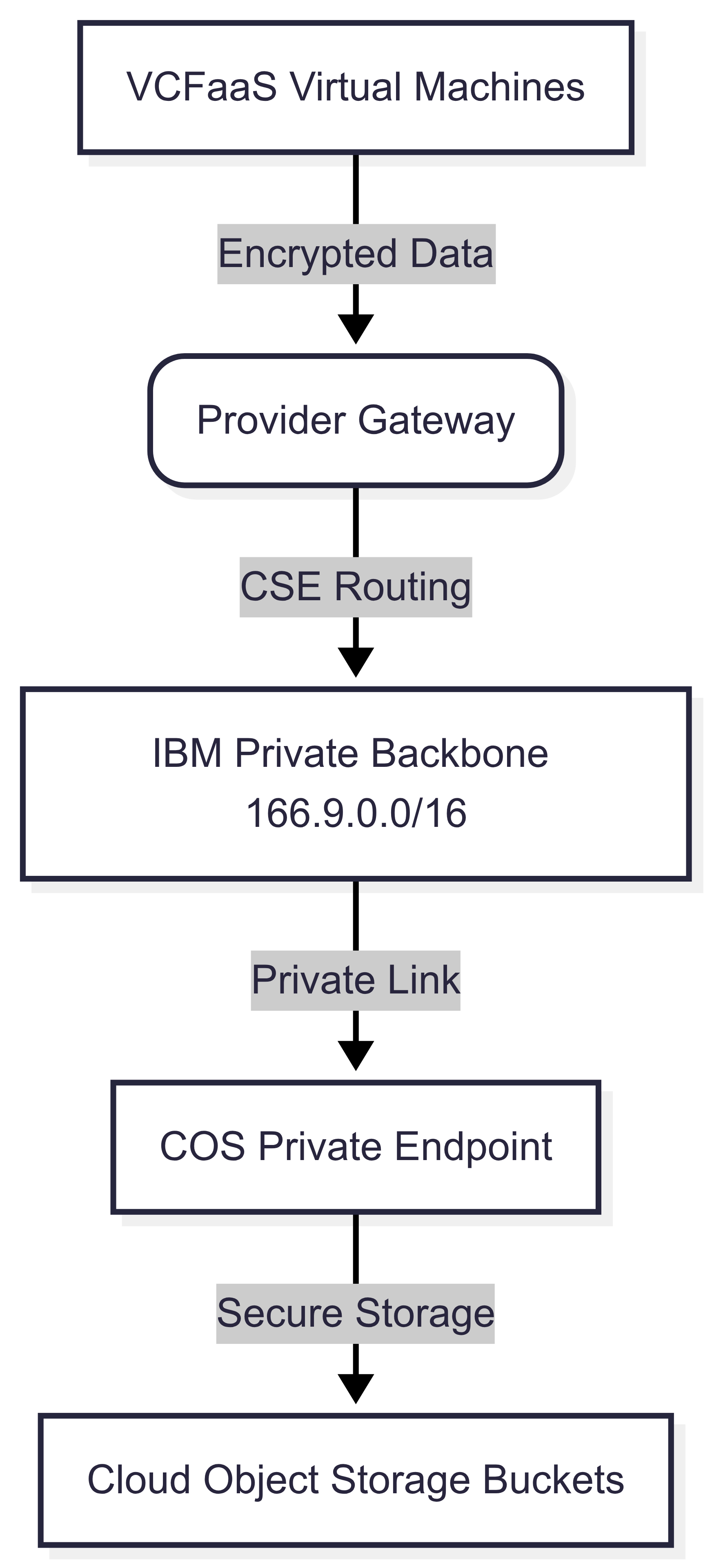
Private connectivity flow
Connectivity Workflow
- Initiation: VMs in VCFaaS target COS private endpoints (e.g.,
s3.private.us-south.cloud-object-storage.appdomain.cloud). - Routing: VCFaaS Provider Gateway directs traffic through pre-configured Cloud Service Endpoints (CSE).
- Transport: Data traverses IBM’s private backbone via RFC1918 addresses.
- Termination: Secure delivery to COS without public internet exposure.
COS Endpoint Comparison
| Endpoint Type | URL Pattern | Security Level | Performance |
|---|---|---|---|
| Public | s3.[region].cloud-object-storage.appdomain.cloud |
Standard TLS | Internet-dependent |
| Private | s3.private.[region]... |
No public exposure | Consistent low latency |
| Direct | s3.direct.[region]... |
Regional isolation | Optimal throughput |
Implementation Guide
Phase 1: Network Configuration
- Gateway attachment:
- Ensure VCFaaS networks are attached to the Provider Gateway.
- Verify firewall rules permit IBM service networks (
166.9.0.0/16).
- Subnet planning:
- Use non-conflicting RFC1918 ranges (e.g.,
192.168.0.0/16) for customer workloads .
- Use non-conflicting RFC1918 ranges (e.g.,
Phase 2: COS Private Endpoint Setup
# Python SDK configuration for private access
import ibm_boto3
from ibm_botocore.client import Config

cos = ibm_boto3.client(
    's3',
    endpoint_url='https://s3.private.us-south.cloud-object-storage.appdomain.cloud',
    config=Config(signature_version='oauth')
Phase 3: DNS Validation
- Configure VMs to use IBM DNS resolvers (
161.26.0.10,161.26.0.11). - Confirm private resolution:
Shell
nslookup s3.private.us-south.cloud-object-storage.appdomain.cloud
# Expected: 166.9.x.x (never public IP)
Security and Operational Benefits
Security Comparison
| Layer | Public Endpoint | Private via CSE |
|---|---|---|
| Network Exposure | Internet-facing | IBM private backbone only |
| Attack Surface | Scannable by malicious actors | Invisible to the internet |
| Compliance Support | Limited certifications | HIPAA/FINRA/GxP compliant |
Operational Advantages
- Cost elimination: No data transfer fees for private connectivity
- Compliance acceleration: Pre-built controls for regulated industries
- Incident reduction: Significantly fewer security events
- Architecture simplicity: No VPNs or complex firewall rules required
Real-World Applications
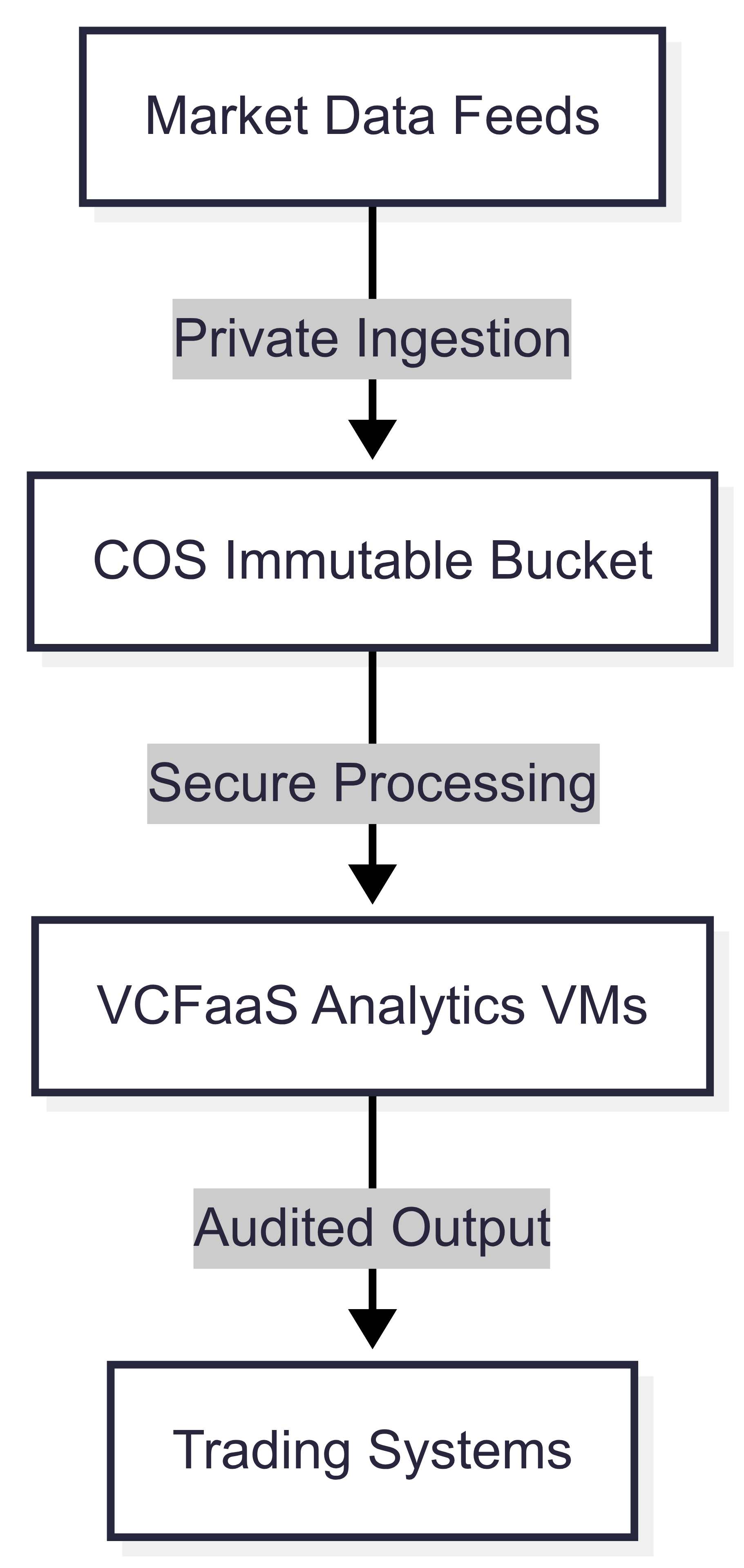
Security Achievements
- Regulatory compliance with S3 Object Lock
- Cryptographic proof of data integrity
- Zero public exposure of sensitive data
Healthcare Diagnostics Platform
- HIPAA-compliant medical image storage
- Private connectivity for AI diagnostic tools
- Certified audit trails for data access
- Patient data never traverses public networks
Media Content Supply Chain
- End-to-end encrypted media transfers
- Content watermarking via metadata
- Regional content sovereignty enforcement
- Tamper-proof archival with Object Lock
Conclusion: Security-First Cloud Architecture
The integration of VMware Cloud Foundation with IBM Cloud Object Storage through private connectivity establishes a robust enterprise architecture that transforms security from a compliance requirement to a strategic advantage. This pattern delivers critical benefits:
1. Architectural Security
Private connectivity implements security at the network layer - the foundation of cloud architecture. By eliminating public internet exposure, organizations gain inherent protection against external threats through IBM's private backbone. This "secure-by-design" approach provides more reliable protection than bolt-on security solutions.
2. Compliance by Design
The architecture validates controls for strict regulations through guaranteed data residency, immutable audit trails, and cryptographic proof of data handling integrity. This significantly reduces compliance validation efforts for regulated industries.
3. Enterprise-Grade Performance
Private backbone connectivity delivers consistent low-latency with high availability, ensuring business-critical operations operate with deterministic performance, unaffected by internet congestion.
4. Economic Efficiency
Beyond eliminating egress fees, the architecture reduces security incident response costs and compliance audit preparation time while optimizing operational efficiency.
5. Future-Ready Foundation
This security-first approach enables next-generation workloads like confidential AI, zero-trust hybrid cloud operations, and quantum-safe cryptography readiness without architectural changes.
For enterprises navigating digital transformation, this pattern demonstrates how security can become a competitive advantage. By implementing private VCFaaS-COS connectivity, organizations achieve the gold standard of cloud architecture, where security, performance, and efficiency converge to enable business innovation without compromise. If you are looking for additional information on VCFaaS and how it supports private connectivity, check this article.
Opinions expressed by DZone contributors are their own.
Comments