

Designing a REST API — What Is Contract First?
In this article, explore the contract first approach to designing a REST API.
Join the DZone community and get the full member experience.
Join For Free
When designing a great REST API, it's important to have great microservices. Contract First approach helps you in designing a great contract before implementing it. However, it does not come easy!
You Will Learn
- What is Contract First approach of designing REST API?
- What are advantages of Contract First approach?
- What are disadvantages of Contract First approach?
- When do you adopt Contract First approach?
REST API
This is the third article in a series of articles on REST APIs:
Understanding Web Services
There are several kinds of web services that are offered — REST and SOAP among others.
For every service, there is a
- The service provider, which provides the service
- The service consumer, which makes use of it
A consumer needs to know the details of the service provided. For this reason, a contract needs to be in place. A service contract specifies:
- What are the inputs and the outputs of/from the service?
- What is the URL at which the service is available?
- How do you send authorization?
Contract First Approach
In a Contract-First approach, you first define the contract, and then implement the service.
Let's look at an example.
WSDL
Let us first take up the case of WSDL — Web Service Definition Language format. Here is an example in use:
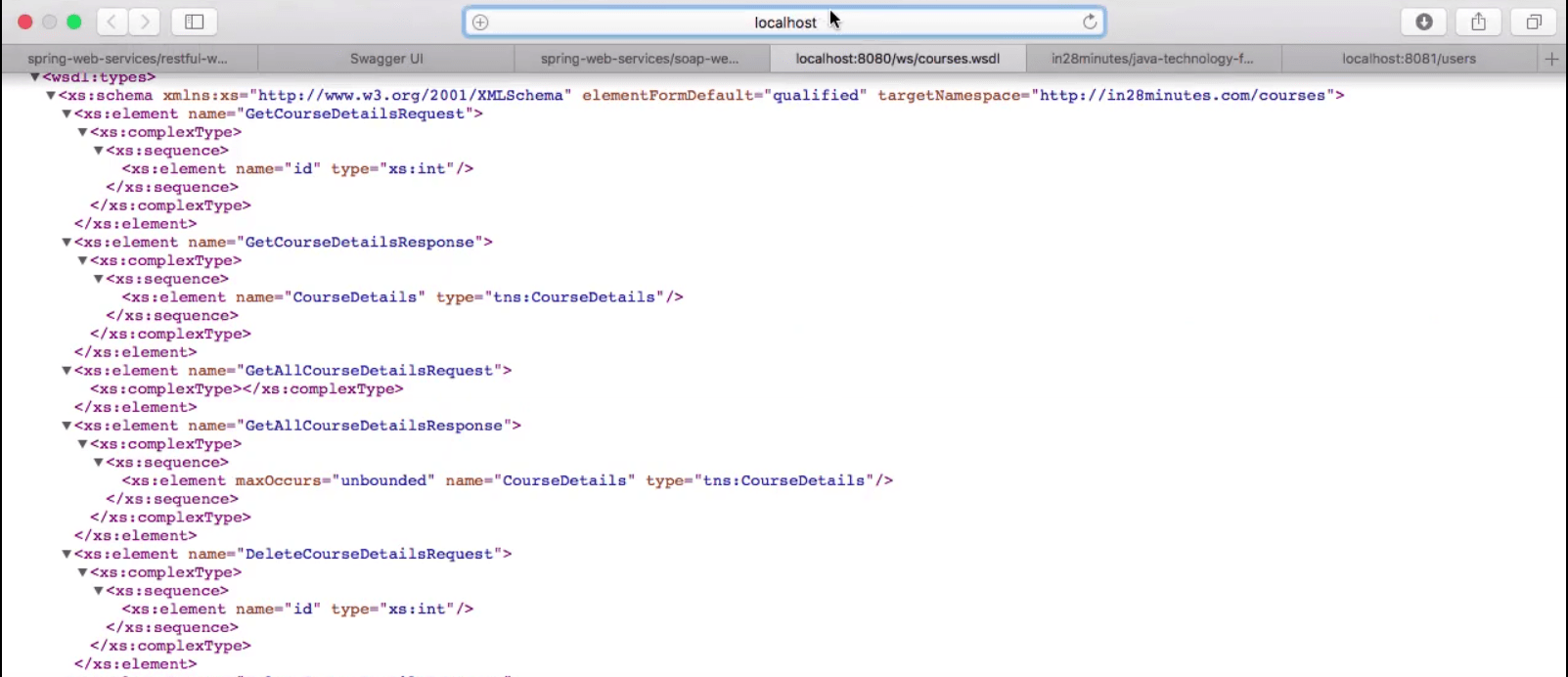
WSDL is typically used with SOAP/XML web services. In such a definition, you typically define:



What Contract-First Implies
When we start out with establishing a contract, we define a WSDL and then share it with our consumer. All this can happen even before we implement the service and make it available.
The contract tells the consumer what the request and response communication is expected to be. Once the contract is in place, the service provider can work on providing a service that adheres to the contract. The service consumer can work on developing an application to consume it.
Advantages of Contract First
Teams Can Develop in Parallel
Since coding happens based on the contract, the service provider and service consumer teams are clear about the communication approach and details. Hence, development can happen at the same time.
Teams Know What to Expect
Since coding happens based on contract, the producer and consumer teams have an idea of each others' expectations. As a result, if cross team testing is not possible due to different paces of development, stub software can be used to mock the other's behavior, all based on the contract.
Cross-Platform Compatible
Once the service parameters depend only on the contract, the actual software framework used to develop the service does not matter that much. The service provider and service consumer can use different technologies.
Enables Reuse of Schemas
The schemas that are used to define the contract for a service, are well defined in the WSDL. Therefore, if parts of services are repeated across other services, then the corresponding schemas can be reused as well.
Disadvantages of Contract First
Requires Initial Additional Effort
Most of this effort would center round agreement on a service contract. You need to make sure that the contract is well defined and does not change very often.
Over the course of using a service, if you update a contract, it affects all the other stakeholders. Therefore, there has to be a proper mechanism to communicate the changes to the various consumers.
Do check out our video on this:
Summary
In this article, we discussed the Contract First approach in the context of web services.
Published at DZone with permission of Ranga Karanam. See the original article here.
Opinions expressed by DZone contributors are their own.
Comments