

Detecting and Measuring Bias in Training Data Before It Reaches Production
How to detect and measure bias in training data before production. What's needed? Relevant metrics, code, and an auditable pipeline.
Most bias conversations happen at the model evaluation stage, after training, after fine-tuning, once there's a model to poke at with a fairness benchmark. That's useful, but it's also the most expensive place to find a problem. If a demographic group is underrepresented or mislabeled in the training data, no amount of post-hoc calibration fully undoes it, and retraining is costly in compute, time, and, in regulated settings, in the audit trail you now have to explain.
The cheaper and more defensible point to catch bias is before the data ever reaches a training run. That shifts the conversation from “why does the model behave this way” to “what did we know about the data going in, and what did we do about it,” which is the question a risk or compliance function will actually ask.
Where Bias Enters Training Data
There are a number of places where bias can enter training data. They include:
- Sampling bias: scraped or purchased data over-represents whatever was easiest to collect (English-language web text, urban populations, recent time periods).
- Label bias: human annotators bring their own assumptions into labels, especially on subjective tasks like toxicity, sentiment, or risk scoring.
- Historical bias: the data faithfully reflects a past pattern of discrimination (lending decisions, hiring outcomes) that you don't want the model to learn as “normal.”
- Measurement bias: a proxy variable (postcode, name, device type) correlates with a protected attribute and quietly reintroduces it.
- Aggregation bias: a single model trained across groups with genuinely different underlying relationships performs worst for whichever group is smallest in the data.
A Three-Stage Detection Pipeline
In practice, bias detection works best as a checkpoint with a re-audit loop, not a one-off report. The pipeline below sits between raw collection and training: data is audited, issues are addressed through reweighting, filtering, or targeted augmentation, and then re-audited before it's signed off.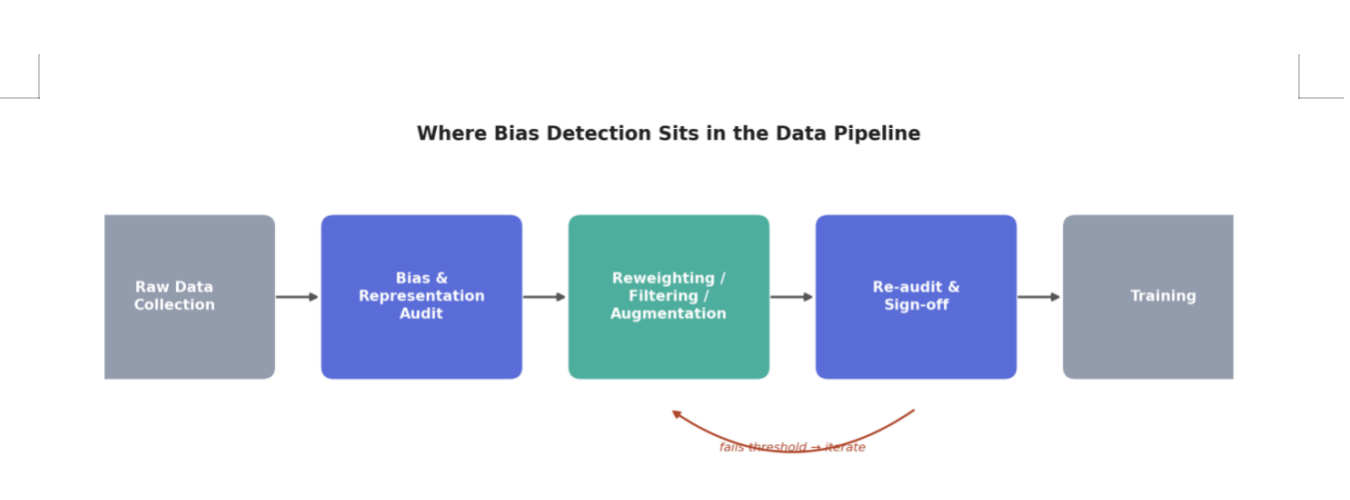
Measuring Representation Bias
The first and most tractable check is representation: does the training corpus's distribution across a group (language, region, demographic segment, source publication) match a defensible reference distribution? The function below compares corpus shares against reference shares and flags any group whose disparity ratio moves more than 25% away from parity, a threshold worth tuning to your own risk tolerance rather than treating as universal.
import pandas as pd
import numpy as np

def representation_gap(corpus_df, reference_shares, group_col="group"):
    """
    Compare each group's share of the training corpus against a
    reference population distribution. Returns a table of gaps and
    a normalized disparity score per group.
    """
    corpus_shares = corpus_df[group_col].value_counts(normalize=True)

    report = []
    for group, ref_share in reference_shares.items():
        corpus_share = corpus_shares.get(group, 0.0)
        gap = corpus_share - ref_share
        disparity_ratio = (corpus_share / ref_share) if ref_share > 0 else np.inf
        report.append({
            "group": group,
            "reference_share": round(ref_share, 3),
            "corpus_share": round(corpus_share, 3),
            "gap": round(gap, 3),
            "disparity_ratio": round(disparity_ratio, 2),
        })

    return pd.DataFrame(report).sort_values("gap", key=abs, ascending=False)


reference_shares = {"Group A": 0.32, "Group B": 0.24, "Group C": 0.20,
                     "Group D": 0.14, "Group E": 0.10}

report = representation_gap(corpus_df, reference_shares)
flagged = report[report["disparity_ratio"].sub(1).abs() > 0.25]
print(flagged)
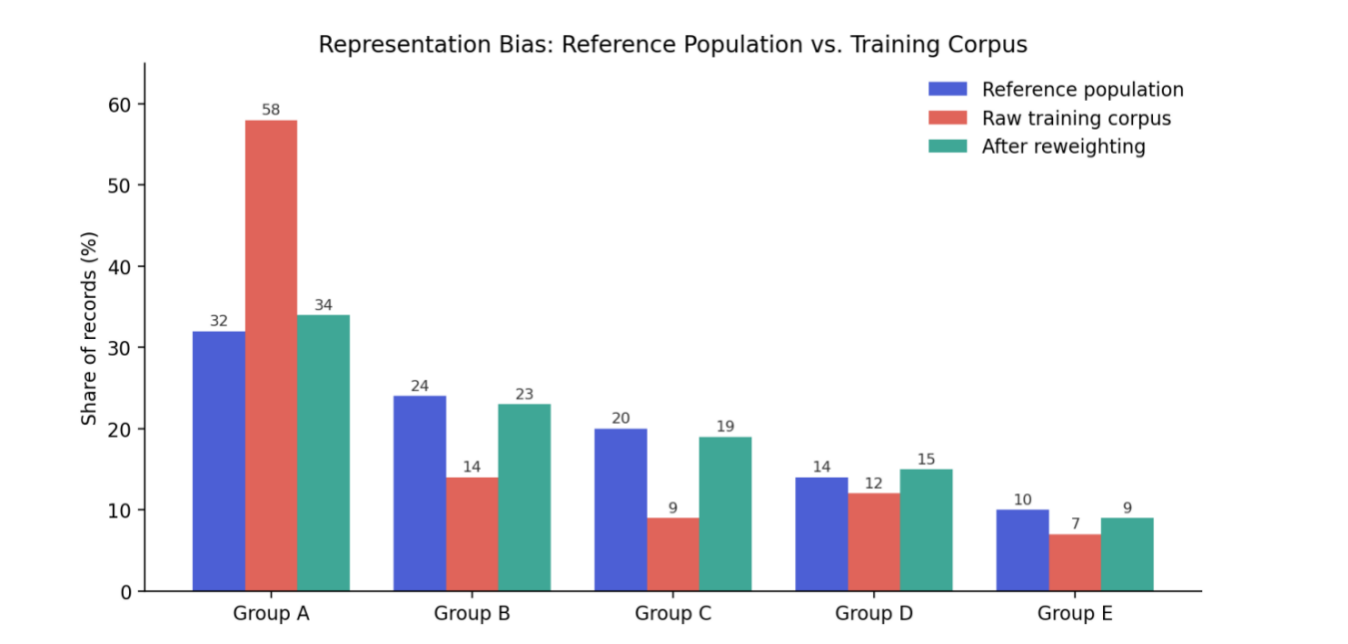
Running this against a real corpus (chart below) makes the gap concrete. The raw scrape over-represents Group A by nearly two to one relative to the reference population, while B, C, and E are all under-represented. Reweighting sampling under-represented groups more heavily during training, or capping over-represented sources, brings the corpus distribution back in line without discarding data outright.
Measuring Association and Label Bias
Representation checks catch “how much data,” but not “what the data implicitly associates.” For that, a Word Embedding Association Test (WEAT)-style check is a lightweight way to flag whether certain concepts sit unusually close to one attribute group's embeddings versus another's, the classic example being occupation words skewing toward one gender's associated terms over another's.
from sklearn.feature_extraction.text import TfidfVectorizer
from scipy.spatial.distance import cosine

def association_bias(embeddings, attribute_words, target_pairs):
    """
    Lightweight Word Embedding Association Test (WEAT-style check).
    Flags target word pairs whose embeddings sit closer to one
    attribute set than the other, beyond a tolerance threshold.
    """
    def mean_vec(words):
        vecs = [embeddings[w] for w in words if w in embeddings]
        return np.mean(vecs, axis=0)
     attr_a_vec = mean_vec(attribute_words["set_a"])
     attr_b_vec = mean_vec(attribute_words["set_b"])

    results = []
    for word_1, word_2 in target_pairs:
        for word in (word_1, word_2):
            if word not in embeddings:
                continue
            sim_a = 1 - cosine(embeddings[word], attr_a_vec)
            sim_b = 1 - cosine(embeddings[word], attr_b_vec)
            results.append({"word": word, "skew": round(sim_a - sim_b, 3)})

    return pd.DataFrame(results)
What to measure, at minimum:
- Demographic parity gap: corpus share vs. reference share, per group.
- Disparity ratio: corpus share divided by reference share; flag anything outside roughly 0.8–1.25.
- KL divergence: a single summary number for how far the corpus distribution has drifted from the reference distribution across all groups at once.
- Embedding association skew: WEAT-style scores for sensitive concept pairs.
- Label agreement by subgroup: inter-annotator agreement, segmented by the group under discussion in the labeled example.
Making it Auditable
The measurement itself is only half the point. In a regulated environment, what actually protects you is being able to show, after the fact, what thresholds were set, what was flagged, what mitigation was applied, and who signed off. That means treating the audit report as a versioned artifact tied to the specific training run it gates, not a one-off notebook that gets rerun informally next time someone asks.
A minimal version of this costs very little: store the reference distribution used, the disparity report, the mitigation applied, and a timestamp and approver, alongside the dataset version hash. When a model behaves unexpectedly in production eighteen months later, that record is what lets you answer “what did we know, and when” instead of reconstructing it under pressure.
Closing Thought
None of this fully eliminates bias; no dataset is perfectly representative, and no threshold is bias-free by definition. The goal is narrower and more achievable: make the bias that does exist visible, measured, and documented before it's baked into a model, so the decisions made about it are deliberate rather than accidental.
Opinions expressed by DZone contributors are their own.