

Predict, Repeat, Improve: Deterministic Simulation Testing Explained
Explore deterministic simulation testing — how predictable, repeatable outcomes boost QA, reliability, and confidence for engineers and architects.
 CORE
·
CORE
·
Join the DZone community and get the full member experience.
Join For FreeIt’s 2 AM. Your phone buzzes, the on-call alert flashes, and suddenly you are staring at a production outage that makes no sense. Following the logs, you get a hint: when you rerun the same scenario in staging, everything behaves perfectly. None of the quality gates/QA pipelines catch it, chaos experiments didn’t reproduce it, and now a ghost is chased that only appears when the system is under real-world pressure.
Distributed systems are notorious for these “phantom failures” — rare timing-dependent bugs that surface unpredictably and vanish just as quickly. They are the kind of dreaded incidents that keep engineers awake at night because they are unreproducible.
Take a real-world example: A service once crashed because two nodes tried to become leader at the exact same millisecond. In staging, the timing never aligned that way, so the bug remained invisible. But in production, under heavy load, it just happens, sending the system into chaos. Engineers spent days trying to recreate the failure, but without a deterministic replay, it's pure luck to get a reliable reproduction. Even when it happens, engineers may not be sure what caused it or how to reproduce it deterministically.
Enter deterministic simulation testing (DST). DST builds a fully controlled, re-playable simulation of your system’s world — nodes, clients, clocks, network delays, partitions — so that even the most elusive bugs can be identified, captured, replayed, and studied.
In this article, we will uncover how DST can transform those unpredictable 2 AM incidents into predictable, debuggable coordinates — giving you a new way to tame the chaos of distributed systems.
Deterministic Simulation Testing
Definition
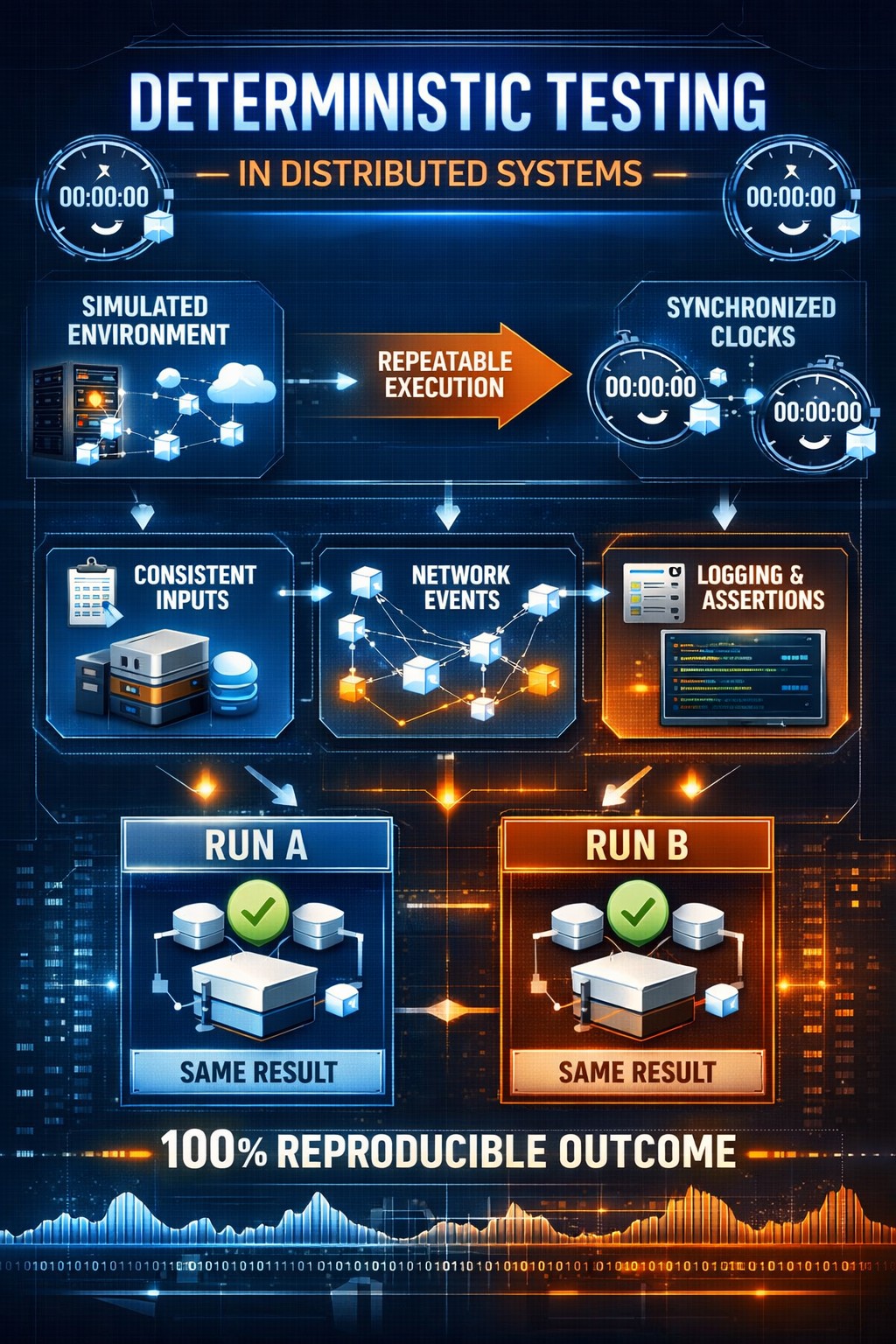
Deterministic simulation testing (DST) is a software testing methodology that places the system under test within a fully controlled, simulated environment. All sources of non-determinism — system clock, thread scheduling, network, disk — are intercepted and made deterministic. The key property is that, for a given initial seed and configuration, the entire execution is reproducible. The same sequence of events, faults, and outcomes will occur on every run with that seed.
Key Concepts
Breaking down the above definition, below are the key concepts for DST:
- Determinism → The system’s behavior is purely dependent upon its initial state and the seed. All non-deterministic sources are simulated to achieve determinism.
- Simulation → The system is run in a virtual environment that can simulate faults and control the passage of time. E.g., controlled clock skew introduced across various nodes, added network delays to achieve out-of-order event delivery.
- Reproducibility → Any failure or bug found during simulation can be reliably reproduced by rerunning the simulation with the same seed.
- Scenario Exploration → By varying the seed and/or simulation parameters, DST systematically explores a vast range of possible execution paths and failure scenarios.
How DST Works
Let's consider a simple scenario where two users update and read the same record in a very short interval. User 1 updates a record with a new value at time instance T0, and User 2 reads the same record at time instance T1. Note that the interval between T0 & T1 stays the same.
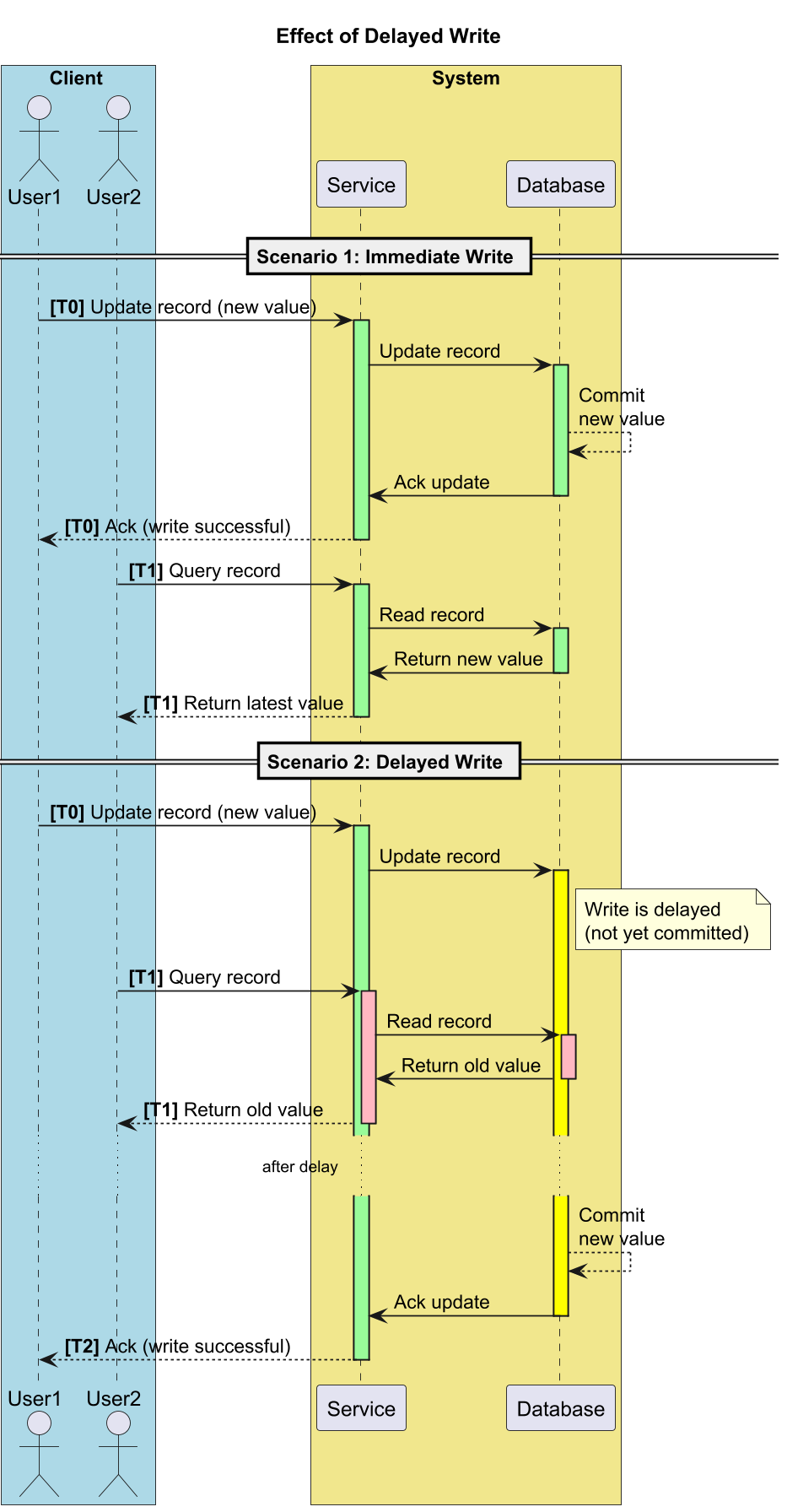
In an ideal case (i.e., scenario 1), the new value is updated or written immediately, i.e., without any delay. Thus, when User 2 reads the same record at T1, it is able to read the latest value.
In scenario 2 suppose the write is delayed due to network partitioning, disk write etc. User 2 thus sees the old value of the record even if it reads the value at the same time instance T1. Although a stale read may look trivial, it may lead to workflow halt, process crash, etc. in a complex real-world system.
Imagine what could happen in a real-world system where:
- Multiple processes are scheduled for execution, within and across nodes.
- Multiple network calls are made between several nodes.
- Multiple operations are performed by several distributed processes on a single disk.
Traditional testing strategies or frameworks are inherently constrained and thus can’t simulate such delays or faults. Because of this, it's nearly impossible to identify, catch, reproduce, or debug issues arising from such situations — rendering them unreliable or, at best, non-deterministic.
To achieve determinism, the testing framework must take total control over the environment to intercept and manage all external interactions as described below:
- Controlled scheduling → Instead of relying on the operating system’s unpredictable thread/coroutine scheduler, the simulator provides its own deterministic scheduler. Thus ensuring various scheduling combinations are simulated.
- I/O mocking → All network calls, disk writes, and clock queries are routed through the simulator, allowing it to inject latency, drop packets, or change the time (e.g., clock skew).
- Single-threaded execution → Many DST frameworks run the entire distributed system stack within a single thread, completely stripping away the chaotic, unrepeatable nature of multi-threading.
Thus, by eliminating real-world “flakiness,” DST allows developers to reproduce chaotic distributed system bugs with perfect precision, thanks to its inherent ability to replay any failing execution:
- Seed-based replay → The same seed reproduces the exact sequence of events, making debugging tractable.
- Time-travel debugging → Some platforms (e.g., Flashback) allow stepping backward and forward through execution, inspecting state at any point for a granular view of the system.
DST Implementation Approaches and Architecture Patterns
Below are two approaches for DST.
Pluggable Non-Determinism
Design the system so that all non-deterministic components (clocks, I/O, etc.) are pluggable. This strategy is used by TigerBeetle.
This requires:
- Abstracting all system interactions behind interfaces.
- Providing both real and simulated implementations.
- Ensuring that the same codebase can run in both production and simulation by swapping implementations at startup.
Pros: Deep control and minimal divergence between test and production code. Suitable for greenfield systems.
Cons: Requires significant upfront design and is challenging to retrofit into existing systems.
Deterministic Hypervisors and Emulation
A more recent and flexible approach is to run unmodified binaries inside a deterministic hypervisor or emulation layer. This strategy is used by Hermit and Weave.
Pros: Can test existing systems without code changes; language-agnostic; simulates the entire stack.
Cons: May have performance overhead; some system behaviors may escape determinism if not fully intercepted.
Benefits
System employing DST benefits as below:
- Identify and reproduce rare failures → DST allows engineers to replay the exact sequence of events that led to a bug. This eliminates the frustration of “flaky” issues that appear inconsistently, making debugging far more reliable. Moreover, DST helps find bugs in execution paths unreachable by example-based tests.
- Improved developer productivity → Bugs are easier to reproduce, debug, and fix; less time spent on war rooms and emergency triage.
- Improved confidence in correctness → DST validates critical invariants (like consensus, failover, or transaction consistency) under controlled simulations. Engineers gain assurance that core distributed protocols behave as expected even under stress. Thus, preventing rare bugs from reaching production, increasing system uptime and user trust.
- Scalable debugging for complex systems → In microservice or event-driven architectures, DST helps tame the exponential growth of possible interleavings by focusing on deterministic seeds. This makes large-scale debugging more tractable.
Challenges and Limitations
While DST provides unparalleled confidence, it requires significant architectural investment. Retrofitting DST into existing systems may require significant refactoring.
It can be highly intrusive, requiring developers to write custom code or frameworks, as production code often cannot rely on external third-party libraries that invoke un-mocked I/O or system calls. Moreover, DST requires careful modeling of external systems to avoid missing integration bugs.
Ensuring sufficient coverage without combinatorial explosion is a major challenge — especially in modern systems with multiple integration points.
Below are gaps in tooling that limit DST outcomes:
- Language and platform support → Not all languages and runtimes have mature DST frameworks.
- Hypervisor limitations → Deterministic hypervisors may not support all system calls or hardware features.
DST Comparison and Applicability
DST vs. Chaos Engineering
DST is proactive and enables perfect reproducibility. It is best suited for development and pre-production, catching bugs before they reach users. It can simulate production chaos in minutes, and every failure is a permanent regression.
Chaos engineering is reactive, non-deterministic, and validates the behavior of real deployments. It is essential for catching issues arising from real infrastructure, misconfigurations, or dependencies that simulation cannot model. However, it cannot guarantee coverage or reproducibility, and carries the risk of impacting users.
In essence, both DST and chaos engineering are complementary to each other and are necessary for comprehensive reliability.
DST in Functional vs. Performance Testing
Functional Testing
DST is ideally suited for functional testing.
- Validates correctness under all possible interleavings, failures, and workloads.
- Checks invariants, safety properties, and liveness under stress.
- Finds rare, timing-dependent bugs that are invisible to example-based tests.
Performance Testing
DST is not primarily designed for performance testing.
- The simulated environment does not reflect real hardware performance, network latency, or throughput.
- Time is virtualized and compressed; I/O is in-memory.
- Performance metrics (latency, throughput) measured in simulation may not correspond to real-world values.
However, DST can be used to:
- Validate performance-related invariants (e.g., absence of deadlocks, progress under load).
- Simulate pathological scenarios (e.g., extreme contention, resource exhaustion) to observe system behavior.
Recommendation
Combine DST for functional correctness with real-world performance and benchmarking suites for comprehensive validation.
DST Applicability to AI/ML and Agentic Systems
AI/ML systems, especially those based on large language models (LLMs) and agentic workflows, are fundamentally non-deterministic.
This makes traditional testing and debugging extremely difficult, with “heisenbugs” that vanish when observed.
DST can be adapted to AI/ML systems by creating controlled, simulated environments for agents to operate in. Or using a hybrid approach of combining deterministic components (rule-based logic) with LLM-driven reasoning, using seeds to replay failures.
Case Studies
- FoundationDB, with its deterministic simulator tool, achieved legendary reliability by running trillions of simulated CPU-hours, finding and fixing every known bug before production.
- TigerBeetle built a Viewstamped Operation Replication simulator (VOPR) to simulate financial transaction systems, catching subtle bugs in consensus and replication.
- Ethereum Merge used Antithesis to test the transition to Proof-of-Stake, simulating multiple client implementations in a deterministic environment.
Conclusion
Deterministic simulation testing (DST) represents a paradigm shift in the testing and validation of distributed systems. By enabling exhaustive, reproducible exploration of the vast state space of concurrent, failure-prone systems, DST empowers engineers to find and fix the rarest and most pernicious bugs before they reach production. Its integration with property-based testing, fuzzing, and fault injection, combined with advances in deterministic hypervisors and simulation frameworks, has made DST accessible to a growing range of systems and organizations.
While DST requires significant engineering investment, careful system design, and ongoing maintenance, its benefits in reliability, developer productivity, and user trust are profound. As distributed systems continue to grow in complexity and AI/ML systems become more agentic and autonomous, the need for rigorous, deterministic validation will only intensify.
The future of DST lies in deeper integration with formal methods, smarter state-space exploration, and broader applicability to AI/ML and hybrid systems. Organizations that embrace DST, alongside complementary techniques like chaos engineering and formal verification, will be best positioned to deliver robust, trustworthy, and resilient distributed systems in the years ahead.
DST Tools and Frameworks
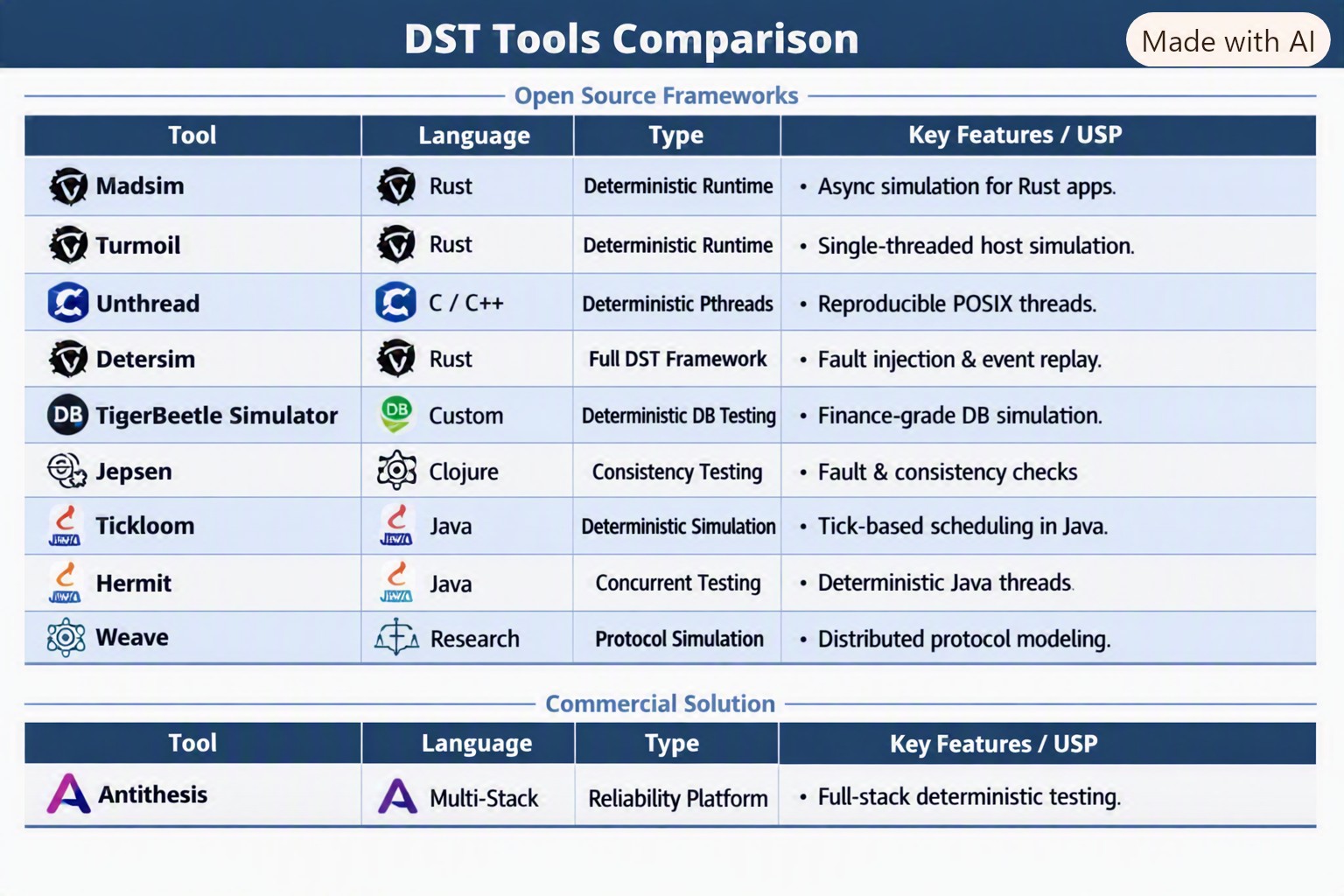
Deterministic simulation testing (DST) tooling is still a niche but growing ecosystem.
Each has a unique focus — ranging from language-level deterministic runtimes to full-stack hypervisor-based reproducibility. Based on the specific needs a single or combination of them can be picked up.
References and Further Reads
Published at DZone with permission of Ammar Husain. See the original article here.
Opinions expressed by DZone contributors are their own.
Comments