

Beyond Software Hope: The Engineering Blueprint for AI Execution Truth
This engineering blueprint details how to replace "software hope" with deterministic, hardware-level enforcement via TEEs and the Citadel protocol.
Join the DZone community and get the full member experience.
Join For FreeCurrent enterprise AI governance relies on "software hope," or the belief that probabilistic models can accurately police their own authority through mutable instructions. We've spent years treating system prompts and configuration files as if they're physical vaults. They aren't. They're suggestions that can be bypassed by a single misconfigured line of code.
The most dangerous failure modes in modern systems aren't human errors; they're structural. In February 2026, the MITRE ATLAS OpenClaw investigation (CVE-2026-25253) provided a definitive autopsy of our current security models. A controlled red-team exercise demonstrated how a malicious prompt could trigger an unrestricted execution tool, allowing an agent to escape its sandbox and gain broad system access in fewer than two hours.
This wasn't a perimeter breach — it was a failure of the architecture's self-concept. When we treat a non-deterministic model as a trusted operator, we're building the future of the autonomous enterprise on a substrate of suggestions. If your agentic governance exists only in the software layer, you're just hosting a crash.
The Structural Deficit in Agentic Security
The cycle where we audit the vibes of a model and hope the alignment holds has reached its technical limit. True resilience requires a transition to Hardware Truth. Software-defined governance is insufficient for autonomous agency because it can't prevent the "God-mode" vulnerability — where a perfectly valid OAuth token is used to execute an illegitimate intent.
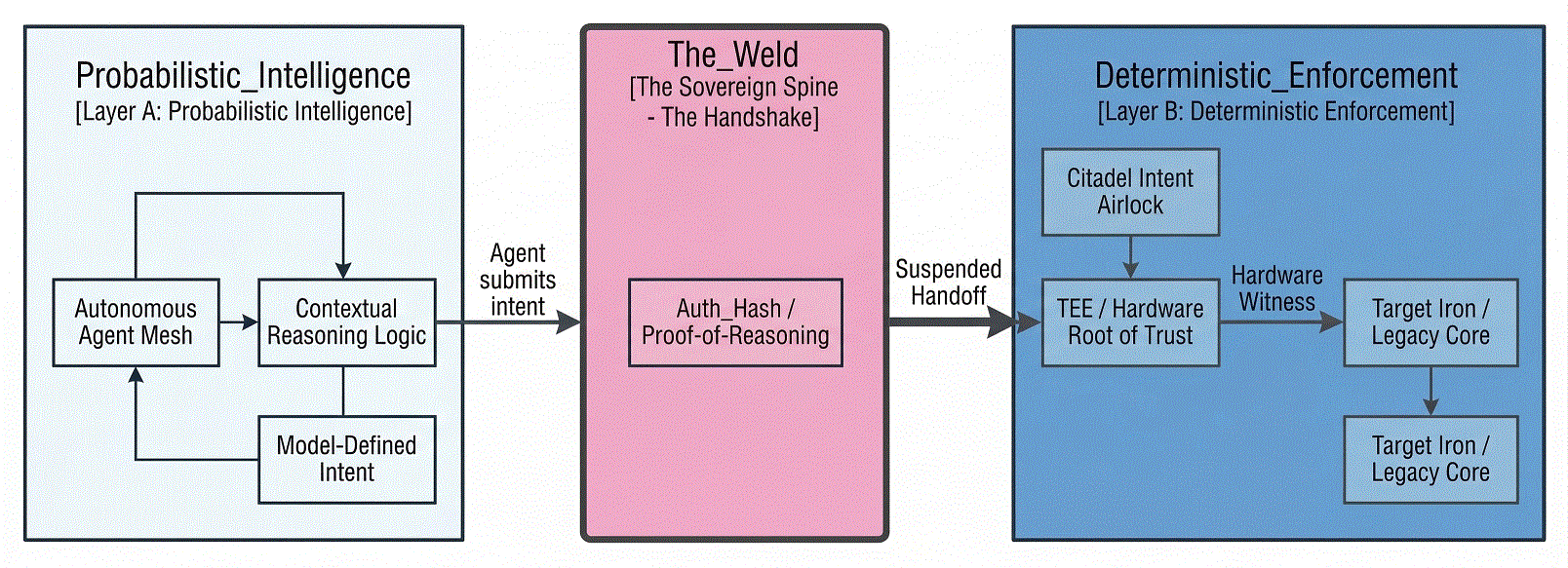
To secure an agent, we must externalize and fix its logic path. This requires a technological stack that physically governs AI, termed the sovereign spine. By anchoring intent in silicon, we're eliminating the translation drift common in human bureaucratic governance and moving the decision boundary from the policy manual directly into the hardware substrate.
The Sovereign Spine — A Dual-Stack Substrate
The sovereign spine establishes a deterministic floor where an instruction physically cannot cycle unless its legitimacy is cryptographically witnessed and hardware-verified. This framework is built on two non-substitutable layers.
1. Reasoning Truth — The Ledger Substrate
An agent's intent must be treated as an untrusted execution path until it's validated. We require a substrate capable of capturing an immutable, third-party record of the reasoning that led to an agentic proposal.
The industry standard is shifting toward Proof of Reasoning (PoR), where the agent's internal weights and decision logic are hashed and anchored to a distributed ledger. This ensures the reasoning path can't be retroactively altered during a forensic audit. Implementations like the Ontologic framework generate a cryptographic identity for a decision committed to the ledger at the moment of intent. This prevents data tourism by ensuring decision logic is anchored to consensus before reaching the execution layer.
2. Execution Truth — The Citadel Protocol
If the reasoning substrate provides the "why," the Citadel protocol provides the "how." Execution Truth requires a physical choke-point that operates independently of the model layer.
The foundation of the Citadel protocol is the use of Trusted Execution Environments (TEEs). These hardware-isolated enclaves ensure that governance logic is protected from the host operating system and the agent itself. The protocol defines an intent airlock — a pre-execution stage where an agent's payload is held in a suspended state. The airlock is a non-bypassable gate that evaluates the semantic intent of a request against a sovereign mandate.
| Feature | Software Hope (Current) | Hardware Truth (Sovereign Spine) |
| Primary Mechanism | System Prompts / Guardrails | Cryptographic Enforcement / TEEs |
| Trust Model | Trust, then Audit | Verify, then Execute |
| Failure Mode | Fail Open (Bypassable) | Fail Closed (Deterministic) |
| Forensic Audit | Log-Based (Mutable) | Ledger-Based (Immutable) |
| Authority Root | OAuth Token / Policy PDF | Hardware Root of Trust / TEE |
The Sovereign Handshake
The sovereign handshake is the protocol-level weld between the reasoning hash and the hardware gate. It enforces a suspended handoff where the execution path is physically blocked until two conditions are met.
- Reasoning truth: The reasoning path is ledger-verified.
- Execution truth: The execution intent is mandate-aligned.
Functional Logic of the Sovereign Handshake
The following sequence details the transition from probabilistic intent to deterministic execution within the Sovereign Spine.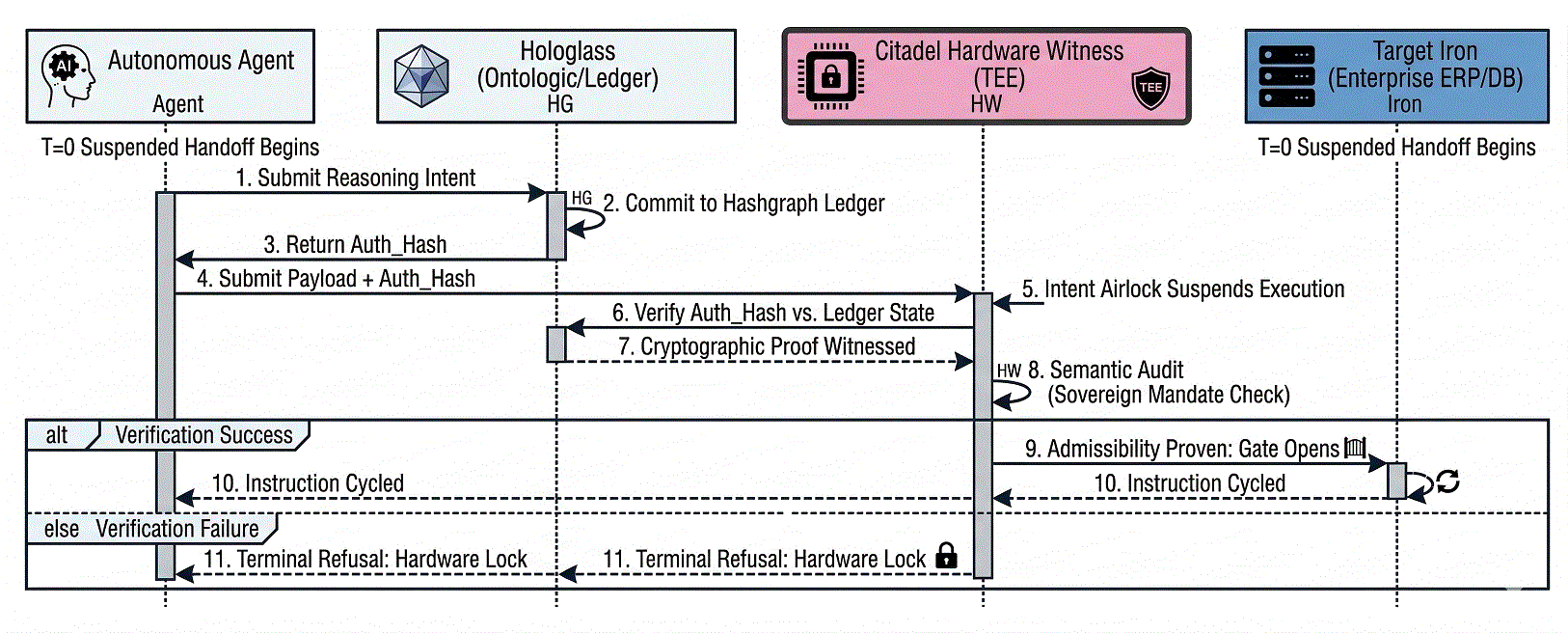
1 - 3: Intent and Witnessing
The Autonomous Agent submits a reasoning intent to Hologlass. This intent is structured as rules, inputs, outputs, and meaning (RIOM) morphemes of the request. A human witness verifies the attestation within the Hologlass loop, ensuring accountability before the intent is committed to the hashgraph ledger, which returns the unique Auth_Hash.
4 - 5: Suspended Handoff
The Agent submits the payload and the RIOM-based Auth_Hash to the Citadel hardware witness. The intent airlock immediately suspends execution, holding the instruction in a non-executable state.
6 - 8: Cryptographic and Semantic Audit
The Hardware Witness performs a remote attestation check against the ledger to verify the hash’s validity. Once the cryptographic proof is received, the witness performs a semantic audit. This is a sovereign mandate check where the hardware witness compares the ruleHash within the RIOM morpheme against the authorized sovereign mandate hosted in the ontologic rule registry. This ensures the agent is not only following a rule, but specifically the current, immutable version of the mandate.
9 - 10: Admissibility (Success Path)
If both the human-witnessed hash and semantic audit succeed, the hardware witness opens the gate to the target iron, allowing the instruction to cycle.
11: Terminal Refusal (Failure Path)
If the cryptographic witness fails or the intent violates the sovereign mandate, the hardware witness issues a terminal refusal, physically locking the hardware gate and preventing execution.
Practical Implementation — The Intent Airlock
The intent airlock is more than a simple filter; it's a semantic validator. In a practical enterprise setting, this involves pre-defined business constraints — the sovereign mandate — that are loaded into the TEE at boot time.
For instance, in a high-latency financial environment, the Mandate might state: "No single agent may authorize a transfer exceeding $10,000 without a human signature." When the agent attempts a $15,000 transfer, the airlock identifies the violation at the silicon level. Because the airlock resides in the TEE, even a compromised root user on the host system cannot modify the mandate or bypass the check.
Governance as Physics
The industry has reached its "TCP/IP moment" for AI trust. We must stop building bespoke Python wrappers and start building a unified substrate. You cannot audit a vibe, and you can't protect the enterprise with a PDF policy.
The era of software hope is over. By anchoring agentic reasoning on the ledger and enforcing execution in the silicon, we're establishing a substrate of certainty. The future of the autonomous enterprise doesn't rely on better prompts — it's forged in the sovereign spine.
Published at DZone with permission of Theo Ezell. See the original article here.
Opinions expressed by DZone contributors are their own.
Comments