

From Wild West to Context-Driven Engineering: How Culture Shapes Software Decisions
Engineering culture shapes architecture. Explore Wild West, Bureaucratic, and Context-Driven models for balancing governance, autonomy, accountability, and AI.
 CORE
·
CORE
·
Join the DZone community and get the full member experience.
Join For FreeSoftware organizations require rules to ensure predictability, knowledge sharing, and sound technical decisions. However, excessive rules, processes, and standards can obstruct progress if they eclipse desired outcomes. This longstanding tension in software engineering is now more pronounced as AI accelerates code generation, solution exploration, and implementation of change.
The main challenge is not the number of rules, but how they fit with context, autonomy, and responsibility. Some organizations have minimal constraints, others tightly control decisions, and a few adapt principles to specific situations. Noticing these models helps engineering leaders assess their organization, understand associated risks, and move toward more effective technical governance.
Software Architecture Is Also an Organizational Problem
Software architecture is often defined by technical elements such as components, APIs, databases, infrastructure, quality attributes, and architectural styles. While these matter, they exist within a wider context. People design and maintain software, influenced by business constraints, communication structures, incentives, policies, and authority levels. Architecture is not only a technical artifact; it also reflects the environment in which teams make technical decisions.
This broader perspective reflects the socio-technical nature of software engineering and is consistent with standards such as ISO/IEC/IEEE 42010, which recognize that architectural concerns encompass organizational, economic, regulatory, and community factors. Conway's Law shows that organizational communication structures often mirror system design. If organizational structure shapes software, then the distribution of authority, management of disagreement, response to failure, and governance of technical decisions likewise influence architecture. Therefore, engineering culture and governance are architectural concerns, not just management issues.
Culture Shapes How Engineering Decisions Are Made
If architecture is formed by its organizational context, organizational culture also directly influences engineers’ daily decisions. Sociologist Ron Westrum offers a system for understanding how organizations respond to problems and opportunities, particularly in high-risk environments. His model focuses on information flow, including cooperation, safe communication of bad news, responsibility management, failure investigation, and acceptance of new ideas. Westrum identified three main cultural patterns: pathological (power-oriented), bureaucratic (rule-oriented), and generative (performance-oriented) organizations.
This distinction matters in software engineering, where architectural decisions depend on information moving across teams, technical boundaries, and leadership levels. Organizations that conceal problems, discourage disagreement, or fragment responsibility make different technical choices than those that discuss risks openly, encourage collaboration, and treat failures as chances to learn. DORA adopted Westrum's model in its research and consistently links generative, high-trust cultures to stronger software delivery and organizational performance. Culture isn't just the environment around engineering work; it shapes how teams interpret technical information, who can challenge decisions, how rules are enforced, and how architecture evolves.
| Pathological | Bureaucratic | Generative |
|---|---|---|
| Power oriented | Rule oriented | Performance oriented |
| Low cooperation | Modest cooperation | High cooperation |
| Messengers “shot” | Messengers neglected | Messengers trained |
| Responsibilities shirked | Narrow responsibilities | Risks are shared |
| Bridging discouraged | Bridging tolerated | Bridging encouraged |
| Failure leads to scapegoating | Failure leads to justice | Failure leads to inquiry |
| Novelty crushed | Novelty leads to problems | Novelty implemented |
Mode 1: Wild West Engineering
Wild West Engineering refers to environments with weak governance, unclear ownership, and few shared engineering principles. Teams may appear highly autonomous, but such autonomy lacks architectural direction, reliable feedback, and consistent accountability. Technical decisions are frequently reactive and localized, with tools and approaches selected for immediate needs or personal preference rather than the wider system context.
The problem is not simply a lack of rules. Experienced teams can operate effectively with minimal rules if they share strong principles and understand the impact of their decisions. Wild West Engineering occurs when autonomy exists without sufficient shared context, accountability, or coordination. Over time, architectural knowledge becomes siloed, similar problems are solved inconsistently, and changes become riskier as no one fully understands the system.
Westrum’s pathological culture is a relevant comparison: cooperation is limited, responsibilities are avoided, bad news is suppressed, and failures result in blame rather than inquiry. In software organizations, this often creates a hero culture where a few engineers become indispensable for managing disorder. AI can worsen this problem; when teams generate code, add dependencies, or make architectural decisions without shared guardrails, inconsistency and technical debt can spread quickly.
Indicators
Typical signs involve unclear ownership, multiple solutions for similar problems, undocumented architectural decisions, reliance on tribal knowledge, fear of changing legacy components, recurring blame after incidents, and dependence on a few key engineers. Another important sign is resignation: engineers stop proposing improvements because changing the system seems riskier than leaving existing problems unresolved.
How to Move Forward
Imposing heavy bureaucracy is not the solution to chaos. The first step is to establish minimum shared guardrails: clarify ownership, document key architectural decisions, define core engineering principles, set baseline expectations for security and operability, and create safer ways to discuss failures and technical debt. The goal is to support autonomy with enough structure to ensure local decisions conform to a coherent system.
Mode 2: Bureaucratic Engineering
Bureaucratic Engineering represents the opposite extreme, where governance is pervasive. Standards, approval processes, architectural reviews, mandatory technologies, and detailed procedures dictate how teams operate. While this structure creates predictability and consistency, problems arise when adherence to process outweighs knowing its purpose. Teams may focus on compliance rather than evaluating whether rules remain relevant.
Westrum’s bureaucratic culture reflects similar traits: limited cooperation, narrow responsibilities, minimal cross-boundary collaboration, and a tendency to view novelty as problematic. In engineering, this occurs when architectural decisions are centralized, outdated standards persist, and exceptions are hard to secure. While these mechanisms may guarantee a baseline of quality, they may also limit performance.
The core issue is not the presence of rules, but the erosion of judgment. Governance becomes rigid when organizations treat principles as permanent mandates and compliance as a substitute for engineering quality. AI can increase this tension, as organizations may respond to new risks with broad restrictions, approved-tool lists, or complex authorization processes. Although these measures may reduce risk, they can also hinder teams from pursuing valuable opportunities, making the organization safer but less nimble and flexible.
Indicators
Typical signs include rules missing explicit justification, standards defended only by “we have always done it this way,” centralized approval for minor technical decisions, difficulty obtaining exceptions, and architectural decisions that ignore local context.
Status quo bias helps explain this persistence. Samuelson and Zeckhauser found that people often prefer existing or default options. In engineering organizations, this reinforces architectural inertia: once a technology, methodology, or rule becomes standard, replacing it requires far more justification than maintaining it. As a result, rules persist not because they are optimal, but because they are easier to retain.
Organizational silence is another key warning sign. Morrison and Milliken define this as a collective tendency to withhold concerns when employees believe speaking up is unwise or ineffective. In engineering, this occurs when developers privately disagree with decisions but remain silent in meetings, believing that contesting established processes will not lead to change. Persistent silence should not be mistaken for agreement; it may signal that the organization discourages dissent.
Another warning sign is when success is measured mainly by process compliance rather than software outcomes. Teams may meet all requirements yet become slower, less innovative, and disconnected from the initial intent of these controls.
How to Move Forward
To move beyond Bureaucratic Engineering, organizations should redefine governance rather than eliminate it. Leaders must frequently review the purpose of rules, distinguish primary constraints from preferences, and replace unnecessary approvals with clear principles. Teams need defined boundaries, authority to make decisions within them, and a clear process for exceptions when justified by context.
A practical test is to ask whether a rule is still justified by its intended outcome. If no one can explain the risk it addresses, the value it protects, or evidence of its need, the organization may be maintaining the process for its own sake. The aim is to shift from prescriptive control to outcomes-based control, with accountability and feedback.
Mode 3: Context-Driven Engineering
Context-Driven Engineering integrates governance with local judgment. Rules are tools for managing risk and ensuring consistency, not ends in themselves. Teams work within defined principles, constraints, and responsibilities, while retaining the autonomy to adapt decisions to their particular technical and commercial context. The core assumption is that the same rule may yield different outcomes in different environments.
This approach corresponds with Westrum’s generative culture, defined by high cooperation, shared risk, cross-boundary collaboration, inquiry following failures, and openness to innovation. In engineering, teams are expected to follow standards, understand their purpose, and recognize when exceptions are warranted. Architectural decisions are treated as explicit trade-offs, not automatic pattern applications. Teams evaluate technologies such as microservices, hexagonal architecture, event-driven systems, or specific cloud platforms based on the problem, constraints, and desired outcomes, rather than assuming they are universally correct.
Applying a rule in the wrong context can lead to poor decisions. The same applies to architectural patterns: they address recurring problems in specific contexts, and applying them without considering context can create anti-patterns. For example, a lifeboat is essential in the ocean but irrelevant in a desert. Similarly, providing water is life-saving for someone dehydrated, but ineffective for someone drowning. A tool or rule's effectiveness depends on the context in which it is used.
This environment requires greater maturity, not reduced governance. Autonomy must be balanced with accountability, feedback, and a readiness to revisit decisions as new information arises. AI fits well with this model, as its use can be governed based on context and risk: low-risk tasks may permit broad experimentation, while sensitive data, production changes, or high-impact decisions demand stricter controls. The objective is responsible judgment within clear boundaries, not unrestricted freedom.
Indicators
Key indicators include clear engineering principles, documented decision rationales, explicit ownership, and constructive disagreement. Teams should be able to explain both the rule and its rationale. Exceptions are allowed but must be justified. Failures prompt learning rather than blame, and architecture teams periodically review standards instead of letting them become outdated. Another strong indicator is that teams can contest established practices without equating disagreement with disloyalty or process violations.
A context-driven organization distinguishes between non-negotiable constraints and situation-dependent choices. Security, legal requirements, data protection, and regulatory obligations remain strict, while implementation details such as architectural style, framework selection, or deployment strategy are evaluated locally. This distinction ensures autonomy does not devolve into unstructured or uncontrolled practices.
How to Sustain This Model
The main risk is regression. Insufficient discipline can lead to disorder, whereas excessive concern for consistency can create bureaucracy. Upkeeping this model requires ongoing review of principles, active feedback loops, documented architectural decisions, clear exception processes, and leaders willing to reexamine their assumptions.
A practical test is whether the organization can answer four questions:
- What problem are we solving?
- Which constraints are truly non-negotiable?
- What trade-off are we accepting?
- What evidence would prompt us to revisit the decision?
When teams can answer these questions consistently, governance functions as a learning system rather than a control mechanism.
Conclusion
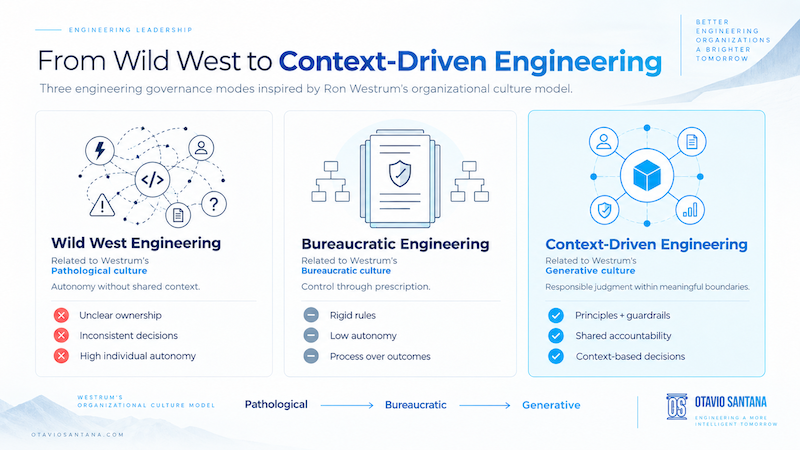
Engineering organizations improve not by simply adding or removing rules, but by ensuring teams understand their purpose, have the required context, and are trusted to exercise judgment within clear boundaries. Wild West Engineering lacks the structure for long-term growth, while Bureaucratic Engineering frequently leads to rigidity and limits learning. Context-Driven Engineering seeks balance through prioritizing principles over prescriptions, fostering autonomy with accountability, and encouraging decisions based on trade-offs rather than routine.
As AI accelerates code generation and change, maintaining this harmony is increasingly important. The most adaptable organizations will foster responsible, context-aware decision-making.
Opinions expressed by DZone contributors are their own.
Comments