

Evaluating LLM-Powered Voice Assistants: A Guide Beyond Traditional Metrics
A practical guide to evaluating LLM-powered voice assistants using multi-dimensional metrics covering helpfulness, accuracy, safety, and system performance.
Join the DZone community and get the full member experience.
Join For FreeVoice assistants have evolved from being simple, rule-based systems to advanced conversational agents driven by large language models (LLMs). Early versions of voice assistants could only handle specific tasks with pre-defined commands. In contrast, modern LLM-powered assistants can now engage in long and open-ended conversations, follow complex instructions, and perform multi-step reasoning. These improved capabilities bring new evaluation challenges. Traditional metrics like intent classification accuracy, slot-filling accuracy/recall, and goal completion rates can no longer capture the overall quality of a voice assistant.
Assistant responses can sound fluent and plausible, even when they contain factual errors or unsafe content. For example, an LLM assistant might correctly identify a user’s request to “find Italian restaurants” (intent) and extract the location “downtown” (slot), but then respond with a restaurant name that doesn’t even exist. Traditional benchmarks would mark the intent/slot task as successful, without accounting for the factual error. Therefore, new metrics and techniques are needed to assess factuality, safety, reasoning ability, instruction following, and user experience.
The HHH Principle and Key Evaluation Dimensions
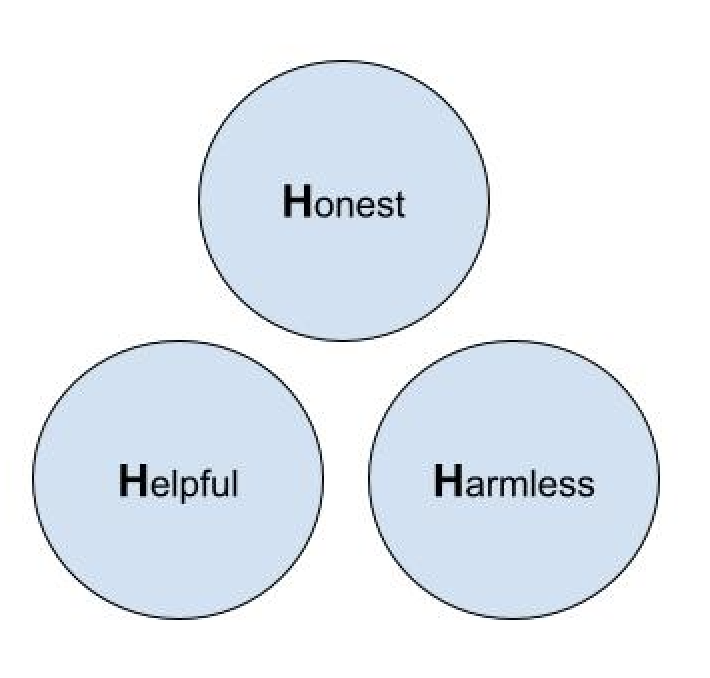
One of the widely used frameworks for evaluating LLM-based assistants is the Helpful, Honest, and Harmless (HHH) principle [1]. It is developed by Anthropic. It emphasizes three core objectives for an AI assistant: provide useful and relevant help, maintain factual accuracy and transparency, and avoid harmful or biased behavior. Let's dive into each of these dimensions and how to assess them.
Helpfulness
Helpfulness measures whether the assistant provides useful, complete, and relevant responses. A helpful assistant should follow instructions accurately, especially for tasks involving multiple constraints or sequential steps. Key ways to evaluate helpfulness include:
- Instruction following or step completion rate: Measured as the percentage of sub-tasks or instructions successfully carried out.
- Logical coherence: Determined by whether the assistant’s response respects the context, sequencing, and constraints given by the user.
Benchmarks like MT-Bench and AlpacaEval offer both automatic and human-in-the-loop comparisons for instruction following and general usefulness. Scoring can be partial when answers are directionally correct but incomplete or vague.
Honesty (Accuracy)
Honesty corresponds to the factual accuracy and truthfulness of the assistant’s responses. LLMs are known to "hallucinate" — producing fluent but factually incorrect answers. Two complementary metrics are commonly used to assess factual errors:
- Micro hallucination rate: Counts factual errors within individual responses.
- Macro hallucination rate: Measures how many responses contain at least one factual error.
Benchmarks like TruthfulQA [2] and FactualityEval assess factual consistency and the model's ability to resist misleading prompts [3]. In practice, humans are usually needed to thoroughly assess honesty, especially in domain-specific or ambiguous queries, since automated tools can flag blatant inaccuracies but often miss nuanced errors.
Harmlessness (Safety)
Harmlessness assesses the assistant's ability to avoid generating harmful, toxic, or biased content and to comply with safety guidelines. This is specifically important for handling a wide range of user inputs, including potentially adversarial or sensitive prompts. Key aspects of safety evaluation include:
- Toxicity and bias: Checking for the presence of derogatory, abusive, or discriminatory language in the assistant’s outputs.
- Policy adherence: Ensuring the assistant refuses or safely handles requests for disallowed content.
- Violation rate: Fraction of responses that are flagged as unsafe or that violate a given policy.
Datasets like RealToxicityPrompts present the model with intentionally provocative or toxic inputs to see if it responds without producing toxicity in return. Similarly, AdvBench and related adversarial evaluations simulate “red-team” attacks: they might involve users trying to trick the assistant into revealing private information or producing disallowed content. It is common to use a combination of automated detectors with human judges, since context matters in determining what is harmful or biased.
Task Completion and Dialogue Context
Task/Goal Completion Success
Beyond these general HHH dimensions, LLM-powered voice assistants are often used in task-oriented scenarios such as booking appointments, generating summaries, or providing instructions. These tasks require their own evaluation methods. Evaluating success here involves:
- Explicit goal completion: Did the assistant achieve the intended task?
- Partial success: Credit for tasks that are partially but meaningfully completed.
This type of evaluation typically spans multiple turns. Session-level analysis helps reveal whether the assistant sustains coherence and effectiveness across extended tasks. Benchmarks like TaskBench provide structured scenarios for evaluating goal-driven performance.
Contextual Understanding in Multi-Turn Dialogue
Effective assistants must maintain context across turns. Evaluation focuses on tracking references, adapting to user corrections, and recalling past information. Key criteria include:
- Entity tracking: Maintaining consistency for people, objects, and topics mentioned earlier in the conversation.
- Reference resolution: Correct interpretation of pronouns and implicit mentions.
- Instruction memory: Retaining earlier constraints or preferences and applying them accurately.
Multi-turn benchmarks like DSTC11 Track 5 test grounding and memory in realistic conversations. Some common issues include forgetting key details, contradicting earlier responses, or drifting off-topic. High scores in contextual understanding mean the assistant feels more “aware” and less robotic, significantly improving the user experience in long dialogues.
Reasoning and Problem Solving
Another important aspect of LLM-powered assistants is their ability to perform reasoning, logic, and problem-solving within a conversation. Evaluation of reasoning abilities involves looking at both the thinking process and the final result:
- Correctness of final answer: Was the problem solved accurately?
- Quality of reasoning or chain-of-thought: Did the model follow a valid reasoning path?
Reasoning tasks often expose limitations in LLMs' internal consistency and problem-solving skills. Benchmarks like GSM8K (math word problems) and BBH (Big-Bench Hard) contain challenging multi-step reasoning tasks that are widely used to test this capability. Additionally, Chain-of-thought annotation is used to evaluate intermediate reasoning steps.
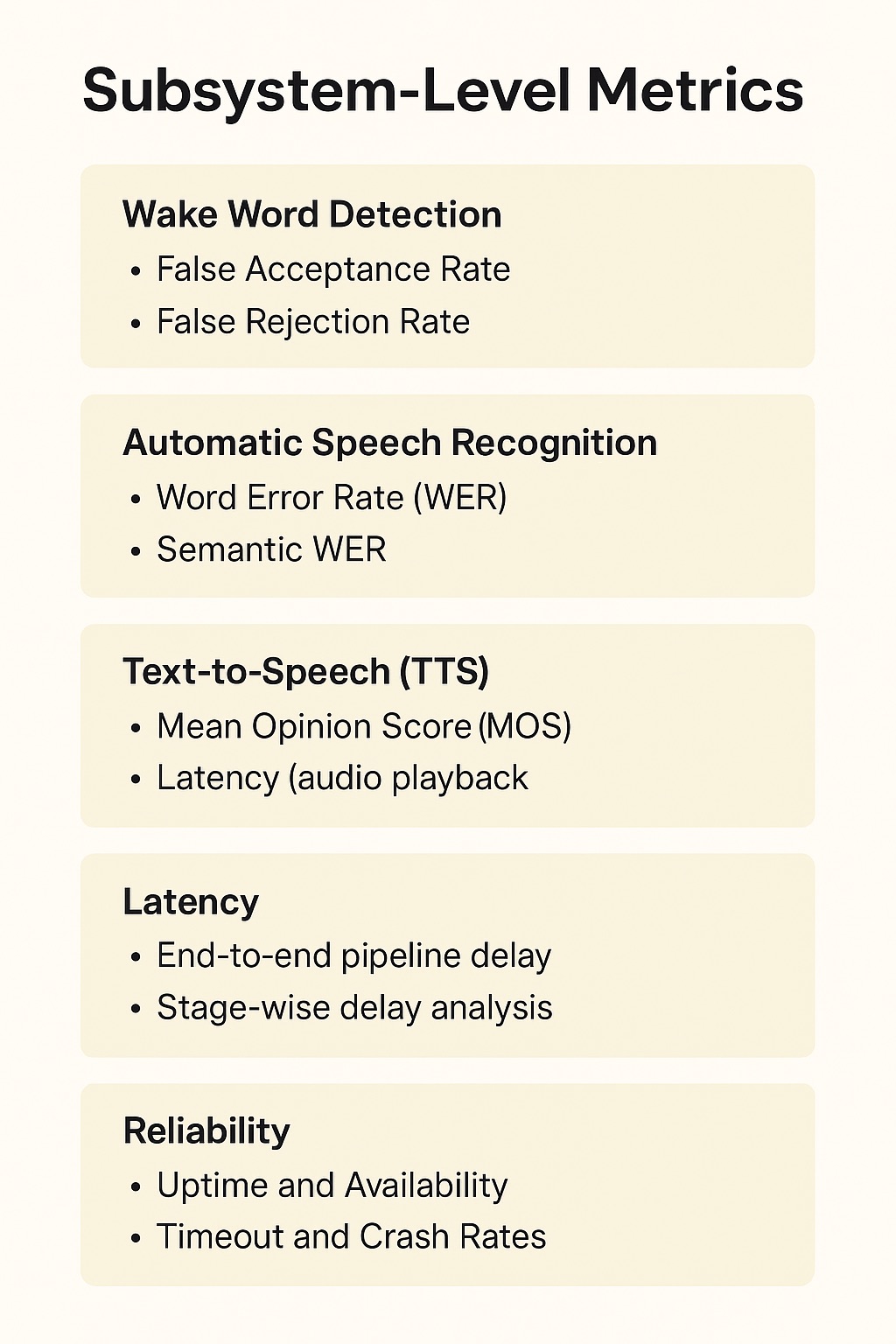
Subsystem-Level Metrics
LLM-driven voice assistants are more than just the language model generating text. They rely on multiple subsystems to handle the full interaction: waking up when invoked, converting speech to text, processing the query, and then turning the LLM’s reply into speech output. If any of these components perform poorly, the user’s experience will suffer, regardless of the LLM’s capabilities. Note that some modern versions are powered by end-to-end/omni models that take audio as input and directly generate audio responses as output.

Key subsystems and their metrics include:
Wake Word Detection
Wake word (WW) detection enables hands-free interaction by listening for a predefined phrase. WW detection focuses on two main types of errors:
- False Acceptance Rate (FAR): How often does the system trigger by mistake, even though the wake word wasn’t actually spoken?
- False Rejection Rate (FRR): How often does the system fail to wake up when the wake word is spoken by the user?
The ideal wake word detector has both a low FAR (to avoid false triggers) and a low FRR (to reliably respond every time it should). There is often a trade-off between the two, so developers tune the system to find an acceptable balance. For example, “FAR: 0.1% at a threshold where FRR: 5%” means a 1 in 1000 chance of accidental activation while missing 5 in 100 legitimate attempts.
Automatic Speech Recognition (ASR)
ASR converts spoken language into text for the LLM to process. Key ASR metrics include:
- Word Error Rate (WER): The standard metric that calculates the percentage of words that were incorrectly recognized by comparing the ASR output to a human-transcribed reference. It accounts for substitutions, deletions, and insertions in the ASR output. A lower WER indicates better recognition accuracy.
- Semantic Error Rate (or Semantic WER): A refined metric that measures whether the meaning was preserved, even if the exact words differ. In other words, it focuses on errors that actually change the intent.
ASR evaluation is often done with curated test sets of spoken commands or typical user queries, covering different speakers and noise conditions. In practice, developers also track ASR performance on live traffic by sampling real user interactions (with consent) to find where transcription errors are causing problems.
Text-to-Speech (TTS)
Text-to-speech is the component that takes the assistant’s text response and synthesizes it into audible speech. Key TTS evaluation criteria include:
- Mean opinion score (MOS): A subjective human rating that assesses audio quality, clarity, and naturalness on a numerical scale (usually 1 to 5).
- Pronunciation and prosody checks: Specific metrics that focus on mispronounced words (especially names or unusual terms), and prosody - the intonation and rhythm of speech.
- Latency: The delay from the generation of text output to the beginning of audio playback. Typically, we measure the delay from the end of the text response generation to the beginning of audio playback. However, more advanced TTS systems can even start speaking while the latter part of the text is still being processed (streaming synthesis) to minimize delay.
Latency
User-perceived latency measures the end-to-end processing time, from the end of user speech to the beginning of audio response playback. This includes wake word detection, ASR transcription, LLM inference, TTS synthesis, and audio output. It is critical because excessive delay can degrade user experience and disrupt conversational flow. Measuring latency at each stage and end-to-end helps identify bottlenecks and improve system responsiveness.
Reliability
Reliability measures the system’s robustness in real-world conditions and includes:
- Uptime and availability: The percentage of time the assistant is operational and responsive without crashes or downtime.
- Timeout and crash rates: The frequency of failures where the assistant does not respond or terminates unexpectedly, leading to incomplete interactions.
- Graceful failure handling: This is a qualitative measurement of whether the system can gracefully handle failures when they do occur. For example, if ASR fails to understand, the assistant could reply saying “I didn’t catch that, could you repeat?”.
These subsystem evaluations ensure that the impressive conversational abilities of the LLM are well supported by equally strong performance in the surrounding systems.
Evaluation Granularity and Methodology
When evaluating LLM-powered assistants, it’s important to consider the granularity at which you assess them and the methods used to aggregate those assessments. Different evaluation levels reveal different insights:
- Turn-level: Assesses individual responses for correctness, relevance, and fluency.
- Session-level: Measures the assistant’s consistency and effectiveness over an entire conversation.
A holistic evaluation combines human judgment and automated tools for a complete picture of an assistant's strengths and weaknesses. Human judgment still remains the gold standard for open-ended aspects (pairwise comparisons, rating scales like Likert, rubrics), but it is slow and expensive. Automated methods (LLM-as-judge, reference-based metrics) scale well. Clear guidelines and calibration are crucial for human evaluators to ensure consistency.
Conclusion
Evaluating LLM-powered voice assistants requires a shift from the narrow, task-specific benchmarks to a layered, multi-dimensional framework. No single metric can capture what makes an assistant truly effective. Accuracy, helpfulness, safety, reasoning, and subsystem quality and reliability must all be assessed using a combination of human judgment, automated tools, and domain-specific benchmarks. As assistants continue to evolve in capabilities, their evaluation must evolve just as rigorously to ensure trustworthiness and utility.
References
Opinions expressed by DZone contributors are their own.
Comments