

DZone
Thanks for visiting DZone today,
Edit Profile
  • Manage Email Subscriptions
  • How to Post to DZone
  • Article Submission Guidelines
Sign Out View Profile
  • Post an Article
  • Manage My Drafts
Over 2 million developers have joined DZone.
Log In / Join
Refcards Trend Reports
Events Video Library
Refcards
Trend Reports

Events

View Events Video Library

Related

  • Enabling Business Transaction Monitoring for App Connect Enterprise
  • MuleSoft Integration With RabbitMQ
  • How to Use IBM App Connect's ‘Mapping Assist’ to Automatically Map Your Integration Flows
  • Advanced Error Handling and Retry Patterns in Enterprise REST Integrations

Trending

  • LLM-Powered Deep Parsing for Industrial Inventory Search
  • Building a Zero-Cost Approval Workflow With AWS Lambda Durable Functions
  • Introduction to Tactical DDD With Java: Steps to Build Semantic Code
  • How to Write for DZone Publications: Trend Reports and Refcards
  1. DZone
  2. Testing, Deployment, and Maintenance
  3. Deployment
  4. Exception/Error Flow in IIB (IBM Integration Bus)

Exception/Error Flow in IIB (IBM Integration Bus)

Take a look at error handling for quality delivery.

By 
Karthik Venkata Thotapalli user avatar
Karthik Venkata Thotapalli
·
Aug. 20, 19 · Tutorial
Likes (2)
Comment
Save
Tweet
Share
20.6K Views

Join the DZone community and get the full member experience.

Join For Free

Any developer or designer should give the highest priority to error handling for quality delivery.

Let's understand how the error flow happens in IIB with reference to the below flow.
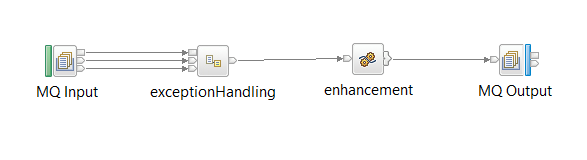
Image title

Say the failure occurred at the compute node in the above flow.
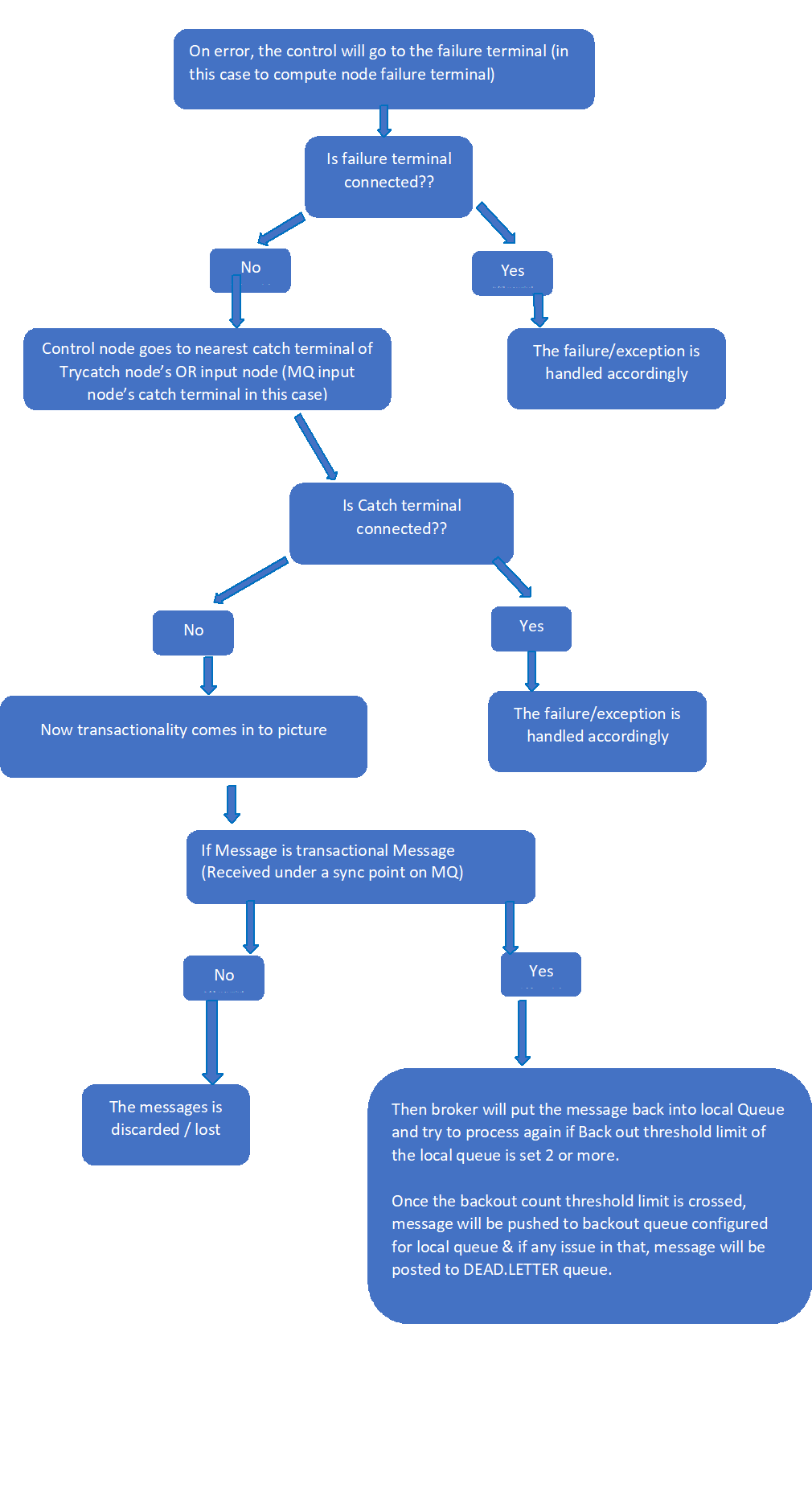
Image title

How Transactionality of Message Is Affected by Transaction Property of Input Node

If transaction property is set to “automatic/yes” and the input message is persistence, the message broker receives the message under the sync point and treats this as a transactional message. If transaction property is set to No and the message is persistence, this creates no effect (treated as non-transactional message).

A Few Things to Consider for Effective Error Handling

Always connect the Failure terminal and the Catch terminal of the input node to the exception handling process.

Ensure that all messages that are received by an MQInput node are either transactional or non-transactional for the length of entire flow, and avoid ambiguous configurations.

It's good practice to have a try-catch node in the middle of complex flows, thus the exception is handled with less time and CPU usage because if only the input node has to handle exception of big flows (having too many nodes and complexity), the failed message control has to travel all the way back to the input node, causing heavy usage of memory, CPU, and time.

Flow (web browser) Integration

Opinions expressed by DZone contributors are their own.

Related

  • Enabling Business Transaction Monitoring for App Connect Enterprise
  • MuleSoft Integration With RabbitMQ
  • How to Use IBM App Connect's ‘Mapping Assist’ to Automatically Map Your Integration Flows
  • Advanced Error Handling and Retry Patterns in Enterprise REST Integrations

Partner Resources

×

Comments

The likes didn't load as expected. Please refresh the page and try again.

  • RSS
  • X
  • Facebook

ABOUT US

  • About DZone
  • Support and feedback
  • Community research

ADVERTISE

  • Advertise with DZone

CONTRIBUTE ON DZONE

  • Article Submission Guidelines
  • Become a Contributor
  • Core Program
  • Visit the Writers' Zone

LEGAL

  • Terms of Service
  • Privacy Policy

CONTACT US

  • 3343 Perimeter Hill Drive
  • Suite 215
  • Nashville, TN 37211
  • [email protected]

Let's be friends:

  • RSS
  • X
  • Facebook