

Faster, Smarter, Stronger: Unleash Your Software's Full Potential With Continuous Shift-Left Test Automation
This article suggests combining shift-left and continuous testing to unleash software development potential and improve business capabilities.
Join the DZone community and get the full member experience.
Join For FreeThe ability to innovate at high speed has been the cornerstone of a modern digital landscape. Leading industry titans release millions of code lines and implement hundreds of updates daily, ensuring impeccable software quality. Due to the sheer volume, manual testing alone can hardly enable such results.
That's why enterprises consider automated workflows essential to projects' success. In regards to QA, test automation is a tried-and-true way to make companies more agile, innovative, and competitive, as well as help them roll out high-quality digital products and new features faster, more frequently, and at lower costs. No wonder its market size globally will double by the end of the decade to $57 billion.
But how can businesses drive the ultimate value out of a test automation approach? In this article, I suggest combining shift-left and continuous testing to unleash software development potential and improve business capabilities.
Continuous Shift-Left Test Automation Concept Exploration
To form an idea of what this compound approach is about, let's have a closer look at its core elements and their interaction:
Continuous Testing
Releasing top-tier software is impossible without obtaining constant feedback after code changes. When relying on manual testing alone and verifying software operation in a separate stage after development, defects may slip into the production environment because of human errors and insufficient test coverage. In addition, developers will have to wait longer for testers' feedback on the impact that the added changes had on complex systems.
To prioritize quality, companies should test IT products throughout the entire development life cycle and introduce test automation in parallel. This is what continuous testing is about. Its objective is to provide ongoing feedback at different SDLC phases and assess system functioning automatically round-the-clock within continuous delivery pipelines (if any). Thus, developers can prevent costly defects with timely fixes.
It works the following way. QA specialists write and run automated scripts. In case of test failure, software engineers are instantly informed about errors in the project/solution/etc. and make corresponding adjustments to prevent a negative impact on other code parts. If tests are successful, the next SDLC stage occurs automatically.
Shift-Left Testing
If speaking about a traditional development methodology like Waterfall, quality assurance starts only when the entire development process is over. Defect resolution becomes more expensive and time-consuming as the whole code has already been written, and in the worst-case scenario, developers may have to redesign entire software parts. This leads to additional expenses, project delays, and customer and business dissatisfaction.
Shift-left approach to QA, on the contrary, moves testing activities earlier in the development process. With this proactive technique, QA engineers start with testing requirements to spot any gaps, contradictions, or ambiguities that can later cause defects.
Test Automation
With a constantly increasing demand for faster time to market, attaining quality at speed becomes the need of the hour. Automated scripts help increase testing efficiency, accuracy, and speed, as they are good at performing hundreds and thousands of repetitive checks without any interruption.
Whether web, desktop, or mobile software products, QA engineers select suitable tools and frameworks, set up the environment, prepare test data, and develop and run scripts to boost the capabilities of any testing activity – from regression to security testing.
So why should businesses combine these approaches and introduce continuous shift-left automation?
It's about starting software testing as early as possible, testing as often as possible, and automating as much as possible. This way, companies can detect far more flaws in software operation, ease their fixing and associated costs, speed up testing cycles, and roll out high-quality IT products adored by end users.
Top 5 Advantages Of Continuous Shift-Left Automation
After understanding the essence of this approach, let's focus on the value it contributes towards enhancing business capabilities and outperforming in a competitive market.
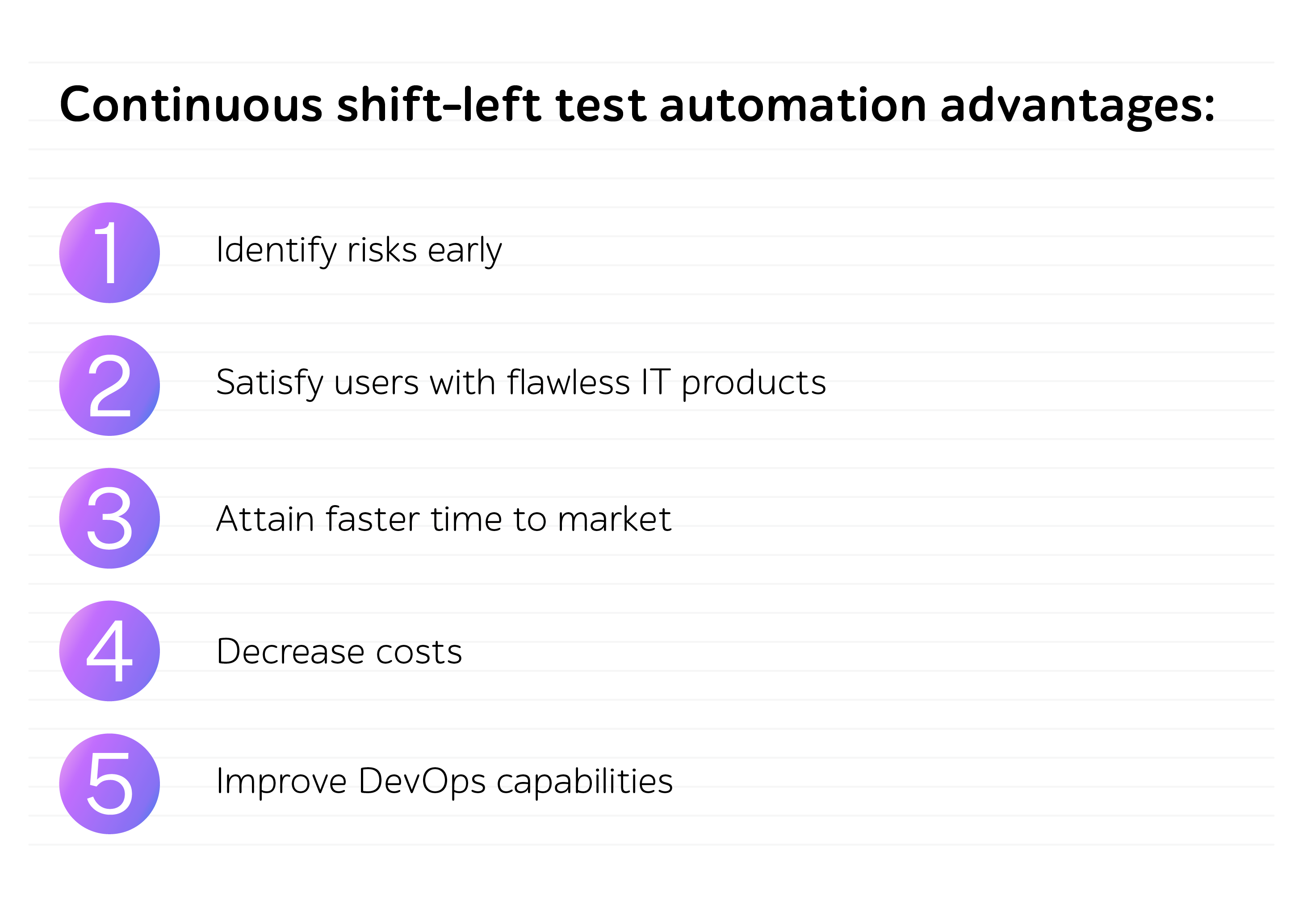
1. Identify Risks Sooner
Companies can significantly decrease risk probability thanks to the close collaboration of QA and software engineers alongside early testing activities. This enables the prompt detection of defects at the beginning of the SDLC. As a result of quick fixes, once they are found, potentially hazardous issues don't have a chance to become more complicated with project development, which prevents risks related to increased costs or missed deadlines.
2. Satisfy Users With Flawless IT Products
Automation and continuous and fast feedback loops mean the QA engineers can maximize test coverage within applications of any size. At the same time, developers can quickly obtain insights into the parts of code that require improvements. In addition, the code is tested each time it's integrated rather than only once in a separate step when the development is over. This helps decrease the number of production issues, roll out more stable and secure IT products, and improve end-user satisfaction.
3. Attain Faster Time to Market
Test automation alone serves to perform repetitive, time-consuming checks faster. When part of a continuous shift-left union, it works miracles. New features are tested quickly, issues are remediated as soon as they are detected, debugging time lowers with quick feedback, scripts are reusable, and tests can be executed in parallel. These conditions accelerate the software development process and ensure efficient usage of available resources.
4. Decrease Costs
Software modules are closely linked to one another, and an issue in one of them can unexpectedly and negatively impact other parts leading to unwelcome downtime. In addition, the cost of software errors after release can be tremendously high. Just have a look: the latest report by Ponemon Institute and IBM indicates that last year, a data breach alone cost organizations in the USA an average of $4.35 million each! And when it comes to IT products for hospitals, the price of a mistake may even be someone's life.
Spotting issues at the earliest development stages possibly ensures that fewer resources are required to address them.
5. Improve DevOps Capabilities
To keep up with increasing market competition and achieve a fast and continuous development process, companies give preference to DevOps, DevSecOps, AIOps, etc. Continuous shift-left automation helps speed up DevOps-based pipelines facilitated by constant testing from the early SDLC stages and thus mitigating business risks.
The Takeaway
In today's digital world, the need for speed becomes a crucial factor for succeeding in the market. Test automation is a powerful method for improving capabilities. Combined with continuous and shift-left approaches, it becomes a first-class enabler of meeting set business goals due to numerous significant improvements. Specifically, these include mitigated risks, enhanced software quality, accelerated speed, lowered expenses, and strengthened DevOps-driven processes.
Opinions expressed by DZone contributors are their own.
Comments