

2025 Gartner Magic Quadrant for iPaaS: A Shift Towards Intelligent Automation
The 2025 Gartner iPaaS report highlights a shift toward AI-driven, low-code platforms, with Workato rising to Leader and MuleSoft slipping to Challenger.
 CORE
·
CORE
·
Join the DZone community and get the full member experience.
Join For FreeThe latest 2025 Gartner Magic Quadrant for Integration Platform as a Service (iPaaS) highlights a transformational shift that's beginning to redefine the future of integration. Once a sector dominated by traditional vendors and service bus-based architectures, the iPaaS space is now undergoing a dramatic evolution — driven by low-code platforms, artificial intelligence (AI), and agentic automation.
What was once a relatively stable market focused on cloud-to-cloud and hybrid integration has now expanded into a converged space that touches workflow automation, robotic process automation (RPA), and AI orchestration. This year's Gartner report is especially important for IT leaders, architects, and developers looking to align their integration strategies with the next decade of business transformation.
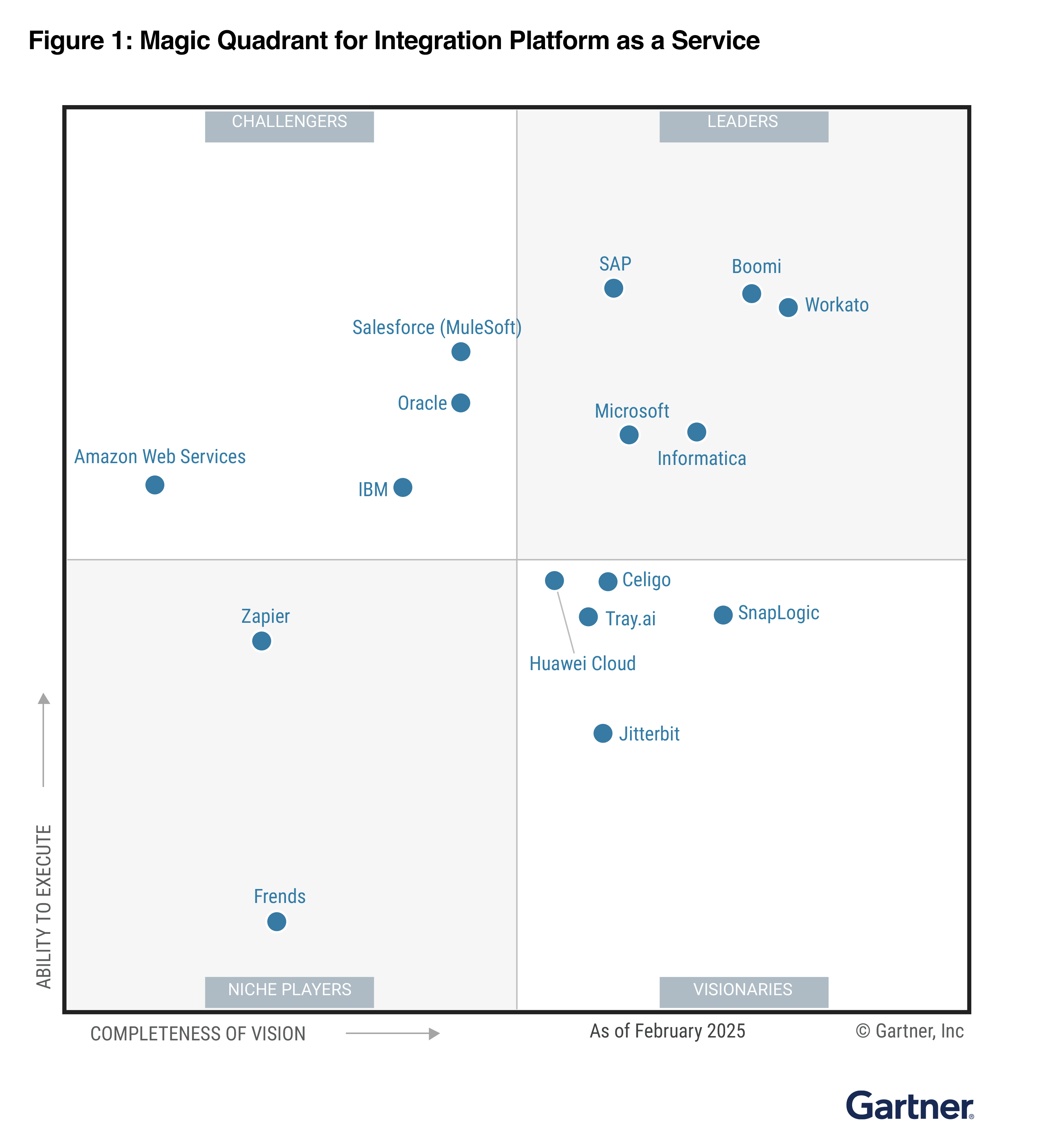
MuleSoft Demoted from Leader to Challenger
One of the biggest headlines this year is the downgrade of MuleSoft from the “Leader” to the “Challenger” quadrant — a surprising yet telling move by Gartner. While MuleSoft remains a robust and trusted tool in enterprise environments, the report points to concerns including:
- Diminishing innovation capacity
- High operational complexity
- A perceived lack of readiness for AI-first, low-code future demands
Despite being a longstanding enterprise integration leader, MuleSoft’s ESB (Enterprise Service Bus)-based architecture seems increasingly outdated in an era where agility, composability, and automation-first thinking are becoming the norm. Organizations are looking for platforms that simplify integration, not add overhead.
What Does This Mean for Developers?
Teams may face increasing pressure to move away from monolithic integration platforms towards those that allow rapid experimentation, visual orchestration, and tight AI integration — all while maintaining enterprise-grade reliability.
Emerging Trend: AI-Powered Automation and Agentic Integration
Gartner notes a growing shift away from traditional iPaaS toward more agile, AI-driven automation platforms. Tools like n8n, tray.ai, and particularly workato are examples of this trend. These platforms are now blurring the line between iPaaS, RPA, and AI workflow orchestration by enabling:
- AI/LLM (Large Language Model) Integrations as core components
- Agentic behaviors, where integration flows become context-aware and self-healing
- Low-code/no-code experiences that are powerful yet accessible
Agentic Integration is an emerging concept where workflows are not just automated but also intelligent, adaptive, and partially autonomous, reacting to context, errors, or new input dynamically.
Workato Declared a Leader – What Made the Difference?
In a much-anticipated move, Workato has been named a Leader in this year’s Magic Quadrant — and with good reason. Over the past few years, Workato has rapidly carved a space for itself as a truly intelligent, user-friendly, and powerful integration platform.
According to Gartner, Workato’s leadership is underpinned by several strengths:
- A low-code/no-code interface that accommodates both business users and developers
- Native capabilities around AI-first process automation
- An ecosystem of 1,000+ reusable connectors for rapid use-case delivery
- Enterprise features such as governance, role-based access, and multi-environment support
- A rapid innovation cycle and strong community backing
Unlike traditional vendors focusing on heavyweight architectural control, Workato is gaining favour by focusing on time-to-value, democratized automation, and developer-in-the-loop agility.
Cloud-Native iPaaS Tools: AWS and Azure Lagging Behind
Despite dominating much of the broader cloud landscape, AWS and Azure's native integration offerings (such as AppFlow, EventBridge, and Logic Apps) have not made a significant impact in Gartner's evaluation.
Key reasons include:
- Limited enterprise-first integration strategy
- Restrictive low-code/no-code tooling
- Lack of platform neutrality, making them better suited for internal cloud workflows rather than diverse SaaS/hybrid environments
- Minimal pre-built connectors or community resources for real-world enterprise use-cases
This opens the door for more cloud-agnostic platforms like Workato, Boomi, Make, and Tray.ai, which aim to sit across ecosystems and neutralize vendor lock-in.
What This Means for Developers, Architects and Integration Teams
The evolving iPaaS ecosystem is no longer just about enabling integrations — it's about building intelligent automation landscapes that can scale, adapt, and collaborate with AI.
For Developers:
- More focus on API composition, governance, and platform extensibility
- Less low-level plumbing and middleware scripting — more drag-and-drop logic with embedded custom code options
- Need to master platforms that can talk to LLMs, handle events in real time, and integrate across cloud-native and SaaS ecosystems
For Integration Architects:
- Time to rethink the centralized ESB model in favour of event-driven and distributed integration architectures
- Need to support citizen automation while maintaining governance and security
- Focus on composability — making interoperable, modular integrations at scale
For Businesses:
- Expect faster project delivery, but also a higher need for governance around automation sprawl
- The integration team becomes a business enabler, not just a backend function
Conclusion: The Future of Integration Is Intelligent, Composable and Collaborative
The 2025 Gartner Magic Quadrant for iPaaS sets a strong signal: the age of heavy, monolithic integration platforms is fading fast. In its place, a new generation of agile, intelligent, and user-centric platforms is emerging — designed not just for backend teams, but also for cross-functional, AI-empowered teams.
To stay ahead, organizations must rethink their integration strategies through the following lenses:
- Agility over rigidity
- AI as a co-pilot, not an afterthought
- Platforms that cater to both developers and business users
- Seamless orchestration across SaaS, cloud, APIs, and event streams
As businesses continue embracing digital transformation at speed and scale, the winners in the iPaaS space will be those that empower teams, accelerate delivery, and make intelligence a native feature — not a bolt-on.
Opinions expressed by DZone contributors are their own.
Comments