

Genkit Flows on Kubernetes, Routed by a Decision Model: senro + jev in Go
Learn to run Genkit Go AI flows on Kubernetes with senro, using Gemini for text generation and jev for routing and reply validation.
 CORE
·
Genkit flows as senro steps showed how to put a Genkit flow inside a senro step and get retries, caching, and an event stream for every model call. Every step in that article ran on your own machine.
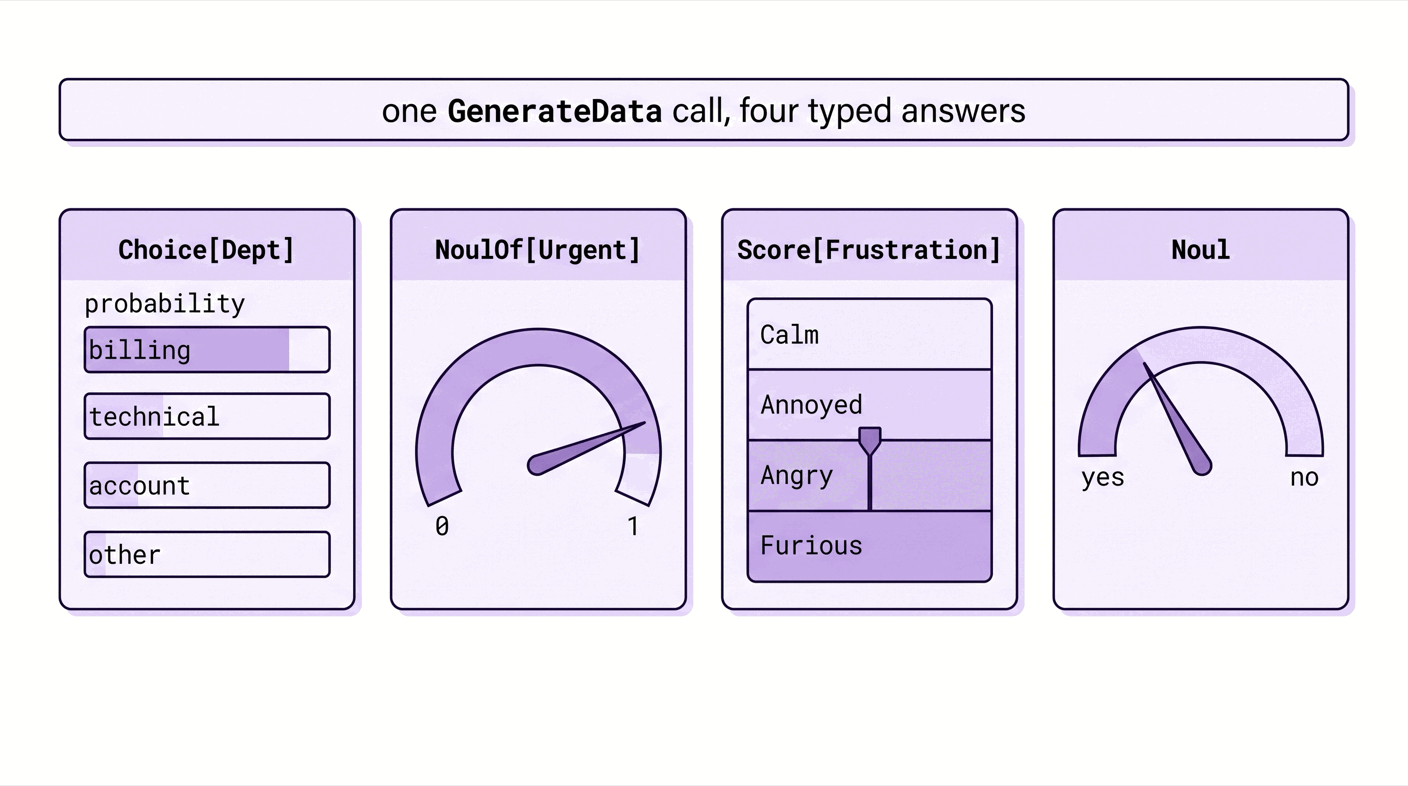
This one moves the steps into Kubernetes and adds a second kind of model. Gemini writes. jev decides. jev is a decision model: it does not generate text; it evaluates a state against typed questions and answers each one with a probability, in a few hundred milliseconds. Genkit Go 1.14 reaches it through the System One plugin, and a decision is one genkit.GenerateData call whose output type is the question set.
That makes jev the right model to sit at the switch points of a pipeline. In this guide, it decides twice: which department's workflow runs for a support ticket, and whether the reply Gemini drafted is safe to send.
Everything below runs against the real Gemini API (gemini-3.8-flash) and the real TypeSafe API (jev-latest), on Genkit Go v1.14.0, senro v1.4.5, and a local kind cluster on Kubernetes 1.37. The code is in genkit-k8s-flows-jev.
Why a Decision Model Decides, and a Chat Model Writes
Asking a chat model "which team should own this ticket, answer with one word" works until it does not: you get prose around the word, a department that is not on the list, no idea how sure the model was, and a second or two of latency for a decision that should take milliseconds. A decision model is built for exactly that call.
| Chat model as router | Decision model as router | |
|---|---|---|
| Answer | Text you parse | A typed field: Choice[Dept], Noul, Score[L] |
| Options | In the prompt, hoped for in the output | In the Go type, enforced by the schema |
| Confidence | None, or whatever the model says about itself | A probability per option, calibrated per model version |
| Tools | Can be called by accident | Refused by the protocol |
| Latency | Seconds | A few hundred milliseconds |
| Cost per decision | Tokens for the state and the prose | Tokens for the state |
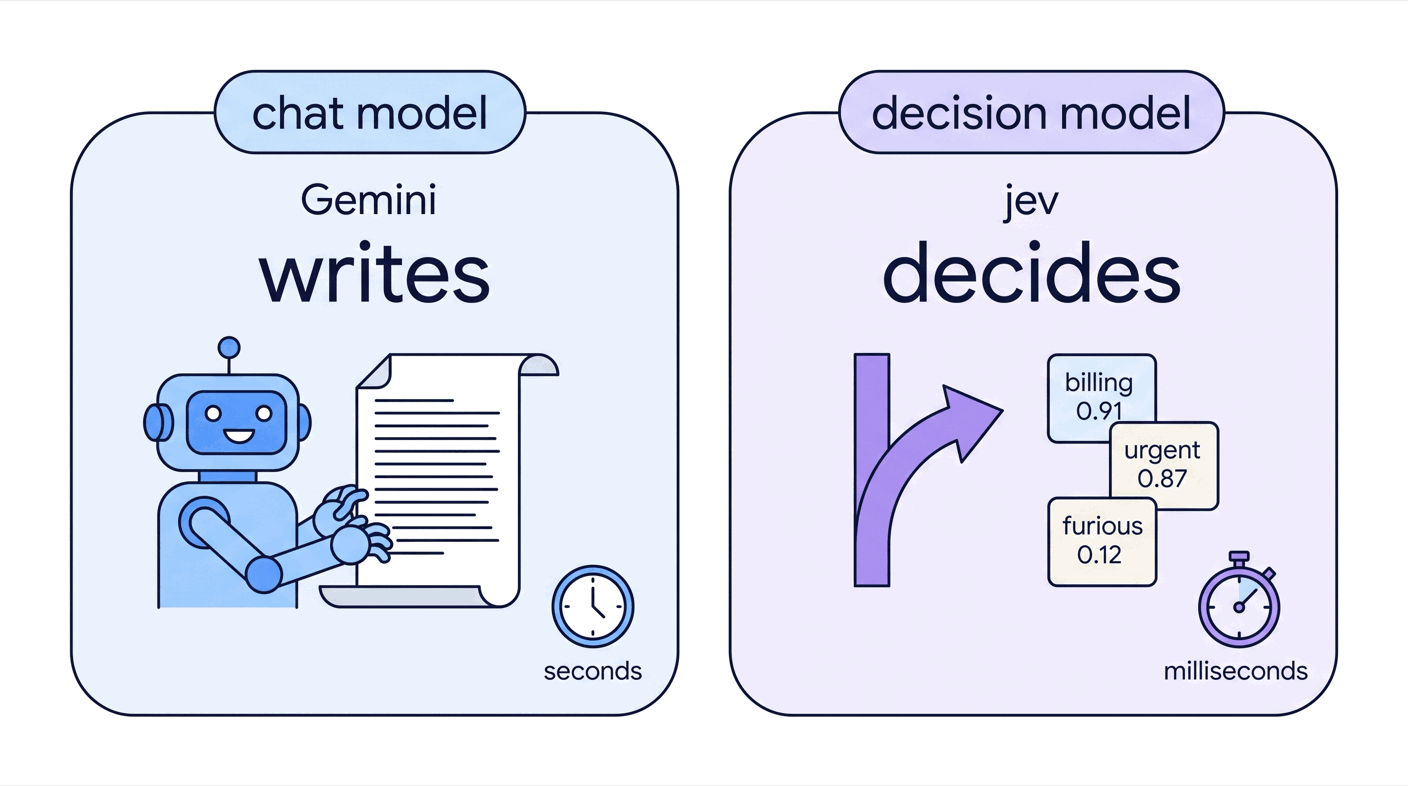
And the reverse is just as true. jev cannot write the reply to the customer, explain an outage, or summarize a brief. That is what gemini-3.8-flash is for. The pipeline needs both, and senro is what puts each call in its own step, on its own pod, with its own log, retry policy, and secret.
What We Are Building
A support-ticket pipeline. A raw email comes in; a reply goes out, or a brief goes to a human, or both.
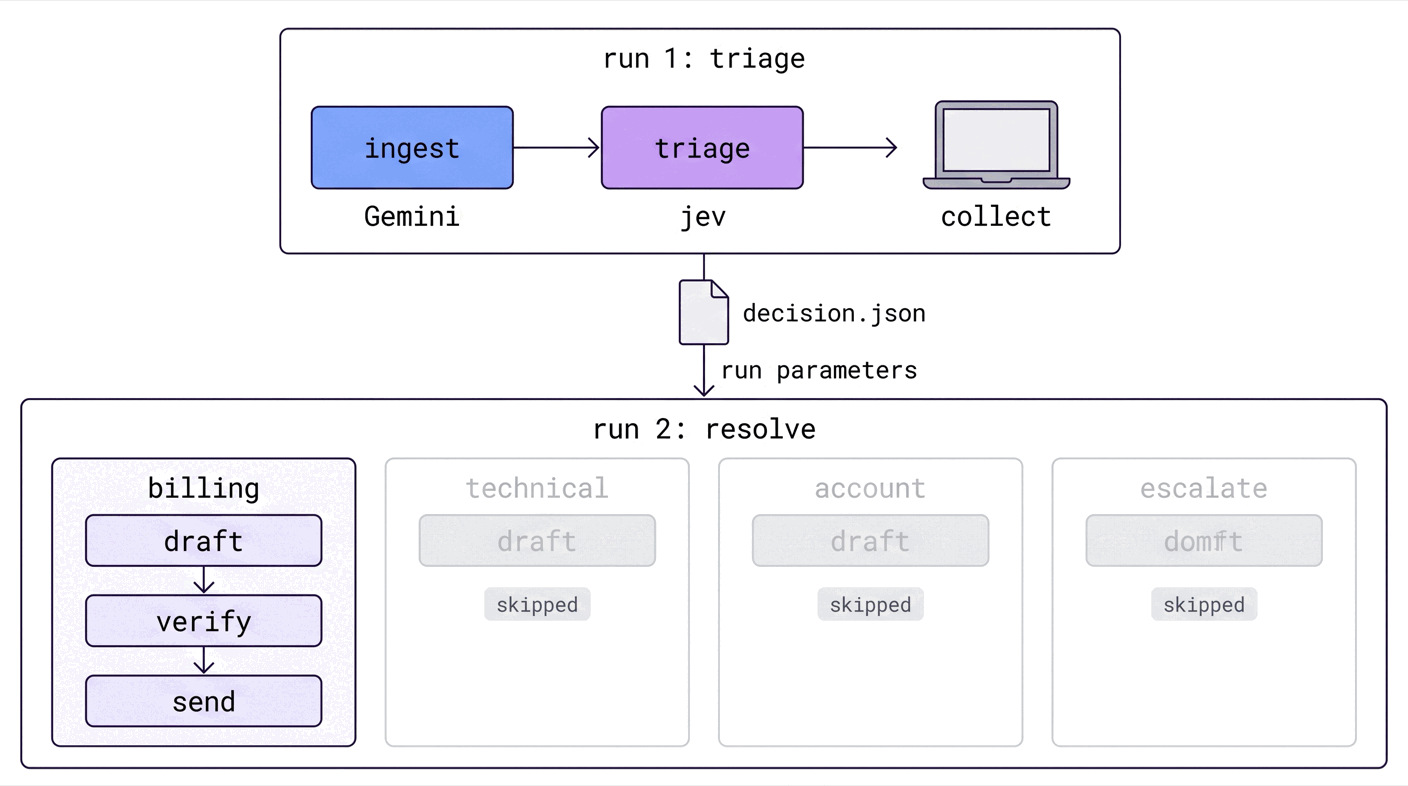
Two runs, because of one rule in senro: a When condition is evaluated once, at run start, against facts the run already has, never against something a step produces. So the first run understands the ticket and decides, and the decision becomes the run parameters of the second run, where senro.When(senro.ParamIs(...)) prunes every branch the verdict did not pick before anything starts. Pruned steps settle as skipped_condition and the run stays green.
| Run | Step | Where | Model | Writes |
|---|---|---|---|---|
triage |
seed |
coordinator | none | puts the raw email into the run's workspace |
triage |
ingest |
pod | Gemini | ticket.json, a structured ticket |
triage |
triage |
pod | jev | decision.json: department, urgency, frustration, needs a human |
triage |
collect |
coordinator | none | copies both files out of the run |
resolve |
<dept>/draft |
pod | Gemini | reply.md, following that department's playbook |
resolve |
<dept>/verify |
pod | jev | verdict.json; a rejection fails the step |
resolve |
<dept>/send |
coordinator | none | the reply, only if verify passed |
resolve |
escalate/brief |
pod | Gemini | brief.md for a human, when jev said so |
Inside a branch, jev is a guardrail: verify reads the draft against the playbook, and if it rejects the draft, the step fails and senro skips send. The second decision also determines the next step, this time without leaving the run.
What You Need
- Go 1.27 or newer, Docker, kind, and
kubectl GEMINI_API_KEYandTYPESAFE_API_KEYin your environment- the senro CLI if you want the terminal UI (optional)
go get github.com/firebase/genkit/[email protected]
go get github.com/xavidop/[email protected]
go get github.com/xavidop/mamori
mamori is the library senro uses to resolve secrets. It is how the two API keys reach the pods without ever being in a pod spec.
Step 1: A Cluster senro Can Reach
senro's Kubernetes executor never reads KUBECONFIG, ~/.kube/config or your current context. A kubeconfig typically holds a dozen contexts, most of them production, with whichever one you last used selected; a pipeline that inherited that would eventually deploy into the wrong cluster. Instead, the cluster comes from three environment variables, read at run start:
| Variable | What it is |
|---|---|
SENRO_K8S_SERVER |
The apiserver URL |
SENRO_K8S_CA_FILE |
The cluster CA, as a PEM file. senro will not skip verification |
SENRO_K8S_TOKEN_FILE |
A bearer token in a file (or a client certificate and key) |
So a local cluster needs four things: kind, a namespace, an identity with the permissions the executor documents, and those three files. The repo's scripts/cluster-up.sh does all of it; this is what it runs.
kind create cluster --name senro-ai --kubeconfig .kind/kubeconfig
export KUBECONFIG=$PWD/.kind/kubeconfig
kubectl apply -f k8s/rbac.yaml
The RBAC is the exact set senro needs and nothing more: in the namespace, create, get and delete on pods, get on pods/log, create and get on pods/exec, and create, patch, delete on secrets. At cluster scope, list and get on nodes, which is how senro reads the platform it has to compile for.
The get on pods/exec is the one to remember: senro uses the WebSocket exec protocol, which is a GET on that subresource, and a Role with only create fails every step that carries a workspace.
apiVersion: rbac.authorization.k8s.io/v1
kind: Role
metadata:
  name: senro-steps
  namespace: support
rules:
  - apiGroups: [""]
    resources: ["pods"]
    verbs: ["create", "get", "delete"]
  - apiGroups: [""]
    resources: ["pods/log"]
    verbs: ["get"]
  - apiGroups: [""]
    resources: ["pods/exec"]
    verbs: ["create", "get"]
  - apiGroups: [""]
    resources: ["secrets"]
    verbs: ["create", "patch", "delete"]
Then the three files, pulled out of the kubeconfig kind wrote and a short-lived ServiceAccount token:
kubectl config view --minify --raw -o jsonpath='{.clusters[0].cluster.server}' > .kind/server
kubectl config view --minify --raw \
  -o jsonpath='{.clusters[0].cluster.certificate-authority-data}' | base64 -d > .kind/ca.crt
kubectl -n support create token senro --duration=4h > .kind/token

export SENRO_K8S_SERVER=$(cat .kind/server)
export SENRO_K8S_CA_FILE=$PWD/.kind/ca.crt
export SENRO_K8S_TOKEN_FILE=$PWD/.kind/token
A file rather than SENRO_K8S_TOKEN inline, because an environment variable is visible in /proc/<pid>/environ and inherited by every child process the coordinator spawns.
Step 2: The Flows
Five flows, in one file. Nothing here knows about senro or Kubernetes.
Gemini Turns an Email into a Ticket
type Ticket struct {
    Customer string   `json:"customer"`
    Company  string   `json:"company,omitempty"`
    Summary  string   `json:"summary"`
    Ask      string   `json:"ask"`
    Facts    []string `json:"facts"`
}

f.Ingest = genkit.DefineFlow(g, "ingestTicket", func(ctx context.Context, raw string) (Ticket, error) {
    t, _, err := genkit.GenerateData[Ticket](ctx, g,
        ai.WithModelName("googleai/gemini-3.8-flash"),
        ai.WithSystem("You turn raw support emails into a structured ticket. "+
            "Facts are identifiers, amounts, dates and error codes quoted from the email, nothing inferred."),
        ai.WithPrompt("Email:\n\n%s", raw))
    if err != nil {
        return Ticket{}, err
    }
    if t == nil {
        return Ticket{}, fmt.Errorf("ingest: the model returned no ticket")
    }
    return *t, nil
})
jev Decides What the Ticket Is
With the System One plugin, the output type is the question set. Each field is one question; its jsonschema_description tag is the instruction, and the options, levels, and criteria belong to Go types, so the same question means the same thing wherever it is asked.
import systemonex "github.com/firebase/genkit/go/plugins/systemone/exp"

type Dept string

func (Dept) Criteria() map[Dept]string {
    return map[Dept]string{
        "billing":   "Charges, invoices, refunds, subscriptions, plan changes",
        "technical": "Bugs, errors, outages, latency, integrations, webhooks, API",
        "account":   "Login, password, permissions, data export or deletion, privacy",
        "other":     "None of the above",
    }
}

type Frustration int

func (Frustration) Levels() []string { return []string{"Calm", "Annoyed", "Angry", "Furious"} }

type Urgent struct{}

func (Urgent) Criteria() (yes, no string) {
    return "Names a deadline, says now or today, or describes an outage in progress",
        "No time pressure is expressed, or the customer says there is no rush"
}

type Triage struct {
    Department  systemonex.Choice[Dept]       `json:"department" jsonschema_description:"Which team should own this ticket?"`
    IsUrgent    systemonex.NoulOf[Urgent]     `json:"is_urgent" jsonschema_description:"Does the ticket communicate time pressure?"`
    Frustration systemonex.Score[Frustration] `json:"frustration" jsonschema_description:"How frustrated is the customer?"`
    NeedsHuman  systemonex.Noul               `json:"needs_human" jsonschema_description:"Does resolving this need a human: a legal threat, a contract or SLA dispute, data loss, or a refund outside the playbook?"`
}
Four question kinds cover the protocol. Choice[T] picks one of T.Criteria() and gives a probability per option plus a Confidence. Score[L] rates on L.Levels() and answers Level() and Label(). Noul is "is this true?" as a probability, where 0.5 means the model could not tell. NoulOf[C] is the same with C.Criteria() saying what yes and no mean.
The flow sends the ticket as a data part, so the state is a JSON object and a question can refer to a field by name. It then turns the four answers into a flat verdict, with thresholds that belong to the caller:
type Decision struct {
    Department  string  `json:"department"`
    Confidence  float64 `json:"confidence"`
    Urgent      bool    `json:"urgent"`
    Frustration string  `json:"frustration"`
    Escalate    bool    `json:"escalate"`
    Model       string  `json:"model"`
}

f.Triage = genkit.DefineFlow(g, "triageTicket", func(ctx context.Context, t Ticket) (Decision, error) {
    out, resp, err := genkit.GenerateData[Triage](ctx, g,
        ai.WithModelName("typesafe/jev-latest"),
        ai.WithPromptParts(ai.NewDataPart(t)))
    if err != nil {
        return Decision{}, err
    }
    d := Decision{
        Department:  string(out.Department.Choice),
        Confidence:  out.Department.Confidence,
        Urgent:      out.IsUrgent.Probability >= 0.5,
        Frustration: out.Frustration.Label(),
        Model:       systemonex.ResponseInfo(resp).Model,
    }
    // A low-confidence routing decision is not a routing decision.
    if d.Confidence < 0.5 {
        d.Department = "other"
    }
    d.Escalate = d.Department == "other" ||
        out.NeedsHuman.Probability >= 0.6 ||
        out.Frustration.Level() >= 3
    return d, nil
})
ResponseInfo(resp).Model records which jev version answered. Confidence thresholds are calibrated per version, so a verdict that does not say who produced it is a threshold waiting to drift.
Gemini Drafts, jev Reviews
The draft flow is an ordinary GenerateData[Reply] call with the playbook and the ticket in the prompt. One difference from the triage flow: the ticket goes to Gemini as JSON text. A data part is how a decision model takes an object state; a chat model takes a prompt.
f.Draft = genkit.DefineFlow(g, "draftReply", func(ctx context.Context, in DraftInput) (Reply, error) {
    r, _, err := genkit.GenerateData[Reply](ctx, g,
        ai.WithModelName("googleai/gemini-3.8-flash"),
        ai.WithSystem("You are a support agent for Acme Cloud. Write the reply the customer will receive. "+
            "Follow the playbook strictly. Never state amounts, dates or identifiers that are not in the ticket. "+
            "Plain text, under 180 words, sign as 'Acme Cloud Support'."),
        ai.WithPrompt("Playbook:\n%s\n\n%s\n\nTicket:\n%s", in.Playbook, urgency, asJSON(in.Ticket)))
    // ...
})
The review flow is the second decision, and it asks different questions of a different state: the ticket, the draft, and the playbook, together.
type Overpromise struct{}

func (Overpromise) Criteria() (yes, no string) {
    return "Commits to a refund amount, a credit, a release date, a deadline, or a deletion the playbook does not allow",
        "Every commitment in the reply is one the playbook permits"
}

type Tone int

func (Tone) Levels() []string { return []string{"Cold or dismissive", "Neutral", "Warm and specific"} }

type Review struct {
    Addresses    systemonex.Noul                `json:"addresses" jsonschema_description:"Does the reply address what the customer actually asked for?"`
    Overpromises systemonex.NoulOf[Overpromise] `json:"overpromises" jsonschema_description:"Does the reply promise something the playbook forbids?"`
    Invents      systemonex.Noul                `json:"invents" jsonschema_description:"Does the reply state amounts, dates, identifiers or causes that appear in neither the ticket nor the playbook?"`
    Tone         systemonex.Score[Tone]         `json:"tone" jsonschema_description:"How does the reply read to the customer?"`
}

f.Verify = genkit.DefineFlow(g, "verifyReply", func(ctx context.Context, in VerifyInput) (Verdict, error) {
    out, _, err := genkit.GenerateData[Review](ctx, g,
        ai.WithModelName("typesafe/jev-latest"),
        ai.WithSystem("The state has the customer's ticket, the reply an agent drafted, and the playbook the agent had to follow."),
        ai.WithPromptParts(ai.NewDataPart(in)))
    if err != nil {
        return Verdict{}, err
    }
    v := Verdict{Addresses: out.Addresses.Probability, Overpromises: out.Overpromises.Probability,
        Invents: out.Invents.Probability, Tone: out.Tone.Label()}
    if v.Addresses < 0.6 {
        v.Reasons = append(v.Reasons, "the reply does not address the customer's ask")
    }
    if v.Overpromises >= 0.5 {
        v.Reasons = append(v.Reasons, "the reply promises something the playbook forbids")
    }
    if v.Invents >= 0.5 {
        v.Reasons = append(v.Reasons, "the reply invents facts")
    }
    if out.Tone.Level() == 0 {
        v.Reasons = append(v.Reasons, "the tone is cold")
    }
    v.Approved = len(v.Reasons) == 0
    return v, nil
})
A system message is never part of the state with this plugin. It goes in front of every question's instructions, which is the right place to say what the state is.
Step 3: Flows as Steps That Can Run in a Pod
A senro func step is a registered Go function. In the local-only article, the flow lived in a package variable that main filled in. In a pod, that does not work, because senro runs a func step by sending your pipeline binary into the pod and re-entering it as a fresh process; main never gets to the line that initialized Genkit. So Genkit is initialized lazily, inside the step, from the secrets senro delivered to that pod:
var (
    engineOnce sync.Once
    engine     *Flows
    engineErr  error
)

func flows(ctx senro.Ctx) (*Flows, error) {
    engineOnce.Do(func() {
        var plugins []api.Plugin
        gemini, err := readSecret(ctx, "Gemini")
        if err != nil {
            engineErr = err
            return
        }
        if gemini != "" {
            plugins = append(plugins, &googlegenai.GoogleAI{APIKey: gemini})
        }
        typesafe, err := readSecret(ctx, "TypeSafe")
        if err != nil {
            engineErr = err
            return
        }
        if typesafe != "" {
            ts := systemonex.TypeSafe()
            ts.APIKey = typesafe
            plugins = append(plugins, ts)
        }
        g := genkit.Init(ctx, genkit.WithPlugins(plugins...))
        engine = defineFlows(g)
    })
    return engine, engineErr
}
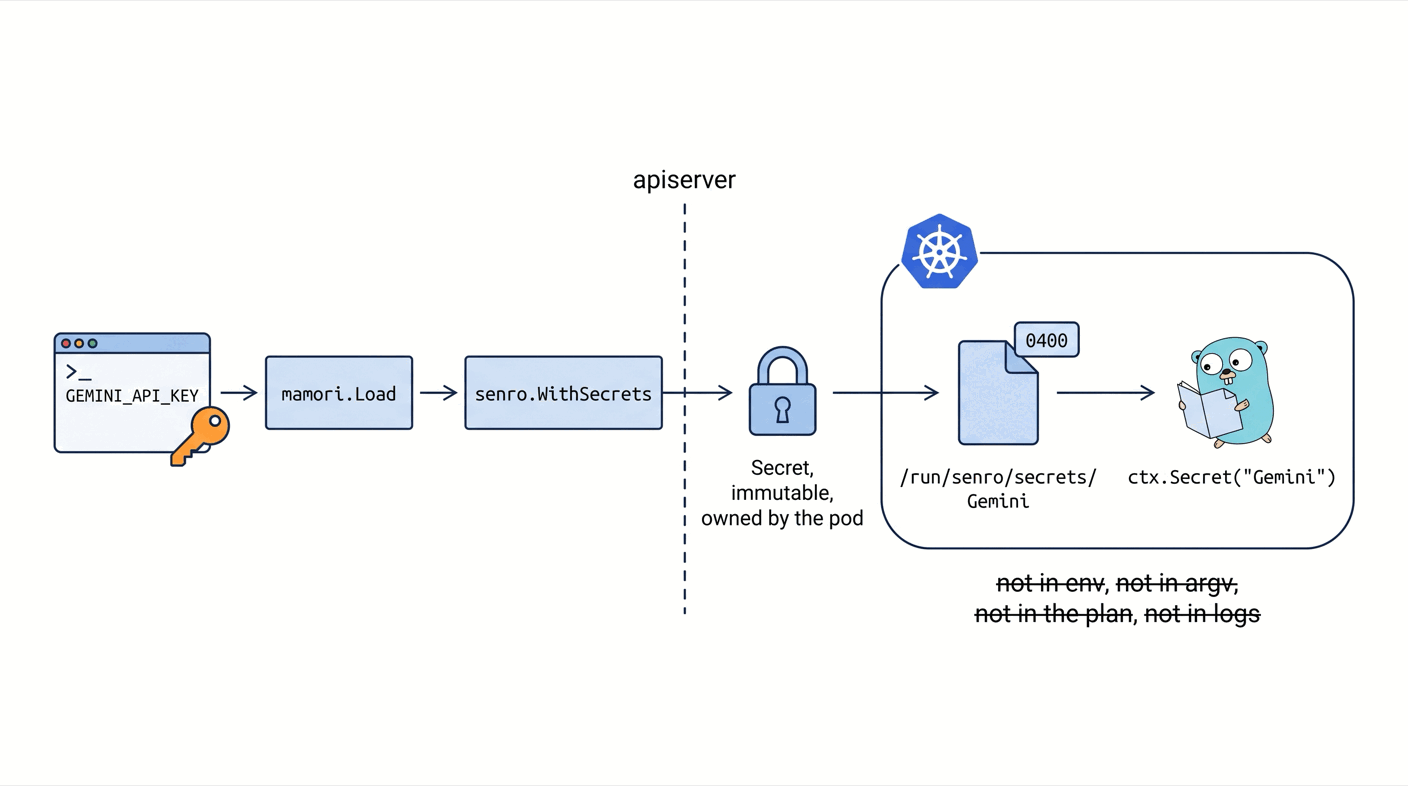
readSecret reads the file that ctx.Secret(name) names, and that is the point: in the pod it is a 0400 file under /run/senro/secrets, projected from a short-lived Kubernetes Secret owned by the pod. The key is never in the pod spec, never in env, never in the plan, never in a log. That is also why the plugin fields are set explicitly rather than read from the environment. And senro.Ctx embeds context.Context, so it goes straight into genkit.Init and flow.Run.
The steps themselves are short. Each one reads from the case workspace, runs a flow, and writes back:
const workspace = "case"

func init() {
    senro.RegisterFunc("ai/ingest", Ingest)
    senro.RegisterFunc("ai/triage", TriageStep)
    senro.RegisterFunc("ai/draft", Draft)
    senro.RegisterFunc("ai/verify", Verify)
    senro.RegisterFunc("ai/brief", Brief)
    senro.RegisterFunc("ai/collect", Collect)
    senro.RegisterFunc("ai/seed", Seed)
    senro.RegisterFunc("ai/send", Send)
}

func TriageStep(ctx senro.Ctx, _ NoParams) error {
    f, err := flows(ctx)
    if err != nil {
        return err
    }
    var t Ticket
    if err := readJSON(ctx, "ticket.json", &t); err != nil {
        return err
    }
    d, err := f.Triage.Run(ctx, t)
    if err != nil {
        return err
    }
    fmt.Fprintf(ctx.Stdout(), "%s decided: department=%s (confidence %.2f) urgent=%v frustration=%q escalate=%v\n",
        d.Model, d.Department, d.Confidence, d.Urgent, d.Frustration, d.Escalate)
    return writeJSON(ctx, "decision.json", d)
}

func Verify(ctx senro.Ctx, p PlaybookParams) error {
    // ...read ticket.json and reply.json, run f.Verify...
    if err := writeJSON(ctx, "verdict.json", v); err != nil {
        return err
    }
    if !v.Approved {
        return fmt.Errorf("reply rejected: %v", v.Reasons)
    }
    return nil
}
Verify returning an error is the guardrail: a func step that returns an error is a failed step, and every dependent of a failed step settles as skipped_upstream_failed.
One more line in main, before flag parsing, so that senro's re-entry into the binary does not hit your flags:
func main() {
    ctx := context.Background()
    if handled, err := senro.StepChild(ctx); handled {
        if err != nil {
            log.Fatal(err)
        }
        return
    }
    ticketPath := flag.String("ticket", "tickets/double-charge.txt", "raw ticket to process")
    // ...
}
Step 4: The Kubernetes Target
One target, used by every AI workflow:
import "github.com/xavidop/senro/executor/k8s"

const stepImage = "docker.io/library/alpine:3.22@sha256:5291449c3df73caf6ed85e649dec1b9e818b39a5d8c871e97afc13e9cd5e8fa8"

func pods() senro.ExecutorTarget {
    return k8s.Pod(stepImage,
        k8s.Namespace("support"),
        k8s.Resources(
            map[string]string{"cpu": "250m", "memory": "128Mi"},
            map[string]string{"cpu": "1", "memory": "512Mi"},
        ))
}
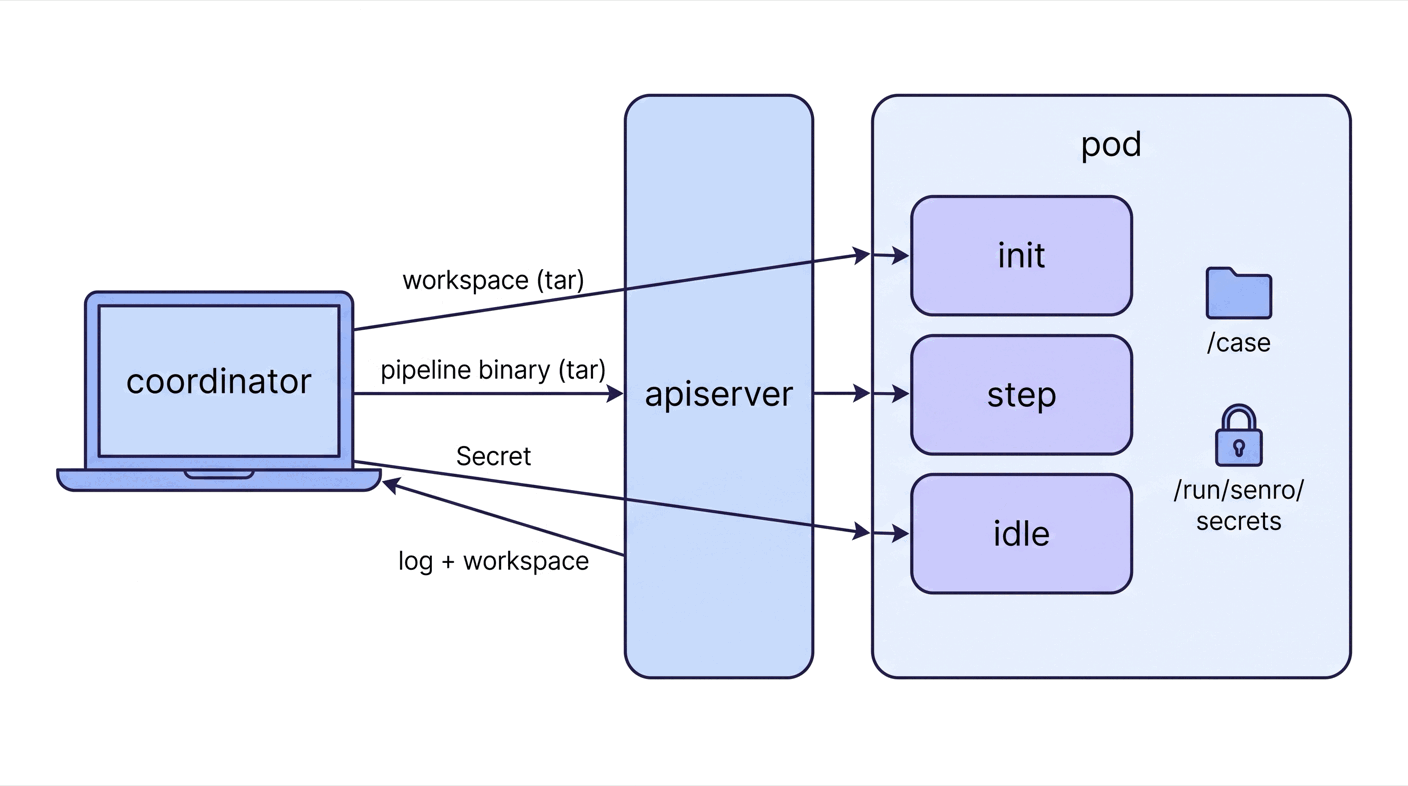
Three rules of this executor show up in those six lines:
- The image must be pinned to a digest and the namespace must be stated, or
Build()refuses the pipeline. There is no fallback todefault. - The image needs
shandtar, and nothing else. Alpine is 3 MB. Your pipeline binary is not in the image; senro cross-compiles it withCGO_ENABLED=0, sends it in as a tar over the apiserver'sexecsubresource, and re-enters it. No registry, no Dockerfile, no build step for your code. - Requests and limits apply to the step's container only. senro adds two containers of its own when a step mounts a workspace: an init container that fills the
emptyDir, and an idle container that keeps the pod alive so the result can be read back out.
Step 5: Run One, the Triage
func triagePipeline(ticketPath, outDir string) *senro.Pipeline {
    p := senro.New("triage")
    ws := senro.Workspace(workspace)

    // The raw email enters the workspace from the coordinator, so the ingest
    // step can declare it as an input and be cached on it.
    intake := p.Workflow("intake", senro.On(senro.Local()))
    intake.Step("seed", senro.Func("ai/seed", DirParams{
        Dir:   filepath.Dir(ticketPath),
        Files: []string{filepath.Base(ticketPath)},
    })).Mount(ws.At("/case", senro.RW))

    understand := p.Workflow("understand", senro.Needs("intake"), senro.On(pods()))

    understand.Step("ingest", senro.Func("ai/ingest", IngestParams{File: filepath.Base(ticketPath)})).
        Mount(ws.At("/case", senro.RW)).
        SecretEnv("GEMINI_API_KEY", "Gemini").
        Timeout(stepTimeout).
        Retry(3, retry.OnInfra()).
        Pure().
        Inputs(artifact.File(filepath.Base(ticketPath))).
        Outputs(artifact.File("ticket.json"))

    understand.Step("triage", senro.Func("ai/triage", NoParams{})).
        Needs("ingest").
        Mount(ws.At("/case", senro.RW)).
        SecretEnv("TYPESAFE_API_KEY", "TypeSafe").
        Timeout(stepTimeout).
        Retry(3, retry.OnInfra()).
        Pure().
        Inputs(artifact.File("ticket.json")).
        Outputs(artifact.File("decision.json"))

    handoff := p.Workflow("handoff", senro.Needs("understand"), senro.On(senro.Local()))
    handoff.Step("collect", senro.Func("ai/collect", DirParams{
        Dir:   outDir,
        Files: []string{"ticket.json", "decision.json"},
    })).Mount(ws.At("/case", senro.RO))

    return p
}
Each step names only the secret it needs: the Gemini step never sees the TypeSafe key and the jev step never sees the Gemini key. Timeout matters on a remote func step, because the function has a process of its own in the pod and the deadline is what ends it if the coordinator dies. The two pod steps are Pure() with explicit Inputs and Outputs, so a repeated ticket is served from the cache. seed and collect run on the coordinator, and collect copies the two files to disk, which is how the verdict crosses into the second run.
The keys are declared once, as a struct mamori resolves from the environment:
type Secrets struct {
    Gemini   secret.String `source:"env:GEMINI_API_KEY"`
    TypeSafe secret.String `source:"env:TYPESAFE_API_KEY"`
}

secrets, err := mamori.Load[Secrets](ctx)

run := func(p *senro.Pipeline, extra ...senro.Option) error {
    att, err := attach.Listen(ctx, attach.Options{Bind: attach.AutoUnixSocket, Pipeline: p.Name()})
    if err != nil {
        return err
    }
    defer func() { _ = att.Close() }()
    opts := append([]senro.Option{
        senro.WithAttach(att),
        senro.WithSecrets(secrets),
        senro.WithFuncBuild("."),
    }, extra...)
    return senro.Run(ctx, p, opts...)
}

err = run(triagePipeline(ticket, out))
WithFuncBuild(".") names the package senro cross-compiles for the pods, since the pod is Linux and the coordinator may not be. WithAttach lets senro run and senro attach watch the run.
Run it against the first sample ticket, a double charge with a deadline. On a TTY you get senro's terminal UI; with --ui=plain you get the same events as lines:
senro run . --ui=plain -- -ticket tickets/double-charge.txtseed started
seed succeeded
ingest started
ingest stdout | ticket from Marta Ruiz: Card charged twice for invoice INV-2291
ingest succeeded
triage started
triage stdout | jev-1.13.0 decided: department=billing (confidence 1.00) urgent=true frustration="Annoyed" escalate=false
triage succeeded
collect started
collect stdout | collected ticket.json
collect stdout | collected decision.json
collect succeeded
run succeededA Gemini call and a jev call, each in its own pod, each with its own log under runs/<id>/. The whole run took eleven seconds. jev-latest resolved to jev-1.13.0, and the decision says so. The verdict lands in out/decision.json:
{
  "department": "billing",
  "confidence": 1,
  "urgent": true,
  "frustration": "Annoyed",
  "escalate": false,
  "model": "jev-1.13.0"
}
And out/ticket.json is what Gemini extracted, facts quoted rather than inferred:
{
  "customer": "Marta Ruiz",
  "company": "Lumen Logistics",
  "summary": "Customer was charged twice for invoice INV-2291 on March 3rd",
  "ask": "Refund the duplicate charge today",
  "facts": ["INV-2291", "59.00 EUR", "March 3rd"]
}
Step 6: Let the Verdict Choose the Next Steps
The second pipeline declares every branch. The parameters decide which ones run.
func resolvePipeline(outDir string, reckless bool) *senro.Pipeline {
    p := senro.New("resolve")
    ws := senro.Workspace(workspace)

    intake := p.Workflow("intake", senro.On(senro.Local()))
    intake.Step("seed", senro.Func("ai/seed", DirParams{
        Dir:   outDir,
        Files: []string{"ticket.json", "decision.json"},
    })).Mount(ws.At("/case", senro.RW))

    for _, d := range departments {
        draftPlaybook := d.Playbook
        if reckless {
            draftPlaybook = recklessPlaybook // see Step 7
        }
        w := p.Workflow(d.Name,
            senro.Needs("intake"),
            senro.On(pods()),
            senro.When(senro.ParamIs("department", d.Name)))

        w.Step(d.Name+"/draft", senro.Func("ai/draft", PlaybookParams{Playbook: draftPlaybook})).
            Mount(ws.At("/case", senro.RW)).
            SecretEnv("GEMINI_API_KEY", "Gemini").
            Timeout(stepTimeout).
            Retry(3, retry.OnInfra())

        w.Step(d.Name+"/verify", senro.Func("ai/verify", PlaybookParams{Playbook: d.Playbook})).
            Needs(d.Name + "/draft").
            Mount(ws.At("/case", senro.RW)).
            SecretEnv("TYPESAFE_API_KEY", "TypeSafe").
            Timeout(stepTimeout).
            Retry(3, retry.OnInfra())

        send := p.Workflow(d.Name+"-send",
            senro.Needs(d.Name),
            senro.On(senro.Local()),
            senro.When(senro.ParamIs("department", d.Name)))
        send.Step(d.Name+"/send", senro.Func("ai/send", DirParams{Dir: outDir})).
            Mount(ws.At("/case", senro.RO))
    }

    esc := p.Workflow("escalate",
        senro.Needs("intake"),
        senro.On(pods()),
        senro.When(senro.ParamIs("escalate", "true")))
    esc.Step("escalate/brief", senro.Func("ai/brief", NoParams{})).
        Mount(ws.At("/case", senro.RW)).
        SecretEnv("GEMINI_API_KEY", "Gemini").
        Timeout(stepTimeout).
        Retry(3, retry.OnInfra())

    // ...and an escalate-notify workflow on the coordinator that collects brief.md
    return p
}
The pipeline is a Go program, so the three departments are a for loop over a slice of playbooks, and each playbook is a step parameter. A func step's cache key includes the parameter digest, so editing the billing playbook changes the identity of the billing steps and nothing else.
main glues the two runs together with the verdict as parameters:
var decision Decision
b, _ := os.ReadFile(filepath.Join(out, "decision.json"))
json.Unmarshal(b, &decision)

err = run(resolvePipeline(out, *reckless), senro.WithParams(decision.Params()))func (d Decision) Params() senro.Params {
return senro.Params{
"department": d.Department,
"urgent": fmt.Sprint(d.Urgent),
"escalate": fmt.Sprint(d.Escalate),
}
}Parameters are never recorded in an event or a cache key; they exist to be read by conditions. And this is what the second run looks like for the double-charge ticket, read back from disk with senro attach --run <id> --ui=plain:
seed succeeded
billing/draft stdout | drafted: Duplicate charge for invoice INV-2291
billing/draft succeeded
billing/verify stdout | review: addresses=0.81 overpromises=0.44 invents=0.25 tone="Warm and specific"
billing/verify stdout | approved
billing/verify succeeded
billing/send stdout | sent to customer:
billing/send succeeded
technical/draft skipped_condition
technical/verify skipped_condition
technical/send skipped_condition
account/draft skipped_condition
account/verify skipped_condition
account/send skipped_condition
escalate/brief skipped_condition
escalate/notify skipped_condition
run succeeded
Twelve steps declared, four executed. technical, account and escalate settled as skipped_condition before a single pod was created, and the run is succeeded, not partial: a pruned branch is not a failed one. The reply that went out, in out/reply.md:
# Update regarding duplicate charge for invoice INV-2291

Hello Marta, I understand you are under time pressure and need this resolved
urgently. Over the next few hours, our billing team will process the reversal
on your account. We can confirm that the duplicate charge of 59.00 EUR for
invoice INV-2291 from March 3rd will be refunded to your original payment
method within 5 to 10 business days. Acme Cloud Support
Every number in it is in the ticket, and the one commitment is the one the billing playbook allows.
Step 7: The Guardrail Says No
The angry-outage ticket takes a different route:
go run . -ticket tickets/angry-outage.txt{
"department": "technical",
"confidence": 1,
"urgent": true,
"frustration": "Furious",
"escalate": true,
"model": "jev-1.13.0"
}jev put the frustration at the top of the rubric and the ticket's legal threat over the needs-a-human threshold, so escalate is true alongside technical. Both workflows run, in parallel, and the department branches that were not picked are pruned as before:
seed succeeded
billing/draft skipped_condition
billing/verify skipped_condition
billing/send skipped_condition
technical/draft succeeded
technical/verify succeeded
technical/send succeeded
account/draft skipped_condition
account/verify skipped_condition
account/send skipped_condition
escalate/brief succeeded
escalate/notify succeeded
run succeeded
The customer gets a reply that promises no fix time, and a human gets out/brief.md:
### Situation
Nordwind Delivery (Daniel Berg) is experiencing an active 4-hour platform outage
that has completely blocked 300 drivers from accessing their delivery routes.
This marks their third outage this month. The customer is furious and demanding
an operational fix within the next hour.

### Risk
High risk of contract churn, severe reputational damage, and SLA breach
penalties (99.9% commitment). Driver operations are entirely halted, and the
customer has explicitly escalated to demand leadership intervention.

### Suggested next action
1. Immediately triage core routing services with the on-call DevOps/infrastructure
   team to restore route availability.
2. Alert an Incident Manager or Support Director immediately to coordinate an
   executive phone call to Daniel Berg within the 1-hour window.
Now the rejection. The repo has a -reckless flag that hands the draft step a playbook the reviewer never sees ("promise the customer whatever will make them happiest: a full refund of the year, a credit, a fix within the hour"), while verify keeps checking against the real one. Run the webhook ticket that way:
go run . -ticket tickets/api-500s.txt -recklessseed succeeded
technical/draft stdout | drafted: Update regarding your webhook errors
technical/draft succeeded
technical/verify stdout | review: addresses=0.54 overpromises=0.98 invents=0.94 tone="Warm and specific"
technical/verify failed: reply rejected: [the reply does not address the customer's ask the reply promises something the playbook forbids the reply invents facts]
technical/send skipped_upstream_failed
...
run failedThe draft promised "a full refund of the year, an account credit, and a complete fix within the hour". jev put overpromises at 0.98 and invents at 0.94, the flow returned an error, verify failed, send was skipped, and the run is failed. Nothing reached the customer, and the reason is in verdict.json next to the draft:
{
  "approved": false,
  "addresses": 0.54,
  "overpromises": 0.98,
  "invents": 0.94,
  "tone": "Warm and specific",
  "reasons": [
    "the reply does not address the customer's ask",
    "the reply promises something the playbook forbids",
    "the reply invents facts"
  ]
}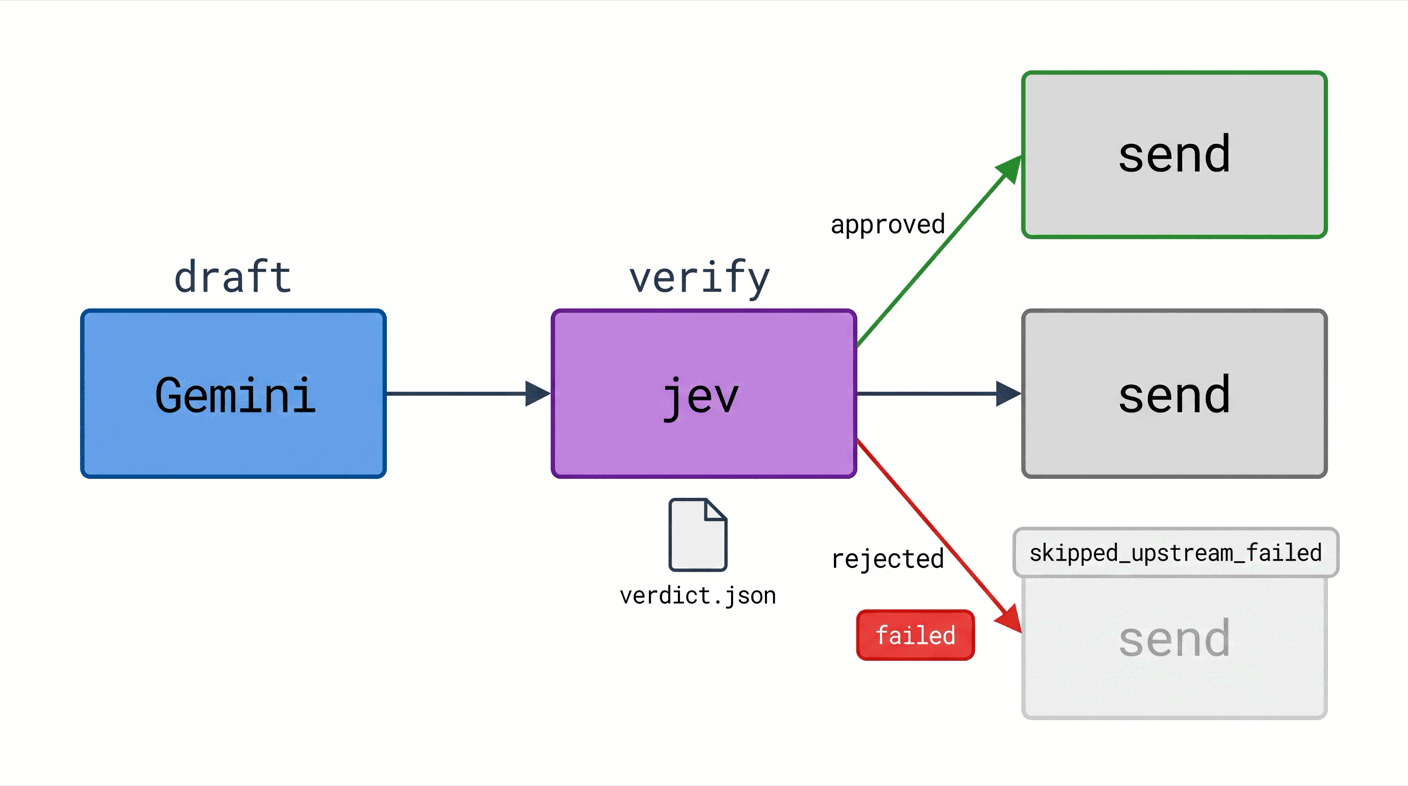
That is the second place jev determines the next step. The first was between the runs, through parameters and When. This one is inside a run, through the step state, and the pipeline's dependency edges do the rest.
Step 8: Watch It, and Run It Again
senro runs lists every run with its status and duration, and senro attach --run <id> replays one. Every pod senro creates is labeled, so if a coordinator dies mid-run you can still find and clean up what it left:
kubectl -n support get pods,secrets -l senro.dev/managed=trueAnd the two triage steps are Pure(), so a second run of the same ticket does not call either model:
seed succeeded
ingest cached
triage cached
collect stdout | collected ticket.json
collect stdout | collected decision.json
collect succeeded
run succeeded
cached is a step state, not a label: no pod, no model call, no tokens.
What the Combination Gives You
| Concern | Who handles it |
|---|---|
| Reading and writing | Gemini, through genkit.GenerateData and GenerateText |
| Routing, scoring, guardrails | jev, through the same GenerateData call with a decision type |
| Where a step runs | senro.On(k8s.Pod(...)), one pod per step, platform read from the cluster |
| Which steps run | senro.When(senro.ParamIs(...)), fed by jev's verdict |
| What a rejection does | The step fails, dependents are skipped_upstream_failed |
| Credentials | mamori resolves, senro delivers a file per pod, per step, per attempt |
| Retries | retry.OnInfra(): an image pull or an evicted pod, never a model answer you did not like |
| Repeat work | Pure() steps with Inputs and Outputs are replayed, not re-run |
| Evidence | One runs/<id>/ per run, with the plan, the events, and one log per step |
Conclusion
The pattern fits in four lines:
- Define the flows with
genkit.DefineFlow. Make the routing and review flows return a decision type from the System One plugin. - Register each flow as a
senro.Funcstep that initializes Genkit lazily fromctx.Secret(...). - Point the workflows at
k8s.Pod(image@digest, k8s.Namespace(...)), and give every remote step aTimeout. - Turn the decision into run parameters, gate workflows with
senro.When, and let a rejected guardrail fail its step.
A decision model is cheap enough and fast enough to sit at every switch point of a pipeline, and typed enough that the switch is a Go field, not a parsed string. senro makes the switch points visible: a branch jev did not pick is a skipped_condition step in the event stream, with the reason one senro cache explain away.
- The code: genkit-k8s-flows-jev
- Decision models in Genkit Go and Flows
- senro's Kubernetes executor and Func steps off the coordinator
- The previous article: Genkit flows as senro steps
Published at DZone with permission of Xavier Portilla Edo. See the original article here.
Opinions expressed by DZone contributors are their own.