

Beyond Dashboards: How Autonomous AI Agents Are Redefining Enterprise Analytics
Agentic AI is fundamentally changing how organizations extract insights from data and make strategic decisions, moving from reactive reporting to autonomous intelligence.
Join the DZone community and get the full member experience.
Join For FreeThe field of data analytics is going through the biggest change since business intelligence platforms were first introduced. Agentic AI — "intelligent systems that perceive, reason, plan, and act on their own" — is changing the way businesses get information and make choices. Generative AI only responds to prompts, but agentic systems work on their own, going after complex goals with little human oversight. They also have persistent memory and can adapt to new situations.
This change marks a shift from reactive analytics to proactive intelligence. Companies are moving away from static dashboards and manual analysis cycles in favor of self-driving systems that monitor data, find insights, and make decisions. The market is expected to be worth $196.6 billion by 2034, and 62% of executives expect a return on investment of more than 100%. This change is transitioning from small-scale tests to large-scale deployments, which significantly impact how businesses operate.
What is Agentic AI?
The main difference between generative and agentic AI is that generative AI cannot make its own decisions and act on its own. Generative AI works by having simple request-response interactions, and it needs human supervision for every task. It doesn't have long-term memory or the ability to understand context. Agentic AI changes this way of thinking by using independent workflows that mimic how humans think, learn, and act in cycles of perception, reasoning, action, and learning.
In a technical sense, agentic AI combines large language models with cognitive modules, external tools, and orchestration layers to make systems that can make decisions on their own. The end result is systems that break down hard problems, manage parallel processing, deal with exceptions, and change workflows on the fly based on what they find. This architecture enables things that traditional AI can't do, such as autonomously finding data from multiple sources, generating and testing hypotheses without human intervention, identifying anomalies in real-time with explanations, and connecting disparate business functions with insights that span multiple domains.
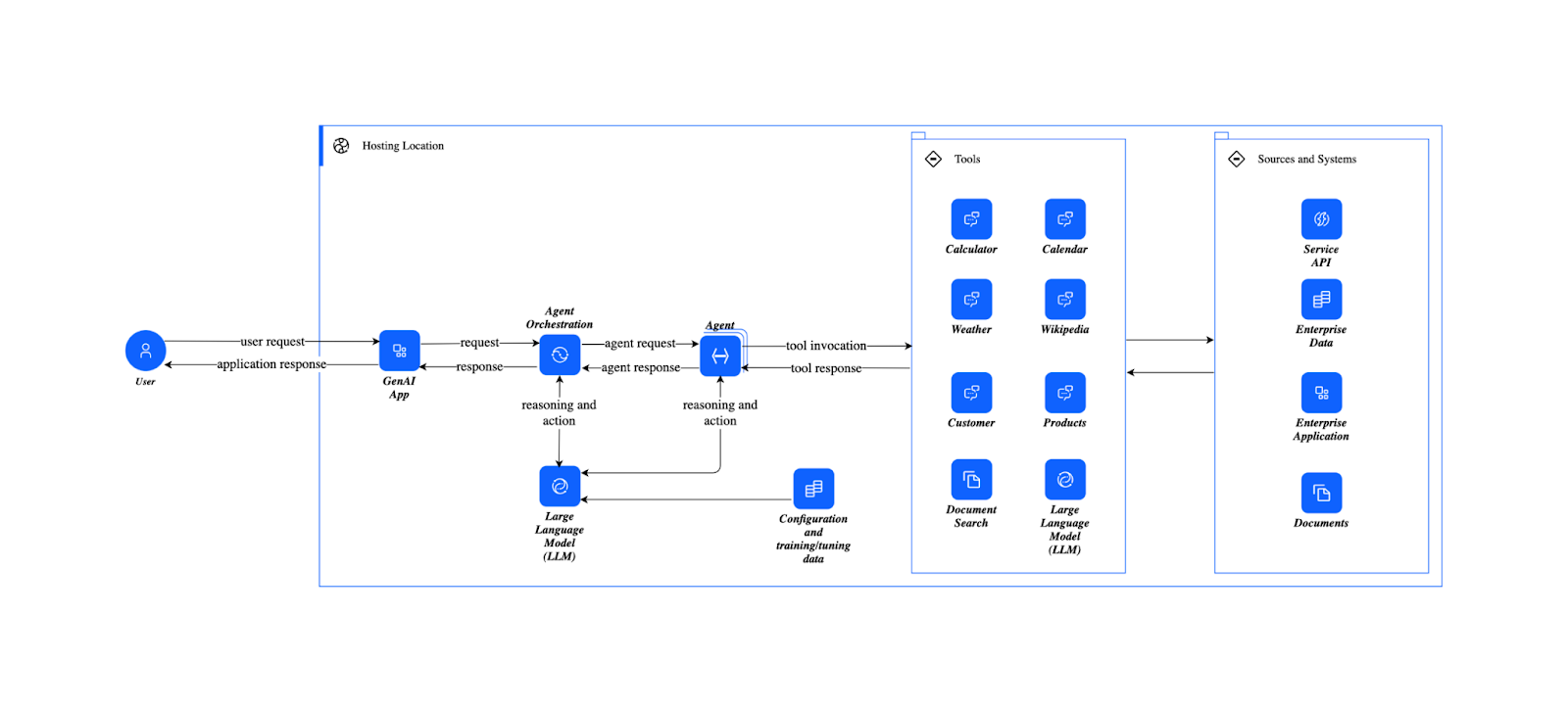
Companies that use these systems will see huge improvements in productivity for analytical tasks because agentic AI takes care of routine analysis while people focus on strategic interpretation and action.
Technical Architecture: How to Make Autonomous Systems Work Together
To make agentic AI work, you need advanced orchestration frameworks that can coordinate many AI agents, keep track of state across complicated workflows, and make sure that the system works reliably at the enterprise level. Three-tier architectures are used by top companies, with controlled intelligence at the bottom, structured autonomy in the middle, and dynamic intelligence at the top.
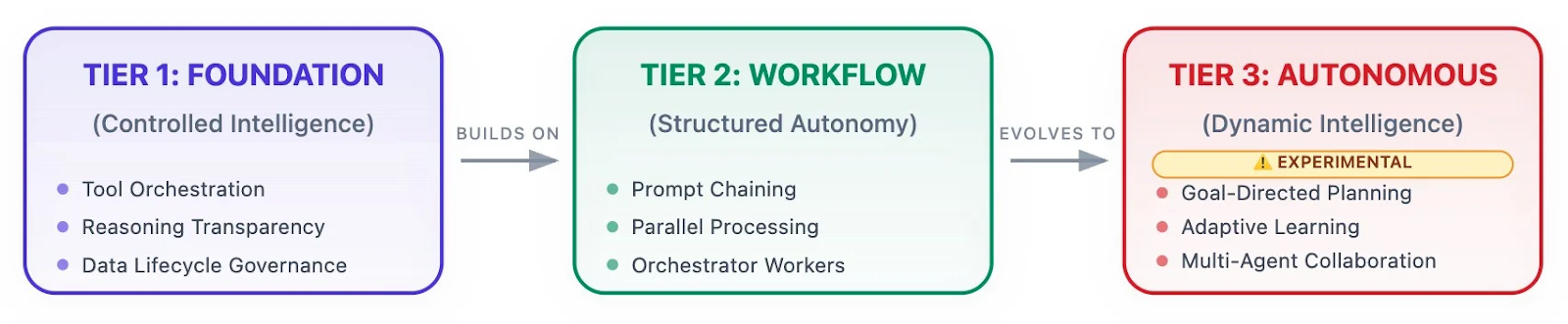
Enterprise Agentic AI Architecture Three Tier Framework
- The Foundation Tier sets up secure API gateways, role-based access control, and a full monitoring system with automated quality checks, bias detection, and data governance.
- The Workflow Tier adds limited autonomy zones with validation checkpoints, multi-pattern execution, and the ability for people to oversee the process.
- The Autonomous Tier is the highest level of dynamic intelligence, with planning that is based on goals, learning that adapts, and collaboration between multiple agents.
The technical problems are mostly about how hard it is to coordinate multiple agents, how to trace and observe workflows, and how to keep state management consistent. LangGraph is one of the best orchestration frameworks because it uses graphs to show workflows. CrewAI, on the other hand, utilizes roles to create agents that behave like individuals within organizations. The best implementations use enterprise orchestration patterns , such as prompt chaining for doing tasks in order, intelligent routing for spreading tasks out, and parallelization with result aggregation.
Strategic Implementation: How to Make It Work
For a successful implementation, there need to be systematic frameworks that take into account technical, organizational, and strategic issues. The best consulting firms suggest progressive methods that gradually increase capability while keeping the focus on business value. IT help desks, customer service tickets, and document processing are all great places to start because they have high-value, low-risk use cases in deterministic environments with clear processes.
Best practices emphasize process reinvention over task automation. Instead of adding agents to old processes, companies need to redesign all of their workflows to give agents more freedom. This method takes advantage of agents' strengths, such as their ability to work in parallel, adapt in real time, and personalize at scale, while also effectively redistributing tasks between agents and people.
New roles in the organization appear: AI Agent Architects create and run agent ecosystems, and Cognitive System Managers are in charge of running things on their own and dealing with problems. Analytics professionals move from doing manual analysis to strategic oversight. Their primary responsibility is to ensure that insights generated by agents align with business goals.
From Dashboards to Autonomous Intelligence
Traditional analytics methods use dashboards that need to be updated and interpreted by hand, which slows down the process of getting insights and makes decisions less accurate. Agentic analytics changes this reactive model into proactive intelligence that can predict needs and find insights on its own.
This will lead to creation of new tools and systems that constantly analyzes data to figure out what users want, find trends, and suggest actions instead of waiting for users to ask questions. They find important patterns on their own and suggest investigations based on their understanding of the business's priorities.
The most important new feature is the ability to generate insights on its own. AI agents constantly look through different datasets to find new trends, explain anomalies in context, and automatically trace data back to find the root causes. Before, it took weeks of manual analysis to get the same results. Now, it happens in real time with constant monitoring and the ability to make predictions.
The Strategic Imperative
Agentic AI is more than just a technological breakthrough; it changes the way businesses use data and make decisions. The initial experimentation with it shows that there is a lot of potential for ROI, productivity gains, and business transformation. To be successful, you need to be a strategic leader, make big changes to the organization, and be willing to rethink how business is done with AI that can work on its own.
The change from reactive analytics tools to proactive business partners opens up new ways to get ahead of the competition. In the new era of autonomy, companies that go beyond testing and start using their ideas strategically will have long-lasting advantages. The agentic revolution in analytics has begun. Leaders don't have to decide whether or not to use autonomous intelligence; they just need to figure out how quickly they can change their companies to make the most of it while still being responsible with the added complexity.
Opinions expressed by DZone contributors are their own.
Comments