

Hybrid Vector Graph with AI Agents for Software Test Case Creation
This article shows how multi-agent, vector-graph systems automate test creation, cutting manual effort while increasing coverage.
Join the DZone community and get the full member experience.
Join For FreeThe Problem: Manual Test Case Creation Doesn’t Scale
Modern software development faces a critical bottleneck in test case creation. As applications become increasingly complex — with microservices architectures, API integrations, and distributed systems — manually creating comprehensive test cases becomes time-intensive and error-prone.
Key challenges include:
- Coverage gaps: Manual test case creation often misses edge cases and complex integration scenarios, leading to production defects.
- Resource intensive: Quality engineers spend 40–60% of their time writing test cases rather than focusing on strategic testing activities.
- Context loss: Knowledge about system dependencies and business logic is often scattered across documentation, making comprehensive test design difficult.
- Maintenance overhead: As systems evolve, existing test cases become outdated, requiring constant manual updates.
Traditional automated test generation tools rely on rule-based approaches or simple pattern matching, which fail to understand complex system relationships and business context.
Analysis: Understanding the Core Requirements
To address these challenges, an effective solution must satisfy several requirements:
- Contextual understanding: The system must comprehend both technical architecture and business logic to generate meaningful test scenarios.
- Comprehensive coverage: Test cases should validate not only individual components but also integration points and end-to-end workflows.
- Adaptability: The solution must evolve with changing requirements and system architecture.
- Domain integration: The approach should leverage existing documentation, code repositories, and institutional knowledge.
Analysis of existing solutions revealed limitations in each approach:
- Rule-based generators lack contextual understanding.
- Simple AI tools generate generic test cases without domain specificity.
- Template-based approaches cannot handle variations in system complexity.
- Manual processes do not scale with system growth.
The Solution: Agentic RAG with Hybrid Vector-Graph Architecture
The proposed solution combines Retrieval-Augmented Generation (RAG) with a multi-agent system architecture, supported by hybrid vector-graph knowledge representation.
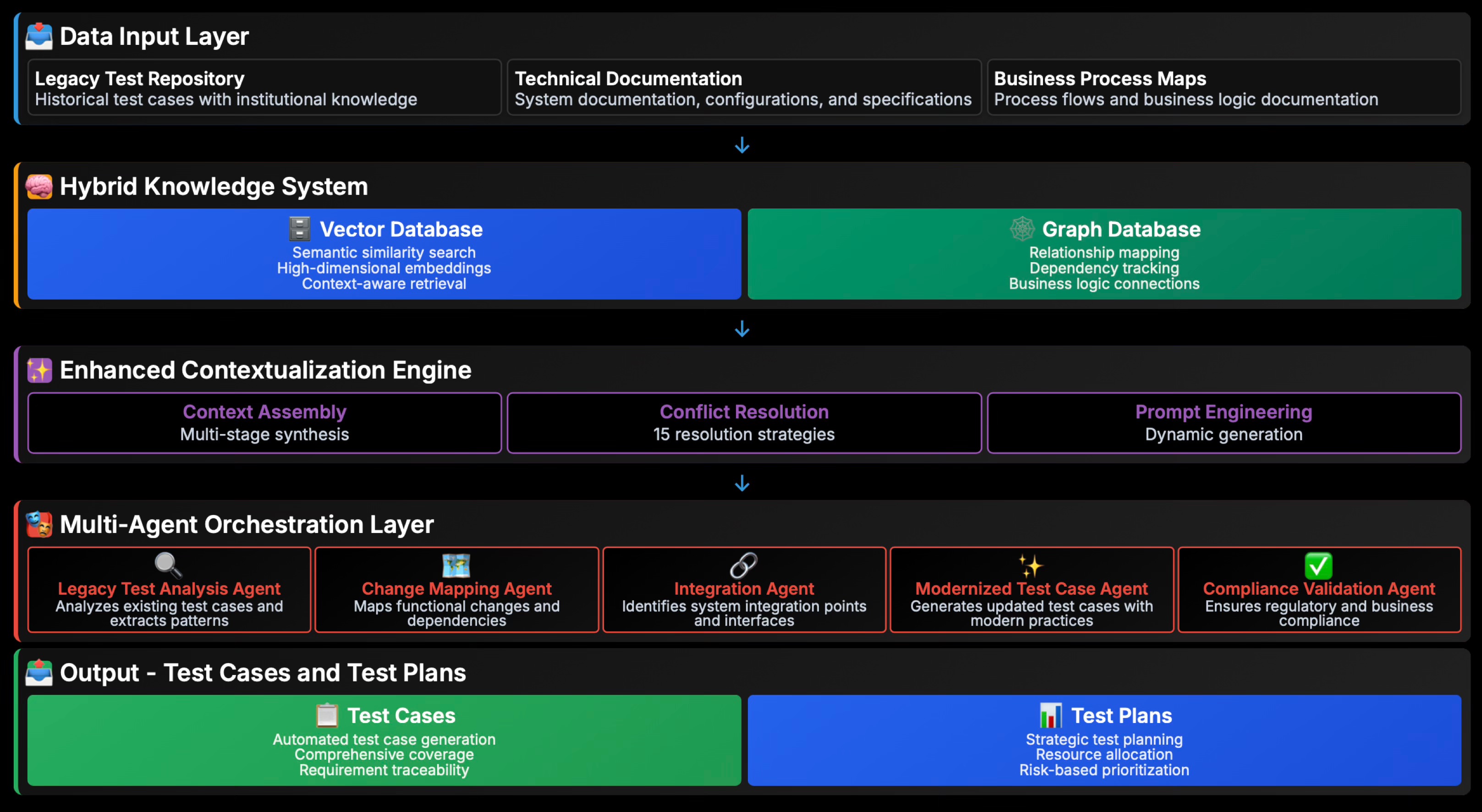
Core Architecture Components
Multi-Agent Orchestration
The system employs specialized agents with distinct responsibilities:
- Requirements analysis agent: Parses functional specifications, user stories, and acceptance criteria to understand intended behavior.
- Code analysis agent: Examines source code structure, identifies critical paths, and maps component dependencies.
- Context retrieval agent: Searches documentation, previous test cases, and domain knowledge repositories for relevant information.
- Test generation agent: Synthesizes inputs from other agents to create structured test scenarios.
- Validation agent: Ensures generated test cases meet quality standards and coverage requirements.
Hybrid Knowledge Representation
The architecture combines two complementary approaches:
- Vector embeddings: Capture semantic relationships between requirements, code components, and existing test cases, enabling similarity-based retrieval and contextual understanding.
- Graph structures: Model explicit relationships between system components, data flows, and dependencies, ensuring test cases validate critical integration points.
RAG Implementation
The Retrieval-Augmented Generation component operates through three phases:
- Retrieval phase: Given a test generation request, the system queries the hybrid knowledge base to retrieve relevant context, including similar test cases, related requirements, and architectural dependencies.
- Augmentation phase: Retrieved context is processed and structured to provide comprehensive background information for test case generation.
- Generation phase: The generation agent creates test cases using the retrieved context, ensuring relevance to both functional requirements and system architecture.
Implementation Process
Phase 1: Knowledge Base Construction
Code Repository Analysis
- Extract component relationships and dependency mappings
- Identify API endpoints, data models, and integration points
- Create vector embeddings for code components and documentation
Documentation Ingestion
- Process requirements documents, API specifications, and user guides
- Extract business rules and domain-specific constraints
- Build knowledge graphs representing system behavior
Historical Test Case Analysis
- Analyze existing test suites to understand testing patterns
- Identify coverage gaps and common failure scenarios
- Create embeddings for test case templates and methodologies
Phase 2: Agent Configuration
Agent specialization configures each agent with domain-specific knowledge and operational parameters. For example, the code analysis agent is trained on architectural patterns relevant to the target system.
Multi-agent coordination establishes communication protocols between agents, defining how information flows during test case generation and how conflicts are resolved.
Feedback integration: Implements mechanisms for agents to learn from test execution results and developer feedback, continuously improving generation quality.
Phase 3: Generation Workflow
Input processing: The system accepts various input types, including new feature specifications, code changes, or explicit test case requests.
Context assembly: Agents collaboratively gather relevant information from the knowledge base, with each agent contributing its specialized perspective.
Test case synthesis: The generation agent creates comprehensive test scenarios incorporating functional requirements, technical constraints, and domain knowledge.
Quality validation: Generated test cases undergo automatic validation for completeness, feasibility, and alignment with testing standards.
Results and Evaluation
Implementation across multiple projects demonstrated significant improvements in test case quality and development efficiency:
- Coverage improvement: Generated test suites achieved 35–40% higher code coverage compared to manually created test cases, particularly in integration and edge-case scenarios.
- Time reduction: Test case creation time decreased by 60–70% for new features, allowing quality engineers to focus on test strategy and exploratory testing.
- Defect detection: Pre-production defect detection increased by 25% due to more comprehensive test scenarios.
- Maintenance efficiency: Automated updates to test cases based on code changes reduced maintenance overhead by 50%.
Specific Examples
Microservices testing: In a distributed e-commerce system, the approach generated test cases covering payment workflows across user, inventory, payment, and notification services — scenarios previously tested in isolation.
API integration: For a data analytics platform, generated test cases identified edge cases in third-party API integrations that manual testing had missed, preventing production failures.
Implementation Guidelines for Quality Engineers
Getting Started
Assessment Phase
- Evaluate current test creation processes and identify bottlenecks
- Catalog existing documentation and knowledge sources
- Define success metrics for automated test generation
Pilot Implementation
- Select a well-documented system component
- Focus on generating test cases for new features
- Establish feedback loops with development teams
Knowledge Base Development
- Prioritize high-quality documentation and code repositories
- Collaborate with domain experts to validate knowledge representation
- Implement continuous updates as system knowledge evolves
Technical Requirements
Infrastructure Setup
- Vector database for embedding storage and similarity search
- Graph database for relationship modeling
- Compute resources for embedding generation and agent orchestration
Integration Considerations
- API interfaces for existing test management tools
- Version control integration for code-change triggers
- CI/CD pipeline integration for automated test case updates
Best Practices
- Incremental adoption: Begin with a limited scope and gradually expand based on demonstrated value. This reduces implementation risk and allows teams to develop expertise progressively.
- Human oversight: Implement and maintain human review processes for generated test cases, particularly during initial deployment. Quality engineers should validate business logic and prioritize test execution.
- Continuous learning: Implement feedback mechanisms that capture test execution results, defect discovery, and developer input to improve generation quality over time.
- Domain customization: Tailor the approach to meet specific domain requirements, incorporating industry-specific testing standards and regulatory compliance requirements.
Conclusion
Agentic RAG for test case generation addresses fundamental scalability challenges in modern quality assurance. By combining multi-agent architectures with hybrid knowledge representation, it produces comprehensive, context-aware test cases while reducing manual effort.
Successful implementation requires careful planning, incremental adoption, and ongoing refinement based on project-specific requirements. Quality engineering teams that adopt this approach can expect significant improvements in test coverage, development efficiency, and defect detection capabilities.
The technology represents a practical advancement in test automation that augments human expertise rather than replacing it, enabling quality engineers to focus on strategic testing activities while ensuring comprehensive validation of complex software systems.
Opinions expressed by DZone contributors are their own.
Comments