


The Inner Loop Is Eating The Outer Loop
The technical limitations that created the divide between the inner and outer loops are being solved just in time for agentic workflows to make merging them a necessity.
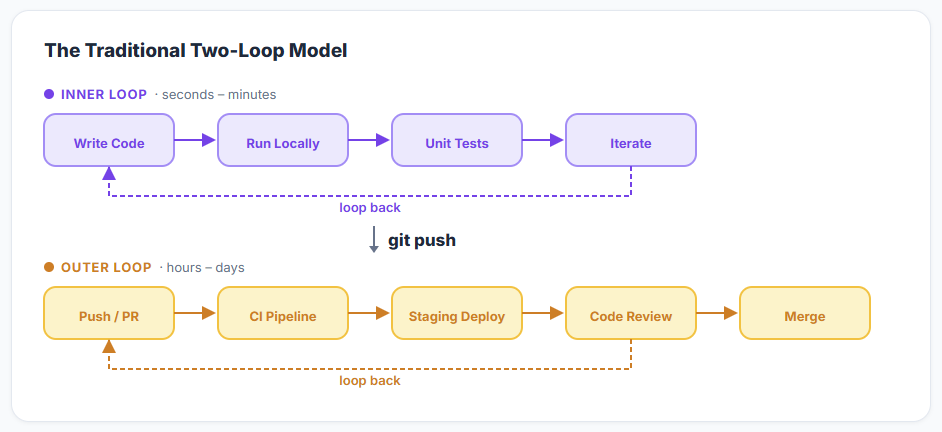
For as long as most of us have been building software, there has been a clean split in the development lifecycle: the inner loop and the outer loop.
The inner loop is where a developer lives day to day. Write code, run it locally, check if it works, iterate. It is fast, tight, and personal. The outer loop is everything after you push. Continuous integration pipelines, integration tests, staging deployments, and code review. It is comprehensive but slow, and for good reason. Running your entire test suite against every keystroke would be insane. So we optimized: fast feedback locally, thorough validation later.
This split was not some grand architectural decision. It was a pragmatic response to a real constraint. Comprehensive validation testing against real dependencies in a realistic environment was slow and expensive.
So developers made a tradeoff to sacrifice thoroughness for speed in the inner loop and defer the real testing to continuous integration (CI). Write a unit test, mock a dependency or two, and move on. The comprehensive stuff runs later, in a pipeline, and you deal with failures when they show up. Sometimes hours later. Sometimes the next day.
That tradeoff only made sense when we had no alternative. Now, the model is evolving into a single loop where validation happens at every stage of the software development lifecycle (SDLC).
The Constraint That Created Two Loops Is Breaking
The inner and outer loop split was never about two fundamentally different kinds of work. It was about a limitation: you could not perform comprehensive validation fast enough to be part of the development loop.
Integration testing meant spinning up services, provisioning databases, and waiting for environments. That was a 15-minute-to-hours proposition, not a seconds proposition. So it got batched into CI.
Now, infrastructure has caught up. Ephemeral environments can spin up in seconds, giving you real integration testing against actual dependencies on a branch, pre-merge. There is no wait. The technical barrier to comprehensive but fast validation is gone.
Continuous Delivery Becomes Practical for Everyone
The idea of pushing smaller units of code to production more frequently is not new, but most teams still struggle to pull it off in distributed, cloud-native architectures.
In a microservices architecture, testing a small change properly means validating it against multiple downstream consumers. Historically, this meant slow environment provisioning, waiting in a queue for a staging spot, or relying on mocked dependencies. To cope, teams batched changes, running massive integration suites nightly or weekly. When something broke, debugging spanned days of commits.
With access to fast, comprehensive ephemeral environments, continuous delivery becomes highly practical. A developer can make a focused change, spin up a sandbox that routes traffic through the modified service, validate against real dependencies in seconds, and push it forward.
The per-change cost of validation drops low enough that batching becomes unnecessary. Debugging is vastly simplified because the blast radius is limited to a single small, well-understood change. Ultimately, the path from code written to running in production shrinks from days to hours.
For Agents, Fast Validation Is a Critical Infrastructural Change
This merging of the loops is an exciting evolution for software development as a whole. But for teams implementing agentic workflows at scale, it is a structural necessity.
Agents are now writing most of our code, and they have a very different relationship with validation than humans do. Fast feedback is not a preference for agents. It is essential. An agent does not get frustrated waiting for tests, but the speed and fidelity of feedback directly impact what an agent can accomplish.
An agent that can validate a change against real services in 10 seconds will iterate 30 times in the window, whereas an agent waiting on a five-minute environment spin-up iterates once. Speed is not just a quality of life thing for agents. It is a throughput multiplier.
Humans traded thoroughness for speed because those two things were in tension. You could have fast but shallow local mocked tests or slow but thorough CI integration tests. Pick one.
In fast, ephemeral environments, agents do not face that trade-off. They get comprehensive validation at inner-loop speed. They can test against real dependencies, real services, and real data flows to validate the behavior of their changes in seconds.
What Agents Do With Fast, Comprehensive Environments
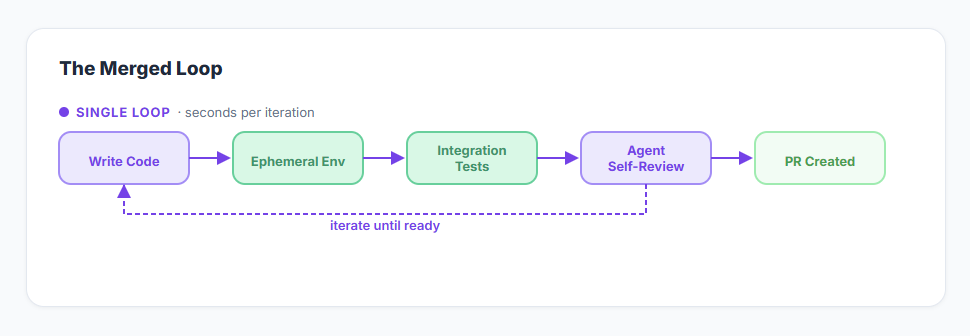
When an agent picks up a coding task with access to the right environment and tools, the workflow looks nothing like the old inner and outer loop divide.
The agent writes code, then validates it. It does not use mocked unit tests, but rather tests against real dependencies in an ephemeral environment that spins up in seconds. It finds a problem, fixes it, and validates again. It might run through this cycle dozens of times before a PR ever exists. Each iteration is both fast and thorough.
Then the agent goes further. It reviews its own code, or has another agent review it. It checks edge cases. It verifies that the change works correctly within the broader dependency graph. All of this happens on a branch, pre-merge, in seconds per cycle.
By the time anything gets pushed toward main, it has already been through a level of validation that most traditional pipelines would envy. The outer loop has very little left to catch, allowing CI to act as a lightweight, continuous feedback mechanism for the agent rather than a heavy, delayed gatekeeper.
Code Review Gets Absorbed Into the Workflow
Here is another piece of the outer loop that is collapsing inward: code review.
Agentic code review is quickly becoming standard. But the interesting shift is not just that AI can review code. It is that the review becomes part of the agent's own development loop rather than a separate phase. An agent writes code, validates it in a sandbox, reviews the change, addresses issues, and re-validates. Only then does it create a PR.
By the time a developer sees a PR, if they need to see it at all, the mechanical quality issues are already resolved. The PR becomes less of a gate to check work and more of a record of what was done, how it was validated, and the evidence that it works.
Developer review does not disappear entirely. Architecture decisions, security-sensitive changes, and novel approaches still benefit from human judgment. But the outer-loop review bottleneck, where PRs sit in a queue waiting for an overloaded engineer to context-switch into reviewer mode, largely goes away.
The Tooling Ceiling Becomes the Agent Ceiling
If this thesis is right, and if the inner loop really is absorbing the outer loop, it creates a very clear bottleneck. The quality of environments and tools available to the agent.
An agent with only local unit testing will catch local bugs. Give it access to fast ephemeral environments with real dependency graphs, and it catches integration issues, configuration drift, and behavioral regressions. Give it access to performance benchmarks, security scanners, and observability data, and it catches even more.
This shifts where the highest-leverage infrastructure investment is. Instead of building more elaborate post-merge CI pipelines, the winning bet is making comprehensive, realistic validation available pre-merge. It must be fast enough and cheap enough that agents can use it on every iteration, not just on PR submission.
Conclusion
The organizations that figure this out first and invest in giving agents fast, comprehensive, pre-merge validation will be the ones that actually achieve continuous delivery. With validation happening continuously, the outer loop becomes part of the inner loop. CI becomes more lightweight, serving as one of several layers of validation and feedback in a true continuous delivery flow.
The inner loop is merging with the outer loop. The question is not whether this shift is happening. It is whether your validation tooling is ready for it.
Check out the full Signadot article collection here.
Comments