

Inside Microsoft Fabric: How Data Agents, Copilot Studio, and Real-Time Intelligence Power the AI-Driven Enterprise
Learn how developers can use data agents for natural-language querying, Copilot Studio for AI interactions, and real-time intelligence for streaming analytics.
 ·
·
Join the DZone community and get the full member experience.
Join For FreeMicrosoft Fabric has been everywhere since its preview in 2023. From the rapid growth of features to rapid adoption, what began as a unified data platform is now a full-stack ecosystem. For an experienced Power BI user, Fabric will be both familiar and upgraded, even complex at that. The learning curve is steep but justified by the payoff. BI teams are enabled to move beyond dashboards to orchestration, governance, and scalability of analytics.
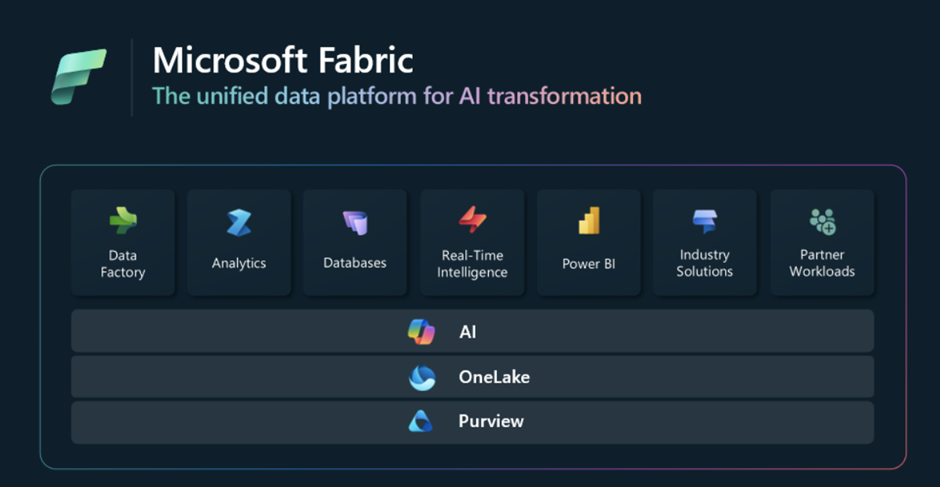
Business intelligence in Fabric is not just about mastering a single tool anymore, it is about mastering a suite of interconnected tools and technologies. From Delta Lake architecture and OneLake semantics to streaming pipelines, SQL endpoints, and choosing between DirectLake/Import modes, the landscape demands fluency across the entire platform. In this article, we are going to explore how Fabric’s AI agents ecosystem works in practice by primarily focusing on the following topics:
- Data agents
- Copilot Studio
- Real-time intelligence
You will learn about strategies to drive Fabric adoption by your teams without losing architectural clarity and control.
Microsoft Fabric and the Rise of AI-Driven Agents
Overview of Microsoft Fabric’s AI
Today, end-users can ask questions in plain language and get answers instantly, receive real-time insights on streaming data, and much more. Fabric’s AI and real-time intelligence ecosystem includes the key components:
- Data agents – Translate natural-language questions into accurate queries on semantic models
- Copilot agents – Powered by Fabric data agents to provide conversational BI
- Real-time intelligence hub – Event-driven analytics for streaming data
Together, these tools will enable business users to get their questions answered instantly, without having to rely on the BI team to translate their questions into technical queries and get them the answers.
Key Scenarios
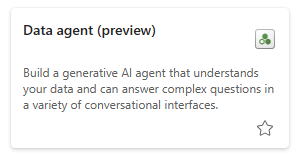 Natural-language BI: Business users query semantic models directly through Data Agents without needing to write DAX or SQL. Results can be text, tables, or charts. They can use channels such as Teams or Slack to ask Copilot questions in natural language and get answers immediately.
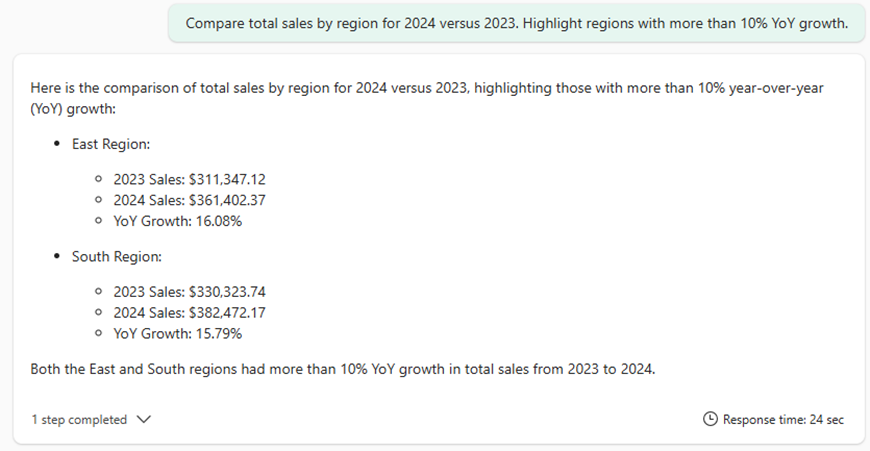
Scenario: YoY Sales Comparison by Region
This query showcases how business users can get strategic insights, such as YoY growth, without writing DAX or SQL queries. By simply asking in natural language, the data agent returns a structured breakdown of regional performance.
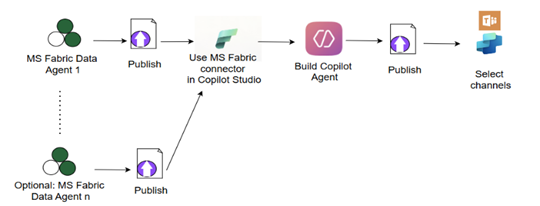
Cross-domain intelligence: Copilot can call multiple agents (Finance, Marketing, Sales) in a single conversation, stitching together insights across business domains.
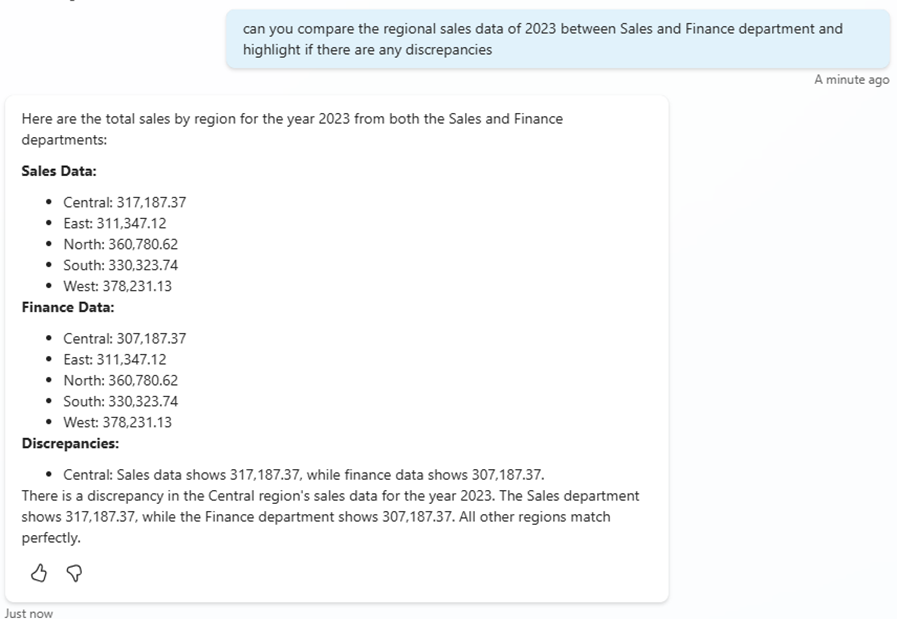
Scenario: Multi-Agent Validation Across Departments
This prompt shows how business users can use data agents to perform cross-domain validations without writing code. By querying total sales by region across 2023, 2024, and 2025, and company results between the Sales and Finance departments, the agent brings up a clear discrepancy: Central region’s 2023 sales differ by $10,000 between the two sources.
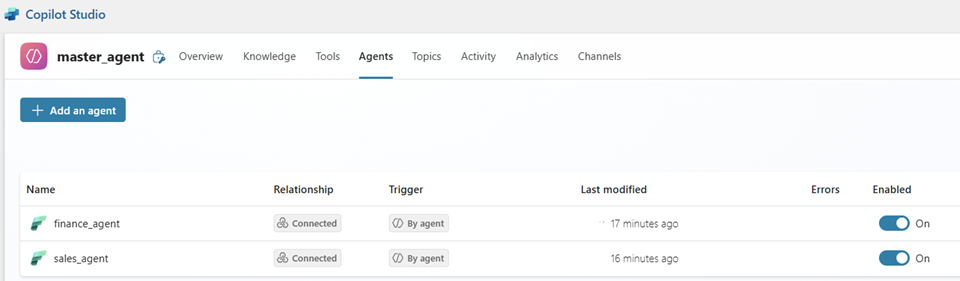
The underlying setup uses two agents, one querying the sales department’s semantic model and the other querying the finance department’s semantic model. This demonstrates how Copilot agents can combine multiple data sources, enabling reconciliation and audit scenarios.
Such multi-agent structures empower business users to detect anomalies, validate reporting pipelines, and ensure alignment between operational and financial systems, all through natural language questions.
Real-Time Intelligence (RIT)
Fabric's RTI can integrate loads of data, whether it's gigabytes or petabytes, all in one spot.
Having no-code experience a Microsoft Fabrics Eventstream is capable of capturing the data ingesting from multiple streaming sources such as Azure Event Hubs, Azure IoT Hubs and can further be transformed and routed to destinations such as Eventhouse. Eventhouse is designed to process data in motion, and the data can further be visualized in KQL query sets, PBI Reports, or in a real-time dashboard by gaining more insights into the data. Alerts could be set up using Activator to monitor for changes/events and take action when a condition/pattern is detected.
Digital Twin Builder is another important feature of the real-time hub, designed to help organizations model their physical environments as digital representations known as digital twins. This is a part of Fabric’s strategy towards agentic AI and real-time intelligence.
Scenario Demonstration: Real-time Workspace Monitoring
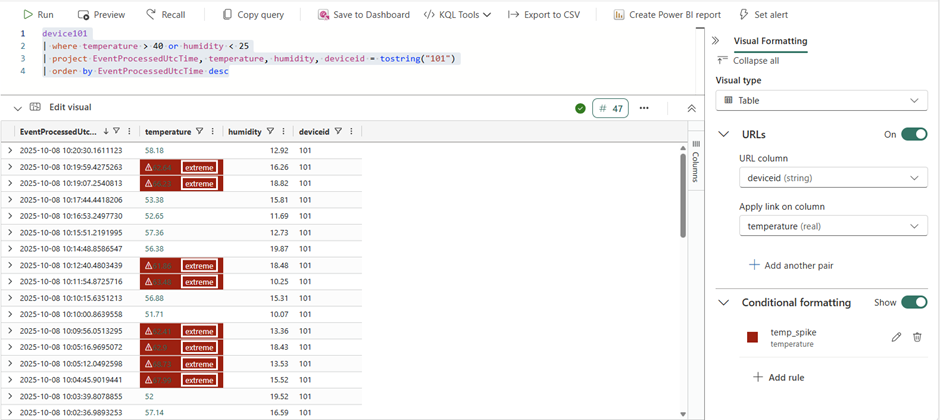
Monitoring telemetry from a remote IoT device where the device must automatically restart if it goes offline, temporarily shut down when the temperature spikes, and immediately alert the operations team of an anomaly. The real-time setup can be implemented using Microsoft Fabric’s Real-Time Hub services.
- Eventstream orchestrates the streaming ingestion of telemetry data.
- Eventhouse stores and enables queries over the incoming events.
- Activator is configured to trigger alerts, such as sending emails or Teams messages, when an anomaly is detected
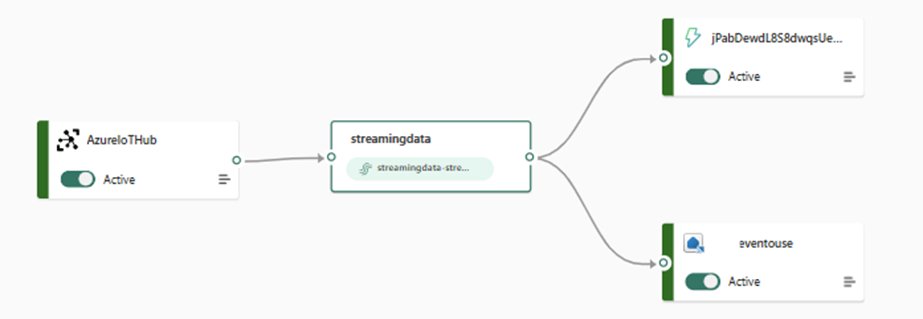
The figures below demonstrate this end-to-end real-time monitoring pipeline.
KQL Query with formatted visuals to highlight temperature spikes:
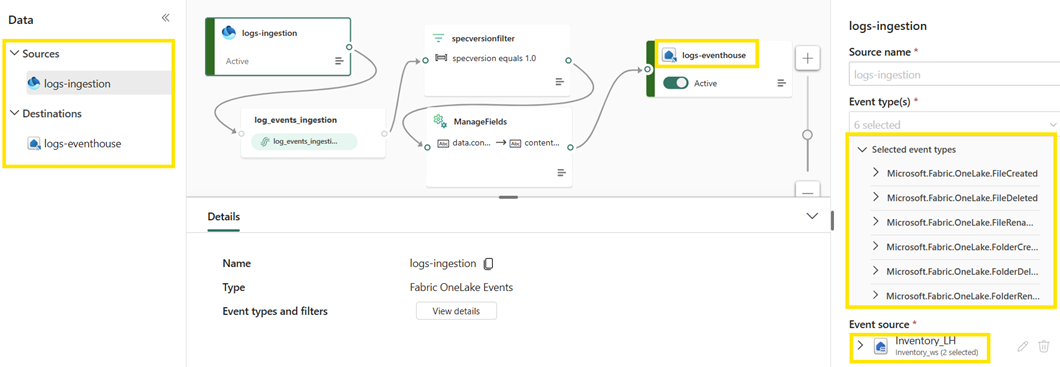
Eventstream pipeline below shows a real-time monitoring system set up to watch a Lakehouse for the occurrence of any object-level event, such as creating, deletion, modification, or access. Eventstream is configured to ingest any such event from the Lakehouse into the Eventhouse after it flows through transformation steps.
This setup enables governance teams to detect unauthorized changes, monitor activity, and trigger alerts when a specific pattern is detected. This demonstrates how Fabric supports real-time observability and trigger actions.
Opportunities and Challenges
Opportunities
- Natural language – Accelerated BI adoption, insights delivered where the users already work (Teams, Excel, Power BI), and a single semantic truth made accessible through natural language.
- Unified governance – Supports centralized metadata, access control, and governance
- RTI – Supports use cases such as fraud detection, live tracking, and predictive maintenance.
Challenges
- Query latency – This can be a challenging factor, especially when working on integrating multiple semantic models.
- Data privacy and governance – There has to be a tight integration with Microsoft Fabric's semantic model in order to better manage access and compliance across organizational data
- Limitations in real-time transformation
- Model output – AI output still depends on the semantic model data quality and accuracy
Key Takeaways
- AI enablement – Fabric’s Data Agents and Copilot bring AI to business users’ fingertips. But raises the bar for tighter data and resource governance.
- Low-code agent orchestration – Business users can build workflows and trigger actions without coding knowledge
- Maturity is a moving target – Organizations should keep the practices adaptive and align policies while Fabric matures.
- The quality of the output is still heavily dependent on the semantic model data accuracy and completeness. There is also noticeable latency that can be introduced by complex queries.
Opinions expressed by DZone contributors are their own.
Comments