

Jakarta NoSQL: Why JPA Is Not Enough for the AI Era
Jakarta NoSQL provides a familiar Java programming model while preserving the strengths of document, graph, key-value, and AI-driven vector databases.
 CORE
·
CORE
·
Join the DZone community and get the full member experience.
Join For FreeThe most effective way to present this idea is to begin with the challenge architects face: AI has transformed the persistence landscape. Enterprise applications were once built almost exclusively on relational databases, making JPA a keystone of Jakarta EE.
Today, modern systems use a mix of relational databases, document stores, caches, graph engines, and increasingly, vector databases that support semantic search, retrieval-augmented generation (RAG), and AI-powered applications. Polyglot persistence is now the industry standard. While Jakarta EE standardized relational persistence through JPA, it still lacks a vendor-neutral standard for non-relational persistence. This gap forces developers to rely on fragmented, proprietary solutions, creating barriers to portability, productivity, and innovation.
The rise of AI makes this gap critical. Vector databases are now essential to intelligent systems, supporting semantic search, embeddings, and contextual retrieval. For Jakarta EE to remain the leading enterprise Java platform in the AI era, it must offer a standardized approach to NoSQL persistence, as it did for relational databases. Jakarta NoSQL is not just another specification; it constitutes a strategic investment in the ecosystem's future. By offering a familiar programming model, reducing vendor lock-in, and integrating with AI workloads, Jakarta NoSQL ensures that Jakarta EE remains relevant and competitive for the next generation of enterprise applications.
NoSQL in the AI Era: Understanding the Modern Data Landscape
For years, enterprise data persistence focused on relational databases. Systems relied on tables, rows, foreign keys, and SQL, making relational technology the standard for business applications. While still essential, modern architectures now use polyglot persistence, where multiple database types coexist, each satisfying specific requirements.
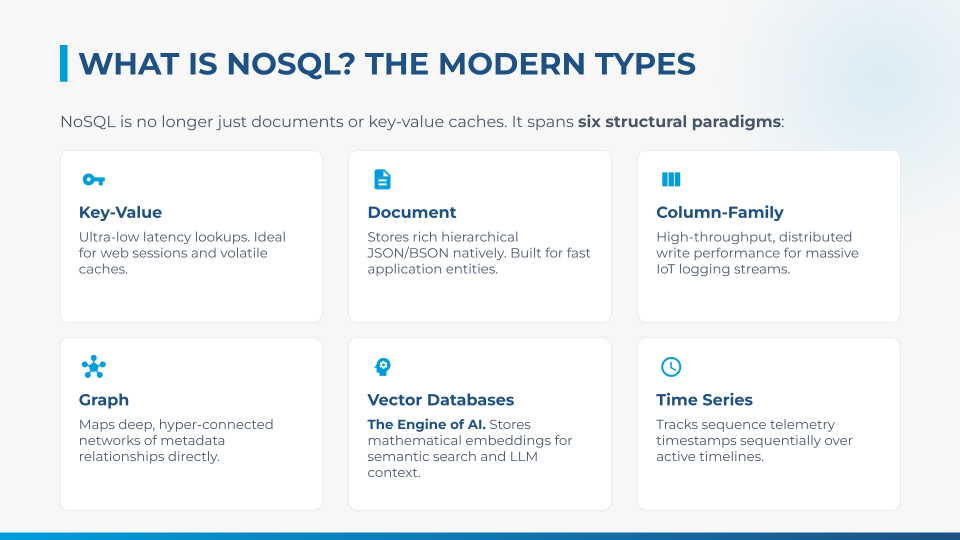
Today, NoSQL refers to a family of database paradigms, each engineered for specific workloads and architectural needs, rather than just document databases.
- Key-value databases store data as key-value pairs, enabling fast lookups and low latency. Typical uses include caching, user sessions, feature flags, and temporary application state.
- Document databases store data as structured documents, such as JSON or BSON. They are effective for applications having hierarchical or evolving schemas, including web applications, e-commerce platforms, and content management systems.
- Column-family databases organize data by columns instead of rows, supporting high write throughput and horizontal scalability. They are used for IoT telemetry, event logging, analytics, and large-scale distributed systems.
- Graph databases model entities and relationships as nodes and edges. This structure is ideal for social networks, fraud detection, recommendation engines, dependency analysis, and knowledge graphs in which relationships are critical.
- Vector databases store high-dimensional embeddings from machine learning models and large language models (LLMs). They enable semantic search, similarity matching, retrieval-augmented generation (RAG), recommendation platforms, and other AI-driven features via understanding meaning instead of exact text matches.
- Time-series databases specialize in timestamped data that changes over time. They are used for observability, monitoring, financial markets, industrial sensors, and operational metrics where high-performance temporal data storage and analysis are essential.
These database types often coexist within the same architecture. Modern applications may use PostgreSQL for transactions, Redis for caching, MongoDB for documents, Neo4j for relationships, InfluxDB for telemetry, and a vector database like Milvus, Pinecone, or Weaviate for AI-powered search and retrieval. This approach, known as polyglot persistence, is now standard in enterprise systems.
The industry has embraced this shift. The Stack Overflow Developer Survey shows that while relational databases still dominate enterprise workloads, NoSQL technologies are now standard tools for developers. Technologies like Redis, MongoDB, and Elasticsearch are used alongside PostgreSQL and MySQL. Organizations no longer choose between SQL and NoSQL; instead, they combine multiple persistence technologies to leverage their strengths. Polyglot persistence is now the baseline for modern software systems.
Vector databases are especially important among NoSQL categories, as they are basic to modern Artificial Intelligence systems. In contrast to traditional databases that store explicit business data, vector databases store numerical representations called embeddings. Generated by machine learning models, these embeddings encode the semantic meaning of words, documents, images, or other content as mathematical vectors. This enables software to search and retrieve information based on meaning rather than exact text matches.
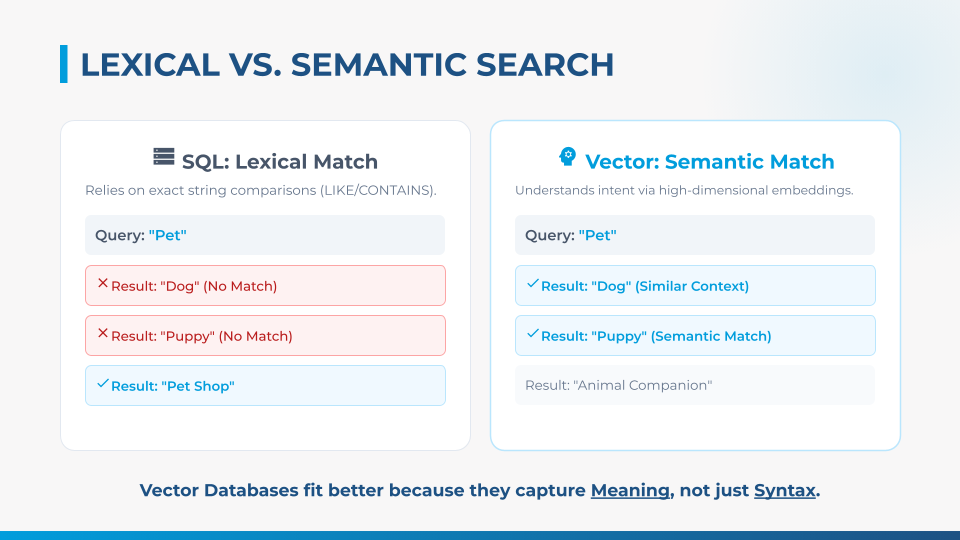
The distinction between lexical and semantic search illustrates the significance of vector databases. For example, a traditional SQL search for “Pet” returns records with that exact term, such as “Pet Shop,” but ignores related expressions like “Dog” or “Puppy.” Semantic search, by comparing embeddings, retrieves documents about dogs, puppies, or animal companions because it recognizes their semantic relationship. The search engine matches meaning, not just syntax.
This function is vital for modern AI architectures. Large language models do not process relational tables directly; they use embeddings and contextual connections between concepts. Systems such as retrieval-augmented generation (RAG), enterprise knowledge search, recommendation engines, and intelligent assistants depend on similarity searches across millions of vectors. While relational databases can support some vector operations through extensions, vector databases are purpose-built for these workloads, offering optimized indexing and similarity algorithms for large-scale semantic retrieval. As AI adoption grows, vector databases are becoming a strategic component of enterprise architecture.
Appreciating the importance of NoSQL, several Java ecosystems have developed their own solutions. Spring offers independent projects like Spring Data MongoDB, Spring Data Redis, and Spring Data Cassandra. These integrations provide a productive programming model but are tightly coupled to the Spring ecosystem. Quarkus supports NoSQL persistence through Panache and database-specific integrations, emphasizing developer productivity and cloud-native deployment. Micronaut Data supports several NoSQL engines, using compile-time code generation and ahead-of-time processing to improve performance and reduce execution overhead.
While these solutions are effective, they remain framework-specific rather than platform standards. Developers switching frameworks encounter different APIs, abstractions, annotations, and operational models, even when solving similar persistence challenges. Jakarta EE addressed this for relational persistence with Jakarta Persistence (JPA), delivering a standardized, vendor-independent programming model. As NoSQL technologies expand and AI workloads more and more depend on vector databases, the lack of a vendor-neutral NoSQL standard is a significant gap in the Jakarta ecosystem.
The Java Standardization Journey
The need for a standardized NoSQL solution in the Java ecosystem has been discussed for years. During the Java EE era, several proposals tried to integrate non-relational databases into the enterprise platform. As NoSQL technologies grew in popularity throughout the 2010s, developers anticipated a dedicated specification to accompany traditional enterprise APIs at JavaOne conferences. Despite clear demand, no such initiative emerged within Java EE. The platform remained focused on relational persistence via JPA, leaving NoSQL adoption to rely on vendor-specific libraries and framework integrations.
The transition of Java EE to the Eclipse Foundation provided an opportunity to address this challenge. Instead of waiting for a platform-level solution, the community launched Eclipse JNoSQL, an open-source project supplying a unified programming model for NoSQL databases. Drawing on JPA's success, Eclipse JNoSQL introduced mapping annotations, repositories, templates, and communication APIs that support document, key-value, column-family, and graph databases. The project showed that a consistent developer experience could be attained without compromising each database model's unique features.
As Jakarta EE matured, Eclipse JNoSQL became the foundation for a new standardization effort: Jakarta NoSQL. Jakarta NoSQL was the first persistence specification created entirely within the Jakarta EE process. Unlike earlier specifications that migrated from Java EE, Jakarta NoSQL was conceived, developed, and released under the Eclipse Foundation governance model. It was among the first to complete the full Jakarta Specification Process from inception to release.
Jakarta NoSQL's impact extended beyond its initial scope. During development, the expert group identified a common challenge for both relational and non-relational databases: developers needed a consistent repository abstraction independent of the underlying persistence engine. This led to the creation of a separate specification, Jakarta Data. The need to standardize NoSQL access patterns directly influenced the development of Jakarta Data's repository-oriented programming model, which applies across multiple persistence technologies.
The relationship between these specifications highlights Jakarta NoSQL's broader influence on the Jakarta EE ecosystem. Jakarta NoSQL focuses on mapping and interacting with non-relational databases, while Jakarta Data delivers a unified repository abstraction for both relational and NoSQL implementations. Together, they significantly reduce fragmentation in enterprise persistence.
This evolution continued beyond Jakarta Data. The drive to standardize modern persistence requirements has inspired new specifications, such as Jakarta Query, which aims to deliver a portable, type-safe, and expressive query language for various persistence technologies. As the Jakarta ecosystem grows, Jakarta NoSQL acts as a key milestone. It addressed the long-standing absence of a NoSQL standard and helped lay the foundation for the next generation of persistence specifications within Jakarta EE.
Jakarta NoSQL: Built for NoSQL, Not Adapted to It
When architects consider standardizing NoSQL development in Jakarta EE, a common question arises: why not extend Jakarta Persistence (JPA) to support NoSQL databases? JPA has long provided a unified programming model for relational databases in the Java ecosystem.
The answer is based on a core architectural principle: tools should be optimized for their intended purpose.
The first challenge is that JPA was designed specifically for relational databases, relying on concepts like tables, columns, joins, foreign keys, and transactional consistency. These are not simply implementation details but core elements of the specification. Forcing document, graph, key-value, or vector databases into this model creates friction and limits the use of each database’s native features.
The second challenge is that NoSQL systems behave fundamentally differently. Graph databases perform path traversals, document databases store nested structures without normalization, key-value databases focus on fast lookups, and vector databases handle similarity calculations. These systems also differ in consistency, transactions, query languages, indexing, and scalability capabilities. Representing all these paradigms through a single relational abstraction leads to compromises.
The third challenge is the importance of specialization. As Abraham Maslow noted, “if the only tool you have is a hammer, it is tempting to treat everything as if it were a nail.” Relational databases are effective, but not ideal for every persistence need. Semantic search, graph traversal, and high-volume telemetry storage are not relational problems. Applying a relational abstraction to all database types runs the risk of losing the unique optimizations each technology provides.
Examine the analogy of transportation: cars, boats, submarines, and airplanes all address transportation but are specialized for different environments. Forcing them to use the same controls would result in mediocrity across all. Similarly, a single persistence abstraction may remove the features that make each database effective.
Therefore, Jakarta NoSQL does not extend JPA beyond its intended scope. Instead, it offers a dedicated persistence model for non-relational databases, while continuing to maintain the familiar developer experience that contributed to JPA’s success.
A key design goal of Jakarta NoSQL is to reduce mental effort for enterprise Java developers. Teams experienced with JPA should find the specification immediately approachable, as Jakarta NoSQL intentionally uses familiar terminology and concepts from the Jakarta EE community.
Developers will encounter annotations like @Entity, @Id, and @Column, enabling a smooth transition from relational to non-relational persistence.
@Entity
public class Car {

    @Id
    private Long id;

    @Column
    private String name;

    @Column
    private CarType type;
}
At first glance, this entity closely resembles a JPA entity, which is intentional. However, the underlying implementation is fundamentally different. Jakarta NoSQL is built to support schema flexibility, embedded structures, nested documents, and database-specific storage models.
This approach is reflected throughout the API. Instead of requiring developers to oversee low-level driver details, Jakarta NoSQL offers a high-level programming model via the Template API.
@Inject
Template template;

Car ferrari = Car.builder()
        .id(1L)
        .name("Ferrari")
        .build();

template.insert(ferrari);

List<Car> sports = template.select(Car.class)
        .where("type").eq(CarType.SPORT)
        .orderBy("name")
        .result();
The objective mirrors JPA’s original mission: permitting developers to focus on domain models and business logic, rather than serialization, connection management, or vendor-specific APIs.
This foundation shaped Jakarta NoSQL 1.0. The initial release introduced the mapping layer, CDI integration, repository support, template operations, and standardized endpoints for four major NoSQL categories:
- Document databases
- Key-value databases
- Column-family databases
- Graph databases
Jakarta NoSQL 1.0 showed that a unified Java programming model can respect the particular characteristics of each database family.
Jakarta NoSQL 1.1 continued this evolution. While version 1.0 focused on mapping and persistence, version 1.1 expanded querying capabilities through integration with Jakarta Query.
A key addition is support for parameterized queries, letting developers to safely bind parameters instead of manually constructing query strings.
List<Car> cars = template.query(
        "FROM Car WHERE type = :type")
        .bind("type", CarType.SPORT)
        .result();
Version 1.1 also introduces projection support, allowing applications to retrieve lightweight views instead of entire entities.
@Projection
public record TechCarView(
        String name,
        CarType type) {
}

List<TechCarView> views = template
        .typedQuery(
                "FROM Car WHERE type = 'SPORT'",
                TechCarView.class)
        .result();
These features improve performance, reduce data transfer, and comply with modern Java features such as records.
An important aspect of Jakarta NoSQL is its long-term architectural vision. While most developers use the mapping layer, the specification also defines a lower-level communication API for advanced scenarios.
DocumentManagerFactory factory = ...;

DocumentManager manager =
        factory.get("users");

DocumentRecord record = ...;

manager.put(record);

Optional<DocumentRecord> result =
        manager.findByKey("user:10");

manager.deleteByKey("user:10");
This communication layer is optional. Application developers can build complete systems without it, but it is valuable for database vendors, framework authors, and advanced integrations needing direct access to database capabilities.
This design is fundamentally different from JDBC, which assumes communication through SQL statements and tabular result sets. That model works well because relational databases share a common language and interaction pattern.
NoSQL databases do not.
Document databases may use BSON, graph databases may offer traversal languages, and vector databases may provide similarity-search APIs. Others use REST endpoints, binary protocols, gRPC streams, or vendor-specific mechanisms. Forcing these models into a JDBC-style abstraction would limit their capabilities or demand ongoing vendor-specific extensions.
For this reason, Jakarta NoSQL uses a layered architecture. The mapping layer offers a portable, productive programming model for developers, while the communication layer remains flexible to support diverse NoSQL systems.
This architecture positions the specification for future growth. As new technologies like vector databases, time-series engines, and AI-native storage emerge, Jakarta NoSQL can evolve without imposing a relational mindset. Rather than treating every database as a nail for the JPA hammer, Jakarta NoSQL recognizes that different problems require different tools, while still presenting a consistent and familiar experience for enterprise Java developers.
Opinions expressed by DZone contributors are their own.
Comments