

Measuring What Matters: A Strategic Lens on Transformation Metrics
Track Agile-DevOps and AI-first transformations effectively by selecting the right metrics—balancing output/outcome, leading/lagging, and subjective/objective measures.
Join the DZone community and get the full member experience.
Join For Free"Only 16% of digital transformations improve performance and sustain gains in the long term." — McKinsey, 2021
Transformation efforts often falter not for lack of ambition but for lack of clarity. Metrics—when used well—serve as navigational tools that align teams, validate progress, and reveal true impact. When misused, they become noise, breeding vanity and confusion.
This article presents a systematic framework for transformation measurement based on three critical dimensions: focus (output vs. outcome), timing (leading vs. lagging), and measurement type (subjective vs. objective).
Through analysis of Agile-DevOps and AI-first transformations, we demonstrate how metric selection must evolve across transformation phases to drive meaningful change.
Applying Metrics: Two Real-World Use Cases
As an illustration, we will take the example of two types of transformation while talking about metrics implementation: Agile-DevOps transformation and an Organization moving to AI tooling and an AI-first strategy
Before diving in, let’s define the key dimensions of metrics.
Key Definitions:
- Output: Direct deliverables or activities
- Outcome: The impact or value delivered
- Leading: Predictive, actionable indicators
- Lagging: Reflects past performance or results
- Subjective: Based on perception or qualitative feedback
- Objective: Quantitative, measurable data
Each transformation journey surfaces different questions. Here’s how we can categorize and apply metrics across various lenses—objective/subjective, output/outcome, and leading/lagging—to Agile-DevOps and AI tool adoption scenarios.
Agile-DevOps transformation:
|
Metrics Categories |
Leading |
Lagging |
|
Output-Subjective |
1. Team excitement or openness to change (survey) |
1. Team feedback on process usefulness |
|
Output-Objective |
1. % teams trained |
1. # features delivered |
|
Outcome-Subjective |
1. Perceived alignment with business goals |
1. End-user satisfaction |
|
Outcome-Objective |
1. Predictability (commit vs. actual delivery) |
1. NPS or CSAT scores |
Organizational transformation to AI tool usage and AI-first strategy:
|
Metrics Categories |
Leading |
Lagging |
|
Output-Subjective |
1. Employee perceived readiness for AI tools(survey) |
1. Feedback on the onboarding experience |
|
Output-Objective |
1. % of teams trained on AI tools |
1. # AI tools rolled out enterprise-wide |
|
Outcome-Subjective |
|
1. User satisfaction with AI support |
|
Outcome-Objective |
1. Reduction in manual effort hours |
1. Defect reduction in AI-generated code |
All these different combinations and numerous examples may seem a little overwhelming, so let's talk about how we decide on which metrics to use and embed that in the transformation journey.
Set Your Metrics Up Early
- Measurement should not be an afterthought in transformation—it must be designed into the journey. Effective metrics align with goals, provide real-time feedback, and evolve with maturity. Without a clear baseline and staged approach to measurement, organizations risk mistaking activity for progress.
- Chart ahead on different steps of the transformation and what is important to measure at each stage, and why.
- Get baseline data for the metrics that you think will move during transformation. If we don’t have a clear baseline, its very challenging to understand the true improvement
Principles for Smarter Metrics
- Tie every metric to a goal: If it doesn’t link to a transformation objective, it’s probably a vanity metric.
- Output and Outcome: Early-stage transformations require heavy emphasis on output metrics to ensure adoption and capability building. As transformation matures, focus should shift to outcome metrics to validate business impact.
- Blend subjective and objective: Data tells what is happening; feedback tells why.
- Mix leading and lagging indicators: Use leading metrics for course correction and lagging ones for strategic validation.
- Avoid harmful comparisons: Don’t pit teams against each other—use metrics to track within-team progress.
Tying It All Back: Match Metrics to Transformation Phases
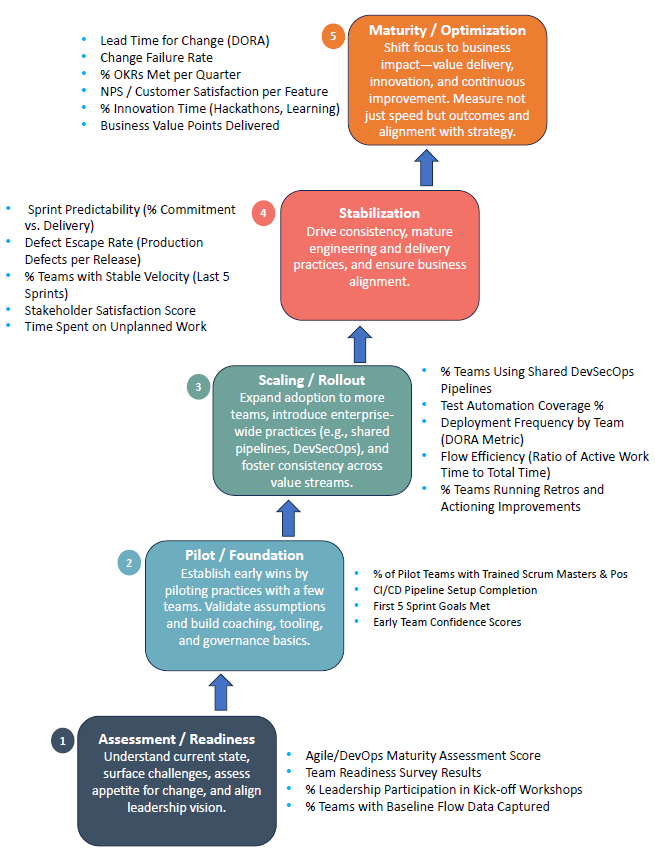
Now that we have defined types of metrics, let us see how they play out across different stages of a transformation. No two transformations are alike, and what metrics to choose depends upon the context of the transformation.
As a sample, let us take a multi-phase enterprise Agile-DevOps transformation, each phase demands a different lens. Your metrics should evolve with the transformation journey, starting with awareness and ending with sustainable, value-driven delivery.
From Measurement to Meaning
Metrics are the map, not the destination. Use them to guide, inform, and challenge assumptions—but always return to the “why” behind your transformation. As you design your measurement system, blend rigor with relevance, and let your metrics evolve with your journey.
How do you ensure your metrics tell the real story? Share your experience!”
Opinions expressed by DZone contributors are their own.
Comments