

Microservices Communication: Service to Service
This Java and microservices tutorial shows how one microservice communicates with another dependent microservice service via the service registry and Eureka Server.
Join the DZone community and get the full member experience.
Join For FreeIn the previous microservices tutorial, we learned how microservices communicate with the service registry. In this tutorial, we will learn how one microservice communicates with another dependent microservice service via the service registry/Eureka Server. This is the second part of the Microservice Communication series.
Let's see the sequence of how one microservice calls another microservice using Eureka server.
Registering the Service: Each microservice should be registered into the service registry with a unique name {service-id}, so it can be identified. Please note that it is an important step, as one of the main benefits of microservices is autoscaling; we can’t rely on the hostname/IP address, so a unique name is important in a distributed environment.
Fetching the Registry: Before calling the downstream/dependent service, the caller service fetches the registry from Eureka server. The registry contains all the active services registered into the service registry.
Finding the Downstream Service: Now, using the unique service Id, the caller service gets the instance of the downstream service.
Resolving Underlying IP Address: Please note the Iniques service id act as a Key in service registry but network does not know about it network expects Hostname to call the desired Rest Endpoint on the dependent service like (localhost:8080/employee/{id} or employee.cognizant,com/2 etc) so it is required to resolve the actual hostname of the dependent service Eureka API provides a method for that we just invoke that method to get the Ip address, For a distributed system it is the public IP of Load balancer.
Call the Rest Endpoint: After resolving the IP address using Spring Resttemplate, we call the actual Rest endpoint and get the data.
Coding Time
For this example, we need three microservices projects:
- Employee Search Service, which we created earlier for searching Employee information.
- Eureka Server: we also created this earlier, so we will reuse that same application
- Employee Dashboard Service: we will create this module and call the Employee Search service via Eureka server to get Employee information.
Step 1: Create a service called EmployeeSearchSearch.java where I insert some employeesusing static block and using Java 8 Stream. After that, I add two methods, findById and findAll, to display Employee information accordingly.
package com.example.EmployeeSearchService.service;

import java.util.Collection;
import java.util.HashMap;
import java.util.Map;
import java.util.stream.Collectors;
import java.util.stream.Stream;

import org.springframework.stereotype.Service;

import com.example.EmployeeSearchService.domain.model.Employee;

@Service
public class EmployeeSearchService {

    private static Map < Long, Employee > EmployeeRepsitory = null;

    static {

        Stream < String > employeeStream = Stream.of("1,Shamik  Mitra,Java,Architect", "2,Samir  Mitra,C++,Manager",
            "3,Swastika  Mitra,AI,Sr.Architect");

        EmployeeRepsitory = employeeStream.map(employeeStr - > {
            String[] info = employeeStr.split(",");
            return createEmployee(new Long(info[0]), info[1], info[2], info[3]);
        }).collect(Collectors.toMap(Employee::getEmployeeId, emp - > emp));

    }

    private static Employee createEmployee(Long id, String name, String practiceArea, String designation) {
        Employee emp = new Employee();
        emp.setEmployeeId(id);
        emp.setName(name);
        emp.setPracticeArea(practiceArea);
        emp.setDesignation(designation);
        emp.setCompanyInfo("Cognizant");
        return emp;
    }

    public Employee findById(Long id) {
        return EmployeeRepsitory.get(id);
    }

    public Collection < Employee > findAll() {
        return EmployeeRepsitory.values();
    }

}
Step 2: Now add a new controller called EmployeeSearchController; expose two endpoints by which other services can call findById and findAll methods. findById takes Employee Id and returns the Employee Domain Object.
package com.example.EmployeeSearchService.controller;

import java.util.Collection;

import org.springframework.beans.factory.annotation.Autowired;
import org.springframework.cloud.context.config.annotation.RefreshScope;
import org.springframework.web.bind.annotation.PathVariable;
import org.springframework.web.bind.annotation.RequestMapping;
import org.springframework.web.bind.annotation.RestController;

import com.example.EmployeeSearchService.domain.model.Employee;
import com.example.EmployeeSearchService.service.EmployeeSearchService;

@RefreshScope
@RestController
public class EmployeeSearchController {

   @Autowired
   EmployeeSearchService employeeSearchService;

   @RequestMapping("/employee/find/{id}")
   public Employee findById(@PathVariable Long id){
      return employeeSearchService.findById(id);
   }

   @RequestMapping("/employee/findall")
   public Collection<Employee> findAll(){
      return employeeSearchService.findAll();
   }
}

Employee Domain Object

package com.example.EmployeeSearchService.domain.model;

public class Employee {
   private Long employeeId;
   private String name;
   private String practiceArea;
   private String designation;
   private String companyInfo;
   public Long getEmployeeId() {
      return employeeId;
   }
   public void setEmployeeId(Long employeeId) {
      this.employeeId = employeeId;
   }
   public String getName() {
      return name;
   }
   public void setName(String name) {
      this.name = name;
   }
   public String getPracticeArea() {
      return practiceArea;
   }
   public void setPracticeArea(String practiceArea) {
      this.practiceArea = practiceArea;
   }
   public String getDesignation() {
      return designation;
   }
   public void setDesignation(String designation) {
      this.designation = designation;
   }
   public String getCompanyInfo() {
      return companyInfo;
   }
   public void setCompanyInfo(String companyInfo) {
      this.companyInfo = companyInfo;
   }
   @Override
   public String toString() {
      return "Employee [employeeId=" + employeeId + ", name=" + name + ", practiceArea=" + practiceArea
              + ", designation=" + designation + ", companyInfo=" + companyInfo + "]";
   }

}
Step 3: Create an EmployeeDashBoard application by downloading the template for this; I chose actuator, config client, web, Jersey, and EurekaClient modules.
Now put @EnableDiscoveryClient on top of the EmployeeDashBoardApplication class to treat this module as Eureka Client and add RestTemplate as a Spring Bean.
package com.example.EmployeeDashBoardService;

import org.springframework.boot.SpringApplication;
import org.springframework.boot.autoconfigure.SpringBootApplication;
import org.springframework.boot.web.client.RestTemplateBuilder;
import org.springframework.cloud.client.discovery.EnableDiscoveryClient;
import org.springframework.context.annotation.Bean;
import org.springframework.web.client.RestTemplate;

@EnableDiscoveryClient
@SpringBootApplication
public class EmployeeDashBoardServiceApplication {

    public static void main(String[] args) {
        SpringApplication.run(EmployeeDashBoardServiceApplication.class, args);
    }

    @Bean
    public RestTemplate restTemplate(RestTemplateBuilder builder) {
        return builder.build();
    }
}
Also, rename the application.properties to bootstrap properties and write the following properties:
spring.application.name=EmployeeDashBoard
spring.cloud.config.uri=http://localhost:9090
eureka.client.serviceUrl.defaultZone:http://localhost:9091/eureka
server.port=8081
security.basic.enable: false
management.security.enabled: false
Step 4: Now create a Controller called EmployeeInfoController and call the Service Registry, then find the EmployeeSerchService by passing the service-id of the Employee Service (EmployeeService-> bootstrap.properties).
Now call the IpAddress method to resolve Ip address and call the dependent service using RestTemplate.
package com.example.EmployeeDashBoardService.controller;

import java.nio.file.Path;
import java.util.ArrayList;
import java.util.Collection;

import org.springframework.beans.factory.annotation.Autowired;
import org.springframework.beans.factory.annotation.Value;
import org.springframework.cloud.context.config.annotation.RefreshScope;
import org.springframework.http.HttpMethod;
import org.springframework.web.bind.annotation.PathVariable;
import org.springframework.web.bind.annotation.RequestMapping;
import org.springframework.web.bind.annotation.RestController;
import org.springframework.web.client.RestTemplate;

import com.example.EmployeeDashBoardService.domain.model.EmployeeInfo;
import com.netflix.appinfo.InstanceInfo;
import com.netflix.discovery.EurekaClient;
import com.netflix.discovery.shared.Application;

@RefreshScope
@RestController
public class EmployeeInfoController {

    @Autowired
    private RestTemplate restTemplate;

    @Autowired
    private EurekaClient eurekaClient;

    @Value("${service.employyesearch.serviceId}")
    private String employeeSearchServiceId;

    @RequestMapping("/dashboard/{myself}")
    public EmployeeInfo findme(@PathVariable Long myself) {
        Application application = eurekaClient.getApplication(employeeSearchServiceId);
        InstanceInfo instanceInfo = application.getInstances().get(0);
        String url = "http://" + instanceInfo.getIPAddr() + ":" + instanceInfo.getPort() + "/" + "employee/find/" + myself;
        System.out.println("URL" + url);
        EmployeeInfo emp = restTemplate.getForObject(url, EmployeeInfo.class);
        System.out.println("RESPONSE " + emp);
        return emp;
    }

    @RequestMapping("/dashboard/peers")
    public Collection < EmployeeInfo > findPeers() {
        Application application = eurekaClient.getApplication(employeeSearchServiceId);
        InstanceInfo instanceInfo = application.getInstances().get(0);
        String url = "http://" + instanceInfo.getIPAddr() + ":" + instanceInfo.getPort() + "/" + "employee/findall";
        System.out.println("URL" + url);
        Collection < EmployeeInfo > list = restTemplate.getForObject(url, Collection.class);
        System.out.println("RESPONSE " + list);
        return list;
    }
}
Then up the services in the following order:
- Start config server.
- Start Eureka Server.
- Start Employee Search Service.
- Start Employee DashBoard Service.
When all services are Up-- hit http://localhost:9091 in the browser and you will see all services are up and running:
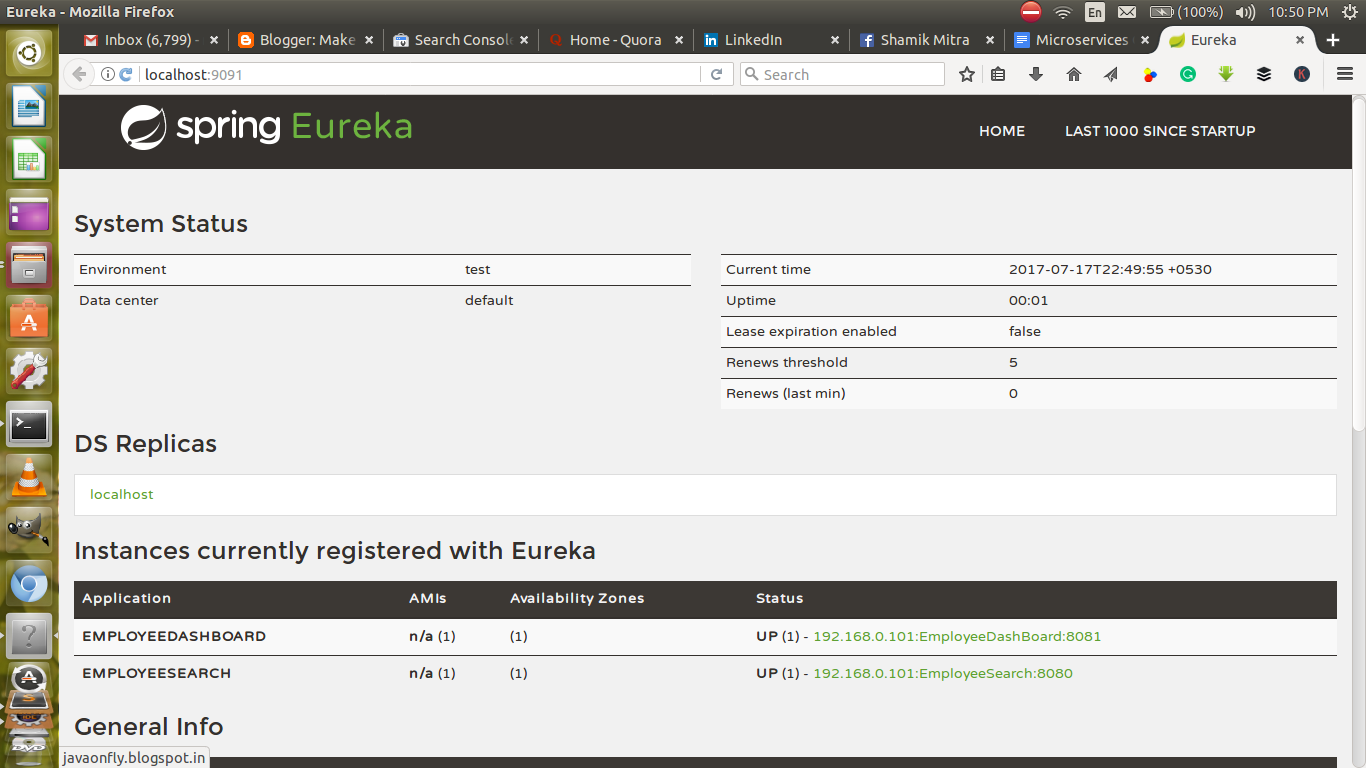
Then hit the following URL: http://localhost:8081/dashboard/2
You will see the Following Output:
{
    "employeeId": 2,
    "name": "Samir  Mitra",
    "practiceArea": "C++",
    "designation": "Manager",
    "companyInfo": "Cognizant"
}Published at DZone with permission of Shaamik Mitraa. See the original article here.
Opinions expressed by DZone contributors are their own.
Comments