

Model Context Protocol Vs Agent2Agent: Practical Integration with Enterprise Data
MCP is production-ready for LLM-to-tool integration; A2A enables emerging multi-agent collaboration. They complement, not compete, and neither replaces Spark or Airflow.
 CORE
·
CORE
·
Join the DZone community and get the full member experience.
Join For FreeModel Context Protocol (MCP), introduced by Anthropic in November 2024, and Agent2Agent (A2A), launched by Google in April 2025, are two different ways of designing AI systems that allow language models and agents to work with tools or with each other.
While both aim to make AI development faster and more efficient, they solve different problems. MCP focuses on deterministic tool integration for language models, meaning it provides predictable ways for models to interact with external tools. A2A, on the other hand, focuses on asynchronous agent-to-agent communication, allowing multiple agents to coordinate and share information independently.
In this article, I take a close look at both protocols from an architectural perspective. I share documented integration patterns with enterprise data systems, highlight real-world production deployments, and provide a practical framework for deciding which protocol fits which use case. I also clearly distinguish proven patterns from emerging or experimental use cases.
Introduction
The AI agent landscape has changed significantly since late 2024. MCP and A2A have attracted considerable attention, but much of the discussion remains speculative — especially when it comes to connecting these protocols to large-scale data systems.
This article avoids speculation. I focus on patterns that have been documented or implemented in the real world, highlighting proven integrations and clearly labeling untested or emerging use cases.
What This Article Covers
- Documented integration patterns: Only patterns with public evidence, code samples, or official vendor documentation
- Production deployments: Real-world usage from companies such as Databricks, AWS, and others
- Architectural decision frameworks: Practical guidance based on observed use cases rather than theory
Understanding MCP: Architecture and Capabilities
What MCP Is
Model Context Protocol (MCP) is an open standard developed by Anthropic and released in November 2024. It standardizes how LLMs connect to external tools and data sources through a client-server architecture.
Core Design
- LLM-agnostic: Works with Claude, Mistral, LLaMA, or any LLM that supports tool calling
- Deterministic routing: The calling application controls which tools or servers are available
- Request-response semantics: Synchronous tool invocations with clear input/output contracts
- Open standard: A published specification allows third-party implementations
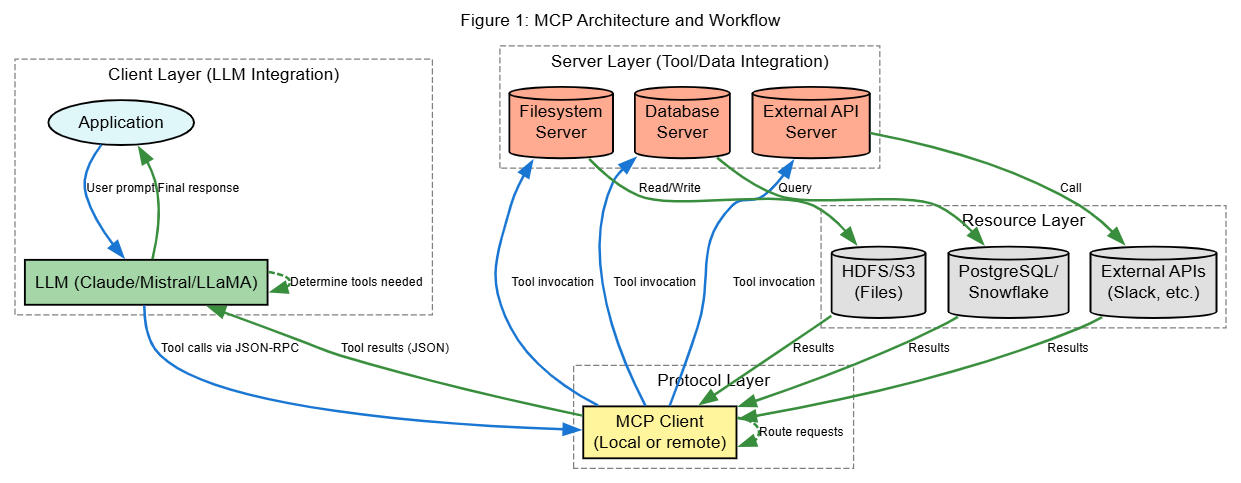
Key Characteristics
- Synchronous request-response for each tool invocation
- LLMs make routing decisions based on their reasoning
- No persistent orchestration layer
- Clear separation between LLM logic and tool implementation
MCP Design Strengths and Limitations
Strengths
- Deterministic: The application controls exactly which tools are exposed
- Simple integration: Well-defined JSON-RPC protocol
- Interoperability: Works with any LLM that supports tool calling
- Security: Fine-grained access control per application
Limitations
- Not for orchestration: MCP is a tool integration protocol, not a workflow orchestrator
- Synchronous only: Each tool call must complete before the LLM receives results
- No agent autonomy: The LLM cannot act independently; it only responds to prompts
- No inter-tool communication: Tools cannot share state or call each other
Understanding A2A: Architecture and Capabilities
What A2A Is
Agent2Agent (A2A), announced by Google in 2025, is a communication protocol that enables autonomous agents to discover one another, collaborate asynchronously, and delegate tasks without predefined integrations.
Core Design
- Agent-centric: Agents are autonomous entities with their own state and reasoning
- Service discovery: Agents dynamically find one another via a registry
- Asynchronous communication: Agents send messages and continue operating independently
- Loose coupling: No central orchestrator; agents coordinate through the protocol
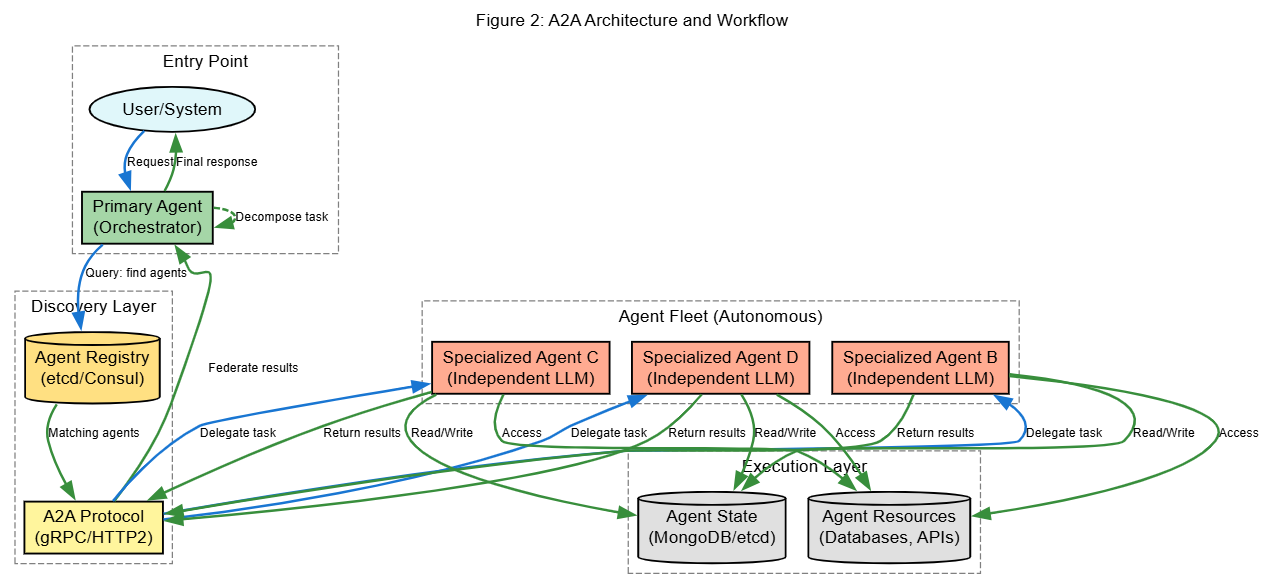
Key Characteristics
- Asynchronous communication between agents
- Each agent maintains independent state and reasoning capability
- Service discovery via a registry
- Support for long-running tasks that can span hours or days
A2A Design Strengths and Limitations
Strengths
- Autonomous collaboration: Agents can operate independently and make decisions
- Loose coupling: Adding or removing agents requires no changes to others
- Multi-LLM support: Each agent can use a different LLM
- Scalability: Organic scaling as agent instances increase
- Long-running tasks: Supports tasks that span hours or days
Limitations
- Operational complexity: Requires distributed tracing, state management, and a service mesh
- Eventual consistency: Results may not be immediately consistent
- Still emerging: Limited production deployments compared to MCP
- Not for tool integration: A2A assumes agents already have access to tools; it focuses on coordination
Comparative Analysis
Architectural Comparison Table
| Dimension | MCP | A2A |
|---|---|---|
| Primary Purpose | LLM tool integration | Agent-to-agent coordination |
| Control Model | Centralized (LLM decides) | Decentralized (agent autonomy) |
| Communication | Synchronous (request-response) | Asynchronous (message-based) |
| Scope | Single interaction | Extended task sequences |
| State Management | Stateless servers | Distributed agent state |
| Discovery | Pre-configured tools | Dynamic registry lookup |
| Tool Access | MCP servers expose tools | Agents own tools/resources |
| Use Case | "Connect LLM to systems" | "Coordinate autonomous agents" |
| Maturity | Production-ready | Emerging (Google ADK available) |
| Operational Burden | Low (stateless) | High (service mesh, tracing) |
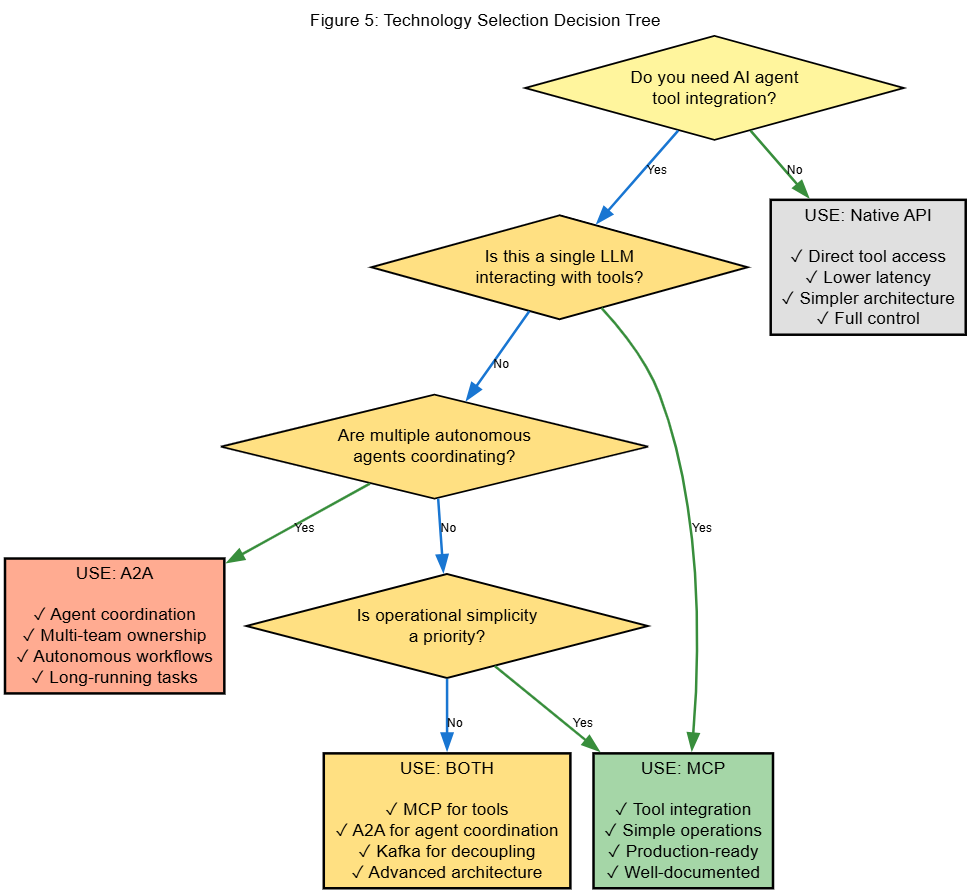
Decision Framework
Use MCP When
- A language model needs to interact with external tools
- The tool set is well-defined and stable
- Fast decision-making is required within a single interaction
- Auditability and compliance demand clear execution traces
- Operational simplicity is a priority
Examples: Chatbots with database access, code assistants, data query interfaces
Use A2A When
- Multiple specialized agents need to collaborate
- Agents operate across different domains or teams
- Tasks require extended reasoning or human-in-the-loop steps
- Agent autonomy and decentralized decision-making are beneficial
- Different agents require different LLMs
Examples: Multi-team research workflows, federated analytics, collaborative AI systems
Use Both When
- MCP servers expose tools while A2A coordinates the agents that consume them
- Some workflows are task-specific (MCP), while others require agent autonomy (A2A)
- Different data tiers benefit from different protocols
Integration with Enterprise Data Systems: Documented Patterns
MCP + Big Data Systems: Proven Integrations
AWS Spark History Server MCP
AWS has released an open-source Spark History Server MCP server that enables AI assistants to analyze Spark application data using natural language queries. The server connects directly to Spark History Server instances, supporting AWS Glue, Amazon EMR, and Kubernetes-based Spark deployments.
What It Does:
- Provides application-level tools for execution summaries, job and stage analysis for bottleneck identification, task-level tools for executor resource consumption analysis, and SQL-specific tools for query optimization
- Runs as a local service on EC2 or EKS, connecting directly to Spark History Server instances to retrieve telemetry and execution metadata
Use Case:
- Debug Spark job performance issues through natural language
- Example: "Why is stage 5 taking 25 minutes? Show me executor memory usage"
- Provides visibility into what happened during Spark execution (post-hoc analysis)
Important Limitation:
- This is analysis and debugging, not job orchestration or submission
- You cannot use MCP to submit new Spark jobs or control running jobs
- Focus is on telemetry and historical data
Databricks MCP Integration
Databricks offers MCP integration through its Databricks Agent Framework, supporting both external MCP servers and custom MCP servers hosted as Databricks apps. This enables AI assistants to query data through natural language against Databricks SQL warehouses and lakehouses.
Capabilities:
- Query Databricks tables through natural language MCP queries
- Access catalog metadata
- Execute notebooks through MCP tool calls
- Multi-query analysis in a single interaction
Production Pattern:
- Databricks hosts MCP servers for standard operations (SQL query, notebook execution)
- Applications connect via standard MCP client
- LLM can chain multiple queries together
File System Integration (HDFS/S3)
MCP servers can connect to HDFS and cloud storage (S3, Google Cloud Storage) through filesystem abstraction layers. Integration is typically configured through environment variables and credential management.
Common Pattern:
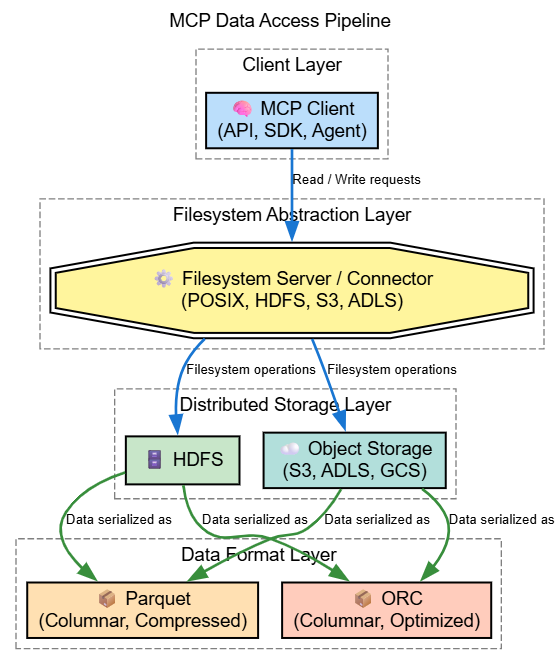
Use Cases:
- Query file metadata without loading full datasets
- List and inspect data schema
- Retrieve sample records for exploration
A2A + Big Data Systems: Emerging Patterns
A2A with Apache Kafka
A2A combined with Apache Kafka forms the foundation for agentic AI architectures, with Kafka acting as the decoupling and event layer between agents, analytical backends, transactional systems, and streaming pipelines.
Architectural Pattern:
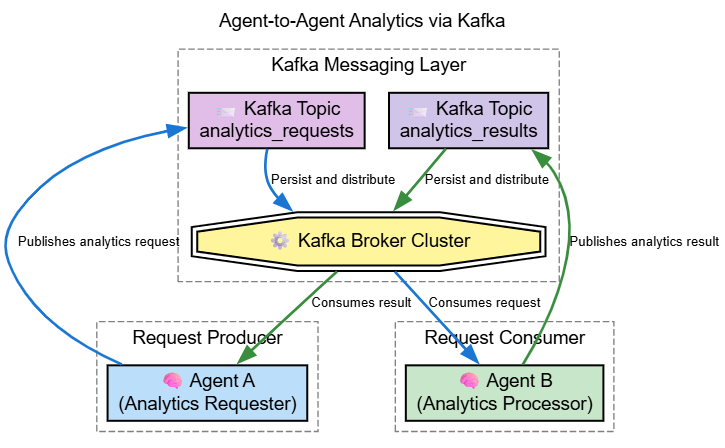
Documented Use Cases:
- Kafka enables linking analytical backends with AI agents, transactional systems, and streaming data pipelines across the enterprise
- Agents subscribe to request topics and publish results
- Natural scaling as agents and consumers scale independently
Current Status:
- This pattern is documented in architectural guidance but lacks published case studies of production deployments
A2A Agent State with Big Data
A2A is designed to support long-running tasks, including scenarios that may take hours or even days when humans are in the loop.
State Management Pattern:
- Agent state persisted in distributed stores (MongoDB, Postgres with replication)
- Between task delegations, agents can persist intermediate results
- Supports human review and approval gates in agent workflows
Common Scenario:
- Agent A initiates long-running analysis
- Results stored in shared state
- Agent B reviews and approves
- Agent C executes next phase (e.g., notification)
- All activity logged and auditable
Production Deployment Patterns
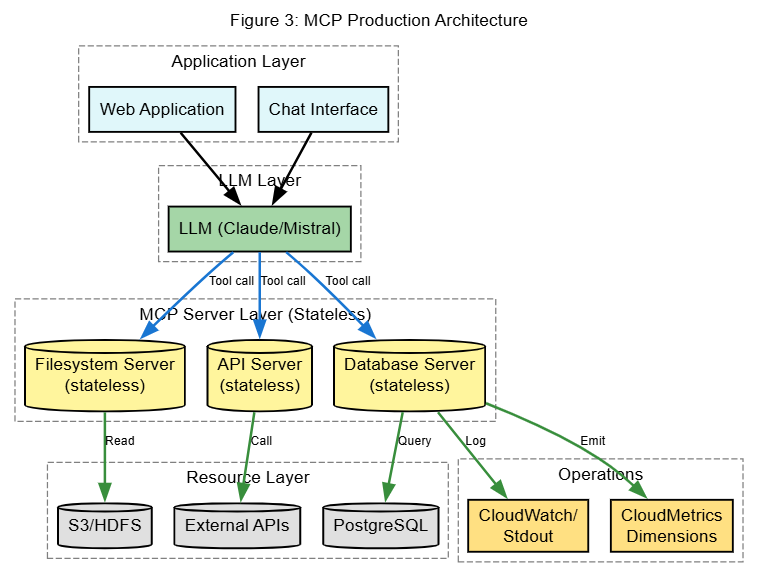
MCP Deployment Architecture
Operational Characteristics:
- Stateless servers: MCP servers hold no state; horizontal scaling is straightforward
- Simple monitoring: Each server logs tool invocations; metrics are per-tool
- Low operational overhead: No distributed tracing, service mesh, or state consistency concerns
- Single LLM process: All tool decisions made by one LLM instance
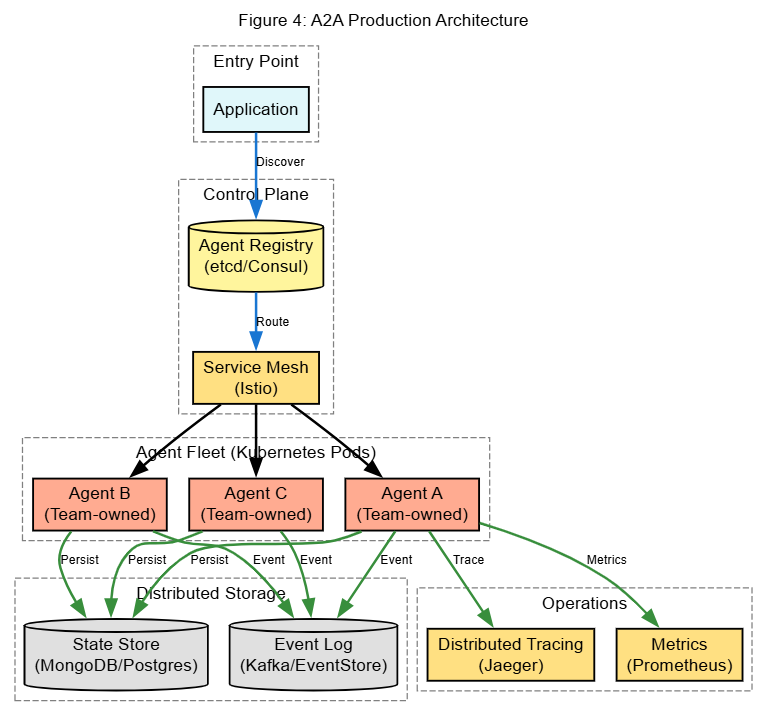
A2A Deployment Architecture
Operational Characteristics:
- Distributed state: Agent state persisted across multiple agents (eventual consistency)
- Service mesh required: Istio or similar for secure agent-to-agent communication
- Distributed tracing essential: Understanding workflow requires correlation across agents
- Higher operational complexity: State consistency, service discovery, health checks
Real-World Usage Patterns (Documented)
MCP: Analytics and Data Query
Pattern: LLM with database query tool
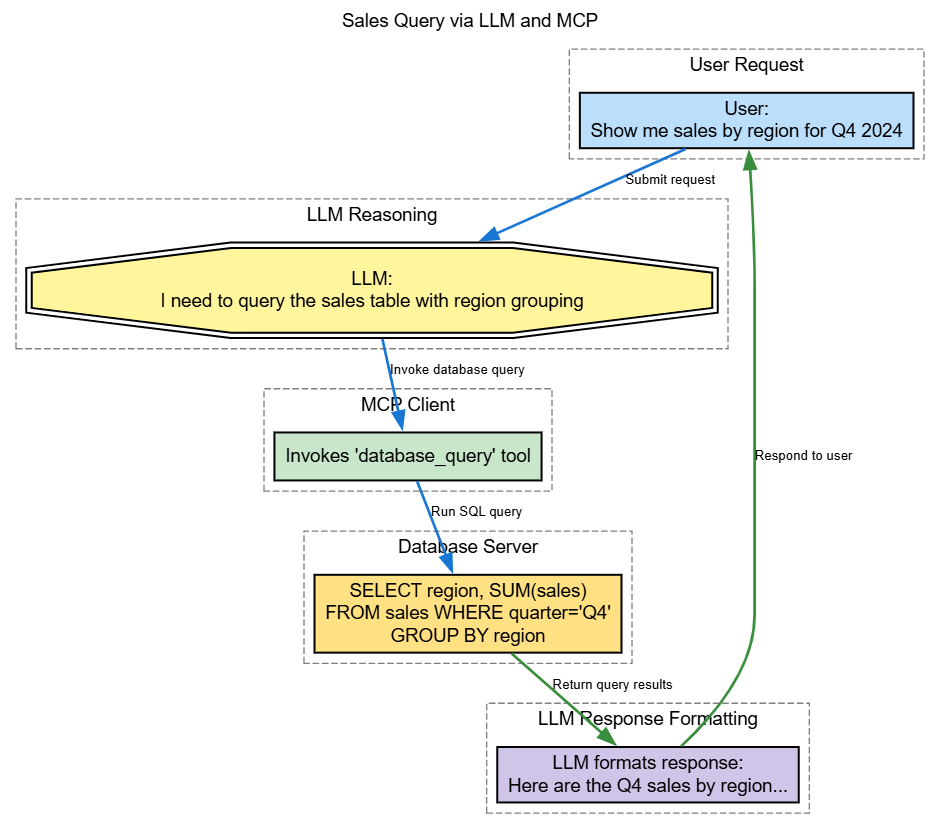
Actual Production Use:
- Databricks users can query their data warehouses through natural language prompts, with MCP handling the SQL generation and execution
MCP: Debugging and Analysis
Pattern: Spark History Server analysis
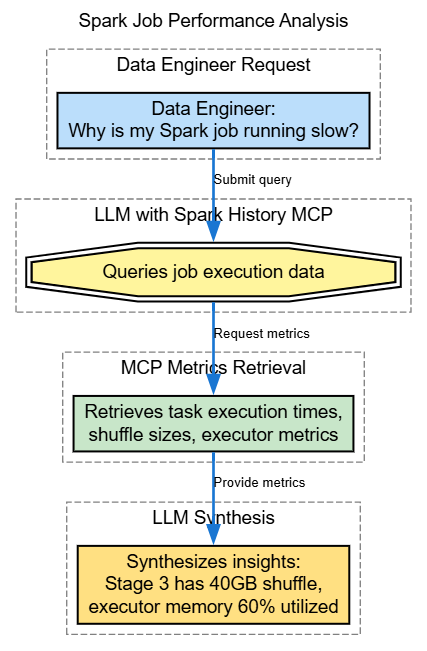
Actual Production Use:
- AWS customers use Spark History Server MCP to debug performance issues through natural language interaction with their Spark telemetry
A2A: Multi-Team Workflow Coordination
Pattern: Agents for different business functions coordinating
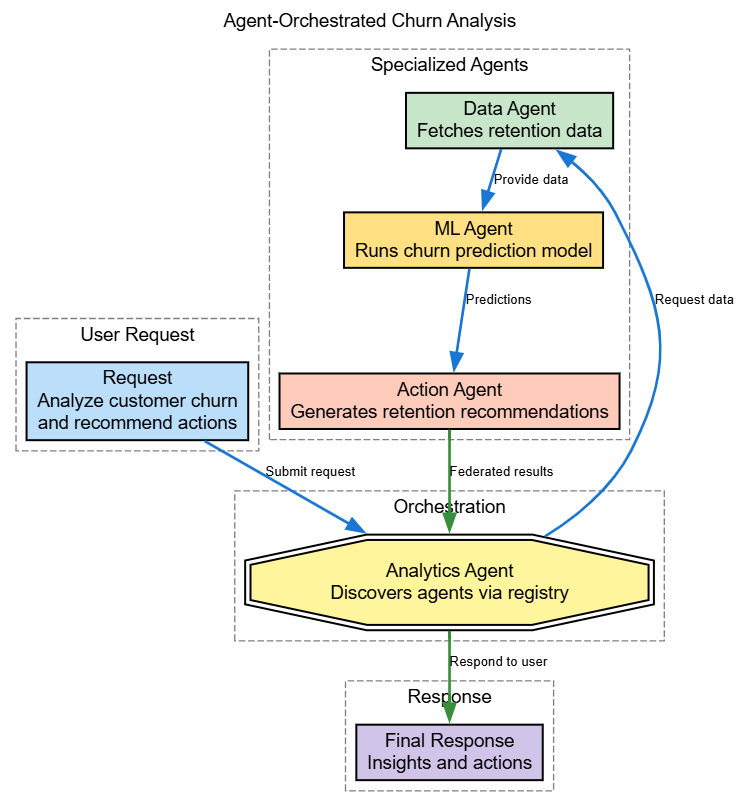
Current Status:
- This pattern is documented in A2A architectural guidance; production case studies are limited as A2A is still in early adoption
Recommendations by Use Case
| Category | Use Case | Examples / Tools |
|---|---|---|
| MCP | Analytics and Query Interfaces | Natural language queries against data warehouses Example: "Show me revenue by our customer segment"-> Databricks SQL query Tools: Databricks MCP, custom SQL server MCP |
| Debugging and Observability | Post-hoc analysis of system execution Example: "Why is my Spark job slow?"-> Spark History Server analysis Tools: AWS Spark History MCP, custom telemetry servers |
|
| Single-Interaction Tasks | Chat interfaces that answer questions Code assistants that generate scripts Chatbots with database/API access |
|
| A2A | Multi-Team Workflows | Different teams own different agents Example: Data team (Agent A), ML team (Agent B), Analytics team (Agent C) Each team develops and maintains their agent independently |
| Long-Running Processes | Tasks spanning hours or days Includes human review/approval gates State persisted between stages |
|
| Exploratory and Research | Agents experiment with different approaches Intermediate results saved and reviewed |
1. Integration Best Practices
| Protocol | Best Practices |
|---|---|
| MCP | Keep servers stateless for horizontal scaling Use 30-60 second timeouts on invocations Return structured JSON results Log all tool invocations for debugging Validate inputs before passing to systems Use connection pooling |
| A2A | Each agent owns its resources independently Use Kafka for asynchronous decoupling Implement circuit breakers for failing agents Use MongoDB/PostgreSQL with replication for state Implement distributed tracing (Jaeger) Design for eventual consistency, not strong consistency |
2. Current State of Integration
| Protocol | Proven (Production-Ready) | Emerging (Limited Evidence) | Not Proven |
|---|---|---|---|
| MCP | SQL databases (Databricks), file systems (HDFS/S3), observability (AWS Spark History) | Custom data processing tools | Spark job orchestration |
| A2A | Kafka for agent coordination | Long-running data pipelines, state persistence for analytics | Replacing Spark scheduling, real-time streaming |
3. Anti-Patterns
| Protocol | Anti-Patterns |
|---|---|
| MCP | Using MCP as workflow orchestrator (use Airflow instead) Storing state in MCP servers (violates stateless design) Using MCP for real-time control (adds unnecessary latency) |
| A2A | Using A2A for simple tool calls (use MCP instead) Over-centralizing agent coordination (defeats loose coupling) |
Technology Landscape
- MCP ecosystem: Production-ready. Providers: Anthropic, Databricks, AWS. Growing community servers.
- A2A ecosystem: Early adoption. Google-led with 50+ partners. Comparable to Kubernetes in 2015.
- Complementary: Kafka (decoupling), Airflow (orchestration), Istio (service mesh), Temporal (durable execution).
Future Outlook
- MCP (12-18 months): Broader tool ecosystem, better authentication patterns, more enterprise case studies.
- A2A (12-18 months): More production deployments, better tooling, integration with Airflow/Temporal.
Conclusion
MCP is production-ready today for LLM-to-tool integration, with proven use cases such as Databricks SQL querying and AWS Spark History Server debugging.
A2A enables autonomous, cross-team agent collaboration and is backed by a growing ecosystem, but operational complexity remains high and production deployments are still limited.
Critical: Neither protocol is for job orchestration. Spark schedulers, Airflow, and Temporal remain the right tools.
Both MCP and A2A accelerate AI development within their intended scope. Choose based on architectural requirements—not hype.
Key Takeaways
- MCP is production-ready for LLM-to-tool integration.
- A2A backed by 50+ partners but operational complexity is high.
- They solve different problems: MCP for tools, A2A for agent coordination.
- Neither replaces Spark schedulers or Airflow.
- MCP is simple and stateless; A2A requires service mesh and distributed tracing.
Opinions expressed by DZone contributors are their own.
Comments