

Modernize Your IAM Into Identity Fabric Powered by Connectors
In an era where most enterprises are moving their workloads to cloud, and AI-driven environments, modernizing IAM isn’t just a buzzword, but an absolute necessity.
Join the DZone community and get the full member experience.
Join For FreeIt’s no secret that technology is evolving much faster than our traditional Identity and Access Management systems can handle. These legacy systems were designed for simpler times, when everything was hosted locally and security was perimeter-based.
So, in an era where most enterprises, if not all, are moving their workloads to hybrid, multi-cloud, and AI-driven environments, these outdated IAM systems are being pushed to their breaking points. Quite frankly, they aren’t doing so well.
Now that identities are spread across multiple environments and AI makes crucial decisions, these systems are leaving big security gaps that are simply too hard to ignore. That’s why modernizing your IAM isn’t just a buzzword, but an absolute necessity.
Introducing the Identity Fabric
Contrary to what most people think, modernization isn’t entirely about replacing everything with flashy new tools, big software investments, or even entire system overhauls.
It involves building a bridge between older systems and new technologies to ensure existing investments work better as you introduce smart, scalable solutions that support long-term goals.
Today, as organizations embrace this initiative, they often find themselves juggling multiple IAM systems, each catering to different user groups. The result? Data silos and fragmented systems that can’t communicate effectively—leaving you with sloppy policies, blindspots, and of course, added costs.
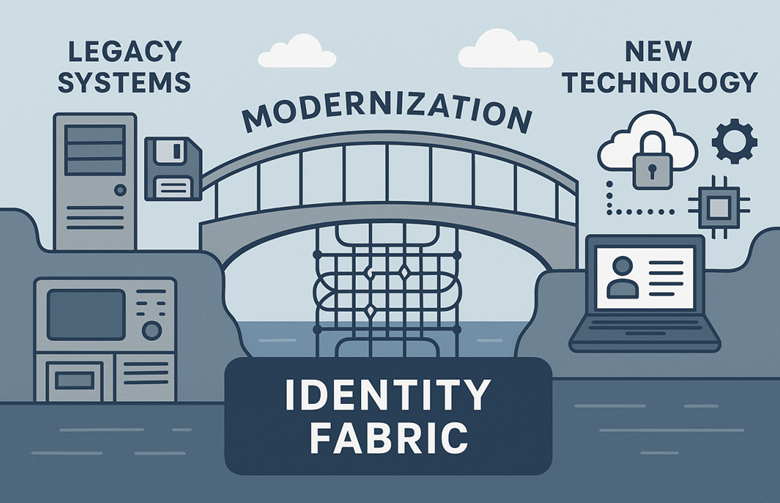
Fortunately, there's a way out of this mess with identity fabric—a modern unified approach that ensures you get hold of "who has what, when and how" all in one place. It’s not a fancy new gadget or software, but rather a centralized framework that weaves all your IAM systems into one.
What Makes It So Special?
Unified Approach
No more juggling passwords, whether you’re using an old company server or a brand-new cloud app. Identity fabric ensures your identity remains consistent across different environments.
Interoperability
This simply means it can seamlessly integrate with diverse identity management tools and emerging technologies such as IoT devices and AI. Therefore, you’ll not only remain relevant today but also be able to withstand whatever the future throws your way.
Flexibility and Scalability
As times change, enterprises usually grow, shift their goals, add or retrench employees, or even adapt to trending technologies. The good news is, identity fabrics grow with you every step of the way. It is super flexible and can handle more users and new tech with ease.
Enhanced Security
By providing a single, streamlined point of access and management, you get a more holistic view of how every user is accessing and utilizing resources. With this information, you can enable various protection measures such as RBAC, MFA, and PAM to ensure only the right users are authorized accordingly.
This also helps in complying with various regulatory standards such as GDPR, HIPAA, and CCPA, just to mention a few.
Improved User Experience
This is what it’s all about today, and with identity fabric, it only gets better. With Single Sign-On, for example, you only need to log in once, and boom, you’re in everywhere. Such experience normally translates to reduced login fatigue and improved productivity.
The Crucial Role of Connectors: Building the “Connector Fabric”
With all that in mind, let’s dig deeper into what makes it tick: the connectors, which are modules or tools that make it possible for Identity Fabric to communicate with different, often disparate, IAM systems, apps, and data sources within an enterprise.
So, How Do They Work?
Picture this: Identity Fabric is the central control panel and sits at the core of all operations. Any user in your HR system, cloud app, or even old legacy database trying to access a particular resource has to go through it.
However, most of these systems usually speak their native language. For instance, your HR systems might have their way of storing data, your cloud apps might authenticate differently using methods like OAuth, and your old database systems might require specific querying formats.
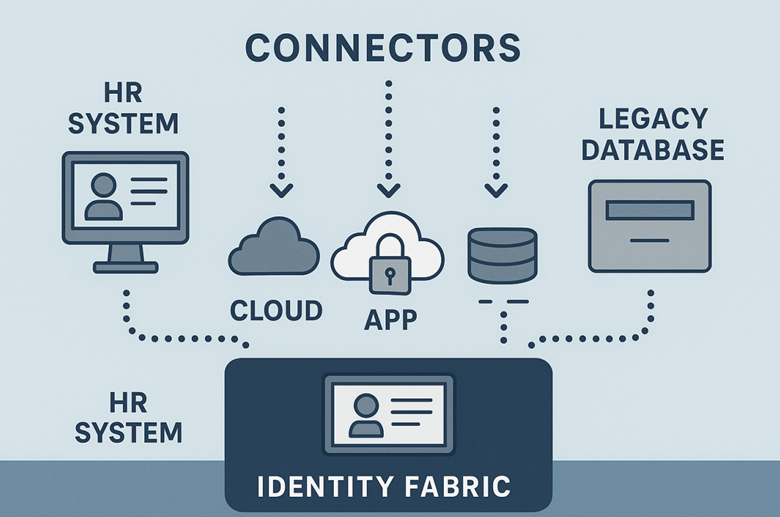
In order for the central control panel to understand all these systems, it needs an interpreter—the connectors. They understand the "language" of each system and translate it into a language that the Identity Fabric can understand, allowing it to pull identity data, provision access, enforce policies, and synchronize changes.
In short, it is these connectors that give Identity Fabric its "unified" and "interoperable" properties, hence the term ‘connector fabric’. Without them, this concept would remain just a pipe dream.
Why Connectors are Indispensable for Identity Fabric
Bridging Silos
In modern IT environments, systems normally exist as a collection of applications, databases, cloud services, and now, AI platforms. Each of these systems usually have their own identities and attributes creating isolated ‘silos’ of information.
Connectors serve as the unifying force that breaks down the walls existing between these systems.
Real-time Synchronization
As organizations adapt to the ever-changing digital landscape, they frequently have to deal with dynamic identities whose attributes keep changing.
New employees are hired, others get promoted and change their roles, and others leave. The same goes for all those NHIs running the show behind the scenes.
If these changes aren’t reflected, things get messy, fast. Someone might still have access to what they shouldn’t, or a new manager might be unable to access their new privileged account.
Connectors step in as the solution by keeping things up-to-date. How? By providing mechanisms necessary for live data syncing. So any role changes or revisions of policies are implemented instantly, like live feeds.
Automation of Lifecycle Management
Imagine having to manually create new accounts each time a new hire comes in, and not just in a single platform, but all of them. On top of that, you also have to repeat an almost identical process of deactivation when they leave. It’s tiresome, boring, time-consuming, and prone to many errors.
Connectors put this whole process on autopilot by streamlining the provisioning and deprovisioning of user accounts. Beyond that, they also automate propagation of attribute changes to relevant systems, hence ensuring access is accurate and up-to-date.
In the context of AI, they can extend this automation to manage access to sensitive AI models, training datasets, and inference engines so that only authorized users can gain access to them.
Support for Heterogeneous Environments
Every enterprise wants to reap all the benefits of moving to the cloud and AI platforms—scalability, agility, and cost efficiency. But the reality is, it’s not that simple. Getting two different systems in almost every aspect to communicate seamlessly is no small feat.
Connectors are highly adaptable. They understand various tech languages and translate data, seamlessly integrating with legacy systems, cloud platforms, and AI tools for a truly unified identity solution.
How Connectors Modernize IAM
Simplified Identity Management
You can think of them as your assistant for all matters of identity, especially when it comes to handling all the stuff you dread—setting up new accounts, deleting old and redundant accounts, or even updating roles.
Connectors take the load off your chest by automating such repetitive tasks. Hence, less manual work for the IT and HR teams, fewer mistakes, and improved overall efficiency.
Increased Agility and Innovation
These connectors come with ready-made connections, making it super easy to integrate with cool new apps and services without reinventing the wheel.
With this, you can jump on new tech much faster and ensure you stay ahead of the curve with ease.
Cost Reduction and Operational Efficiency
This is the part that most enterprises like to hear about, because let’s face it, everyone is in it to win it. And these connectors help you do just that—cut unnecessary costs.
How? By streamlining repetitive tasks. This means your IT team isn’t stuck on routine data entry jobs but is rather focused on more important stuff like innovation, hence saving time and money.
Strengthened Security Posture
In any company, there are many apps and services, such as email, HR software, sales tools, project management, you name it. Connectors centralize access control of all these assets, ensuring that only authorised users are granted permission to what they require.
They also enforce the rule of least privilege so that no ‘ghost’ employees come back to haunt the organization, and current employees don’t abuse their privileges.
Conclusion
Identity Fabric isn’t a "someday" idea or a concept; it’s a reality. And it doesn't bulldoze what's already there, but makes it even stronger. It’s a strategic shift that aims to modernize IAM systems in today's digital sprawl through unification.
As technology continues to grow and evolve, adopting an Identity Fabric approach puts your enterprise in a better position to handle sensitive information and deliver a better user experience.
Opinions expressed by DZone contributors are their own.
Comments