

Modular Monoliths Explained: Structure, Strategy, and Scalability
Modular monoliths: one deployable unit, cleanly split into modules. Simpler ops, strong boundaries, no microservice overhead.
 CORE
·
CORE
·
Join the DZone community and get the full member experience.
Join For FreeChoosing the right architectural style is crucial for building robust systems. It’s a decision that must balance short, medium, and long-term needs — and the trade-offs involved deserve thoughtful consideration.
In software engineering, we’re spoiled for choice. But with buzzwords flying around and shiny new paradigms tempting us at every turn (did someone say FOMO?), it’s easy to feel overwhelmed. Some styles get dismissed as “legacy” simply because they didn’t work well for a few organizations — even if they still hold merit.
The classic debate often boils down to monolith and microservices. Both have their strengths and weaknesses, but the trade-offs may not age well or meet evolving system requirements. Re-architecting later isn’t always feasible or cost-effective, and the resulting technical debt can become a bottleneck for business growth.
But what if there’s a middle ground? An architectural style that combines the simplicity of monoliths with the flexibility of microservices — and allows you to pivot as your system matures.
Introducing the modular monolith — or modulith.
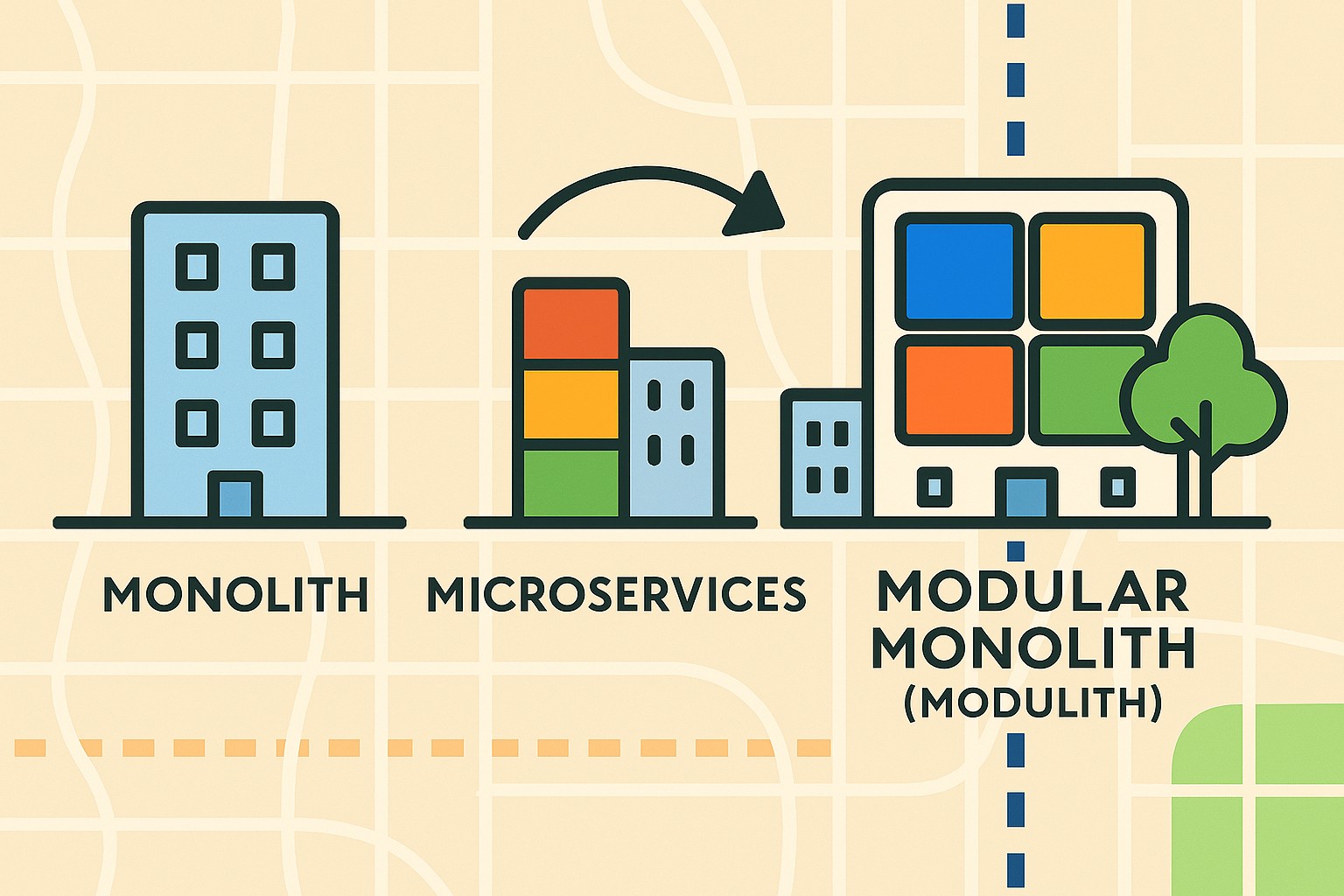
Modular Monolith
Definition
The term modular monolith consists of two parts, viz., module and monolith.
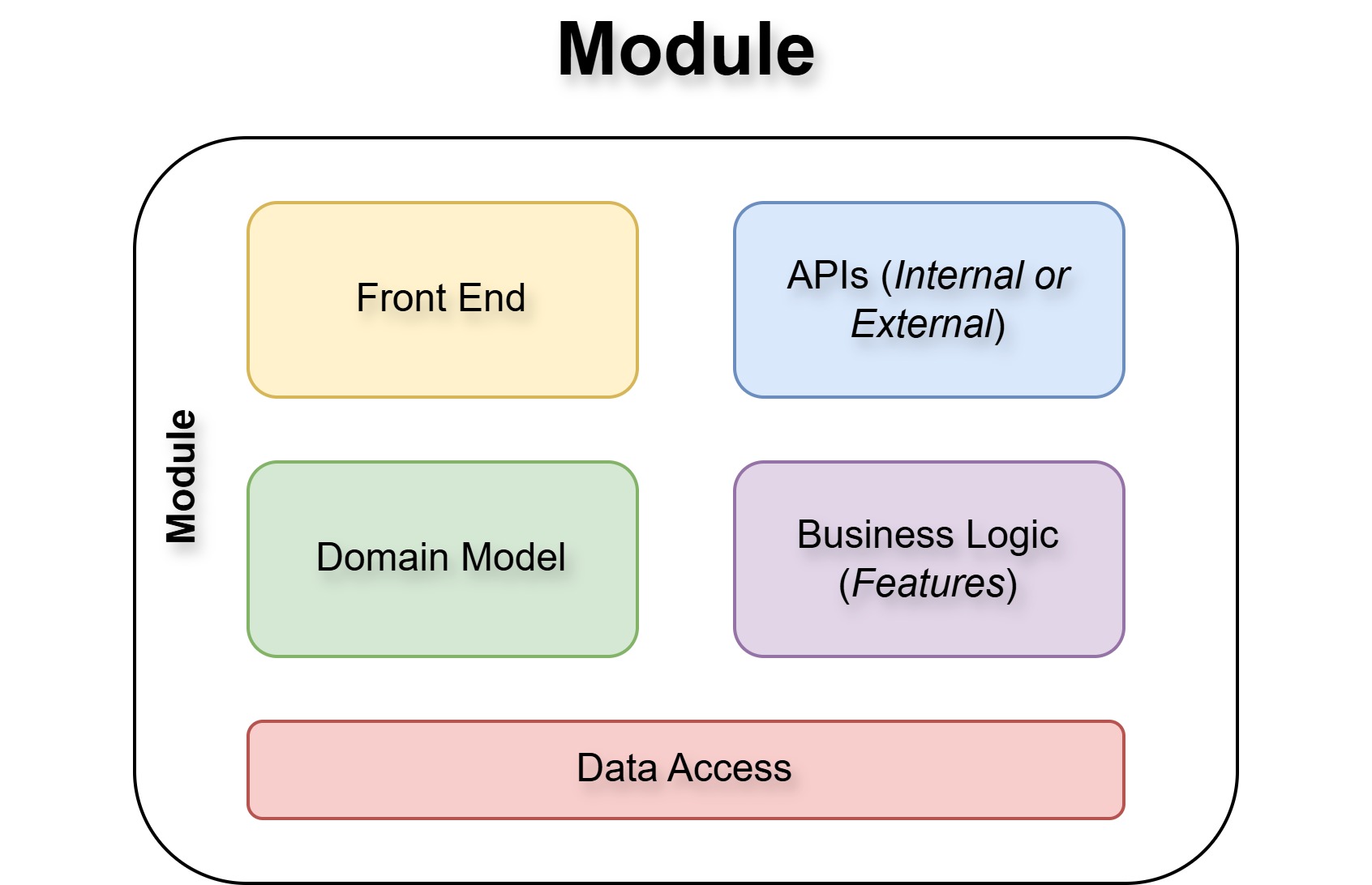
In general, a module can be defined as a standalone logical application. This logical application may consist of several features, domain model, APIs (for external and internal consumptions), DB tables, and microfrontend.
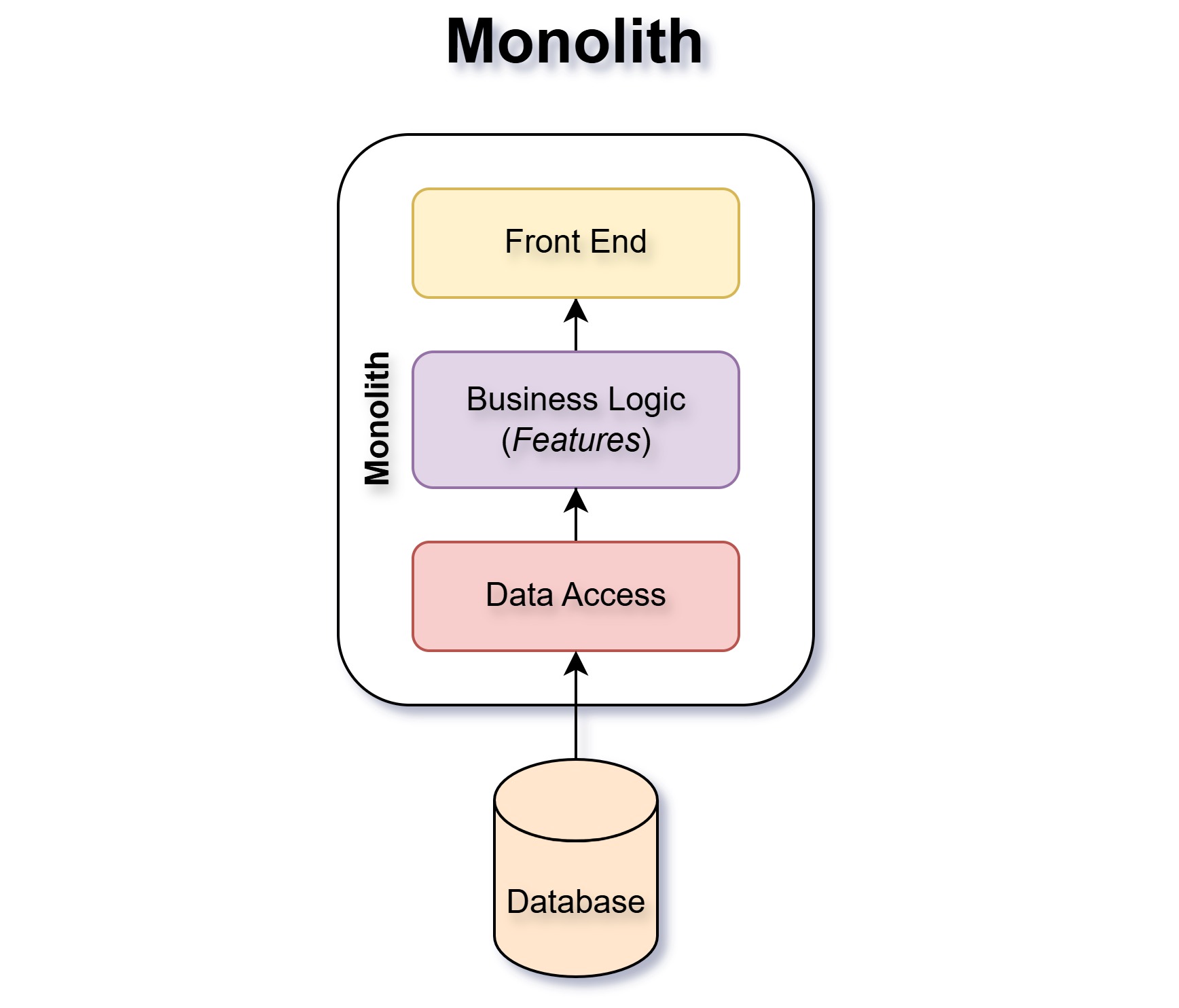
A monolith, as we know, is an application built as a single unit with all the features, DB tables, front end intertwined and tightly coupled with each other.
Thus, by combining these two, a modular monolith can be defined as an application with multiple independent but cohesive modules coupled together as a software unit.
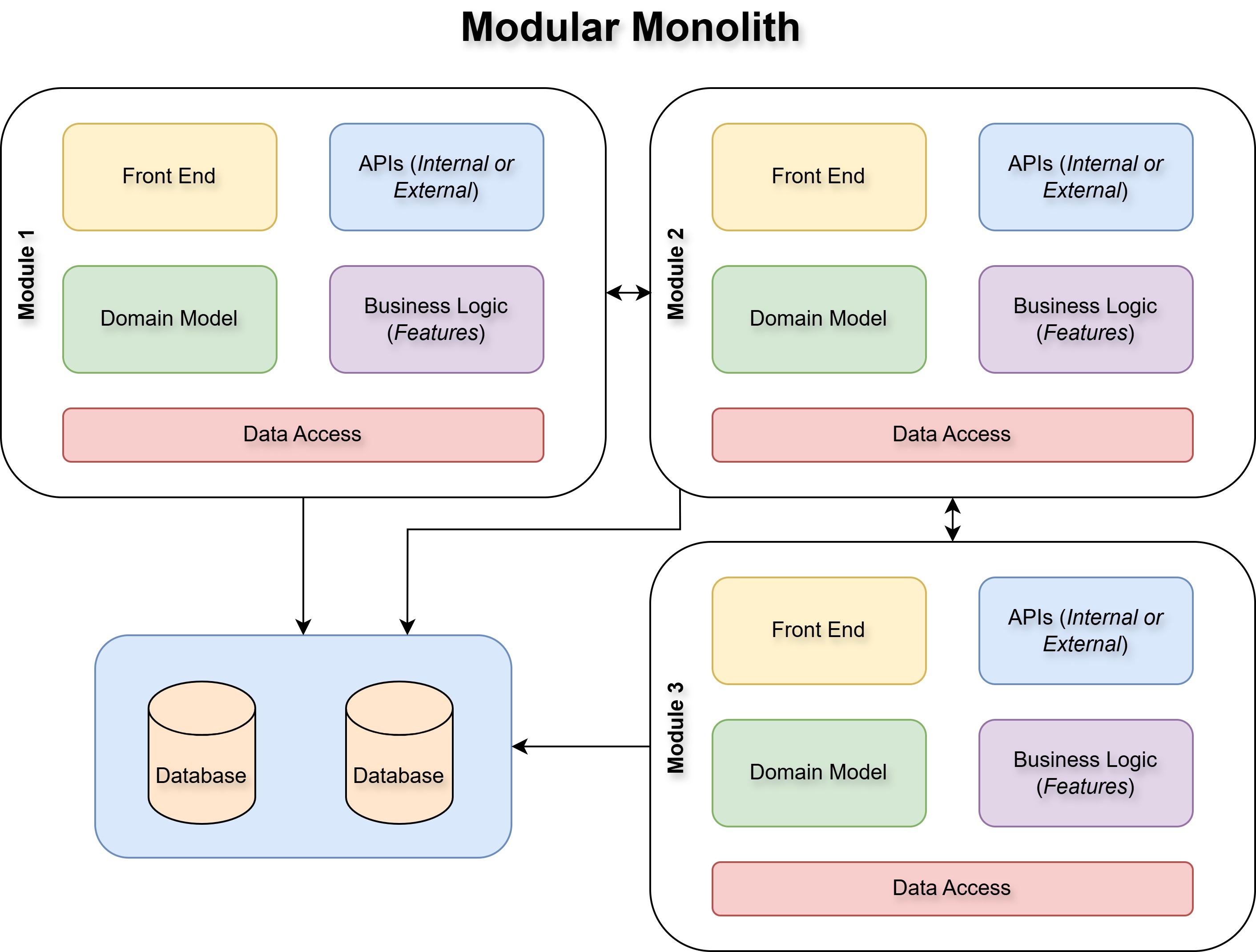
Module Structure or Boundary
A key characteristic of a modular monolith is the clear definition of modules and their respective boundaries — i.e., the business capabilities each module is responsible for. These boundaries can be derived similarly to bounded contexts in domain-driven design (DDD).
Initially, boundaries don’t need to be rigid. This flexibility allows teams to evaluate and refine the module structure over time, making it easier to pivot if needed. For example, if a module is found to be too lightweight (anemic) or overly complex (bloated), it can be merged with another module or split into smaller ones.
While modules may reside in separate code repositories for organizational purposes, they are deployed together as a single unit.
Strategy
Let's discuss available strategies for key design considerations. These strategies are crucial for reaping the maximum benefits from the modular monolith architecture.
Depending upon the domain complexity and consistency requirements, either one or more or a mix of patterns can be incorporated for respective considerations.
Inter-Module Communication
Although a module is principled as self-contained and independent unit of processing it still need to communicate with other module(s) to function as a system. To achieve loose coupling and tight cohesion, the communication pattern choice is crucial.
Below are a few available choices for effective inter-module communication:
- In-memory events. With events, the modules are decoupled and communicate asynchronously. Modules publish events for other modules to react to the domain changes. With this pattern, the extraction of the module as a separate deployable unit (microservice) is eased to a great extent. This pattern, however, is suitable only if an eventual or weaker form of consistency is required.
- Dependency inversion (DI). Modules invert dependency between themselves by allowing other modules to define the core logic. The dependent module defines a contract (viz. an interface) which is implemented by the provider module. E.g., for a payment module (dependent) to send a notification, the dependency is inverted by allowing the notification module to implement & determine which and how the notification is being sent (email, SMS, etc.).
- API. Participating modules define APIs and communicate via them only. These APIs could simply be a direct function call or REST, gRPC, etc. In the case of a direct function call, there is a risk of cyclic dependencies between module code, and thus it should be carefully implemented.
- Orchestrator. An additional module, viz., orchestrator, can act as the aggregator by communicating between modules and delegating the individual core processing to them. The communication between the orchestrator and modules could be event-based or API calls. The coarse-grained external APIs are available through this orchestrator. This pattern is suitable where strong consistency is required. E.g., An order processing orchestrator would communicate with inventory, payment, notification, shipping, etc. modules to process the order. This orchestrator is also responsible for handling failures.
Note: Inter module communication choices are independent of the external API communication pattern. As an example, external APIs could still be synchronous while modules communicate internally asynchronously via events or DI or both. Neither of them should influence or enforce the other.
Data Isolation
Data isolation strategy influences the robustness, fault tolerance, throughput and scalability of system. Although the choice is strongly influenced by the consistency requirement of system, it can be adapted feature/module wise as well. E.g., while payment requires strong consistency, notification could work for eventual or weaker consistency. Thus, payment module would have different data isolation as compared to notification module.
Below are a few available choices for data isolation:
- No isolation. Every module is allowed to write or read from all the DB tables. This simplifies the systems’ transaction management and ensures strong consistency. However, the chances of data corruption by any rogue module are high. Moreover, any schema changes have a corresponding ripple effect on almost every module. Thus, this strategy should be employed only as the last choice unless absolutely necessary.
- Write isolation. Only owning module writes to the table but all modules can read from the table directly. This ensures data integrity and simplified transaction management. However, any schema update breaks the reader modules.
- Command Query Responsibility Segregation (CQRS). Similar to write isolation, only the owning module writes to the table. For other modules, read-only views or shadow tables (with read-only access) are provided. This strategy is the most preferred one as it ensures data integrity, simplified transaction management, flexible schema changes without breaking reader modules, and high read and write throughput. The readers, however, could experience some delays in data freshness.
- Schema per module. Every module owns a DB schema/tables to which it can read and write freely. Access of data for other modules are restricted via respective APIs only. While data integrity and flexible schema changes are ensured, this strategy suffers from providing eventual consistency and complex transaction management. Thus, this choice should be carefully evaluated before being incorporated.
Development Velocity
Initially, if high development velocity is required, start with a monolith first. A typical monolith doesn’t age well, and they eventually end up as a big ball of mud with low development velocity. Thus, at a certain point in the development journey, the monolith should be first broken into modules as a modular monolith and evaluated on various parameters. However, if an existing monolith is to be broken, then evaluate Modular Monolith first.
Thus, a typical development journey could look like below:
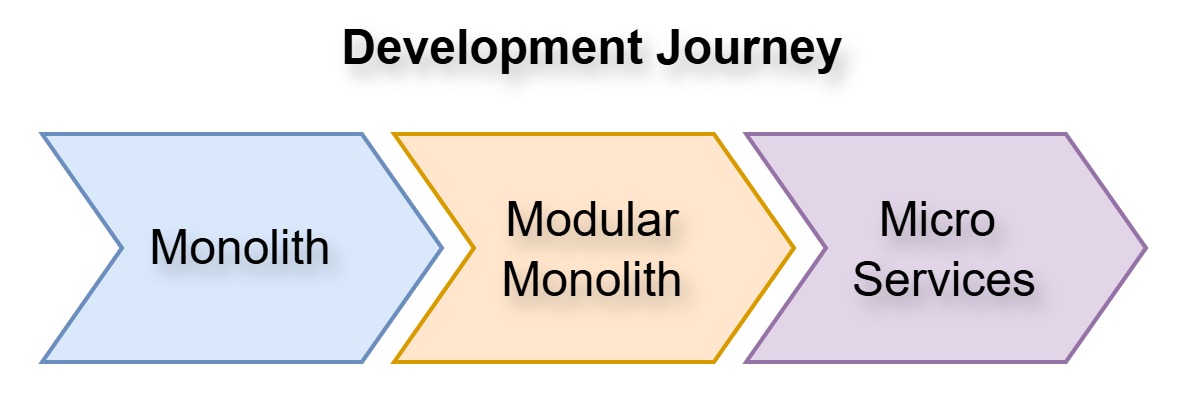
Note: Spring modulith promises to assist developers and enforce the modular monolith principles, thus increasing the development velocity.
Advantages and Disadvantages
Below are the key advantages and disadvantages of modular monolith that we should be aware of. The majority of which are similar to that of a monolith.
Advantages
- Simplified deployment — Entire application is deployed as a single unit, reducing orchestration complexity.
- Enhanced modularity — Codebase is organized into well-defined modules, improving maintainability and clarity.
- No network overhead — In-process communication between modules avoids the latency and complexity of inter-service calls.
- Easier debugging — Centralized logging and stack traces make troubleshooting more straightforward than in distributed systems.
- Supports domain-driven design (DDD) — Modules can align with bounded contexts, promoting clean domain separation.
- Lower operational cost — Fewer infrastructure components mean lower DevOps overhead than with microservices.
- Smooth refactoring path — Modular monolith helps to test the module boundaries early (e.g., if the domain split is incorrect it can be merged back quickly and easily). Reverse migration can be done easily from micro services to a modular monolith.
Disadvantages
- Limited scalability — Cannot scale modules independently, which may impact overall system throughput.
- Risk of tight coupling — Poor boundaries or shared state can lead to hidden dependencies between modules.
- Single point of failure — A rogue module can potentially crash the entire system.
- Harder to enforce isolation — Unlike micro services, module boundaries rely on discipline instead.
- Deployment bottlenecks — Any change, even in a single module, requires redeploying the entire application.
Case Studies
Below are a few real-world case studies of Modular Monolith being used or evaluated for the benefits it offers:
- Shopify successfully migrated from the existing monolith to a modular monolith (reference).
- GitLab is evaluating the movement from legacy monolith to modular monolith (reference).
Conclusion
Modular Monoliths strike a thoughtful balance between traditional monoliths and micro services. By organizing code into cohesive, loosely coupled modules, teams gain clarity, maintainability, and a smoother path to future architectural evolution. This approach reduces operational overhead, supports domain-driven design, and enables faster development cycles — especially in early stages. While it doesn’t offer independent scaling like microservices, it avoids their complexity and fragmentation.
For many teams, starting with a modular monolith provides a solid foundation that can adapt as the system grows, making it a strategic choice for building robust, flexible, and maintainable software systems.
References
- Atlassian — Micro services vs Monolith
- Martin Fowler — Monolith First
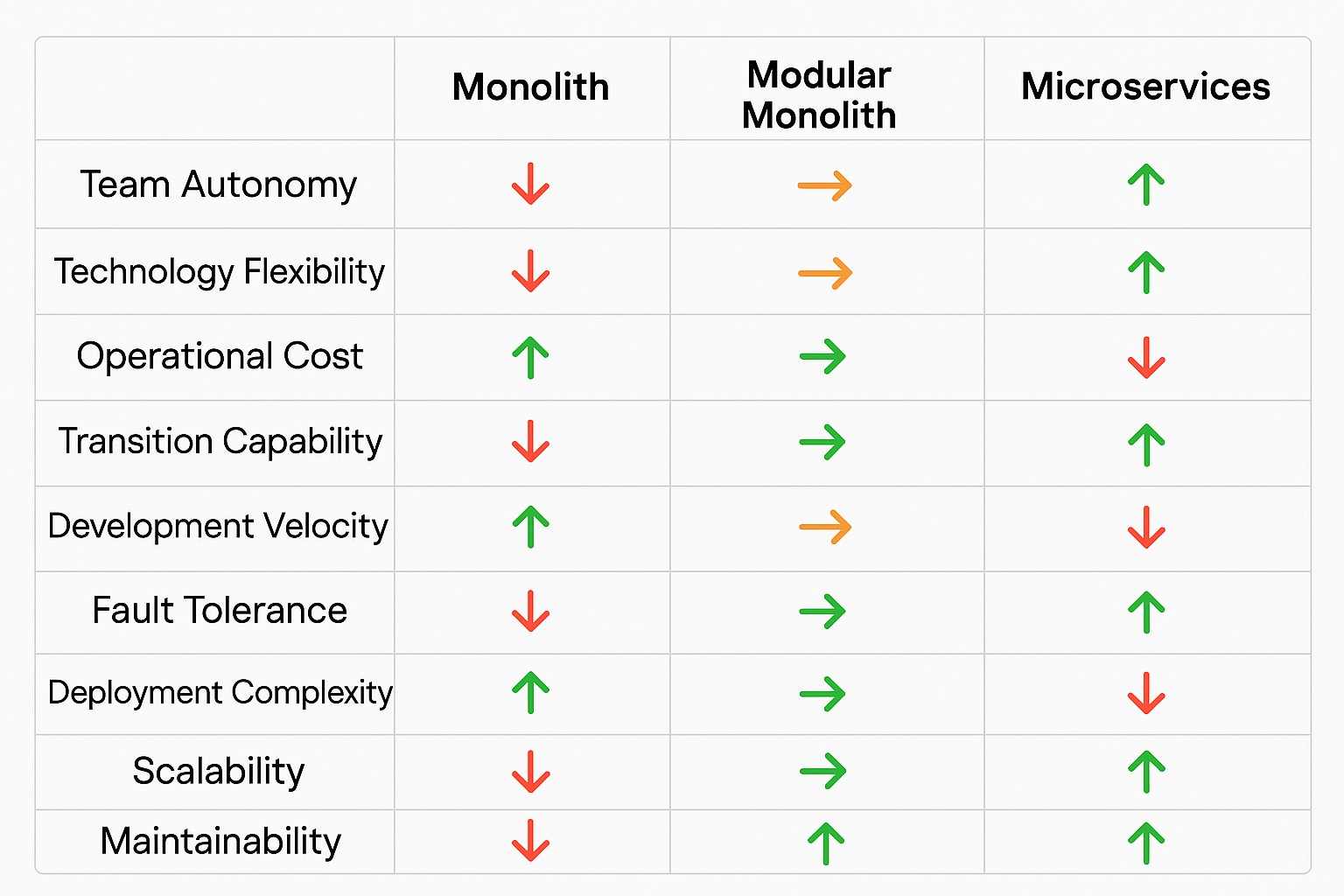
Monolith vs. Modular Monolith vs. Microservices
A quick primer on the comparison of monolith vs. modular monolith vs. microservices.
Published at DZone with permission of Ammar Husain. See the original article here.
Opinions expressed by DZone contributors are their own.
Comments