

DZone
Thanks for visiting DZone today,
Edit Profile
  • Manage Email Subscriptions
  • How to Post to DZone
  • Article Submission Guidelines
Sign Out View Profile
  • Post an Article
  • Manage My Drafts
Over 2 million developers have joined DZone.
Log In / Join
Refcards Trend Reports
Events Video Library
Refcards
Trend Reports

Events

View Events Video Library

Related

  • Mastering Multi-Cloud Integration: SAFe 5.0, MuleSoft, and AWS - A Personal Journey
  • Revolutionize Your MuleSoft Deployments With GitOps
  • MuleSoft Integrate With ServiceNow
  • Migrating AnypointMQ-Based Mulesoft Service to Serverless World

Trending

  • Introduction to Tactical DDD With Java: Steps to Build Semantic Code
  • Offline-First Patch Management for 10,000 Edge Nodes: A Practical Architecture That Scales
  • The Agentic Agile Office: Streamlining Enterprise Agile With Autonomous AI Agents
  • Zero-Downtime Deployments for Java Apps on Kubernetes
  1. DZone
  2. Software Design and Architecture
  3. Integration
  4. MuleSoft Runtime Fabric (VM) Integration With Amazon CloudWatch

MuleSoft Runtime Fabric (VM) Integration With Amazon CloudWatch

In this brief tutorial, learn more about how MuleSoft Runtime Fabric (VM) facilitates the enable logs forward feature using a control plan.

By 
Sadik Ali user avatar
Sadik Ali
·
Mar. 07, 22 · Code Snippet
Likes (4)
Comment
Save
Tweet
Share
4.5K Views

Join the DZone community and get the full member experience.

Join For Free

Enable monitoring is a crucial point while configuring the hosted environment. MuleSoft Runtime Fabric (VM) facilitates the enable logs forward feature using a control plan. For more details about CloudWatch, click here.

Configure Platform Level

Configure CloudWatch credentials in the control plan as follows:
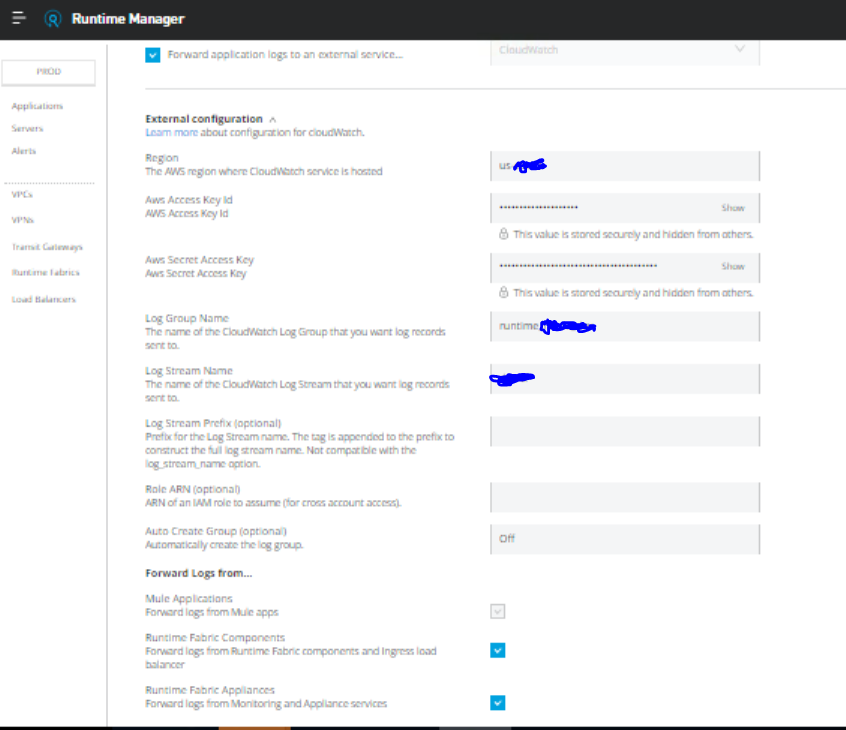
Configure CloudWatch credentials in the control plan

  • CloudWatch (AWS) credentials should have configured all required permissions to push the log to CloudWatch.
  • Log Group Name and Log Stream Name should follow environment naming that is conventional to identify logs in CloudWatch.

Verify Log Forwarding Process

  • Login in Runtime Ops Center.
  • Look for the external-log-forward pod in the ops center and open it in the monitoring tool.

External-log-forward pod in the ops center

  • Go to Log -> search with container:external-log-forwarder.
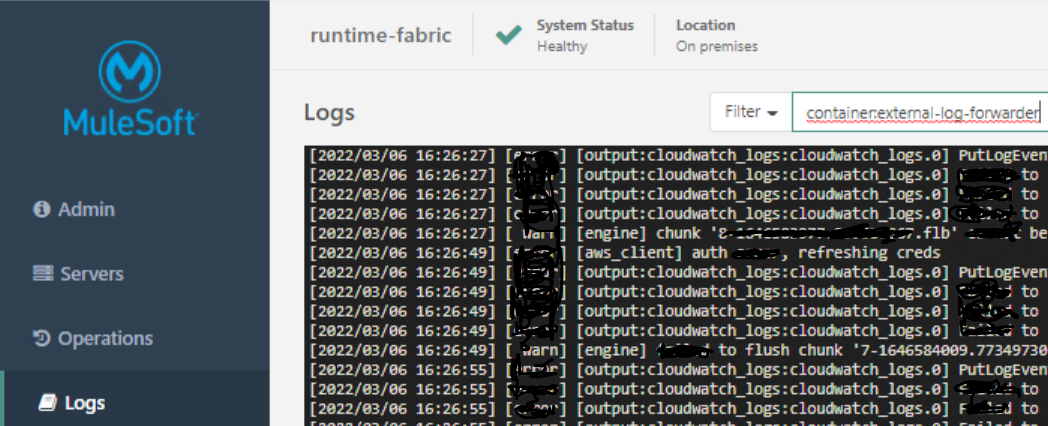
MuleSoft Logs screenshotIn the log, we can identify the process and status of the log forwarding process. In the pod, we can identify any connection or issue in the log forwarding process. It's done!

MuleSoft Integration

Opinions expressed by DZone contributors are their own.

Related

  • Mastering Multi-Cloud Integration: SAFe 5.0, MuleSoft, and AWS - A Personal Journey
  • Revolutionize Your MuleSoft Deployments With GitOps
  • MuleSoft Integrate With ServiceNow
  • Migrating AnypointMQ-Based Mulesoft Service to Serverless World

Partner Resources

×

Comments

The likes didn't load as expected. Please refresh the page and try again.

  • RSS
  • X
  • Facebook

ABOUT US

  • About DZone
  • Support and feedback
  • Community research

ADVERTISE

  • Advertise with DZone

CONTRIBUTE ON DZONE

  • Article Submission Guidelines
  • Become a Contributor
  • Core Program
  • Visit the Writers' Zone

LEGAL

  • Terms of Service
  • Privacy Policy

CONTACT US

  • 3343 Perimeter Hill Drive
  • Suite 215
  • Nashville, TN 37211
  • [email protected]

Let's be friends:

  • RSS
  • X
  • Facebook