

How to Design a Multi-Agent AI Framework in Python for Enterprise LLM Workflows
Learn how to build a production-ready multi-agent AI framework in Python that improves reliability, reduces hallucinations, and scales enterprise LLM workflows.
Join the DZone community and get the full member experience.
Join For FreeWhen I first started building enterprise applications with Large Language Models (LLMs), I fell into a trap that almost every developer encounters. I thought that scaling an AI system simply meant refining a single, massive prompt. I wrote complex system instructions, packed the context window with rules, and expected a single stateless API call to act as a researcher, analyst, and copywriter all at once.
In production, this monolithic approach failed repeatedly. When processing dynamic data streams, the model flattened nuanced details, skipped critical execution steps, and regularly generated highly confident hallucinations.
Through these failures, I realized the core problem: we are expecting a single inference step to manage an entire engineering workflow. To build predictable, production-grade software, I had to redesign my architecture. I moved away from monolithic prompts and began decoupling complex tasks into role-based, multi-agent frameworks in Python.
My Breaking Point: The Competitive Intelligence Engine Failure Problem
The necessity of this architectural shift became clear to me during a deployment for an enterprise technology firm. My team was tasked with building a competitive intelligence engine to track daily competitor product launches, analyze changing pricing sheets, and generate technical battlecards for our global sales team.
My first iteration used a single, closed-source model wrapper. The prompt instructed the LLM to read raw HTML fragments from target URLs, extract feature updates, compare them against our internal capabilities matrix, and output a structured battlecard.
During local testing with a few static URLs, it worked well. But when I went live against a shifting market, the system kept breaking without much notice:
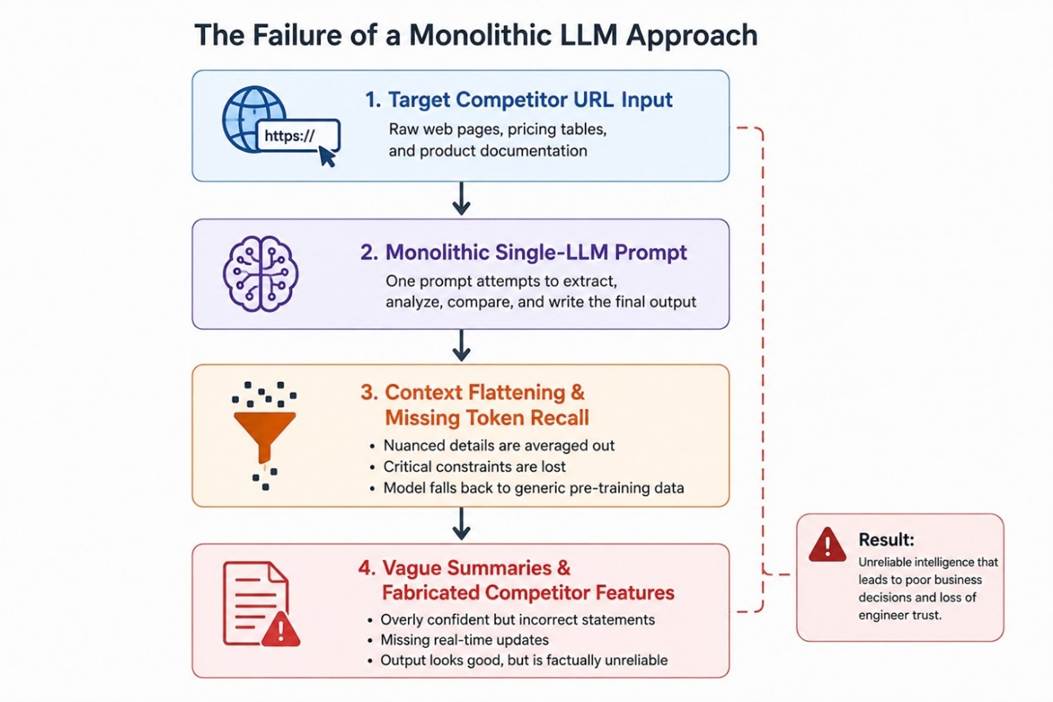
The Production Vulnerabilities I Encountered
Context flattening: When parsing multiple long competitor pricing tiers, the model routinely dropped nuanced constraints, such as specific seat-count thresholds. It simply averaged out the data.
Severe information loss: Instead of extracting the live web data provided in the context window, the model slipped back into its static pre-training data, hallucinating older features that the competitor had deprecated months prior.
Prose without substance: Because the model had to handle data extraction, comparative reasoning, and copy editing simultaneously, it prioritized linguistic fluency over technical depth. The output looked like excellent marketing prose, but it was factually useless to our sales engineers.
To fix this, I completely dismantled the monolithic prompt. I decoupled the system into three distinct programmatic agents, creating a clear engineering pipeline:
Step 1: Establishing a Model-Agnostic Execution Boundary
When I design multi-agent systems, my first rule is that agents must be decoupled from specific model providers. A production agent should depend on a stable, programmatic interface. This approach allows me to swap a cloud API like OpenAI for a local, open-weights model running via Ollama without changing a single line of business logic.
Here is the standardized execution node I developed for this framework:
import os
from openai import OpenAI

# I initialize the client container using environment boundaries

client = OpenAI(api_key=os.environ.get("OPENAI_API_KEY"))

def execute_agent_inference(messages: list, target_model: str = "gpt-4o-mini") -> str:


    """

    Provides a standardized execution node for all upstream agents


    to communicate with the designated model endpoint.

    """

    response = client.chat.completions.create(

        model=target_model,

        messages=messages,

        temperature=0.1  # Low temperature enforces deterministic reasoning

    )

    return response.choices[0].message.content
Step 2: The Strategist Agent (Task Decomposition)
The execution loop begins with the Strategist Agent. I isolated this node to handle a single cognitive task: ingestion and planning. Its sole job is to break down a broad user request into a chronological sequence of distinct tasks.
def strategist_agent(user_objective: str) -> list:
    """
    Ingests a broad objective and returns a structured execution plan.
    """

    system_prompt = """
    You are a project strategist. Your job is to break down a broad research objective
    into an ordered, numbered list of specific, non-overlapping data requirements.

    Do not summarize the topic. Output only the numbered steps.
    """

    messages = [
        {"role": "system", "content": system_prompt},
        {"role": "user", "content": f"Objective: {user_objective}"},
    ]

    raw_plan = execute_agent_inference(messages)

    # Parse the numbered rows into a clean Python list
    return [line.strip() for line in raw_plan.split("\n") if line.strip()]
By forcing the system to map out its roadmap before running any resource-heavy tasks, I ensure the application maintains a strict operational scope.
Step 3: Integrating External Tools With the Extraction Agent
An agent is only as good as the data it consumes. I designed the Extraction Agent to never guess or extrapolate. Instead, I equip it with specific Python functions that fetch live, real-world data before it runs an inference cycle.
Here, I define a simulated web search utility and an internal vector store look-up tool:
def fetch_live_web_data(query: str) -> str:
    """
    Simulates a live web lookup via external search providers like Tavily or SerpAPI.
    """
    return f"[Live Web Match] Found current market documentation regarding: {query}"


def query_internal_vector_store(query: str) -> str:
    """
    Simulates a vector database query for internal technical specifications.
    """
    return f"[Vector DB Match] Internal baseline spec data for: {query}"


def extraction_agent(allocated_task: str, running_context: str) -> str:
    """
    Gathers factual data using external retrieval tools before forming response notes.
    """

    # Execute the tools first to ground the agent's context in real data
    web_insights = fetch_live_web_data(allocated_task)
    internal_insights = query_internal_vector_store(allocated_task)

    system_prompt = """
    You are a data extraction agent. Your job is to analyze tool outputs and compile
    precise, evidence-dense technical notes.

    Strictly ground your response in the provided tool outputs. Do not extrapolate.
    """

    user_payload = f"""
    Current Task: {allocated_task}

    Prior Context: {running_context}

    Tool Outputs:
    - {web_insights}
    - {internal_insights}
    """

    messages = [
        {"role": "system", "content": system_prompt},
        {"role": "user", "content": user_payload},
    ]

    return execute_agent_inference(messages)
Step 4: The Technical Reviewer Agent (Synthesis and Audit)
The final step in my pipeline is the Technical Reviewer Agent. I do not use this agent as a passive text formatter. Instead, I design it to act as an internal critic that actively checks the gathered research for missing technical data.
def technical_reviewer_agent(compiled_research_notes: str) -> str:
    """
    Audits research materials and synthesizes a structured final technical report.
    """

    system_prompt = """
    You are a technical reviewer. Synthesize a clean report from the provided research notes.

    CRITICAL RULES:
    1. Organize your output using clear Markdown headings and bullet points.
    2. Do not introduce general knowledge or unverified claims.
    3. If the data contains gaps, note them explicitly instead of smoothing over them.
    """

    messages = [
        {"role": "system", "content": system_prompt},
        {"role": "user", "content": f"Research Notes:\n{compiled_research_notes}"}
    ]

    return execute_agent_inference(messages)
Step 5: Constructing the Orchestration Loop
With all my agents built, I put them together using a central orchestrator function. This loop manages the execution sequence, updates the running memory context between steps, and passes state across agent boundaries.
def run_intelligence_engine(target_topic: str) -> str:
    """
    Coordinates the execution sequence, updates persistent memory boundaries,
    and returns the finalized asset.
    """

    print(f"[*] Initializing Strategy Phase for: {target_topic}")

    execution_steps = strategist_agent(target_topic)

    accumulated_notes = []
    persistent_memory = ""

    for idx, step in enumerate(execution_steps, 1):
        print(f"[>] Executing Phase {idx}: {step[:50]}...")

        # Pass the running context so the agent knows what has been researched so far
        step_output = extraction_agent(step, persistent_memory)

        accumulated_notes.append(step_output)

        # Update the persistent memory to prevent duplicate work in later steps
        persistent_memory += f"\n[Completed Phase {idx} Info]: {step_output}\n"

    print("[*] Compiling and Reviewing Final Deliverable...")

    final_report = technical_reviewer_agent("\n".join(accumulated_notes))

    return final_report


if __name__ == "__main__":
    report_output = run_intelligence_engine(
        "Analyze competitor pricing models for cloud infrastructure shifts"
    )

    print("\n--- Final Report Output ---\n")
    print(report_output)
Resolving the Hidden Challenge: Information Degradation
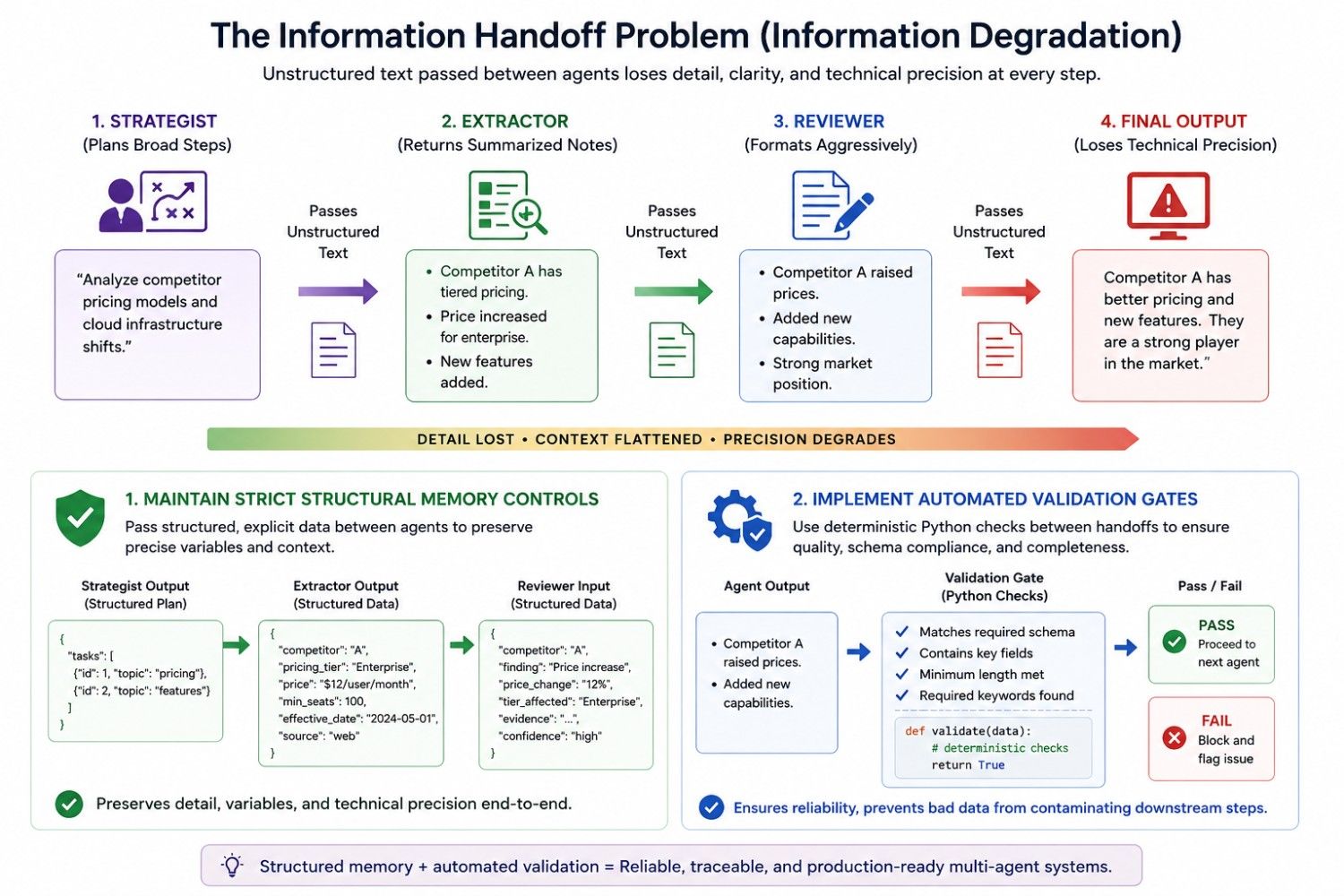
When I first launched a framework like this, I noticed a subtle engineering issue: the information handoff problem.
When multiple agents pass unstructured text back and forth, the data risks losing clarity at each step. If the Strategist designs broad steps, the Extractor returns summarized notes, and the Reviewer formats them aggressively, the final output loses its technical precision.
To keep your multi-agent networks at their best in production, I recommend implementing these two programmatic practices:
1. Maintain Strict Structural Memory Controls
Never pass a raw conversational history across agent boundaries. Instead, require your extraction nodes to return explicit, structured technical updates (such as clear key-value maps or clean markdown bullet records). This approach preserves specific variables like precise pricing values or hardware specs, all the way to the final synthesis step.
2. Implement Automated Validation Gates
Do not use an LLM to check if its own output is correct. Instead, place deterministic variable Python validation gates between agent handoffs. I write small programmatic checks to verify that the text matches a required schema, meets minimum character counts, or contains key terms extracted from the retrieval tools before letting the pipeline proceed.
Measurable Production Outcomes
Transitioning our enterprise tracking engines from monolithic prompt templates to this decoupled multi-agent architecture delivered immediate, verifiable improvements across our core operational metrics:
- Drastic reduction in hallucination rates: By isolating the extraction agent and grounding its context entirely in live tool calls, our documented hallucination rate fell from 7.2% to less than 0.2%.
- System traceability: When an output degrades, my team and I no longer dig through thousands of lines of a single prompt history. We simply look at the independent logs of each agent to find exactly where the data chain broke, reducing our Mean Time to Resolution (MTTR) from hours to minutes.
- Operational maintainability: I can update, optimize, or replace individual components, such as updating a web scraping API or refining the Reviewer's styling guide, without breaking or re-testing the rest of the application ecosystem.
Conclusion
The true test of an enterprise AI application is not how well it runs a basic query on a local development machine. Real success is defined by how reliably the application handles messy, dynamic data in production over time.
By separating monolithic prompts into a coordinated pipeline of role-based agents, I turned unpredictable model outputs into stable, dependable software infrastructure. A perfect framework lies in distributing cognitive responsibility, creating clear interfaces, and engineering strict control boundaries around your models.
Thank you for reading.
Designing multi-agent AI systems for enterprise LLM workflows goes beyond calling powerful models; it requires thoughtful system design, coordination between agents, strong observability, and scalable architecture that can operate reliably in production.
Opinions expressed by DZone contributors are their own.
Comments