DZone
Thanks for visiting DZone today,
Edit Profile
  • Manage Email Subscriptions
  • How to Post to DZone
  • Article Submission Guidelines
Sign Out View Profile
  • Post an Article
  • Manage My Drafts
Newsletter
Log In / Join
Refcards Trend Reports
Events Video Library
Refcards
Trend Reports

Events

View Events Video Library

Related

  • AI-Powered CI Test Failure Triage
  • When a Coding Agent Fixes the Test Instead of the Bug
  • Testing Java and Spring Applications With Kotlin: Low-Risk to Adoption
  • Your Visual Regression Suite Is Mostly Testing Anti-Aliasing

Trending

  • Why Your Test Automation Is Always Behind the Code And the Architecture That Fixes It
  • Spring AI on Local LLMs
  • 5 Mistakes Companies Make When Working With Staff Engineers
  • The Real Cost of Change in Software Development

Draft This article hasn't been published, so readers can't see it.

In moderation This article is waiting for review, so readers can't see it yet.

Deleted This article has been deleted, so readers can't see it.

  1. DZone
  2. Testing, Deployment, and Maintenance
  3. Testing, Tools, and Frameworks
  4. Mutation Testing: Covering Your Code With the Right Test Cases (Part 2)

Mutation Testing: Covering Your Code With the Right Test Cases (Part 2)

Check out our second installment on how to mutate code and obtain quality code coverage.

By 
Dmitry Egorov
DZone Core CORE ·
Updated Jun. 10, 20 · Tutorial
Post on X (opens in a new tab) Share on LinkedIn (opens in a new tab)
39.0K Views

Join the DZone community Save articles, join the discussion, and download Refcards and Trend Reports with a free account.

Join for free Already a member? Log in

Image title

In part one, we achieved 100 percent coverage. In this installment, we mutate our code and check how good our tests are.

There are several mutation testing frameworks. In this case, we will use PITEST.
Image title

What mutation might be applied to the code? Here is a list of pitest mutations here:
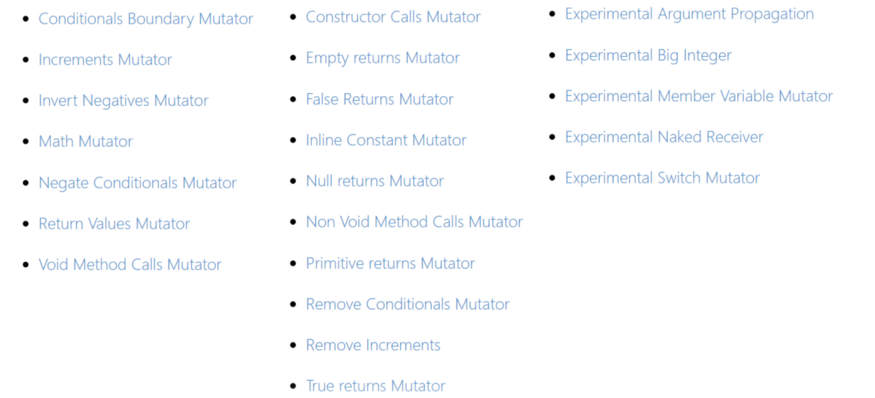
Image title


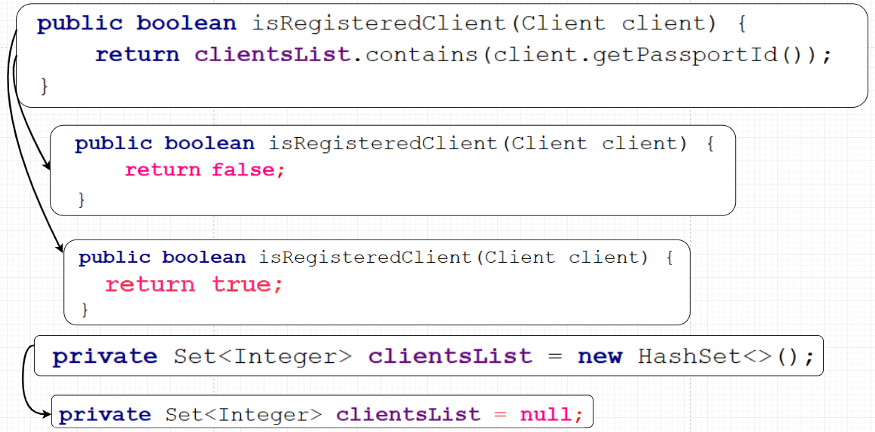
Let me introduce our mutants (just few of them). First is the line of origin, and the following are mutants (modified code is highlighed by red):Image title
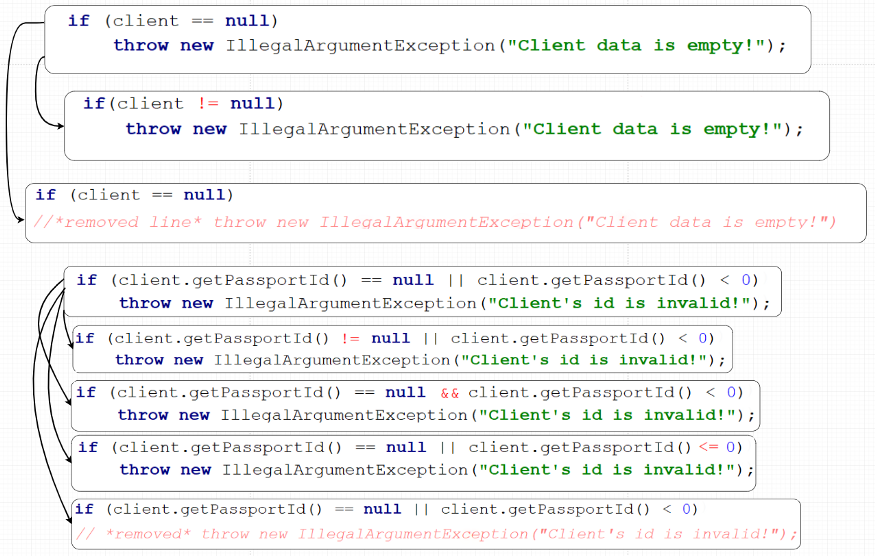
Image title


Now, let's execute the pitest Maven plugin and check the mutation testing result:

mvn clean test

mvn org.pitest:pitest-maven:mutationCoverage


Open report located in target/pit-reports/201902032155/index.html
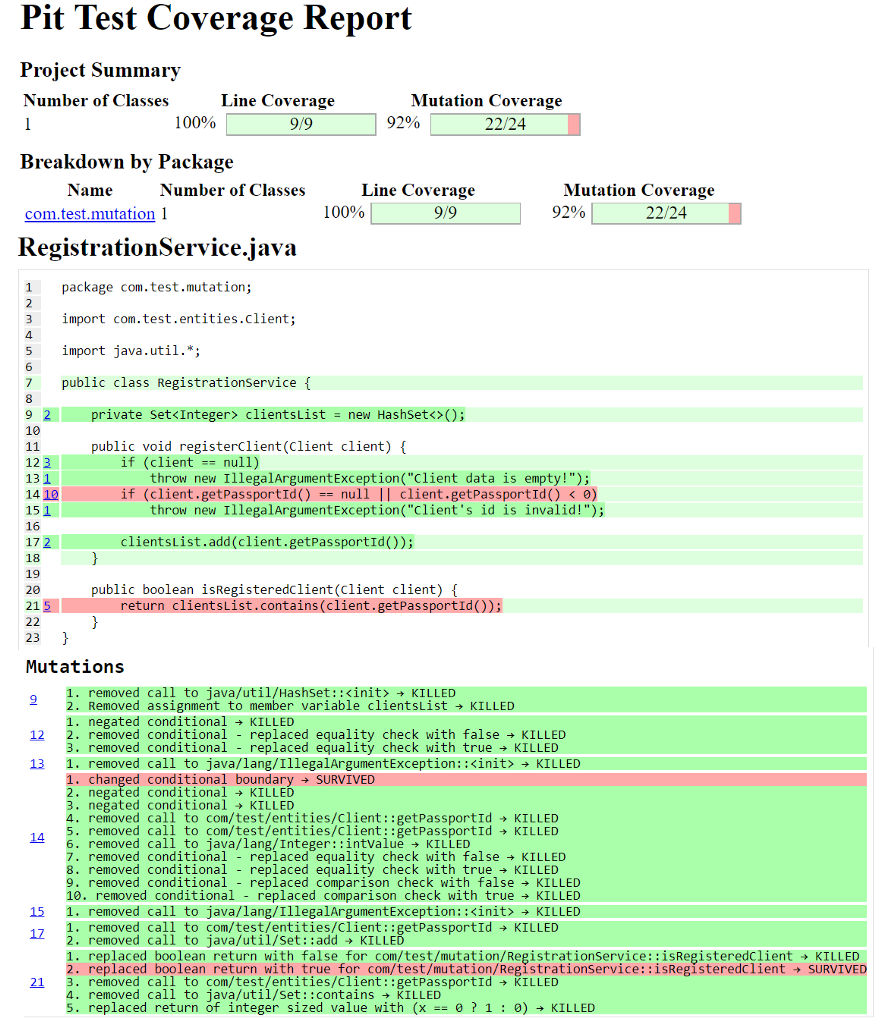
Image title


So, the report says:

  1. Line coverage 100 percent, but we knew it from the JoCoCo report earlier
  2. There are two mutation that survived and 23 were killed.
  3. Mutant 1 was created by changing conditional boundary at line 14 and the second by replacing return with true.

Let's clarify what mutants looks like:

Image title


So, what are the missing test cases that might eliminate our mutants?

  1. For our first mutant, we create a boundary case and assert that the client is created as far as zero passport id is valid
  2. For the second mutant, we check that the service doesn't have an unexistent client.

Image title


Results give us 100 percent killed mutants, but can we rely on it?

Unfortunately not. Mutation testing gives us just some hints —what cases we might forget (especially for boundary conditions).If we count all possible application set of states, we found out there are more "missing" cases.

Criticism of Mutation Testing

  • Time-consuming. Due big number of execution: number of mutations * number of tests
  • Creates impression of fully tested app if no mutations been found 
  • Don't provide clear metrics of test quality 

Conclusion

  • Mutation testing helps us to find possible missing test cases
  • Mutation testing can't find all missing test

Lastly, I didn't describe a case when mutation can be equivalent to the initial code, but it does not happen that often.

Code used in this article is available on GitHub.

Testing

Opinions expressed by DZone contributors are their own.

Related

  • AI-Powered CI Test Failure Triage
  • When a Coding Agent Fixes the Test Instead of the Bug
  • Testing Java and Spring Applications With Kotlin: Low-Risk to Adoption
  • Your Visual Regression Suite Is Mostly Testing Anti-Aliasing

Partner Resources

×

Comments

Loading comments

The comments didn't load

Please try again in a moment.

Likes

Loading

The next likes didn't load. Please try again.

The likes didn't load

Please try again in a moment.

See who liked this

Log in or join DZone for free to see who liked this article.

Log in Join for free
  • RSS
  • X
  • Facebook

ABOUT US

  • About DZone
  • Support and feedback
  • Community research

ADVERTISE

  • Advertise with DZone

CONTRIBUTE ON DZONE

  • Article Submission Guidelines
  • Become a Contributor
  • Core Program
  • Visit the Writers' Zone

LEGAL

  • Terms of Service
  • Privacy Policy

CONTACT US

  • 3343 Perimeter Hill Drive
  • Suite 215
  • Nashville, TN 37211
  • [email protected]

Let's be friends:

  • RSS
  • X
  • Facebook